We analyzed 18 business formation landing pages. Only 9 are worth stealing from.
We read 18 LLC and incorporation pages that were paying for Google Ads clicks, top to bottom. These 9 are the ones worth your time. Everything we found is here, free.

18 landing pages screened
From real business formation / LLC Google Ads campaigns in the US
9 winners curated
The landing pages actually worth stealing from
4 burning money
So you know exactly what to avoid
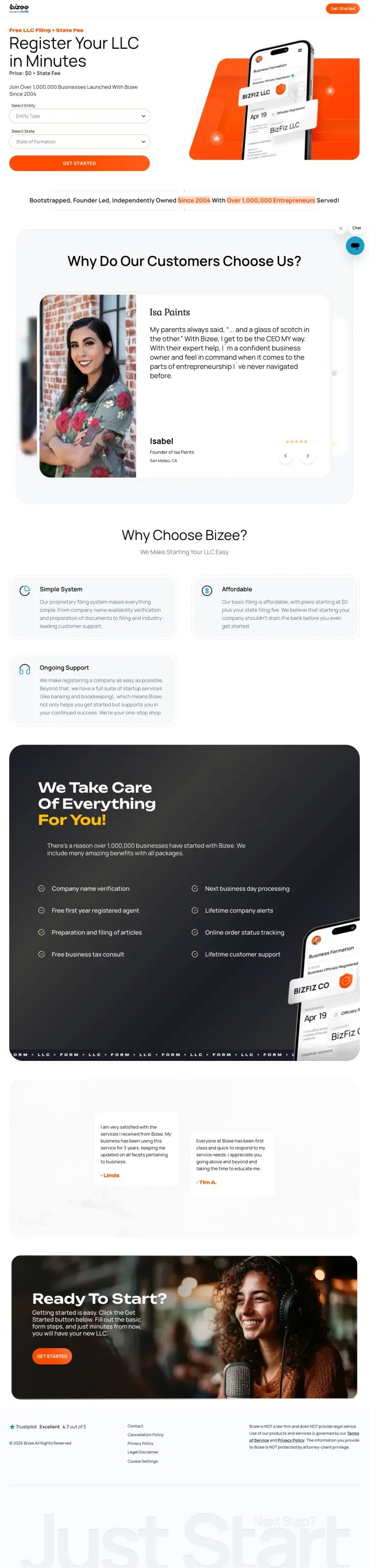
Bizee took the top slot by putting the order form itself in the first screen. The hero asks entity type and state of formation from two dropdowns, and nothing else, with the orange kicker Free LLC Filing plus State Fee sitting above the headline and Price colon dollar zero plus State Fee under it. The rest of the page is a customer story, a benefits block and a dark band listing what every package covers. No phone number renders anywhere in that first screen.
Put the registration form directly in the hero section with only 3 fields (entity type, state, email) so visitors can start the process without scrolling. The headline 'Register Your LLC in Minutes' with 'Price: $0 + State Fee' removes both complexity and price objections in one glance.
- +
Order starts in the first screen fewer stepsone afternoon
This is not a lead form, it is the start of the order, and it asks entity type and state of formation from two dropdowns. Nothing else. Somebody who knows they want an LLC in Texas is moving before reading a sentence. Take your checkout's first two questions upstairs.
- +
Price arrives before the first dropdown price framingeasy
The orange kicker names the offer, the headline names the job, then one line prints the price and says the state fee is on top. All three land before the dropdowns. When a page asks somebody to start an order, the number arrives first.
- +
Strip names them bootstrapped and independent positioningeasy
It runs under the hero, founder led and independently owned, with the year it started and the businesses served. Every rival on this list is venture backed or private equity owned, and the person forming their own company notices. Say it in a line.
- ✕
Testimonial cards carry no source at all weak proofone afternoon
The review cards further down give a first name and a first name with an initial, no photograph, no company, no date and no star rating. A Trustpilot score exists here and waits until the footer. Move your score up beside the form and link it out.
- ✕
Header offers a logo and a button only hard to contacteasy
The header holds a logo and a Get Started button, and no telephone number renders in the first screen. This page asks somebody to begin a legal filing, and a share of those visitors want to ask one question first. The only route offered is a chat bubble.
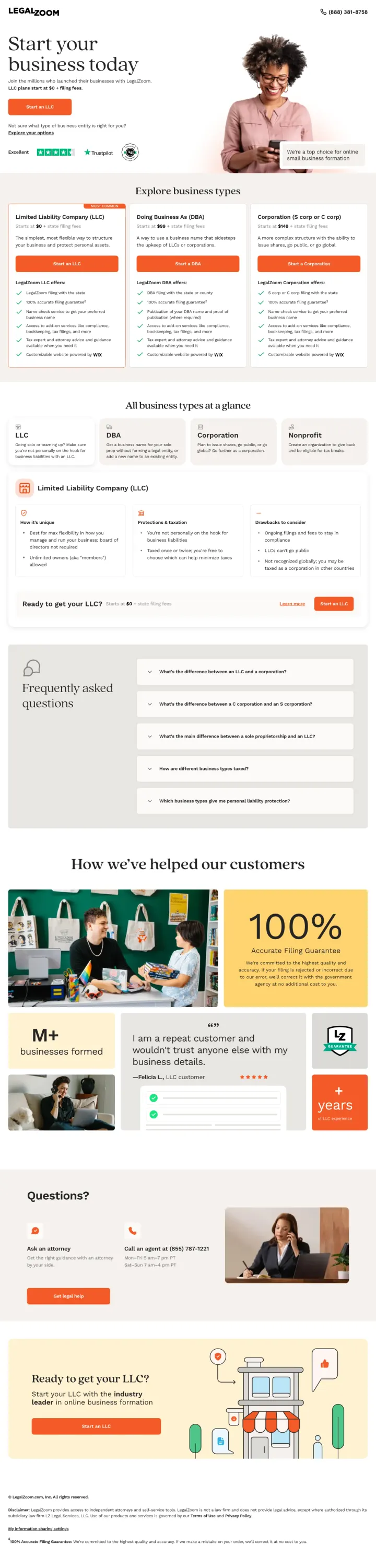
LegalZoom sells the biggest brand in this category and still does the hardest work in the file, which is pricing three entity types on one screen. Under the hero sit three cards, LLC, DBA and Corporation, each with a starting figure, its own start button and the same list of what the fee covers, with MOST COMMON flagged over the LLC. The Trustpilot bar and a guarantee seal sit under the headline, and the header carries a real phone number in full size.
Lead with 'Start your business today' plus the $0 entry price ('LLC plans start at $0 + filing fees'), then immediately present a self-selection mechanism ('I can do most of the work myself' vs 'I want peace of mind knowing attorney guidance is there'). This lets visitors self-segment into Basic ($0), Pro, or Premium without overwhelming them with features.
- +
Three entity cards sit level and priced choice architectureone afternoon
LLC, DBA and Corporation each carry their own starting figure, their own start button and the same list of what the fee covers. That turns the visit from whether to file into which to file. Lay your options out level and let the columns argue.
- +
Small tab picks the default for you makes it easiereasy
One orange flag over the LLC card says MOST COMMON. A visitor who does not know the difference now has a default, and the page made the awkward choice without ever selling. If most of your customers buy one thing, flag it.
- +
Phone number gets full size in the header fewer stepseasy
It sits top right beside a phone icon at reading size, nothing competing for the space. Most pages in this file hide the number in small utility text or leave it out. This one treats ringing as a real path. Match your button text for size.
- ✕
Proof tiles print a unit with no figure broken on the pageeasy
Two coloured tiles read M plus businesses formed and plus years of LLC experience. The numbers never render. Those are the two proof points this page most wanted to land. Load your own page in a clean browser and read every number out loud.
- ✕
Page turns into a reference work below loses focusone afternoon
Below the priced cards sits a glance table of four entity types, a breakdown of how an LLC is unique, its taxation, its drawbacks, then frequently asked questions. All accurate, none selling. Everything under your offer should still be selling the offer.
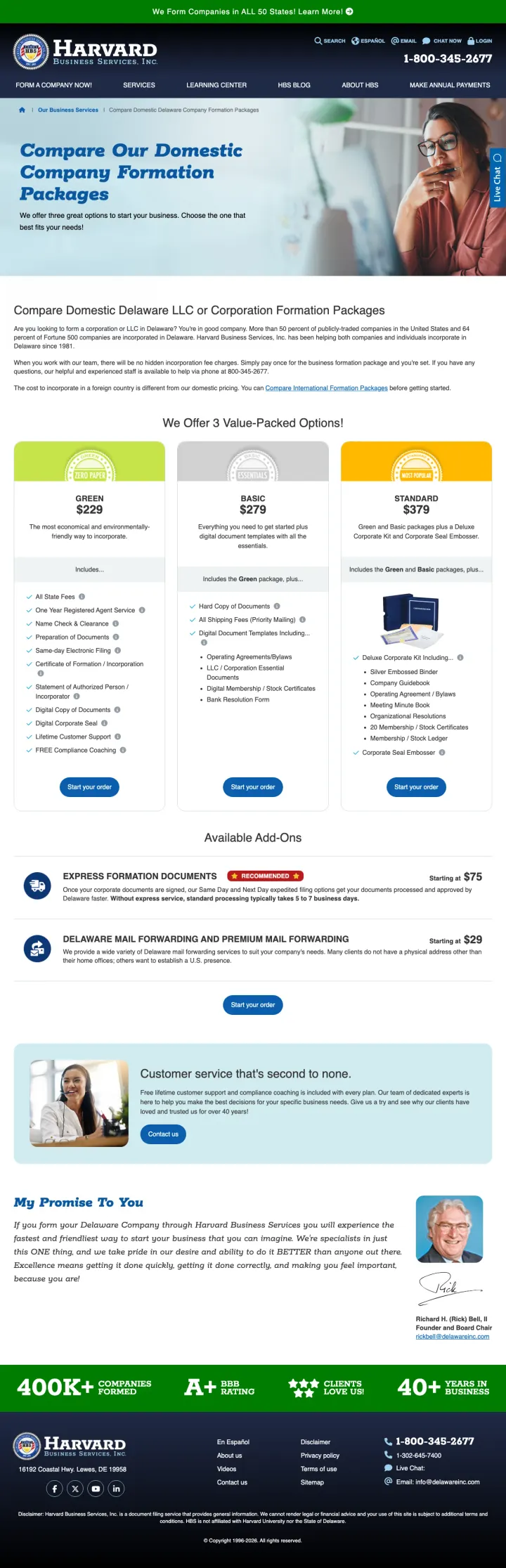
Harvard Business Services runs the delawareinc.com page, and it earns its place with a green comparison of three priced packages and a signed promise from the man who founded the firm. Rick Bell appears further down with a photograph, a handwritten signature and his own email address printed under his job title. Above the footer a green band prints the companies formed, the BBB rating and the years in business. The hero itself promises nothing but three great options.
Show three incorporation packages side by side with exact pricing ($329 / $579 / $799) and a clear feature comparison. Then add a personal guarantee with a named individual ('My Promise to You' with founder photo). The combination of transparent comparison pricing with personal accountability creates trust that generic incorporation sites cannot match.
- +
Founder signs his promise with an email made personalone afternoon
A block headed My Promise To You carries his photograph, his handwritten signature, his job title and his own address, sitting above the numbers band. Everybody here sells the same paperwork. Almost nobody puts a human name against it. Write yours in the first person.
- +
Each column adds to the one before it price framinga pricing call
Green, Basic and Standard run side by side with their prices, and the second and third say includes the package to the left plus what is new. The visitor only reads the difference. Build yours the same way and flag the one you want them to buy.
- +
Green band lends the BBB rating around credentialshard to earn
Above the footer a full width strip prints the companies formed, the BBB rating, a clients love us line and the years in business, four cells in one row. The rating is the only one a stranger can check. Find the body that rates your trade.
- ✕
First screen shows none of three prices weak offereasy
You get a breadcrumb, the heading Compare Our Domestic Company Formation Packages and a line saying there are three great options. No price, no rating, no offer, and the packages are a long way down. Move your cheapest figure into the subhead.
- ✕
Four rows of navigation precede the headline covers the pageeasy
A promo bar, a utility row, a six-link menu and a breadcrumb stack above it, and each link is a way off the page you paid for. The section on Delaware and the "Fortune 500" starts lower for it. Load your own page and count the rows above your headline.
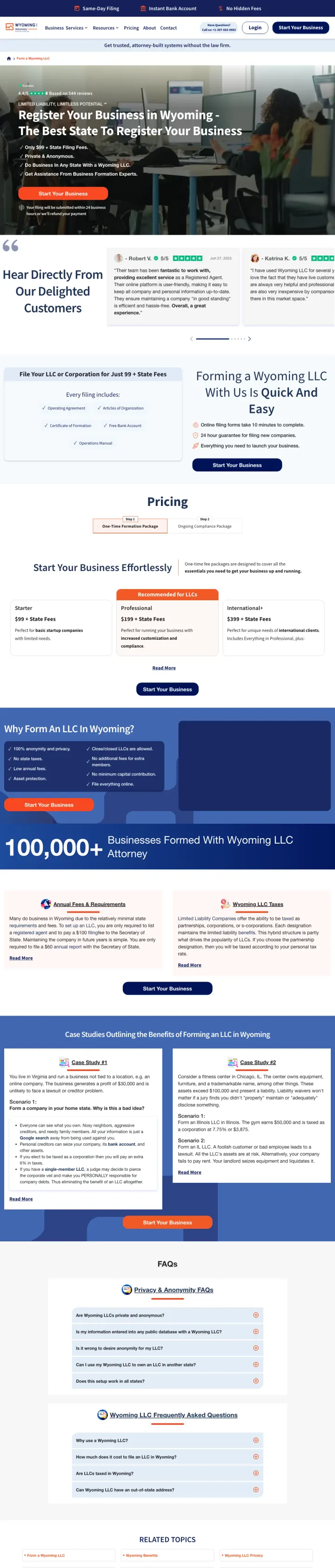
Wyoming LLC Attorney wins on the state rather than the service, and that is the whole pitch: register here, not where you live. The Trustpilot score and its review count sit above the headline, and the four hero bullets carry the price, the privacy claim and the promise that a Wyoming company works in any state. Under the filing button is the sharpest line on the page, a refund if the filing misses twenty four business hours.
Own a single jurisdiction with attorney branding and a flat-fee hero ('Register Your Business in Wyoming - $0 State Filing Fee, $99 LLC formation, Same-Day Guarantee'). The headline tells the visitor who has already searched 'wyoming LLC' that they are in the right place AND that the entity handling the filing is an attorney, not a filing form.
- +
Filing promise carries a refund penalty answers a worrya pricing call
Under the hero button, in small type beside a stopwatch icon, the filing goes in within twenty four business hours or the payment comes back. That is not a guarantee, it is a penalty. Work out what you can afford to refund and print it under your button.
- +
Rating outranks their own headline reviewshard to earn
The Trustpilot mark, the score, the star bar and the review count sit in a row above it, so the visitor meets somebody else's verdict before the pitch. The count does the work, because a score with nothing behind it means nothing. Put your badge in the top corner.
- +
Four ticked lines answer four objections price framingeasy
The price, the privacy claim, the line saying a Wyoming company can trade in any state, and the promise of a formation expert. Each settles something separate, and the block reads in a couple of seconds. Write the four questions your visitors ask on the phone.
- ✕
Dollar sign missing from the price heading broken on the pageeasy
The blue heading over the includes panel prints its price with no dollar sign in front of the number, though the hero bullet above it has one. It makes a shopper stop and read again. Read every price on your page out loud before you call it live.
- ✕
Review carousel opens on an old date stale proofone afternoon
They carry a name, a face, a verified tick and a full score, which beats most of this file. The first is dated a couple of years back, and a stranger wonders what has happened since. ZenBusiness pulls the most recent instead.
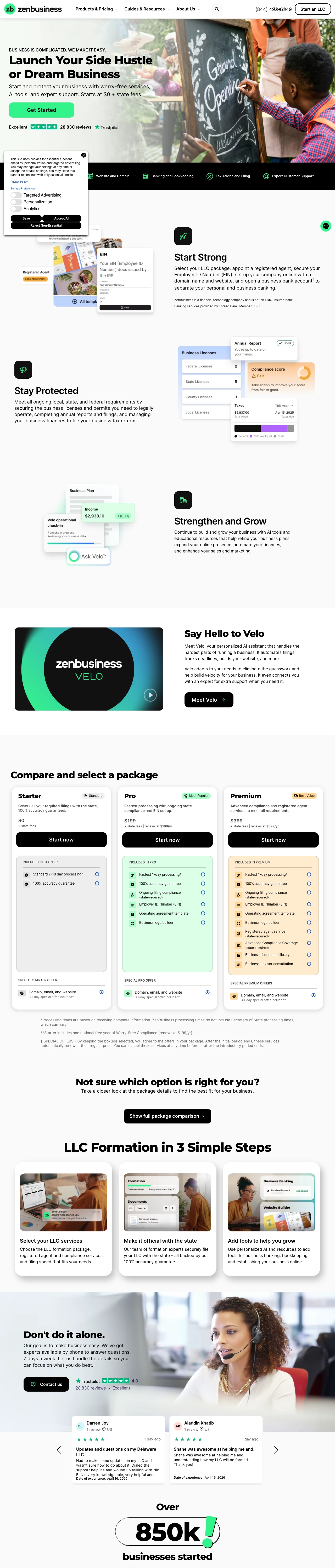
ZenBusiness is the only page in this file pulling its reviews live. Named customers with dates from this month sit in a carousel that says how many reviews each person has written and where they are, which no competitor here matches. The hero itself is a headline, one button and a Trustpilot bar. The order form waits until far down the page, where a single box asks for a preferred business name.
Open with a clean $0 / $199 / $399 three-tier pricing grid where the middle 'Most Popular' Pro tier ($199 with 1-day processing, EIN, ongoing compliance, and operating agreement) is the one most visitors pick. Put a named AI assistant ('Say Hello to Velo') below the pricing so the offer is not a one-time filing but a year-round compliance partner. The Pro tier is the price the whole grid gets compared against, and it is what keeps $0 shoppers spending more.
- +
Carousel pulls live from the review site reviewsone afternoon
Trustpilot supplies a name, a set of initials, how many reviews that person has written, their country, the star bar and how long ago it was posted. Nobody else in this file dates a review. Wire your widget to the source and let it update itself.
- +
Name box asks the exciting question first fewer stepsone afternoon
Enter your preferred business nameThe only form field here wants the one thing the visitor has already answered in their head, and it does not feel like a form. Under it the page says what it costs and how long it takes. Keep email and address for a screen they reach later.
- +
Assistant gets a name, a face, a video positioningneeds a developer
Say Hello to VeloEvery competitor now says AI tools. This page describes what it does in plain words: filings, deadlines, a website. A named product is something a visitor can remember and repeat. If you have built anything your rivals have not, name it.
- ✕
Biggest line on screen does no work no differentiatoreasy
Launch Your Side Hustle or Dream Business could sit on any page in this file, and on plenty that are not about company formation. The subhead does carry the price, so the page is not lost. Somebody who clicked an LLC advert already wants to start a business.
- ✕
Only input waits past the whole page hard to actone afternoon
It sits after the pricing grid, the three step explainer, the support block and the review carousel. Everything above it is a Get Started button handing the visitor to a separate checkout. The one low friction ask is the last thing anybody meets. Copy it into the hero.
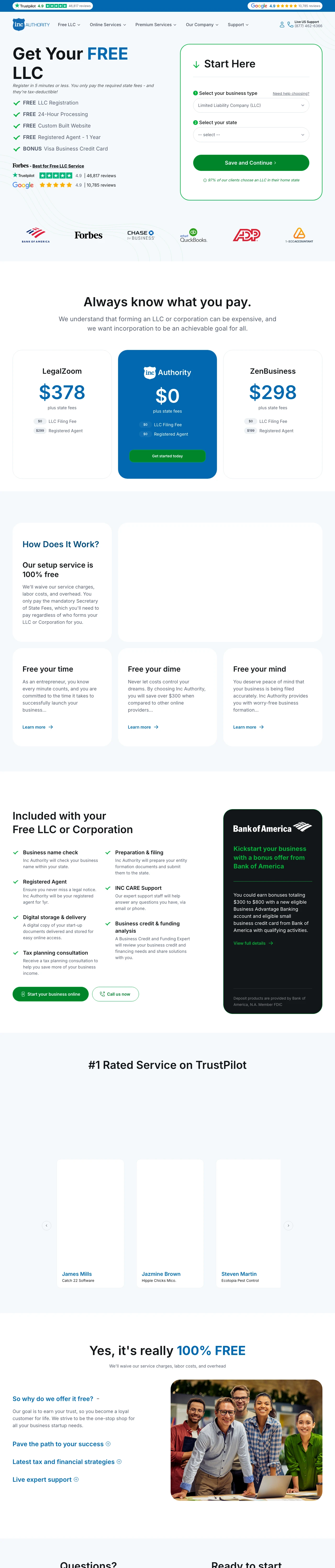
Inc Authority is the most aggressive page in the file and the arithmetic is why. Its hero puts a two dropdown Start Here card on the right, the word FREE five times on the left, and a Trustpilot score, a Google score and a Forbes award under the bullets. Then it prints its own price against LegalZoom and ZenBusiness by name, in a row of three cards, which almost nobody has the nerve to do.
Lead with the word FREE five times in a bulleted list (FREE LLC Registration, FREE 24-Hour Processing, FREE Custom Built Website, FREE Registered Agent, BONUS Visa Business Credit Card). Then add a vs-competitor comparison table on the page itself ('LegalZoom $378 vs Authority $0', 'ZenBusiness $298 vs Authority $0'). Most competitors make the visitor leave to compare prices. IncAuthority forces the comparison on-page.
- +
Rival prices print beside their own price framingeasy
Always know what you pay.Three cards in a row, and the outer two carry a competitor's name and total. Each breaks the figure into the filing fee and the registered agent fee. Almost nobody has the nerve to print a rival's price. If you are genuinely cheaper, show the sum.
- +
Rating sources agree in one block reviewshard to earn
Best for Free LLC ServiceA Trustpilot score with its review count, a Google score with its count, and the Forbes award above them, all under the hero bullets and repeated in the top bar. Two independent sources agreeing is a different claim from one shouting. Print every count.
- +
Line under the button answers the doubt makes it easiereasy
97% of our clients choose an LLC in their home stateThe dropdown asks the visitor to pick a state, which is the one question somebody might get wrong. What sits below tells them what nearly everybody else picks. Find the question your form makes people hesitate over and answer it right underneath.
- ✕
Testimonial videos render as white rectangles broken on the pageone afternoon
Three cards run in a row, each with a client's name in blue and their company under it, and the panel above every name is empty. The names are real customers with real businesses and the page gets none of the benefit. Put a still image behind the video.
- ✕
Word free repeats until it stops landing no differentiatorone afternoon
Yes, it's really 100% FREEIt appears in the headline, in every hero bullet, in a heading further down, and in three subheadings after that. Repeat a word that often and a shopper starts wondering what the catch is. Say it once, then explain how you can afford to.
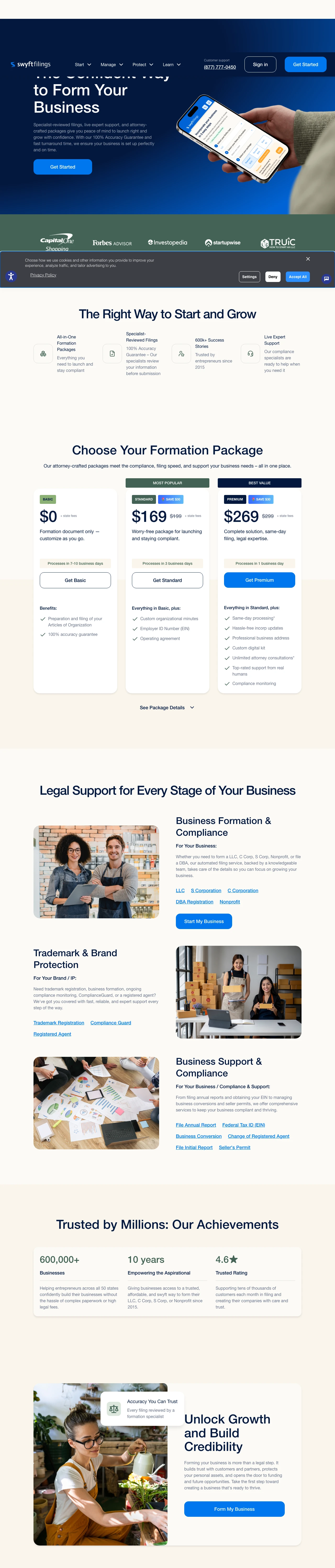
Swyft Filings makes the turnaround time the product. Its three tiers each carry a processing promise, seven to ten business days, three business days, one business day, with the older price struck through beside the current one. The hero above them names no price at all and sells a guarantee instead. Its footer carries the Arizona Supreme Court licence number, the only checkable licence in this file.
While competitors fight for the lowest number, build the hero around competence: 'The Confident Way to Form Your Business' with 'Specialist-reviewed filings, live expert support, and attorney-crafted packages'. Then show three tiers ($0 Basic, $169 Standard, $269 Premium) where Standard and Premium are discounted $30 from a stated MSRP. The framing positions the $0 tier as the loss-leader and the paid tiers as the actual product, backed by attorneys and compliance specialists.
- +
Filing speed prints on every tier price framinga pricing call
Processes in 1 business dayEach card carries a time in its own pill under the price: seven to ten business days, three business days, one business day. That is the difference the visitor pays for. When competitors all charge nothing plus state fees, speed is the only ladder left.
- +
Old price sits crossed out beside the new the offereasy
SAVE $30The paid tiers show the current figure large with the previous one struck through and a small save badge on the tab above. Said both ways, the discount reads as a real reduction rather than a number invented for the weekend. Show the price you came down from.
- +
Court licence hides in the legal footer credentialshard to earn
Swyft Legal is licensed by the Arizona Supreme Court, and the number is printed. A licence with a number is the only claim in this file a stranger could check in a public register, and nobody will read it there. Put yours where the money decision happens.
- ✕
Sticky header cuts the headline in half wrong first screenneeds a developer
The Confident Way to Form Your BusinessIt sits over the top line of the hero heading, so what a visitor reads first is a fragment, then two clean lines. It costs a few pixels of padding and it is the first thing anybody sees. Click your own advert and look at what the browser shows you.
- ✕
Review cards clip their own text and names broken on the pageone afternoon
Positive and knowledgableThey are shorter than the reviews inside them, so the last line runs under the card edge and the reviewer name and date get cut off. One card holds a review whose body repeats its own headline, attributed to the word customer. Set the card to fit the content.
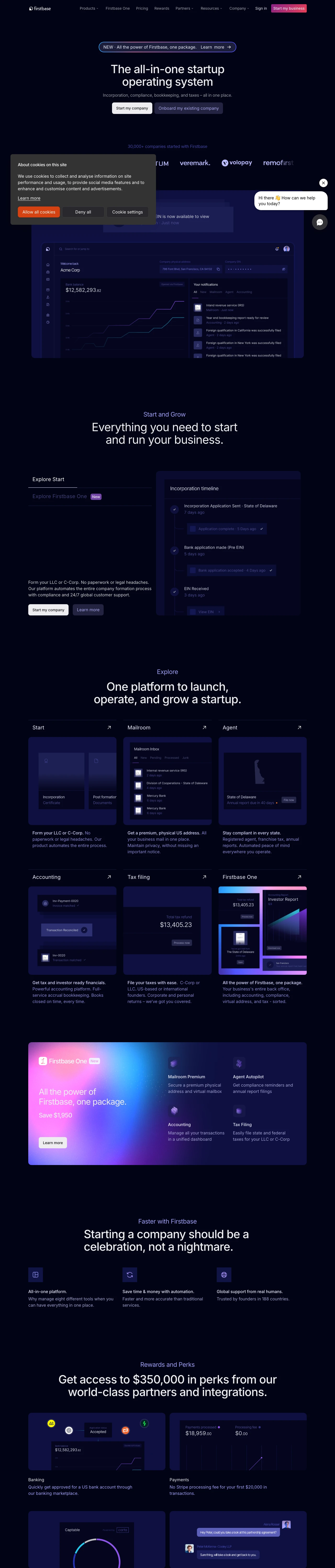
Firstbase sells to founders rather than to shoppers, and its page reads that way. There is no price, no lead form and no phone number anywhere in the first screen: a headline, two buttons and a customer count on a dark background. What it has instead is four endorsements from people the buyer already knows, including the chief executive of Carta and a partner at Y Combinator, each with a photograph and a company mark.
Drop the filing-service vocabulary entirely. Lead with 'The all-in-one startup operating system' and 'Incorporation, compliance, bookkeeping, and taxes, all in one place'. Back it with Y Combinator and HubSpot investor logos, 30,000+ companies started, and 'Trusted by founders in 188 countries'. The visitor who is about to take VC money or build a global product reads this as a peer brand, not a filing website.
- +
Investors and founders lend their own names credentialshard to earn
I'm excited to be a part of Firstbase’s journey as they democratize access to starting companies by making it accessible to everyone.A carousel of quotes, each with a photograph, a job title and the company mark above it: Carta, Y Combinator, StatusPage, a fund. The buyer already knows those names, so the trust arrives borrowed rather than claimed. Ask the one name your buyer knows for two sentences.
- +
Partner perks add up past the filing fee the offera pricing call
Get access to $350,000 in perks from our world-class partners and integrations.Banking approval, waived payment processing on the first transactions, a cap table in Carta, credits from law firms. Each is a separate card with a figure attached, and together they dwarf the filing cost. Add up what your partners give and put the total in a heading.
- +
Line names the problem before the product positioningeasy
Starting a company should be a celebration, not a nightmare.It says the thing the reader already half thinks, then puts the product on the other side of it, with three short columns explaining why. Naming the standard problem persuades harder than claiming excellence. Find what everybody in your trade does badly and say it.
- ✕
Hero names no price and no rating money too lateeasy
The first screen holds a new feature pill, a headline about an operating system, one line of what is included and two buttons. No figure, no phone number, no form. Every rival on this list names a price before the visitor scrolls.
- ✕
Cookie card lands on the logo wall covers the pageeasy
A dark consent panel covers roughly half the customer logo strip in the first screen. The customer count above it survives and the logos behind it do not. The proof block nearest the top is the one thing the banner chose to sit on. Move yours to a corner.
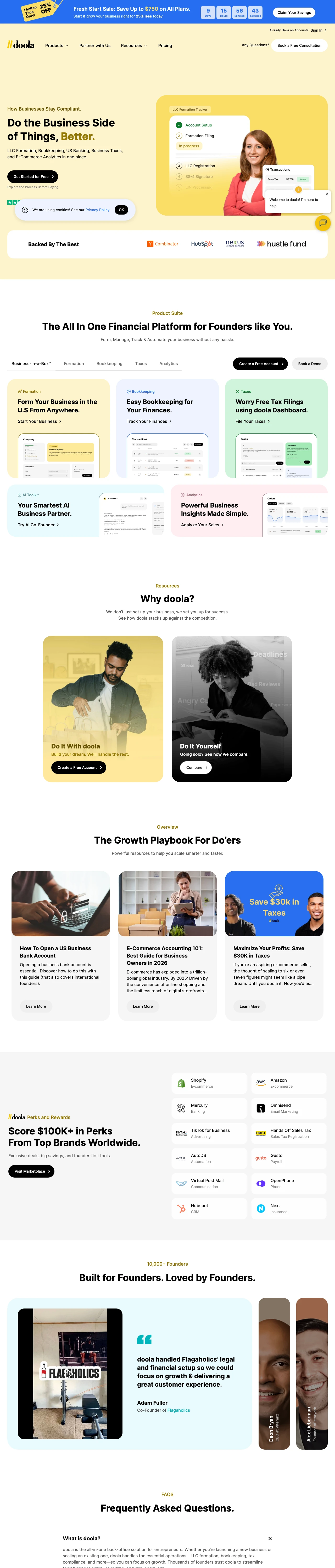
doola runs the loudest offer on the page and the least proof behind it. A blue promo bar caps the page with a discount, a saving and a live countdown, and the hero under it sells the whole back office rather than the filing. The founder quotes are named and linked to real companies. The cookie card lands straight on top of the review widget in the first screen, so the score beside the stars never gets read.
Combine a concrete time-bound promotion ('Fresh Start Sale: Save Up to $750 on All Plans' with live countdown clock) with a specific segment hook ('Form Your Business in the U.S From Anywhere'). The countdown gives price-sensitive shoppers a deadline while the 'from anywhere' framing pulls in international founders who cannot use domestic-only filing services. One hero serves two buyer types.
- +
Investor marks run in a strip under the hero credentialshard to earn
Backed By The BestA white band carries several of them, and the founder reading this page knows all of them. That is somebody else vouching, in a row that takes no vertical space and no argument. Whoever backs you, banks you or certifies you, put their marks there and link each one out.
- +
Testimonial links out to a real business reviewsone afternoon
doola handled Flagaholics’ legal and financial setup so we could focus on growth & delivering a great customer experience.It gives a full name, a job title and a link to the customer's own live site, with a photograph of their premises beside it. A stranger can click and check the company exists. That is what separates a testimonial from a sentence somebody typed. Get the link.
- +
Two panels make the visitor pick a mood choice architectureone afternoon
Do It YourselfThe left one is warm and yellow and says build your dream, we will handle the rest. The right is grey, with stress, deadlines, bad reviews, angry customers and paperwork over a photograph of somebody buried in it. Draw the alternative honestly.
- ✕
Consent card lands across the review stars covers the pageeasy
The widget sits under the hero button and the banner covers it, leaving the first few green stars visible and hiding the score and brand name to their right. What survives is a fragment of a badge, which reads worse than no badge at all. Check the first screen.
- ✕
Clock counts down to no date at all false urgencyeasy
Fresh Start Sale: Save Up to $750 on All Plans.The blue bar runs days, hours, minutes and seconds above a sale named after a season. A founder comparing three formation services will open this page more than once, and a clock that resets loses somebody who was reading carefully. Print the date it ends.
What the formation winners do
Wildcards
Pages that break the playbook in interesting ways
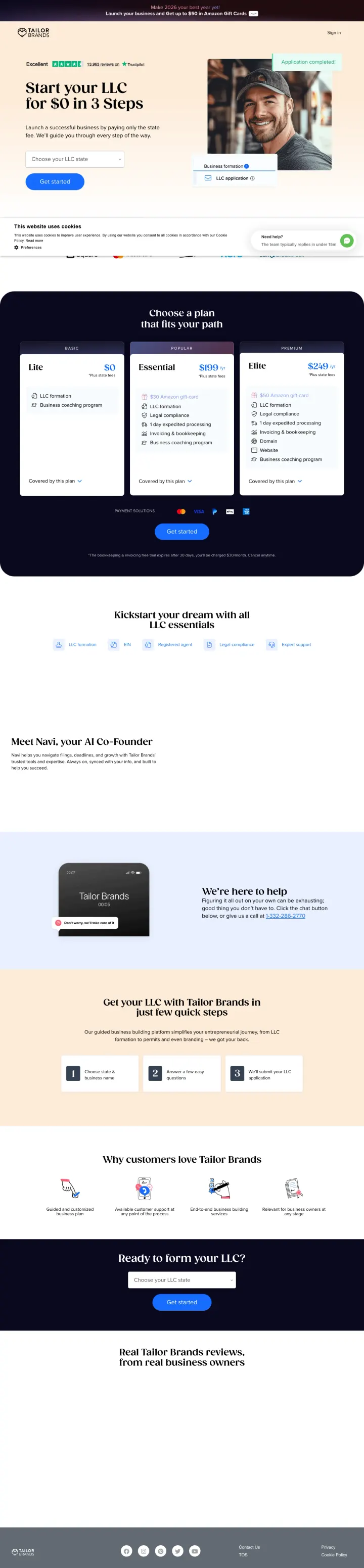
Why this breaks the rules: Every other $0 LLC service in this set leads with the filing price and sells the upsell (registered agent, EIN, operating agreement) later. TailorBrands bundles LLC formation with a logo/brand kit that no one asked for. It sounds wrong until you read the hero: 'Start your LLC for $0 in 3 Steps, launch a successful business by paying only the state fee'. They are not selling filings, they are selling the 'launch a business' feeling, then slipping the brand kit into the $0 package.
- price framing
Headline 'Start your LLC for $0 in 3 Steps' compresses the three objections (will it work, is it hard, what does it cost) into one line. 'Launch a successful business by paying only the state fee' completes the pitch with nothing left to object to
- reviews
Trustpilot 'Excellent' badge with 13,961 reviews is an unusually high review count for this category. The volume alone signals 'this is the real deal' before the visitor evaluates anything else
- reviews
Promo banner at the top ('Launch 2026 as your best year yet! Launch your business and get up to $50 in Amazon Gift Cards') uses a concrete time marker and a universally recognized bribe to give the visitor a reason to act now without feeling salesy
- wrong promise
A cookie overlay sits across the bottom half of the hero on first load, clipping the 'Get started' CTA and the state picker precisely where the first-time visitor's eye is already searching for action
- extra steps
The state picker ('Choose your LLC state') is a dropdown that requires a click before the visitor sees their own state, one extra step that Bizee's 3-field inline form avoids
- too much at once
Brand kit bundling is the differentiator but it is not mentioned in the hero headline. The visitor who clicks through from 'how to make llc in texas' sees the same $0 LLC pitch as every competitor and has to scroll to discover the brand-kit angle
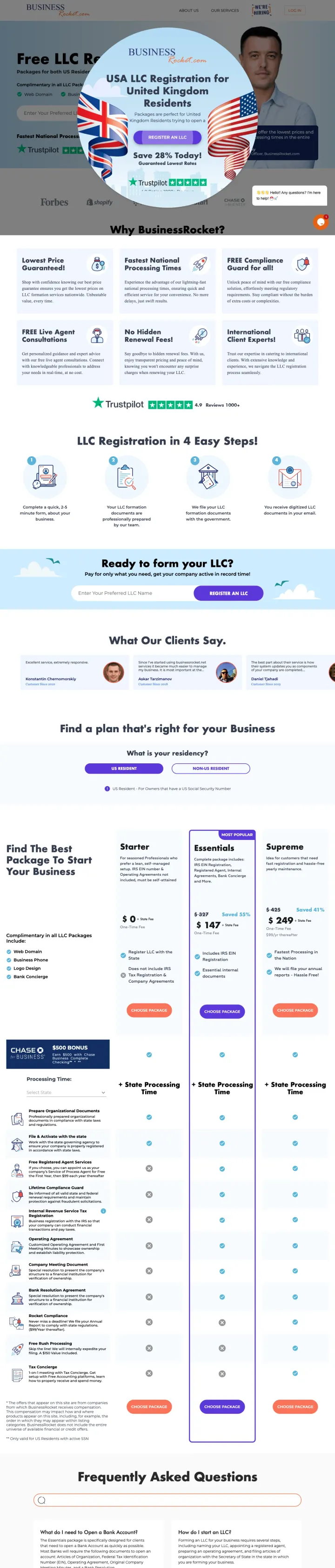
Why this breaks the rules: Every other LLC filing page in this set shows a single offer to every visitor. BusinessRocket's page loads with a modal overlay aimed specifically at UK residents ('USA LLC Registration for United Kingdom Residents, Register an LLC, Save 28% Today'). The modal covers the hero entirely on first load. It should be a conversion-killer, but for UK-resident visitors searching for US LLC formation it is the most message-matched hero imaginable. It is a bet that segment-specific overlays convert better than one-size-fits-all heroes.
- made personal
Segment-specific modal overlay with flag iconography (US and UK flags side by side) turns a generic LLC formation page into a vertical-specific landing page for UK entrepreneurs without building a separate URL
- price framing
'Same-Day LLC Filing Available' and '$0 Service Fee LLC Filing' in the ad copy set the price expectation before the click, and the modal keeps it for the UK visitor
- credentials
Trustpilot 'Excellent' badge is visible behind the modal and logos (Forbes, Shopify) vouch for a platform most visitors have not heard of
- wrong promise
The modal covers the hero on every visit, not just UK-source traffic. Non-UK visitors see an offer that is not for them and must dismiss it before seeing the actual page. This likely hurts non-UK conversion
- missing proof
'Save 28% Today!' pushes the visitor to act today but is vague. 28% off what? A promotion that does not name the base price reads like a gimmick to the analytical buyer
- wrong promise
The page targets 11 keywords with 1,180 total monthly search volume, which is tiny compared to Bizee (371K) and TailorBrands (174K). Either the paid strategy is narrowly targeted or the page is not ranking for the volume its competitors pull
Compare the winners
The same questions asked of every winner, so you can find the row that matches the traffic you are already buying.
| Page | The hook | Form fields | Offer named up top | Phone in the first screen | Rating before the scroll | Standout move |
|---|---|---|---|---|---|---|
| #1Bizee | The order form itself | 2 | Yes | No | No | Entity and state, then start |
| #2LegalZoom | Three entities, three prices | No form | Yes | Yes | Yes | The LLC card flagged most common |
| #3Harvard Business Services | Compare our packages | No form | No | Yes | No | The founder signs the promise |
| #4Wyoming LLC Attorney | Register in the best state | No form | Yes | Tiny | Yes | A refund if the filing runs late |
| #5ZenBusiness | Launch your side hustle | 1 | Yes | Yes | Yes | Reviews dated this month |
| #6Inc Authority | Free, said five times | 2 | Yes | Tiny | Yes | Its price against two rivals by name |
| #7Swyft Filings | The confident way to file | No form | No | Tiny | No | Every tier sells a turnaround |
| #8Firstbase | An operating system, not a filing | No form | No | No | No | Endorsed by people founders know |
| #9doola | A sale with a clock on it | No form | Yes | No | Yes | The whole back office in one plan |
Read the keywords you are buying, then find the row that matches them. Somebody typing form an llc in wyoming has already picked the state and wants the price and the filing time. Somebody typing how to start a business has picked nothing yet, and needs the entity types laid out and priced before any of your buttons mean anything. You paid the same for both clicks.
The copy bank
Lines lifted word for word off the pages above. We tell you whose page each came from, and one click copies it.
The all-in-one startup operating system
Launch Your Side Hustle or Dream Business
The Confident Way to Form Your Business
We offer three great options to start your business. Choose the one that best fits your needs!
Losers
4 pages burning ad spend with fundamental issues
Every click to these pages costs real money. We found pages with no reviews or badges anywhere, mismatched intent, weak CTAs, and messaging that ignores what the searcher actually typed. Here is what to avoid.
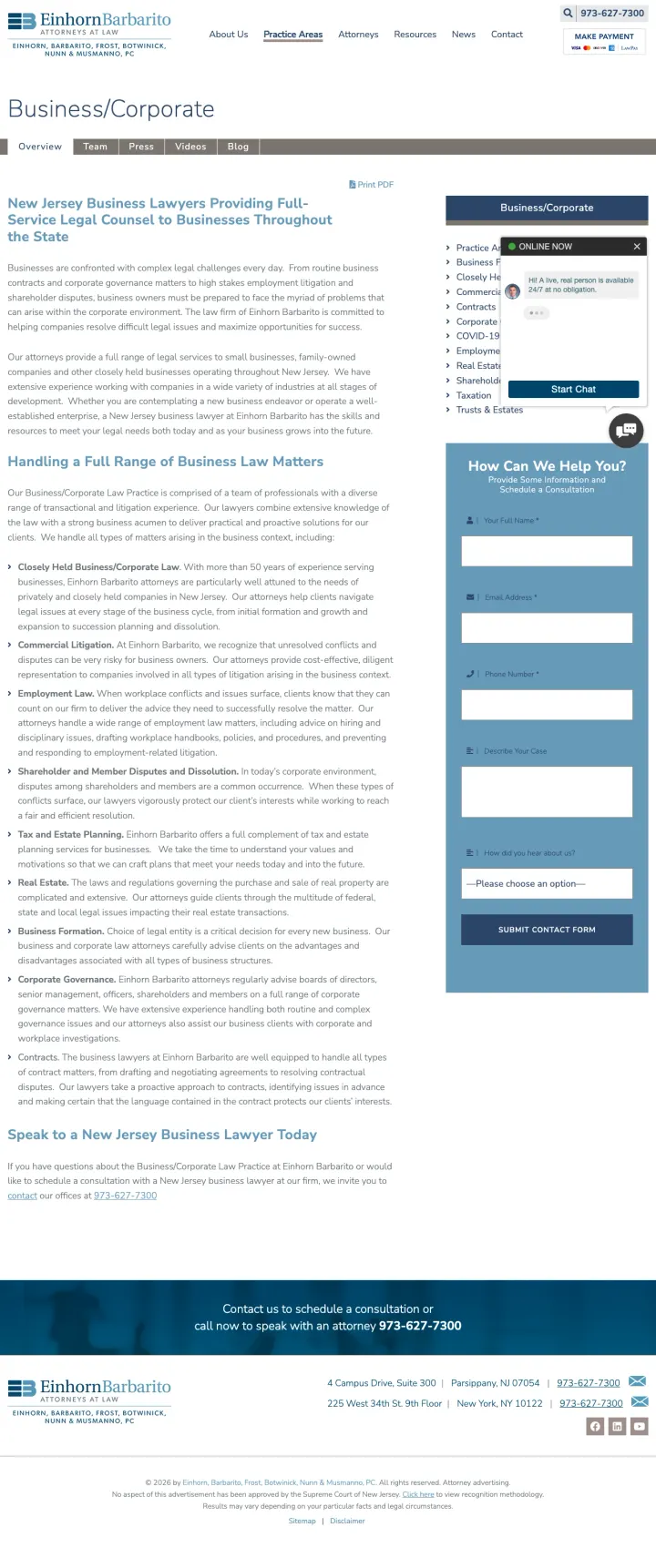
This page targets 'business lawyers in new jersey' (SV: 390) and delivers a long text page listing every type of business law the firm handles (commercial litigation, employment law, real estate, tax). No form, no CTA button, no attorney photos above the fold. The only conversion path is a phone number and address at the very bottom. At legal CPCs of $15-30, every click lands on what reads like a law school syllabus.
- too much at once
Dense paragraphs of text describing each practice sub-area read like a legal directory listing, not a page designed to generate consultations
- looks off
No attorney photos, no case results, no testimonials. Nothing that differentiates this firm from any other NJ business law firm
- too much at once
No form and no prominent CTA. The visitor must scroll to the footer to find a phone number
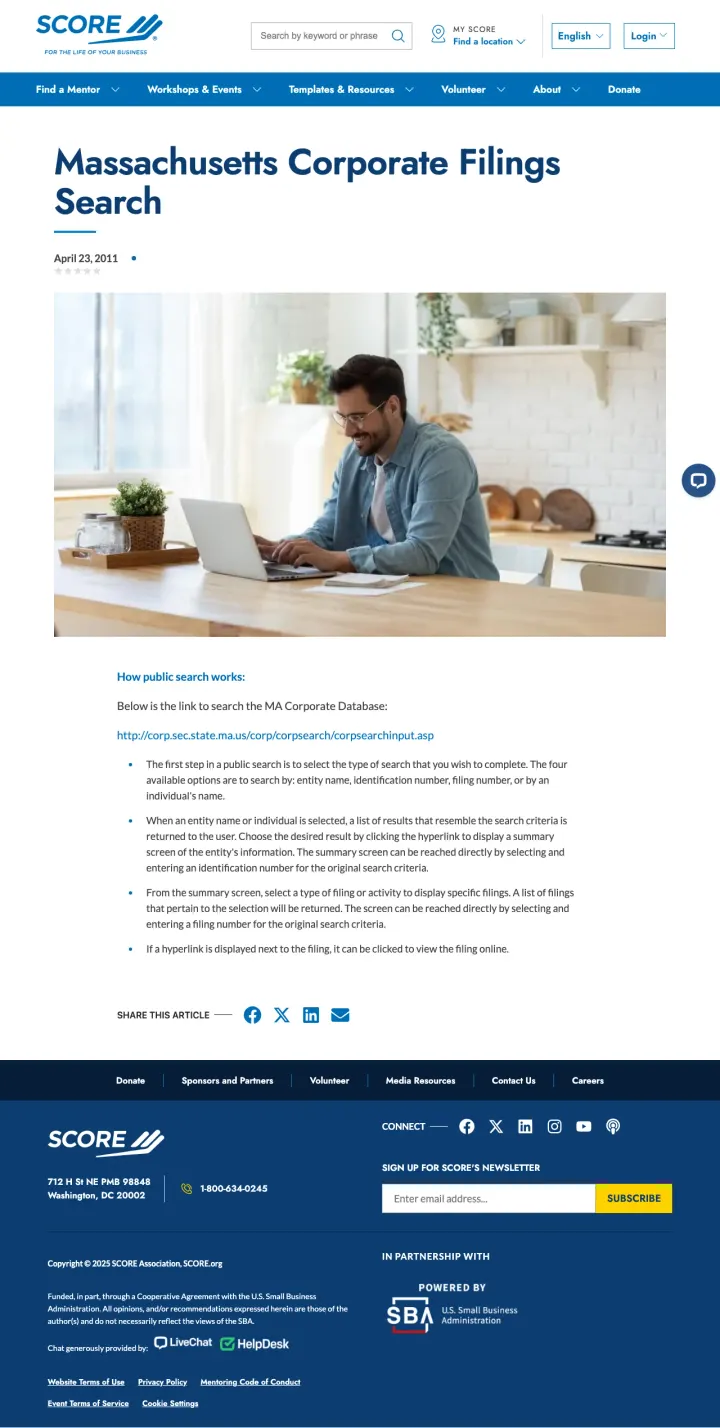
The ad targets 'massachusetts business lookup' (SV: 12,100) and the landing page is a SCORE.org resource page that provides instructions for using the Massachusetts Secretary of State's corporate database, then links directly to that government site. The visitor who clicks the paid ad gets directed to a free government tool via an intermediary. SCORE provides no value beyond the link itself, and the visitor will leave immediately to use the actual government search tool.
- wrong promise
The page's only purpose is to link to a free government website. Paying for clicks to an intermediary page adds zero value
- extra steps
SCORE.org is a business mentoring nonprofit, not a business formation service. The keyword targeting is fundamentally misaligned
- looks off
A large stock hero image of a man with a laptop fills the viewport before any useful content appears, giving 'I paid for this click' visitors a generic nonprofit brochure instead of the search tool they asked for
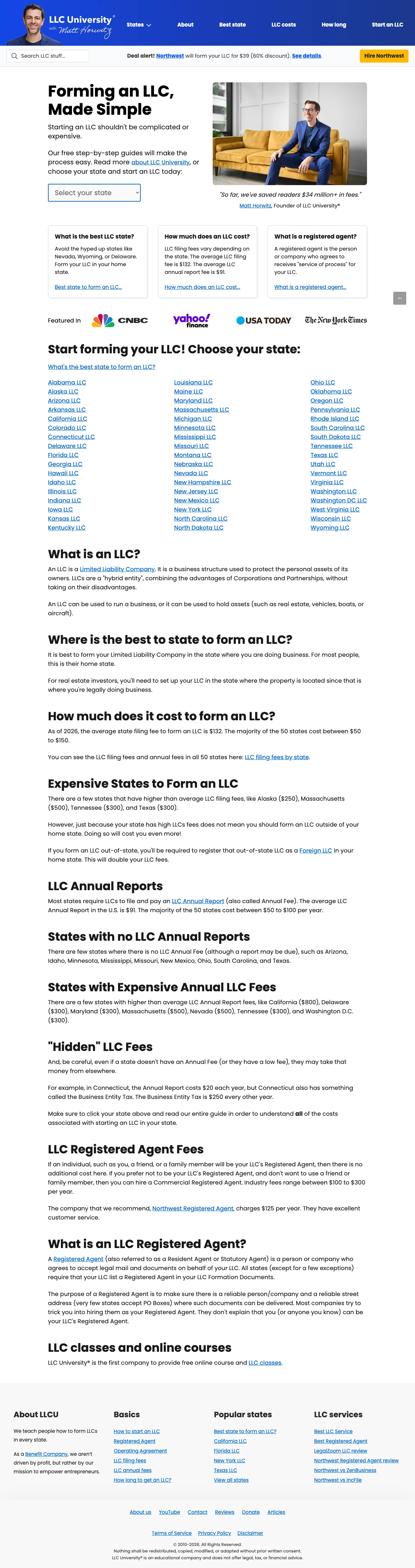
LLC University is a pure content site. There is no formation service, no filing product, no checkout. The homepage leads with 'Forming an LLC, Made Simple' and a state picker, but every click routes to a free educational article, not to a filing flow. The site runs on affiliate revenue from registered-agent services and ad placements, which means it is paying for clicks only to hand the visitor off to a partner. At LLC-formation CPCs of $8-30, this is the worst position in the market: you pay full price for the click, then the visitor has to click again to reach a paid service.
- extra steps
No form, no pricing, no checkout anywhere above the fold. The primary CTA is a state dropdown that leads to another article, not to a purchase
- too much at once
The hero pitch ('Starting an LLC should not be complicated or expensive') sets up an expectation that this site will make it simple, then delivers a 50-state directory of long-form guides instead of a filing service
- wrong promise
Every formation-intent keyword sends the visitor one click away from a competitor. The site's best case is that the visitor clicks an affiliate link to Bizee or Northwest, which means the $8-30 CPC is spent to generate a commission worth a fraction of that
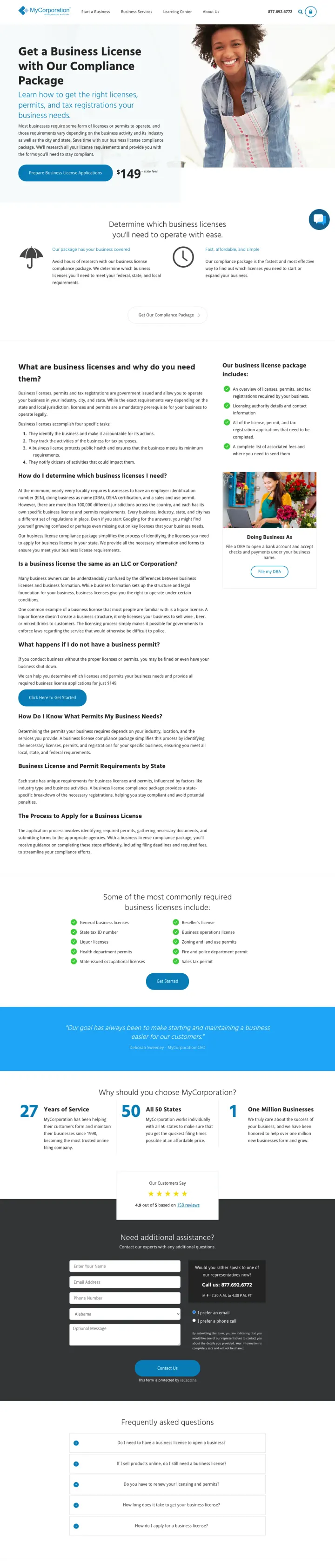
This page targets 'tennessee business license application' (SV: 220) and delivers a generic business license compliance page at $149 + state fees. While the pricing is transparent and the page is professionally designed, the content is generic (not Tennessee-specific) and the form is buried below multiple content sections. The ad promises state-specific help but the page delivers a generic national service page. For visitors searching for their specific state's business license requirements, this generic approach feels like a bait-and-switch.
- wrong promise
The ad targets 'tennessee business license application' but the page never mentions Tennessee, so the visitor lands on a national page that ignores what they typed
- too much at once
The intake form is buried below multiple content sections about what business licenses are and why you need them
- looks off
The hero stock photo of a smiling woman adds nothing to the message and takes up valuable above-the-fold space
What we learned
$0 + state fees is the price every other offer gets measured against in this market
Bizee, LegalZoom, TailorBrands, and BusinessRocket all lead with the same hook: $0 service fee, you only pay the state filing fee. This is a loss-leader model where the upsell (registered agent, EIN, operating agreement, bank account setup) is where the real revenue lives. For the price-sensitive entrepreneur, '$0' eliminates the first objection instantly. For the platforms, it moves competition from price to speed, features, and brand.
Inline 3-field forms in the hero are faster than any CTA button
Bizee's hero is three form fields (entity type, state, email) and a GET STARTED button. The visitor can begin the LLC formation within 5 seconds of landing, no scrolling, no extra click. BusinessRocket uses the same pattern. This outperforms a 'Start Now' button that routes to a separate form page, because every extra step drops conversion. When the filing itself is the product, the filing form should be the hero.
Jurisdiction specialists win by owning their niche, not by competing on price
Harvard Business Services (Delaware, 40+ years, 400K+ businesses formed) and Wyoming LLC Attorney ($99 + bank account included, 100,000 businesses formed) both charge more than the $0 platforms and both win their state-specific searches. They do it with founder photos, statute references, and deep copy about why that jurisdiction matters. For the entrepreneur who has already decided 'Delaware' or 'Wyoming', a national $0 platform looks generic next to a specialist.
State-specific searches sent to generic national pages are the biggest source of waste
MyCorporation targets 'tennessee business license application' and sends traffic to a generic national business-license page that never mentions Tennessee. This is the most common failure pattern in business formation PPC: state keyword goes to a generic page, message match collapses, and the visitor bounces to a competitor whose page actually says their state name. The fix is templated state-specific pages, exactly what LegalZoom does with /marketing/texas/llc-overview and /marketing/california/llc-overview.
Winners lead with the price ($0 or a specific tier), put the filing form or tier-picker above the fold, and match the state in the search query. Losers send filing traffic to practice-area law firm pages with no form, to nonprofit resource pages that link out to free government tools, to long-form educational articles about what an LLC is, or to generic national pages for state-specific queries.
If you're building a page like these yourself, here's my comparison of AI landing page builders, with prices and what each one is best for.
What the formation winners taught us
Almost everybody selling an LLC now leads with the same free filing, so the price has stopped being the thing that separates these pages. What separates them is how fast the filing happens, who is answering for it, and whether the visitor can start without ringing anybody.
- 1
Sell the filing time, not just the fee. When every competitor charges nothing plus state fees, the fee cannot be your argument any more. Swyft Filings puts a processing promise on each tier, seven to ten business days, three business days, one business day, and that is what the visitor is actually paying the difference for. Wyoming LLC Attorney goes further and refunds a filing that misses twenty four business hours. Put your own turnaround beside your own price and you have a reason to be the dearer one.
- 2
Put a form on the page instead of a button that starts a checkout. Most of the pages in this file have no lead form at all: every conversion point is a button, and the visitor who is still comparing has no way to raise a hand. The ones that do ask almost nothing. Bizee wants an entity type and a state. Inc Authority wants the same two from a card in the hero. ZenBusiness wants a preferred business name and nothing else. None of them ask for a street address. A first step that small is very hard to refuse, and it gives you an email for the people who leave to go and think about it.
- 3
Price the entity types, because the visitor has not picked one. Somebody searching how to start a business does not know yet whether they want an LLC, a DBA or a corporation, and no button on your page means anything until they do. LegalZoom answers it on the screen under the hero: three cards, a starting figure on each, the same list of what the fee covers, and MOST COMMON flagged over the LLC so an undecided visitor has a default. That single block does the job your sales call was going to do.
- 4
Name somebody who answers for the work. The Harvard Business Services page carries a block headed My Promise To You, signed by Rick Bell with his photograph, his job title and his own email address under it. That is a founder putting his name against the filing, on a page selling the same paperwork as everybody else. Firstbase does the other version, borrowing the chief executive of Carta and a partner at Y Combinator. Either works. A page with nobody's name on it is a form with a logo above it.
- 5
Check that your own trust badge is not being covered up. The doola page runs a review widget in the first screen and its own cookie card lands directly on top of it, leaving the first few stars showing and hiding the score and the brand name beside them. Inc Authority runs three named client videos further down and every one of the panels renders as an empty white box, with only the name and the company underneath. Both faults look fine in the page builder. Open the live page in a fresh browser, let every banner appear, and look at what a first time visitor actually sees.
Score your own formation page
Every line below came off a screenshot somebody sat and counted. Open your own page beside it and tick what it already does.
What a cold click sees on your page
Bizee's hero is three fields - entity type, state, email - under the headline 'Register Your LLC in Minutes'. It's one of the 9 winners you just scrolled through. And not one of them tells you anything about your own page. So hand postclick the URL your LLC ads point at. It reads that page like someone who just clicked your ad and knows nothing about you, tells you why they leave without starting the form, then draws new versions and builds the one you pick.