We analyzed 50 criminal defense landing pages. Only 7 are worth stealing from.
We pulled 50 criminal defense pages that were paying for Google Ads clicks and read every one. These 7 are the ones worth your time, and everything we found sits on this page, free.

50 landing pages screened
From real criminal defense Google Ads campaigns in the US
7 winners curated
The landing pages actually worth stealing from
4 burning money
So you know exactly what to avoid
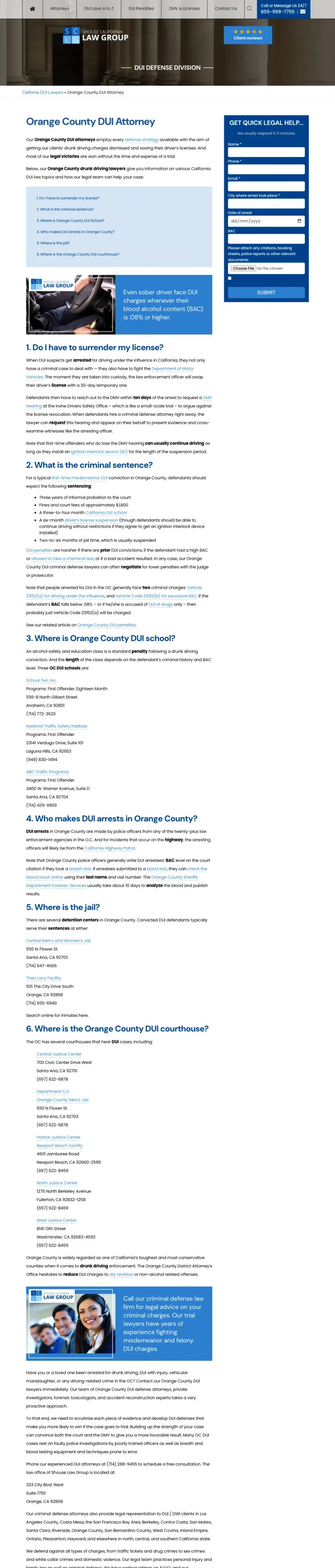
Shouse Law Group takes the top spot for putting the form in the first screen. It sits in the right rail beside a numbered run of questions about the license, the sentence and where the jail is, and a shorter version of it comes back above the footer. The catch is the form itself, which asks for more than any other in this file, including the date of the arrest and a blood alcohol reading.
Anchor the form to the right rail and let it travel as the visitor scrolls through the FAQ. Most firms tuck the form into a contact page; Shouse keeps it visible through every question the visitor wants answered.
- +
Form sits level with the headline form placementone afternoon
We usually respond in 5 minutes.Yours probably sits at the foot, so a visitor who decides halfway down scrolls back past everything that convinced them. Shouse puts theirs in the right rail, and runs it again above the footer without the arrest date or the blood alcohol reading. Print how fast somebody answers.
- +
Headings repeat the arrest-hour question matches the searchone afternoon
Where is Orange County DUI School?Somebody arrested last night types exactly that, along with where the jail is and whether they lose the license. Each one becomes a numbered heading, and the schools, jails and courthouses are named with addresses and phone numbers. Brochure language belongs on the about page.
- +
Phone number gets the only coloured cell phoneeasy
Call or Message Us 24/7It sits in a blue block at the right end of the nav, the only coloured thing in the row, with the promise above it and a mail icon beside it. A criminal defense click is a panic click. Make the number the loudest thing and let people ring.
- ✕
Star row carries no score, no count reviewseasy
Gold stars sit in a square blue block in the hero over the words client reviews, and that is the whole claim. Nothing a stranger can check, and the block is shaped like a button rather than a badge. Print the score and the number of people behind it.
- ✕
Nothing on the page is a case result case resultshard to earn
The nearest thing is the opening line saying most of their legal victories come without a trial, which reads as a claim rather than a case. What gets a frightened person to ring is a charge like theirs that ended in a dismissal, with a date on it.
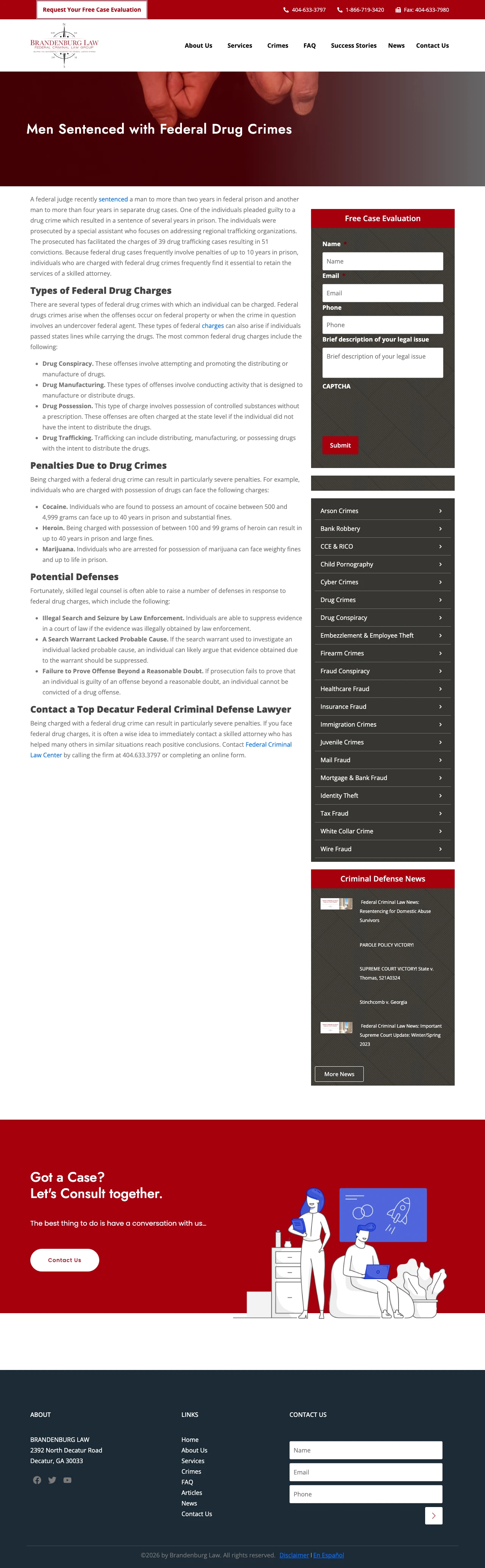
Brandenburg Law runs this federal drug crimes page, and it earns its place on the body copy rather than the design. The article works through the charges, then the penalties, then the defenses that could apply, and leaves its own ask until last, which is the order a frightened person reads in. The form does not wait for any of that: it sits in the right rail from the first screen. Its own headline works against it, because it is written about somebody else.
List the exact federal defense strategies ('Causation', 'Illegal Search and Seizure', 'Federal Entrapment') as bullet points above the form. Visitors Googling 'federal drug crimes lawyer' are often educated and want to know which defense applies before they call. Naming the defenses earns the call.
- +
Sidebar form asks four things form lengtheasy
Free Case EvaluationA name, an email, a phone number and one line about what happened. Nobody in a crisis works through a drop-down about charge types. Count what your form asks and delete the rest. Then fill it in yourself, because theirs prints a CAPTCHA label over an empty band.
- +
Article lists the defenses that could apply answers the fearone afternoon
skilled legal counsel is often able to raise a number of defenses in response to federal drug chargesIt walks through what the charge covers, what the sentence could be and which defenses exist, including an illegal search and a warrant with no probable cause, and only then asks for contact. Name the defenses and let the reader recognise their own situation.
- +
Toll-free line runs beside the local one phoneeasy
by calling the firm at 404.633.3797 or completing an online formFederal work travels, so the family ringing you is often in another state. A second number says you take those calls. Copy the pair and not the styling, because theirs are set so small in the red strip along the top that they read as utility text.
- ✕
Hero headline reports on strangers wrong promiseeasy
Men Sentenced with Federal Drug CrimesThat is a headline about other men going to prison, written for a search engine, and it is the only thing printed on the hero image. Your visitor wants to know what happens to them and whether you can stop it. Name their situation in the first line.
- ✕
No lawyer is named anywhere credentialsone afternoon
The logo and the footer say Brandenburg Law, the body copy calls the firm Federal Criminal Law Center, and under the street address there is no bar number, no board certification and no rating body. Federal defense is bought on the lawyer. Put a name in the first screen.
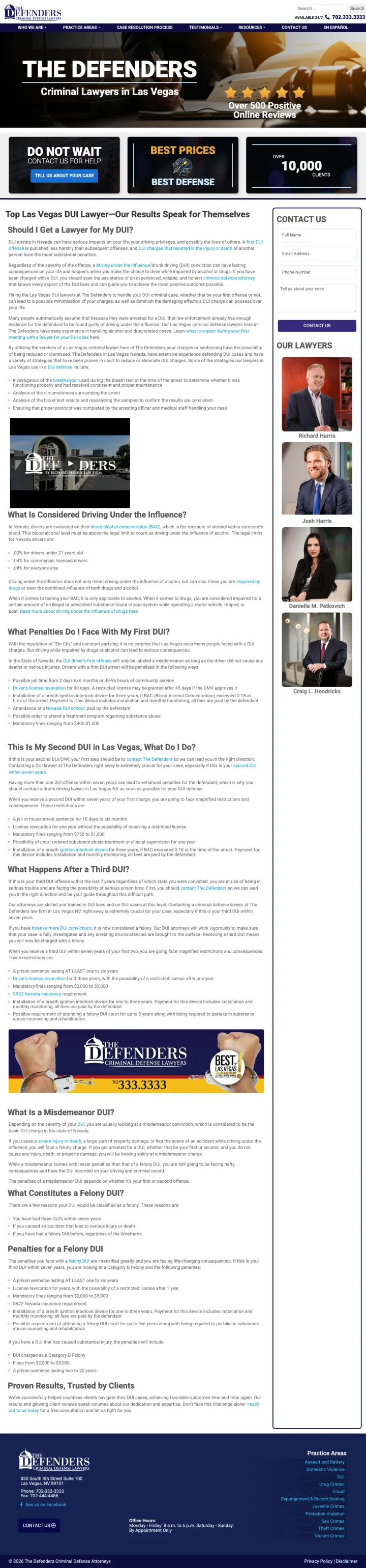
Volume is the whole pitch at The Defenders, and in a market where nobody is allowed to promise an outcome, it works. A star row and a review count sit over the hero photo, the local number is in the header above it, and a card counting the clients lands right underneath. What none of that proof does is say where a stranger could go and check it.
Frame scale as trust. 'OVER 10,000 CLIENTS' and 'Over 500 Positive Online Reviews' sit in the hero as the first two numbers a visitor sees. In a vertical where 'are you any good?' is the real question, proof-by-volume works on panicked visitors better than a list of bar associations.
- +
Money gets a card in the first screen moneyeasy
Best PricesCost is what anybody wonders second, right after whether they go to jail, and almost every firm dodges it. Here it sits between a card telling you not to wait and a card counting the clients. Then the card wastes it, because best prices names no price.
- +
Heading matches what people type first matches the searcheasy
Should I Get a Lawyer for My DUI?People search that before they ever type lawyer near me, and it is the first question this page answers. Answering it straight, including the part where a first offense is punished less harshly, costs nothing and buys the trust the pitch needs.
- +
Local area code does the geography phoneeasy
AVAILABLE 24/7 702.333.3333It tells a Las Vegas visitor you are in Las Vegas before any map or address does. The number sits top right beside the promise that somebody picks up at any hour, and only the logo is set larger. Let the number carry the location for you.
- ✕
Star row and client count name no source reviewseasy
A review count sits over the hero photo and a client count gets a black card under it. Nothing says where either number came from: no Google, no Avvo, no year, nothing a stranger could open in another tab. Print the score and link straight to it.
- ✕
One free-text box carries the whole intake intakeeasy
Tell us about your caseEverything your team needs to route the call comes out of a box some people leave empty. A single drop-down naming your practice areas costs a tap and tells you whether this is a first DUI or a felony before anybody rings back. Add the tap, keep the typing short.
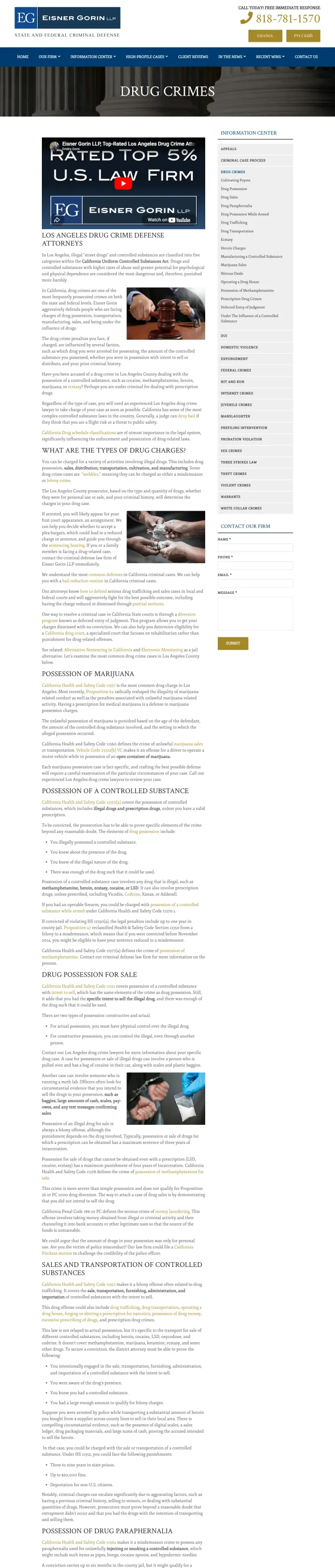
Eisner Gorin opens with a video where most firms open with a paragraph, and the still frame sells to the people who never press play. Beside it the right rail names the drug charges one by one, then every other practice area, so an unusual charge still finds its own page. Underneath, the page turns into California drug law, and the board certification and the rating badges wait in the footer, a very long way from the decision.
Put an embedded YouTube intro above the body copy so the 2am visitor can hear a human voice before they read anything. The 'Rated Top 5% U.S. Law Firm' thumbnail appears inside the hero; clicking plays a 90-second attorney intro. For a high-CPC call-driven vertical, this is cheaper than paying for another ad creative test.
- +
Video still prints a ranking claim proofone afternoon
Eisner Gorin LLP, Top-Rated Los Angeles Drug Crime AttorneysMost people never press play, so the frame does a headline's work for free. Theirs sets a rated-top line right across it, the firm and the lawyer named above. Choose your thumbnail on purpose, and publish a real score too, because a claim inside an image checks out nowhere.
- +
Rail names every drug charge separately navigationone afternoon
Information CenterSomebody charged with cultivation does not want a page about drug crimes in general. The list runs from cultivation and possession through trafficking and manufacturing to under the influence of a controlled substance, then a second block for every other practice area. Build the same list.
- +
Header promises an immediate response phoneeasy
Call our office 24/7 at (877) 781-1570 for an immediate response.Everybody promises to be available around the clock. This one promises a free and immediate response at the top right, with the number under it in gold at a size you cannot miss. Immediate answers the question the caller has, which is whether a human picks up now.
- ✕
Statute runs on below the video too much at onceone afternoon
California Health and Safety Code 11350(a)Below the video come schedule classifications, possession against sale and diversion programmes, with code numbers doing the talking. Somebody arrested on Friday night cannot read that. Put the short answer at the top and let the law live further down for the people who want it.
- ✕
Video leaves nowhere to answer it no captureone afternoon
The only way to respond from that first screen is the number in the header. The box to type in waits below, in the rail under the charge list, and on a page this long it never comes back. Somebody who cannot talk needs that box wherever they stopped reading.
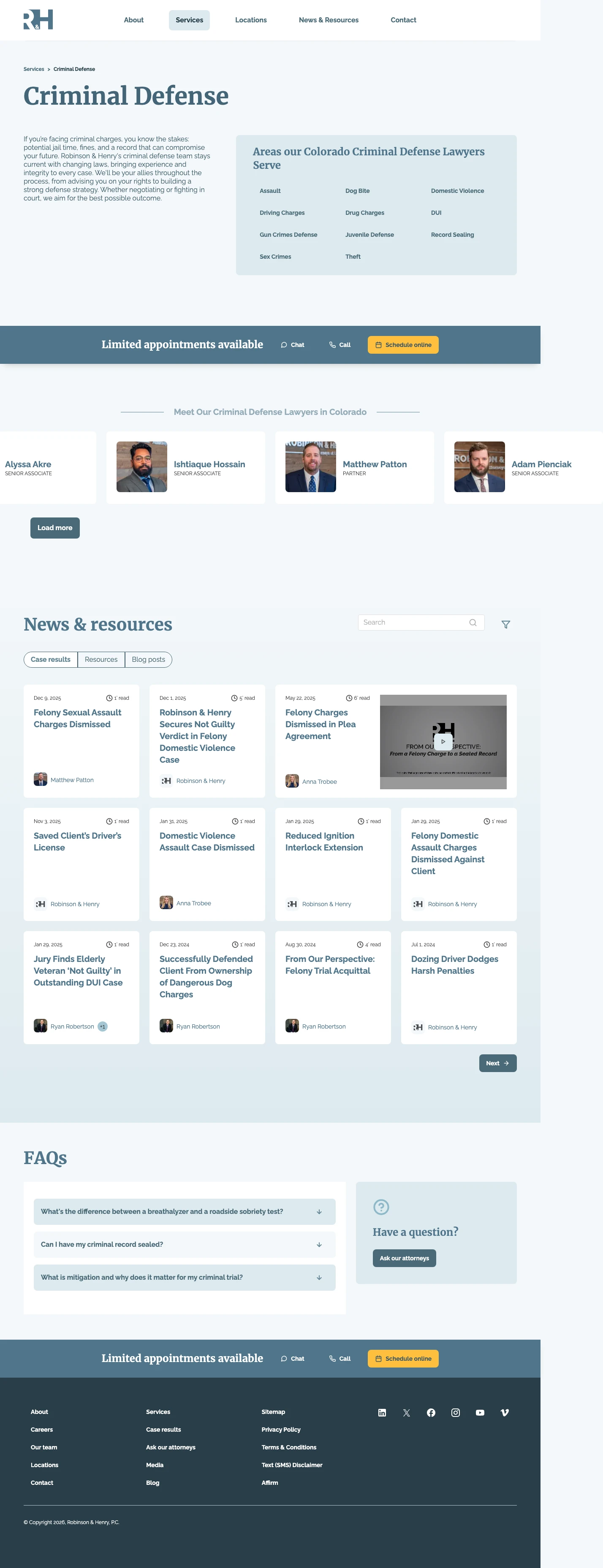
Robinson & Henry has no lead form anywhere on the page, and it still earns its place on case results. Every card carries the outcome as its headline, the date it landed and a byline, and the best of them are signed by the lawyer who did the work, with a photograph beside the name. The hero above them is a paragraph any defense firm in the country could publish.
Stack a case-result feed directly under the attorney grid. Cards like 'Felony Sexual Assault Charges Dismissed', 'Saved Client's Driver's License', 'Reduced Ignition Interlock Extension' give the panicked visitor an instant answer to 'could this firm get me out of this?' without forcing them to read a testimonial paragraph. The date and author stamp on each card reads as calendar-fresh, not stock copy.
- +
Booking bar offers chat, call and calendar call to actionneeds a developer
Limited appointments availableOne strip lets the visitor pick whichever suits the room they are standing in, and the same strip comes back above the footer. The scarcity line sits at the left doing the pushing. Make yours true, because a firm always short of appointments teaches people to read past the words.
- +
Charge names are links beside the opening paragraph navigationeasy
Record SealingAssault, dog bite, domestic violence, driving charges, drug charges, DUI, gun crimes, juvenile defense, record sealing, sex crimes and theft: every one lands on its own page in a tap. Hide that list in a dropdown and the unusual charge assumes you do not handle it.
- +
Case cards carry a date and a byline case resultshard to earn
Felony Sexual Assault Charges DismissedEach names the outcome and prints the date it landed. The strongest are signed by the lawyer who did it, with a photograph beside the name, the weaker ones only by the firm mark. A named human who won a case like theirs, recently, convinces.
- ✕
Word call replaces the actual digits phoneeasy
Schedule onlineIt sits in the bar beside a handset icon and the number never appears in the first screen. Somebody whose partner was arrested an hour ago will not press a word and wait to find out what happens. Print the digits at a size you can read across a room.
- ✕
Opening paragraph any firm could publish empty copyeasy
bringing experience and integrity to every caseEvery defense firm in the country could print that sentence unchanged, which is how you know it is worth nothing. The things only this firm can say, the named lawyers and the wins with dates, sit a long way below it. Pull a result up into the hero.
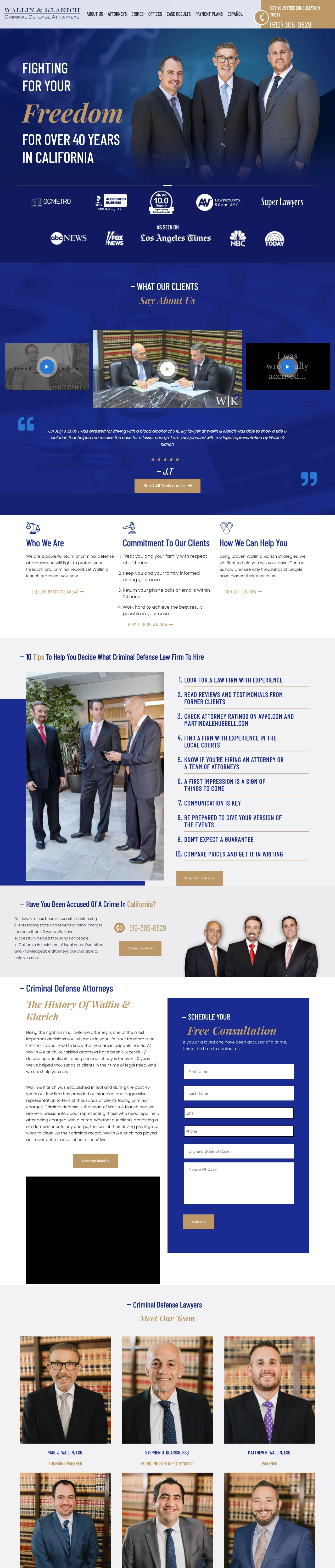
Wallin & Klarich sells its tenure as an outcome instead of a fact, so the hero is about freedom and the years sit underneath as the proof. A row of rating badges follows straight after it, which is rare in this file, because most of these pages leave their credentials to the footer or print none at all. The form is a long scroll away, and when you reach it, it asks for more than the short ones do.
Run five real client video testimonials as the first piece of body content, not in a footer carousel. Wallin & Klarich embeds five YouTube client clips above the attorney bios, so the first proof a visitor sees is the face of a former client. For a vertical where the most common visitor objection is 'I cannot trust a stranger with my life', letting former clients say it earns the call better than any credential block.
- +
Headline leads on freedom, not experience headlineeasy
Fighting for Your Freedom For over 40 years in CaliforniaFreedom is what the visitor wants. Experience is what you have. This hero stacks the want in big type, sets Freedom in a gold italic and lets the years sit underneath as proof. Rewrite your headline so the largest words name what your client walks away with.
- +
Badge row sits inside the first screen credentialshard to earn
A local magazine award, a bureau grade of A plus, a directory score and a lawyer rating all in one line, with news logos on a second line under them. Most firms park these next to the copyright. Move yours up, and keep padlocks out of that row.
- +
Service promises carry a clock service standardeasy
Return your phone calls or emails within 24 hours.A promise with a time limit can be checked, and that is what makes it worth printing. They also promise to keep the family informed, and the family usually does the ringing round. Write your own standards in a numbered list, then keep them. The page is the easy half.
- ✕
First screen has no box to type in no captureone afternoon
The header calls properly, with the free consultation line and the number in white on a gold panel. No box to type in fits. The form turns up far down, wanting a name, an email, a phone number, the city and state, and the details.
- ✕
Client videos send the visitor to YouTube leaks trafficone afternoon
A carousel of thumbnails, a play button on every one, and every one a link out to YouTube, so the visitor you just paid for finishes the story elsewhere. Embed the player where it sits. The point of a client video is that they watch it beside your phone number.

Summit Defense says its team includes former prosecutors and law enforcement officers, and the page turns that into a reason to hire them rather than a line in a bio. A client quote, a star row and an award strip all land in the first screen, beside a call button and a link to schedule. The only box to type in waits at the foot of a very long page.
Reframe the team's prior careers as the qualification. Summit Defense leads with 'Over 120 Years of Criminal Defense Experience' and then explicitly says the team 'includes former prosecutors and law enforcement officers who understand how best to defend your rights'. Turning the inside-the-system credential into the reason to hire is the move. Most firms bury this in an attorney bio page; Summit makes it the hero promise.
- +
Hero stacks place, reason, then action headlineeasy
Over 120 Years of Criminal Defense ExperienceWhere you are, why you are worth it, then what to do next, all centred on the photo with a call button under them. Read your own hero out loud and see how far the visitor gets before they learn which city you cover and what to press.
- +
Client quote names the lawyers who worked reviewshard to earn
I never imagined I would need a criminal lawyer (have had many other types) but Summit Defense is truly a gifted team of trial lawyers. Collin Moore, Jessica and the whole firm were just amazing. Highly recommend.The reader gets somebody to go and search for, and the star row sits directly above it. A quote with nobody named inside it reads like something the agency wrote. When you next ask a client for a review, ask them to name the person who helped.
- +
Badge strip covers several kinds of trust credentialshard to earn
A best-rated award, a bar register, a clients' choice badge with the lawyer's name on it, a defense lawyers' association seal and a Yelp mark, all in a row. Different visitors trust different badges. Earn them slowly, then print them where the decision happens.
- ✕
Only box to type in waits at the foot no captureone afternoon
Contact Us Now For a Free ConsultationEverything above it is a call button or a link to book, and you scroll a very long way to reach it. Plenty of people cannot make that call, because somebody is in the room. Put a short form beside the call button: a name, a number, what happened.
- ✕
Hero uses a courthouse steps photo stock imageryone afternoon
Figures in suits, some cropped off at the shoulders and the rest turned to each other, and the client quote is printed on that same picture. Further down there is a grid of this firm's own people, named and photographed. Shoot the hero with them in it.
What the criminal defense winners keep doing
Wildcards
Pages that break the playbook in interesting ways
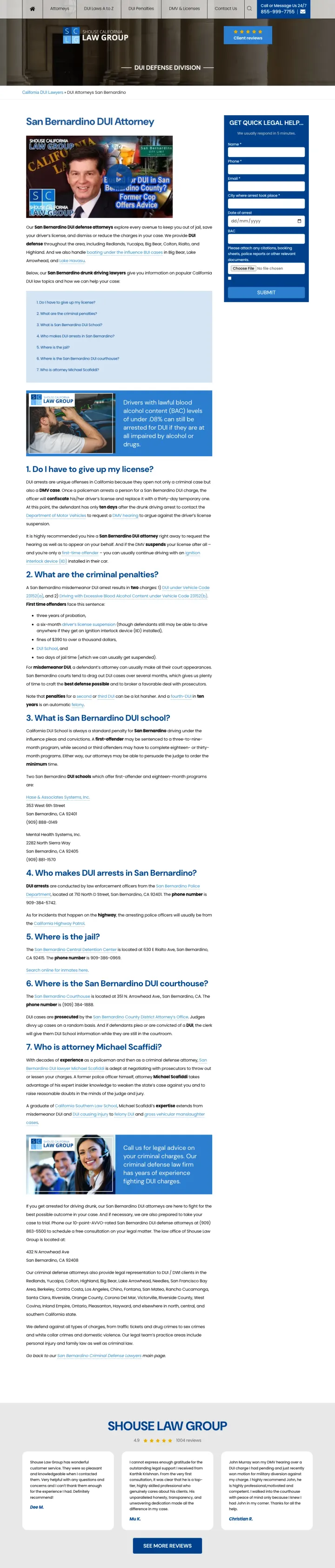
Dedicate an FAQ entry to the attorney's identity. Section 7 on this page is literally titled 'Who is attorney Michael Scafiddi?' with a 'Former Cop, DUI expert advice' video thumbnail reused from the hero. Most firms bury the attorney bio on a separate page; bolting it into the FAQ flow keeps the visitor answering their real question (can I trust this person?) without a second click.
- answers doubts
'Former Cop, DUI expert advice' as the hero video label. It reframes former prosecutor messaging into an even stronger 'inside the system' credential. For a geography where local judges and officers matter, naming the attorney's ex-cop status out-performs generic 'decades of experience' claims.
- answers doubts
FAQ section numbered '#7 Who is attorney Michael Scafiddi?' lets the visitor discover the attorney on their own scroll path. Same form, same header, same right rail as the other Shouse metro pages; the differentiator is the attorney section.
- layout
Hero image shows the attorney with 'SG' firm initials overlaid on California typography. Ties the personal brand to the firm brand in one glance.
- wrong promise
The video thumbnail is a default YouTube still with the attorney mid-speech. A cleaner poster frame would read more professional without losing the authenticity.
- wrong promise
The location-specific content (San Bernardino DUI School addresses, courthouse info) is below the attorney section. For someone whose search intent is purely navigational ('where is the San Bernardino courthouse'), those answers deserve to be earlier.
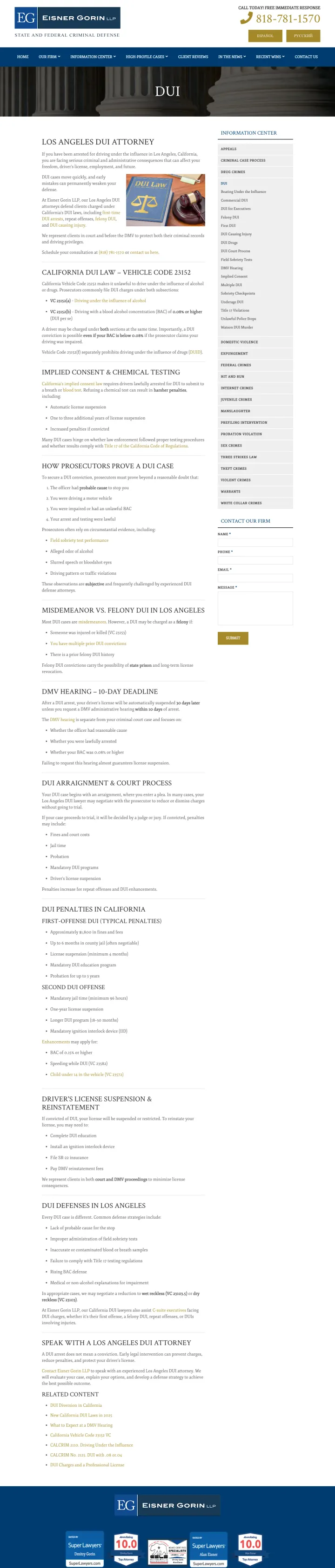
Replace the right-rail form with a scannable link list of every related sub-topic the visitor might actually want ('Implied Consent', 'Chemical Testing', 'First DUI', 'Felony DUI', 'DUI Drugs', 'Title 17'). For a vertical where the visitor is researching before calling, a deep internal-link menu can outperform a form because it keeps the session alive. Form fills come later, on the sub-pages.
- fewer steps
Vehicle Code 23152(a) and (b) are linked by the exact statute number, not just 'California DUI law'. Visitors who have already read their citation recognize the code and trust the page instantly.
- fewer steps
The right-rail 'Information Center' is organized by research intent (Appeals, Criminal Case Process, Drug Crimes, DUI, etc.) rather than by service offering. Mirrors the way a visitor actually navigates legal research, not how a firm names its practice areas.
- deadline
Firm phone '(818) 781-1570' labelled with a speed promise rather than an availability promise. 'Immediate' outperforms '24/7' for visitors in crisis because it commits to a response time, not just a pickup window.
- extra steps
Researcher-leaning visitors get a link list, but there is no form in the hero to capture them when they are ready to convert. For a DUI keyword at $50-$150 a click, 60% of conversions are calls; the other 40% are form fills, and this page sacrifices the second segment.
- looks off
Courthouse column stock photo in the hero repeats the category cliche and undercuts the sophistication of the content below. Swapping in the named attorney (as the drug crimes page does) would lift trust without a redesign.
Compare the winners
The same questions asked of every winner, so you can find the row that matches the searches you are already buying.
| Page | Entry path | Form fields | Phone in the first screen | Credential you can check | Standout move |
|---|---|---|---|---|---|
| #1Shouse Law Group | Form in the right rail | 7 | Yes | Footer only | Numbered arrest-night questions |
| #2Federal Criminal Law Center | Free case evaluation | 4 | Tiny | None | Names the defenses before the ask |
| #3The Defenders | Call or right-rail form | 4 | Yes | Footer only | Review count and client count up top |
| #4Eisner Gorin | Call the number | 4 | Yes | Footer only | A video before a word of copy |
| #5Robinson & Henry | Chat, call or book | No form | No | None | Dated case results |
| #6Wallin & Klarich | Call, form far below | 6 | Yes | First screen | Rating badges under the hero |
| #7Summit Defense | Call now | 4 | Yes | First screen | Former prosecutors as the pitch |
Match the row to the search you are paying for. Somebody typing a charge and a city in the middle of the night wants a number and a human awake at the other end, so the header does the selling and the form barely matters. Somebody typing a federal charge is reading, comparing and often not the person charged at all, so the defenses, a name they can look up and a form that is still there after a long read are what close it. Both clicks cost you the same money.
The copy bank
Lines lifted word for word off the pages above. We say whose page each one came from, and one click copies it.
Men Sentenced with Federal Drug Crimes
Best Prices
Limited appointments available
Robinson & Henry's criminal defense team stays current with changing laws, bringing experience and integrity to every case.
Losers
4 pages burning ad spend with fundamental issues
Every click to these pages costs real money. We found pages with no proof a stranger could check, mismatched intent, weak CTAs, and messaging that ignores what the searcher actually typed. Here is what to avoid.
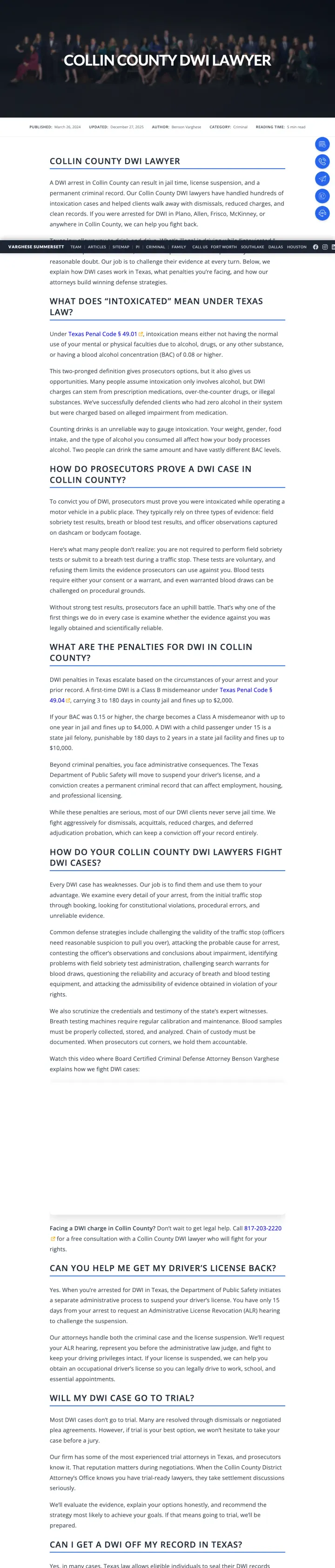
DWI keyword CPCs in Texas metros run $30-$100. Sending paid traffic to a 9-minute read with no hero form and a buried bottom bar wastes nearly every click.
- too much at once
The page is a long-form blog article ('Published March 26, 2024', 'Reading Time: 9 min read', 'Author: Benson Varghese'). These signals tell the visitor to settle in and read, which is the opposite of what a DWI-keyword searcher needs.
- extra steps
No form visible above the fold and no phone number in the hero. The only conversion paths are a pair of floating icons on the right edge and a sticky bottom bar that appears later.
- wrong promise
Location specificity is there (Collin County, Plano, Allen, Frisco, McKinney) but it is buried as flat text inside paragraphs. No map, no office addresses, no 'we appear in these courts' block.
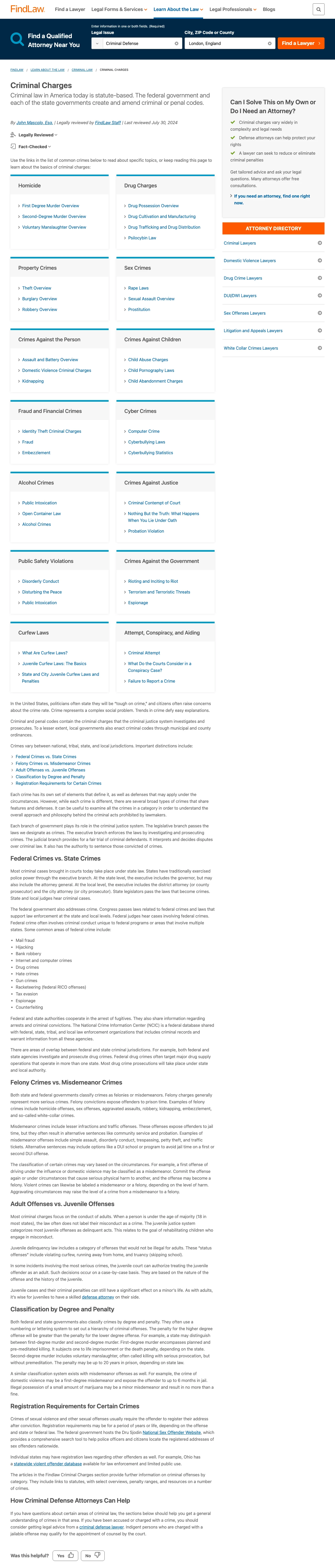
Criminal defense CPCs run $50-$200. Sending paid traffic to a directory hub that has no phone number, no named firm, and a lead-gen search box trained to resell the visitor destroys the ROAS on every click.
- extra steps
Hero is a 'Find a Qualified Attorney Near You' search box with a 'Legal Issue' dropdown and a city-or-ZIP field. This is a lead-gen intake form for FindLaw's paid directory, not a conversion asset for the firm paying for the click.
- wrong promise
Body is a 2,000+ word encyclopedia article ('Feonies vs. Misdemeanors', 'Inchoate Crimes') with inline links to more editorial pages. A visitor arriving from a paid ad has no phone number, no named attorney, and no case-result block.
- missing proof
The page is geographically un-anchored. It targets 'Criminal Defense in Centreville, Virginia' in one line and then serves a generic national article. A visitor from Houston sees the same page as a visitor from Boston.
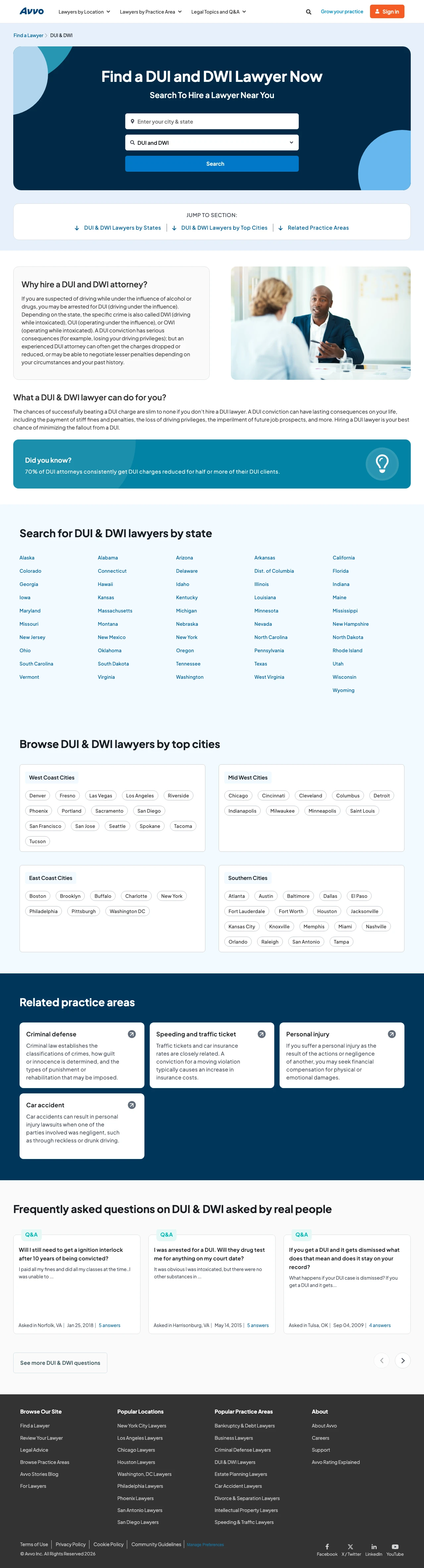
DUI keyword CPCs run $50-$200. Sending a paid click to a directory that resells the visitor to another firm wastes 100% of the spend for the firm buying the ad.
- wrong promise
Hero is 'Find a DUI and DWI Lawyer Now / Search To Hire a Lawyer Near You' with a ZIP search box. No named firm, no phone number, no CTA that leads to anything except another Avvo directory search.
- wrong promise
Body is a state-by-state list of links (Alaska, Alabama, Arizona, Arkansas...) followed by a top-cities list. This is SEO footer content served as page body. A visitor arriving from a paid ad gets no LP experience at all.
- wrong promise
The 'Did you know? 70% of DUI attorneys consistently get DUI charges reduced for half or more of their DUI clients' stat has no source, no firm attached, and no date. Reads as directory-generated filler to keep the page crawlable.
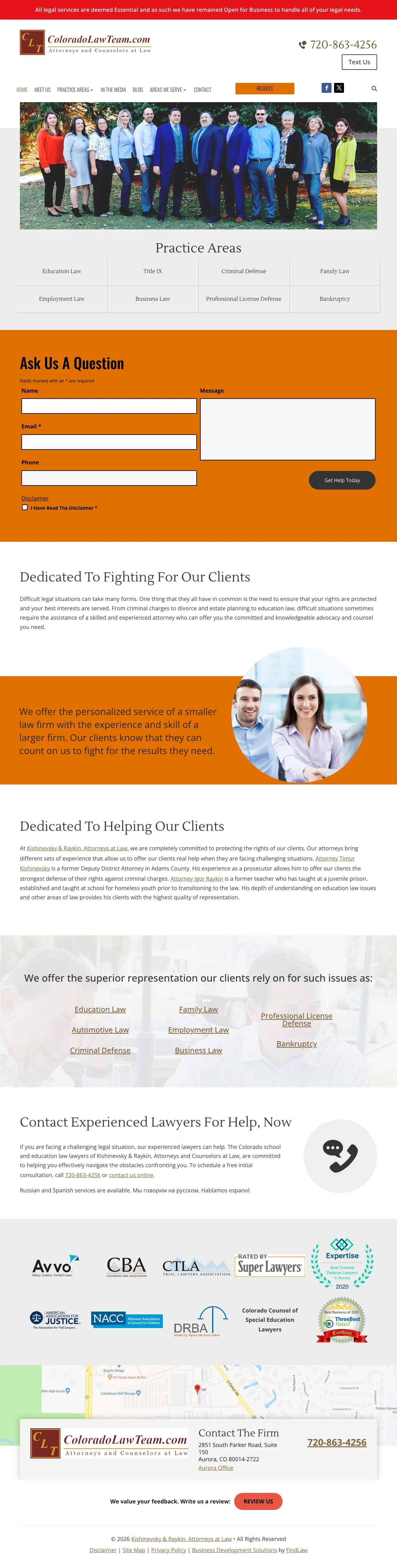
Criminal defense keyword CPCs in Denver run $40-$120. Landing crisis visitors on a seven-practice home page dilutes message-match and forces the visitor to scan for relevance before calling. Bounce rate on a diluted LP in this vertical is commonly 60%+.
- wrong promise
Hero is a wide-angle team photo of 10+ attorneys in matching navy suits. For a criminal defense search intent, this reads as a generalist practice with many partners, not a specialist team. Crisis visitors want one named attorney, not a firm composite.
- no proof
Practice Areas tile grid shows seven parallel specialties (Education Law, Criminal Defense, Family Law, Employment Law, Business Law, Professional License Defense, Bankruptcy). Every category signals 'we will take your case whatever it is', which is the opposite of what a panicked DUI searcher trusts.
- too much at once
Body copy reads 'difficult situations sometimes require the assistance of a skilled and experienced attorney who can offer you the committed and knowledgeable advocacy'. This is generic marketing prose that could belong to any firm. No case results, no attorney names, no charge-type specificity.
What we learned
Sidebar form that rides the scroll
Four of seven winners lock a contact form to the right rail and let it travel as the visitor reads. Shouse Law, The Defenders, Federal Criminal Law Center, and Eisner Gorin all do this. The visitor never loses the conversion point even when they scroll through the 'what will happen to me' content. Firms that drop the form in a footer get bounced traffic at $80 a click.
Answer the arrest-hour questions as section headings
Winners structure the body around 'Will I lose my license?', 'What is the criminal sentence?', 'Where is the jail?', 'Where is the courthouse?'. These are the searches happening the morning after an arrest. Matching the panic language instead of the brand language converts higher than any credential block ever will. Losers publish essays with no headings and assume the reader will hunt.
Named attorneys with a story beat a gavel stock photo
The San Bernardino wildcard uses a video thumbnail of attorney Michael Scafiddi labelled 'Former Cop, DUI expert advice' and dedicates FAQ section #7 to 'Who is attorney Michael Scafiddi?'. Robinson & Henry exposes a four-attorney grid with real case-result cards underneath. Summit Defense names former prosecutors and law enforcement officers in the hero sub-head. The losers all reach for a courthouse column or a gavel. In a vertical where trust is everything, showing a named human face with a verifiable credit outperforms any template.
Winners committed to a single conversion pattern (sticky sidebar form, FAQ body tuned to arrest-hour questions, named attorney above the fold). Losers hedged by publishing a long-form article, a directory search box, or a multi-practice-area home page, and hoped the visitor would find the phone number themselves.
If you're building a page like these yourself, here's my comparison of AI landing page builders, with prices and what each one is best for.
What the criminal defense winners taught us
The winners here answer the question the visitor arrived with, in the first screen, and then make it easy to reach a human. Where these pages fail, it is nearly always the same failure: nowhere to type, and nothing a stranger could go and check.
- 1
Print the phone number in the first screen, big. The click you paid for often comes from somebody who has just been arrested, or from their mother, and neither is going to fill in a form. Some of the pages here hide the number, and one sets it in a red utility bar beside the fax number. That is a call you already paid for and did not take.
- 2
Make your headings the questions people type at the worst moment. Do I lose my license, what is the sentence, where is the jail, where is the court. Those are searches, and the best page in this file simply turns each one into a numbered heading and answers it, down to the address of the school and the jail. Your own page probably opens by telling them when the firm was founded.
- 3
Move one credential out of the footer. A bar admission, a board certification, a rating body somebody can look up: some of these firms park theirs at the bottom next to the copyright, and some print none at all. The decision happens at the top. A padlock or a card logo is not a credential, it only says the connection is encrypted.
- 4
Give the people who cannot talk a box to type in. Somebody still in custody, somebody with family in the room, somebody at work: they can read your page and they cannot ring you. Some of the pages here scroll the whole way down before they offer a form, and Robinson & Henry offers none at all. A name, a number and one line about what happened is enough.
- 5
Put a real result where the money decision happens. Nobody may promise an outcome, and everybody writes aggressive representation instead. A charge like theirs, the date, the outcome and the lawyer who did it says more than any adjective, and it is checkable. Ask each of your lawyers to write up one case this week and stamp it with their name.
Score your own criminal defense page
Every line below came off a screenshot somebody sat and read. Open your own page next to it and tick what it already does.
Now run this on your own page
Four of the seven winners lock the contact form to the right rail and let it travel as the visitor reads - Shouse Law, The Defenders, Federal Criminal Law Center and Eisner Gorin all do it. You've just read 50 pages that aren't yours. Give postclick the URL your DUI ads point at. It reads your page the way the guy at 2am with a court date reads it, names what's costing you the call, and draws new versions you can look at. The first audit and two concepts are free.