
Get FREE Book - THE AI Playbook For PPC Pros

We analyzed 50 ecommerce platform landing pages. Only 6 are worth stealing from.

Curated from real Google Ads campaigns
Winner screenshotWinner screenshotWinner screenshotWinner screenshotWinner screenshot
Stewart Dunlop
Stewart Dunlop / PPC.io

These are real ecommerce saas platforms pages spending actual money on Google Ads right now.

1

🛒 50 landing pages screened

From real ecommerce saas platforms Google Ads campaigns in the US

2

🏆 6 winners curated

The landing pages actually worth stealing from

3

🔥 2 burning money

So you know exactly what to avoid

Sponsoredbuildyourstore.ai
Create Your Free Online Store | Create Your Store for Free
Trusted by 1M+ users. AI-driven Shopify stores, ready in minutes. Get started for free.
buildyourstore.ai
buildyourstore.ai
Scroll to explore the full landing page
The Magic Moment

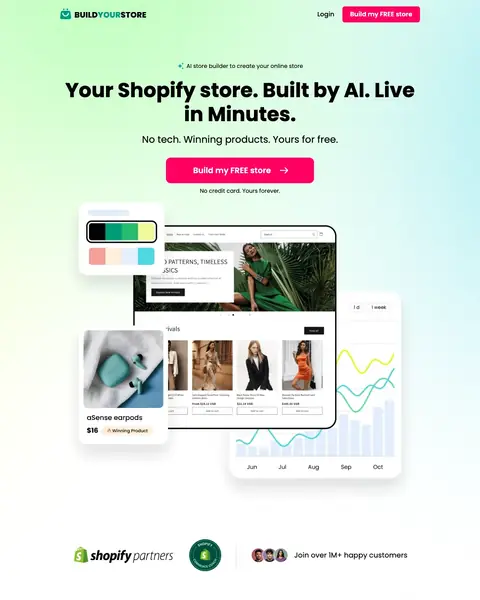
Add a scarcity counter that is specific enough to feel real. 'Only 9 stores left! Get it now' sits pinned at the top of the buildyourstore.ai page. That number is small enough to seem like a literal inventory (not '10,000 spots left this month') and creates urgency on a product the visitor was going to bookmark and forget. For a free-trial funnel where no one actually pays today, borrowed-urgency tactics like this are the main way to convert Red-persona visitors who came from a 'create shop' keyword.

What to Steal 3 tactics
  • +
    authority

    'Your Shopify store. Built by AI. Live in Minutes.' works because it compresses three barriers (platform choice, build time, technical skill) into one promise. The visitor does not have to decide between Shopify and Squarespace -- this tool delivers Shopify directly, which piggybacks on Shopify's brand equity without paying for it.

  • +
    objection handling

    'No tech. Winning products. Yours for free.' is the real pitch -- the phrase 'winning products' acknowledges the unspoken fear of every dropshipping visitor (I do not know what to sell) and promises AI product selection, not just store build. Competitors sell the store; this page sells the decision.

  • +
    social proof

    Three-store template preview (different screen sizes, different niches) shows the output variety without making the visitor click through a gallery. The preview is integrated into the hero, so the visitor sees 'real' generated stores before any feature copy.

What's Broken 3 issues
  • trust gap

    'Join over 1M+ happy customers' appears with three tiny face avatars but no named customer, no brand logo, no success story above the fold. For a new-ish brand competing with Shopify, anonymous volume claims raise the question the trust signals should be answering.

  • message mismatch

    The dropshipping course pitch ('Get the ultimate dropshipping course for free') buried mid-page shifts the product from 'AI store builder' to 'course funnel,' which will confuse any visitor who came from a store-builder ad and now has to figure out whether this is a product or an info-product.

  • trust gap

    Legal and compliance signals are absent: no PCI mention, no mention of what happens to the store if the visitor stops using the product, no clarity on whether the 'free forever' domain is really free forever or a promotional hook. For a platform that asks the visitor to bet their ecommerce business on it, the lack of terms is a trust gap.

Ad Intelligence
3 keywords
640 searches / mo
2 ad variants found
create shopstore builder
Sponsoredsquarespace.com
Create Your Restaurant Website | Squarespace Website Builder
Grow your business with a beautifully designed restaurant website and powerful Squarespace tools.
squarespace.com
squarespace.com
Scroll to explore the full landing page
The Magic Moment

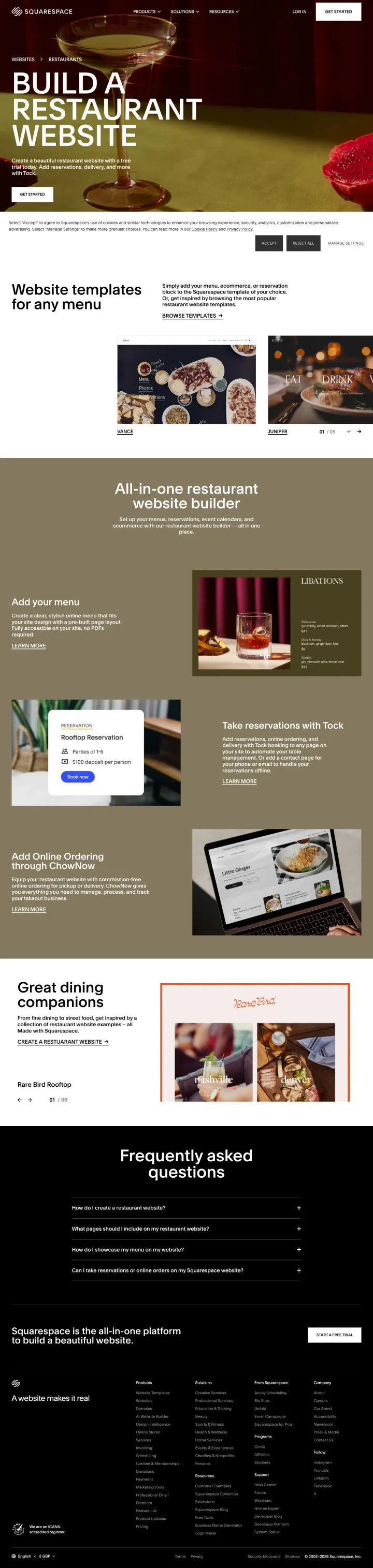
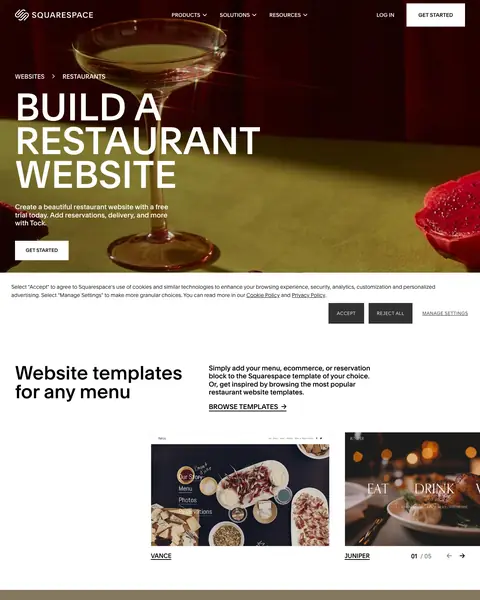
When a PPC keyword is vertical ('website builder for restaurants'), build a vertical page, not a filtered view of the general platform. Squarespace's restaurant page leads with a dressed-table photo and the headline 'Build a Restaurant Website.' Every section addresses a restaurant-specific concern: menu blocks, reservations (via Tock), online ordering (via ChowNow), named restaurant templates (Vance, Juniper, Auburn, Chotto, Atlantic, Rare Bird Rooftop). A generic 'website builder' page forces the restaurant owner to mentally translate every feature into their use case. This page skips the translation.

What to Steal 3 tactics
  • +
    social proof

    Naming real templates in the copy (Vance, Juniper, Auburn) rather than saying 'over 100 templates' creates specific aspiration and gives the visitor concrete search targets. The visitor who clicks 'Vance' has a commitment artifact the generic gallery does not produce.

  • +
    visual hierarchy

    Tock integration in the hero subhead ('Add reservations, delivery, and more with Tock') acknowledges that restaurant operators already know Tock and want to hear a trusted name -- integration quality matters more than feature count for operational software.

  • +
    objection handling

    The 'Great dining companions' photo section shows a working hostess with a POS and a ChowNow ordering screen, which answers the hidden objection 'will my staff actually use this' before the feature list does.

What's Broken 3 issues
  • friction

    The hero CTA ('Get Started') links directly to the template browse page rather than a trial signup, which means the visitor has to do a template-selection step before providing email. That extra step leaks the Red-persona visitors who wanted one click to trial.

  • missing proof

    No pricing, no transaction-fee mention, and no note that restaurant integrations (Tock, ChowNow) may have their own subscription costs. Restaurant owners run on tight margins and will assume hidden costs the page does not disclaim.

  • message mismatch

    The 'Frequently asked questions' section asks 'How do I create a restaurant website?' and 'What pages should I include on my restaurant website?' -- these are top-of-funnel questions, not bottom-of-funnel decision questions the paid-click visitor is now ready to answer.

Ad Intelligence
1 keywords
880 searches / mo
1 ad variants found
website builder for restaurants
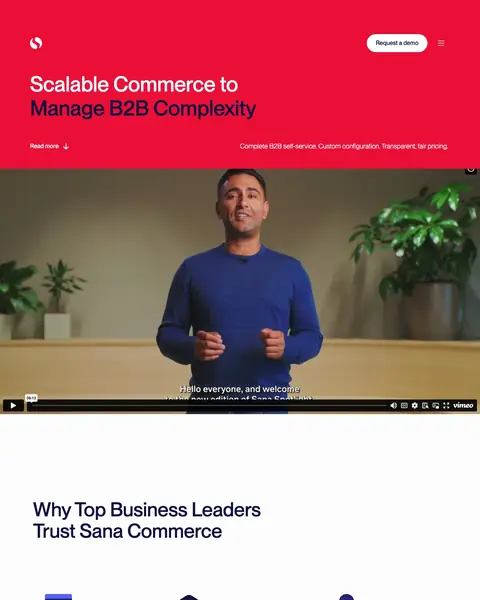
Sponsoredsana-commerce.com
Integrated eCommerce platform - Trusted By 1500+ Customers
See why Sana Commerce is the leading solution for B2B ecommerce. Book a demo now.
sana-commerce.com
sana-commerce.com
Scroll to explore the full landing page
The Magic Moment

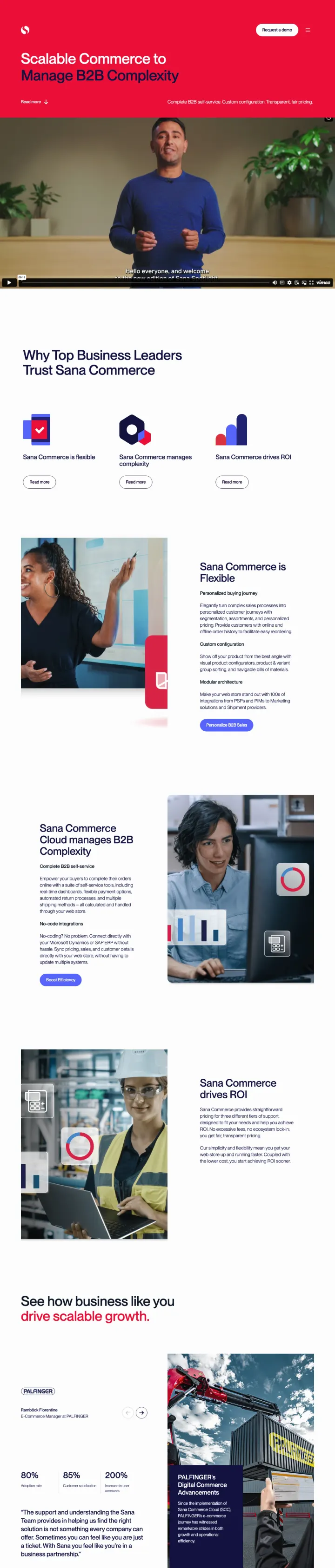
Put a named human on camera in the hero. Sana Commerce's page opens with a man in a blue sweater speaking to camera against a bright red background, above the 'Scalable Commerce to Manage B2B Complexity' headline. For a B2B category where the visitor is weighing a multi-year platform commitment, a face and a voice in the hero shortcuts the 'who are these people' question that logo walls and static photography leave open. The red background forces the page to stand out from the blue-white palette that every competitor uses.

What to Steal 3 tactics
  • +
    objection handling

    'Complete B2B self-service. Custom configuration. Transparent, fair pricing.' as the hero subhead compresses three specific B2B buyer fears (dependency on sales reps, rigid feature sets, opaque enterprise pricing) into a three-phrase promise. Each phrase is a direct shot at Magento Commerce and Adobe Commerce, Sana's real competitors.

  • +
    social proof

    Three percentage stat bars (80%, 83%, 81%) for customer outcomes -- visible as a graphic block rather than buried in a testimonial -- let the Blue-persona visitor lock onto specific numbers without reading a full case study. Numerical density above the fold works for an audience that will do spreadsheet comparisons anyway.

  • +
    objection handling

    The 'Why Top Business Leaders Trust Sana Commerce' section below the hero uses trust-badge iconography (Sana Commerce is flexible, Sana Commerce Cloud manages B2B complexity, Sana Commerce drives ROI) -- phrasing that maps directly to the three C-suite objections for B2B platform purchases.

What's Broken 3 issues
  • trust gap

    The hero video is uncaptioned and autoplays muted, which means the spokesperson's actual words do not land for visitors who never enable sound. The video is a trust signal that leaks its main asset.

  • trust gap

    'Transparent, fair pricing' in the subhead is undermined by the page never showing a price, a starting point, or even a pricing tier. For a B2B audience that values transparency, claiming it without showing it is a credibility risk.

  • trust gap

    The 'Request your product demo' CTA routes to a form that asks for company details but does not preview the demo length, format, or who will run it. For enterprise buyers who need to justify the calendar hold, the form friction is higher than the page earns.

Ad Intelligence
2 keywords
2.9K searches / mo
2 ad variants found
india ecommerce platformskorea b2b
Sponsoredbigcommerce.com-b2b
B2B Online Made Simple
B2B Ecommerce Modernized. Sell, Track, Invoice and More, All From Your BigCommerce Dashboard. Book a Demo Today.
bigcommerce.com-b2b
bigcommerce.com-b2b
Scroll to explore the full landing page
The Magic Moment

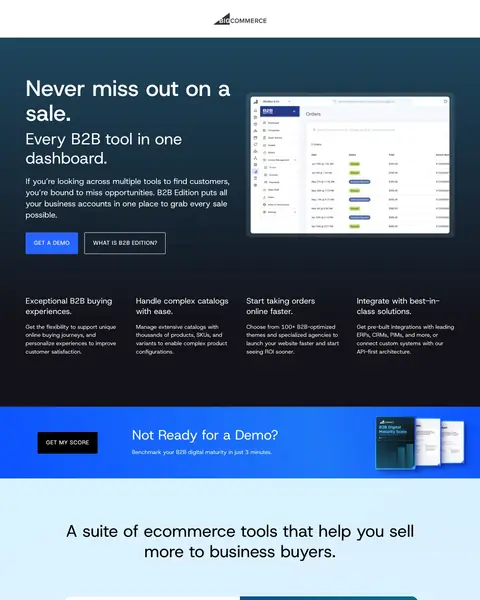
Show the backend, not the storefront, when your audience is operators. BigCommerce's B2B Edition page leads with a clean order-management dashboard screenshot ('Every B2B tool in one dashboard') instead of the rendered storefront every consumer ecommerce platform shows. That choice filters the visitor instantly: a D2C brand-builder bounces, a B2B wholesale operations manager leans in. Deliberate audience filtering in the hero is worth more than a broader appeal.

What to Steal 3 tactics
  • +
    visual hierarchy

    The hero headline 'Never miss out on a sale' pairs with a subhead naming the operator pain explicitly: 'If you're looking across multiple tools to find customers, you're bound to miss opportunities.' The page names the tool fragmentation problem before pitching the consolidation, which is how B2B operators actually think.

  • +
    social proof

    Feature sections organized around buyer workflows (Handle complex catalogs, Start taking orders online faster, Integrate with best-in-class solutions) rather than feature names (Buyer portal, Customer groups, Multi-storefront). The structure mirrors how the operator reviews platforms, not how engineers categorize capabilities.

  • +
    social proof

    Named merchant outcomes placed above the secondary 'Ready for a Demo?' CTA: 'The Beer Bat +115% revenue, Yeti Cycles +49% page views.' These are specific B2B brands with specific percentage wins, which is the evidence a procurement committee will cite in its internal approval memo.

What's Broken 3 issues
  • friction

    Demo form lives at page bottom with no indication of demo length, who runs it (SE, AE, or product specialist), or what the outcome is (custom quote, sandbox, pilot). B2B buyers trying to schedule around other priorities need this information to commit.

  • friction

    No pricing signal at all -- not 'starting from,' not 'custom pricing,' not 'contact for tiers.' Every visitor has to fill the demo form just to discover if BigCommerce B2B is even in their budget, which wastes time for small-mid buyers and burns sales capacity on unqualified leads.

  • friction

    The 'More freedom. More sales. Less complexity. That's BigCommerce.' closer is a brand slogan that does not tie back to the B2B-specific promise. After a page that was tightly B2B-focused, the generic close feels like it was copy-pasted from the consumer landing page.

Ad Intelligence
7 keywords
1.9K searches / mo
2 ad variants found
suppliers in usabigcommerce b2b
Sponsoredtopdawg.com
U.S. Dropshipping Suppliers
Trusted US Suppliers. Work With American Partners. Sync Orders, Automate, and Scale.
topdawg.com
topdawg.com
Scroll to explore the full landing page
The Magic Moment

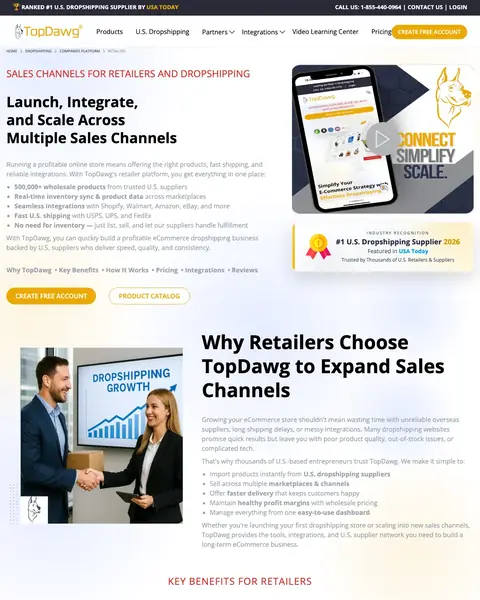
Replace the hero paragraph with a five-bullet operator brief. TopDawg's hero reads as a specific product-shipping-integration checklist: '500,000+ wholesale products from trusted U.S. suppliers; Real-time inventory sync; Seamless integrations with Shopify, Walmart, Amazon, eBay; Fast U.S. shipping; No inventory needed.' The dropshipping buyer is evaluating four to five platforms against this exact checklist -- giving them the answers in the hero means they never have to scroll to another tab.

What to Steal 3 tactics
  • +
    authority

    Named integration partners (Shopify, Walmart, Amazon, eBay) in the hero give the visitor permission to evaluate TopDawg as the dropshipping layer rather than a platform replacement. For a Shopify store owner, 'this plugs into my Shopify' is worth more than 'we have 500,000 products.'

  • +
    objection handling

    The 'U.S. Dropshipping' positioning is explicit in the URL, the hero headline, and the bullet list -- and directly addresses the 2024-onward tariff anxiety and shipping-time penalty that AliExpress dropshipping has taught every serious seller. National origin is a conversion-critical attribute that most dropshipping pages treat as a footnote.

  • +
    social proof

    '#1 U.S. Dropshipping Supplier 2026 -- Featured in USA Today' as a gold-badge trust signal positions TopDawg as publisher-validated, which is the kind of external endorsement that dropshipping platforms almost never carry (the category is flooded with unverified rankings).

What's Broken 3 issues
  • message mismatch

    The consent overlay on first load occupies roughly 25% of the hero and hides the right-side product mockup until dismissed, so the first visual impression is truncated for every new visitor.

  • focus

    Two competing hero CTAs ('Create Free Account' in orange, 'Product Catalog' outlined) split attention. The 'Product Catalog' path is a hard exit from the conversion funnel -- once the visitor is browsing products, they are comparison-shopping, not signing up.

  • cognitive load

    'Why Retailers Choose TopDawg to Build & Grow Your Dropshipping Business' section below the fold runs as dense paragraph text without scannable section dividers, which for a Blue-dominant dropshipping audience (who will skim-compare four vendors) reads as hard to evaluate.

Ad Intelligence
1 keywords
40 searches / mo
1 ad variants found
dropshipping usa supplier
💡 What Winners Have in Common

Patterns Every Winner Shares

🛡️ Trust signals above the fold 6/6 winners
💬 Headlines that match search intent 5/6 winners
📸 Strong visual storytelling 5/6 winners
💰 Transparent pricing and value 4/6 winners
🎯 Clear, high-contrast CTAs 3/6 winners

Pages that break the playbook in interesting ways

🃏
Why wildcards matter. Not every good landing page follows the textbook. These pages go against the grain with an unconventional approach, unusual structure, or a creative angle that challenges assumptions about what works. They might not score highest on our framework, but they offer something worth studying.
Sponsoredshopify.com-plus
Sell Internationally | Sell Across Borders | Worldwide Selling On Shopify
With local currencies, payment methods, and more. Start selling in 150+ countries.
shopify.com-plus
shopify.com-plus
Scroll to explore the full landing page
Why This Breaks the Rules

Try a dark enterprise hero with a single luxury-good prop instead of the rendered-storefront pattern. Shopify Plus shows a red leather handbag floating over a dashboard showing 'International Sales $6,980,345' with currency-specific callouts (£ Sales +8%, € Sales +20%, $ Sales +34%). The prop signals premium tier, the number signals global scale, and the color-coded currencies signal 'this is what actually changes when you sell across borders.' For enterprise visitors who already run a store, this page pivots from 'start from scratch' to 'expand from here.'

What Makes It Work3 tactics
  • +
    social proof

    The currency-specific mini-dashboard overlays in the hero (£ +8%, € +20%, $ +34%) show the product output visually without asking the visitor to read a case study. A merchant running one currency sees immediately what three currencies would look like on their own dashboard.

  • +
    authority

    Brand logo strip features D2C-to-wholesale brands (Lazarus, GLAMLITE, WOLFpak, Caden Lane, SuitShop, Impact) rather than the standard consumer DTC lineup. The logos signal 'these are the brands who scaled internationally using this stack,' not 'these are brands you recognize from Instagram.'

  • +
    objection handling

    'Managed Markets -- a turnkey operations solution -- is like adding a new department to your team' is a below-fold pitch that reframes international infrastructure as a hire rather than a feature. For enterprise buyers budgeting operations, the hire framing is how the spend already gets justified internally.

What It Gets Wrong3 issues
  • friction

    The hero headline 'Sell internationally, effortlessly' is generic enough that it could appear on any platform's cross-border page. The distinctive asset is the currency overlay, not the words -- which means the visitor who skims the headline misses the product's actual differentiator.

  • message mismatch

    No price visible and no 'starting from' tier -- Shopify Plus is known to start in the thousands of dollars per month, and the page assumes the visitor already knows that. A first-time Plus-evaluator visitor who clicked from a 'sell in Canada' ad will not.

  • message mismatch

    The hero uses a 'Try Shopify' (not 'Try Shopify Plus') secondary CTA, which downgrades the visitor back to the self-serve product. For a page that is selling an enterprise tier, the escape hatch to the consumer product undercuts the commit.

Ad Intelligence
2 keywords
3K searches / mo
2 ad variants found
india ecommerce platformssell in canada
Sponsoredbigcommerce.com-essentials
Get a Quote - Open Your Ecommerce Store Fast
Grow revenue and reach new customers with small business ecommerce tools that scale.
bigcommerce.com-essentials
Scroll to explore the full landing page
Why This Breaks the Rules

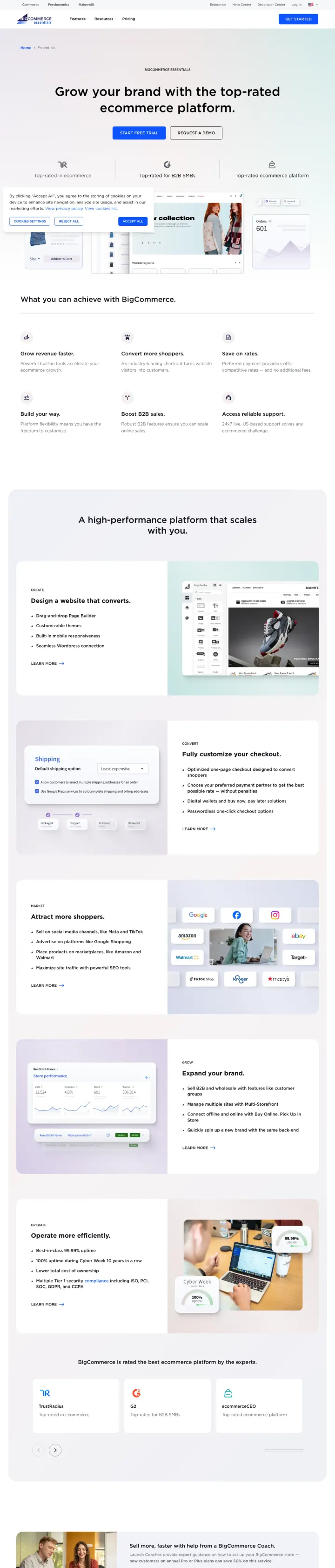
Put three independent proof badges directly under the hero headline. BigCommerce's Essentials page runs 'Top-rated in ecommerce, Top-rated for B2B SMBs, Top-rated ecommerce platform' as three side-by-side icon trust blocks, right under the headline and above the CTAs. This pre-answers the 'is this platform respected' question for the analytical visitor before they even read a feature. The copy is hedged ('top-rated' rather than '#1'), which reads as a careful third-party claim rather than self-hype.

What Makes It Work3 tactics
  • +
    friction reduction

    'Grow your brand with the top-rated ecommerce platform' as hero headline with a migration-oriented 'Request a Demo' secondary CTA pairs aspiration (grow your brand) with a safety-netted path (talk to a human before committing). The dual framing serves both the eager Red visitor and the cautious Blue analyst.

  • +
    authority

    Three trust blocks visible above the fold take the space most pages waste on logo walls. Logos are a volume signal; labeled category wins ('top-rated in ecommerce') are a quality signal, and for a platform choice the quality signal matters more.

  • +
    social proof

    The collection-gallery mid-page shows a pink-tone fashion store mockup with actual product cards, which extends the 'show the finished store' pattern. For a mid-market buyer who needs to believe their store can look this good without a $15,000 theme budget, the mockup carries more weight than a template gallery.

What It Gets Wrong3 issues
  • message mismatch

    The hero CTA stack is 'Start Free Trial' (solid) plus 'Request a Demo' (outlined) with no clear hierarchy on which the visitor should choose. Without pricing context or trial terms visible, the Blue analyst defaults to the demo path (conservative) while the Red just-launch visitor stalls.

  • trust gap

    The 'high-performance platform that scales with you' subsection below the fold uses abstract performance language without a concrete number (no uptime %, no site speed stat, no Black Friday proof). This is BigCommerce's strongest technical argument on the Woo comparison page; on Essentials, it goes silent.

  • trust gap

    A large video block sits mid-page under a 'Unleash next-level growth' banner but autoplays muted and with no caption -- the visitor who never enables sound loses the testimonial argument the video is carrying.

Ad Intelligence
1 keywords
50 searches / mo
1 ad variants found
create my own online store
🤦

2 pages burning ad spend with fundamental issues

⚠️ www.your-ecommerce-saas-platforms-landing-page.com
Learn More
Contact Us
Weak CTA
No Trust Signals
Wall of Text
Generic Headline

Every click to these pages costs real money. We found broken trust signals, mismatched intent, weak CTAs, and messaging that ignores what the searcher actually typed. Here is what to avoid.

Sponsored
Squarespace Website Builder - Squarespace Pricing Plans
Squarespace is the all-in-one platform to build a beautiful online presence. Modern Templates.
squarespace.com-pricing
Scroll to explore the full landing page
Why this wastes ad spend

A pricing-only page is the wrong landing page for top-of-funnel PPC traffic. Visitors who clicked a 'Beautiful Website Templates' ad expect to evaluate Squarespace against alternatives and see what their site could look like. A four-column fee table asks them to convert before they have decided, which leaks the £10-£30 click to the competitor page they will open in the next tab.

What's Broken 3 issues
  • relevance

    The 'Beautiful Website Templates' ad promises templates; the page shows none. A visitor expecting to browse template thumbnails lands on tiered feature lists and has to navigate away to find what they came for, which at £10-£30 CPCs is an expensive detour.

  • message mismatch

    Full site navigation (Products, Solutions, Resources, Log In) visible in the header gives the visitor six exit paths before they have seen a price. Every nav link is a leak in the conversion funnel for a paid click.

  • message mismatch

    Four pricing columns with similar feature lists differentiated mostly by payment-processing fee percentages force the visitor to do mental math (what is my volume? what % difference matters?) before they can pick a plan. The page never recommends a plan or explains which fits which use case.

Sponsored
Start selling tomorrow | Start Your Business
Get Up And Running Fast With Easy To Use Tools To Build Your Brand.
shopify.com-start
shopify.com-start
Scroll to explore the full landing page
Why this wastes ad spend

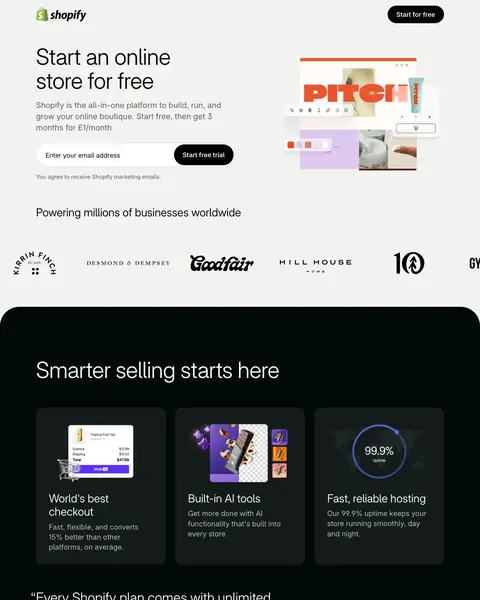
The visitor arriving from a 'launch your store' paid search is ready to sign up -- but the page strips out the email field, hides the CTA in the nav, and leads with a brand film. Every second the visitor spends decoding the video is a second they are not converting, and at Shopify's CPCs the brand-film approach costs real money against its own /ppc/online-store sibling page.

What's Broken 3 issues
  • friction

    The hero signup field that works on Shopify's other PPC pages is missing here -- only the 'Start for free' nav button remains, which visually reads as navigation rather than a conversion action. The paid click has no obvious next step.

  • message mismatch

    The video autoplays muted and the visible frames show an abstract orange-object-on-dark hero with no product context. A visitor who never unmutes cannot tell what Shopify is or what the video is arguing.

  • trust gap

    The mid-page 'Choose your design' section runs as black-on-black template previews that are hard to distinguish, and the 'Get ready to get paid' trust section below is almost invisible against the dark theme. The visual contrast drops precisely where the conversion argument needs to land.

🧠 Analysis

What We Learned

💡

Show the rendered store, not the admin dashboard

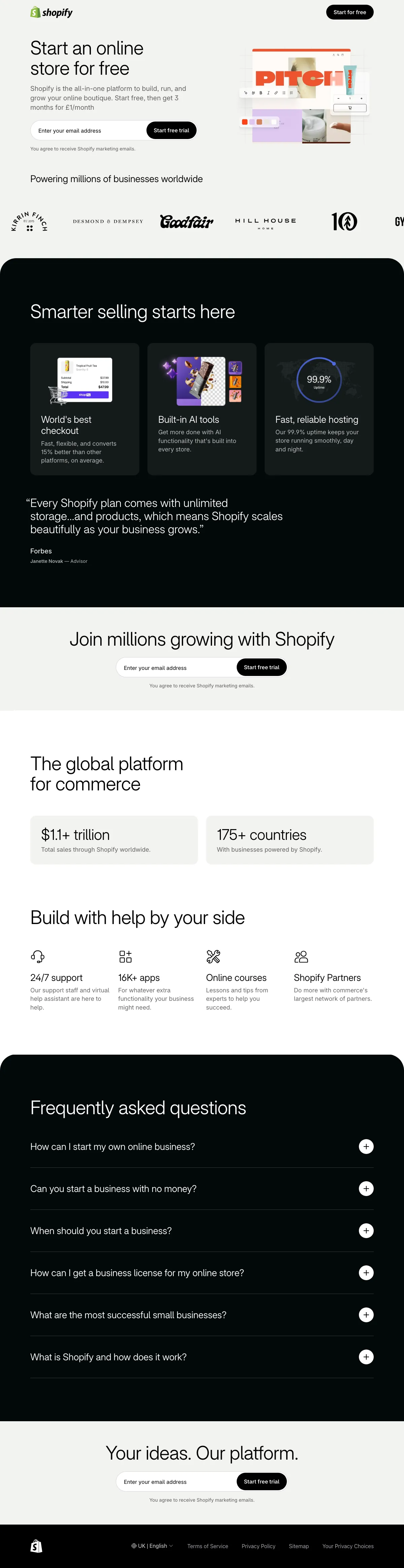
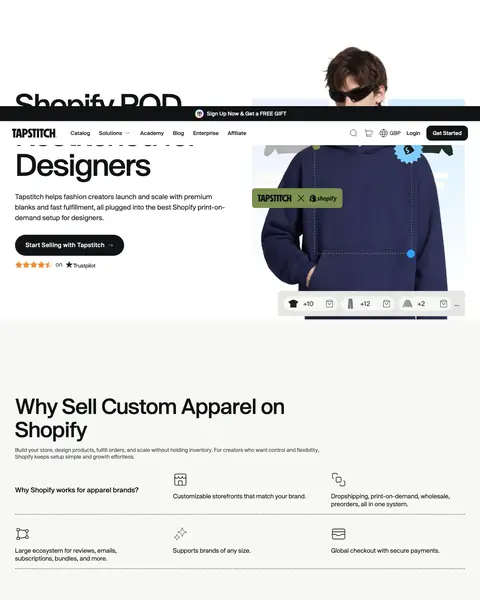
Shopify leads its PPC page with a finished juice-brand storefront (Zest). Buildyourstore.ai shows three template-ready stores at different breakpoints. Squarespace's restaurant page shows a dressed table shot with named templates (Vance, Juniper, Auburn). BigCommerce's B2B page breaks this rule b...

shopify.combuildyourstore.aisquarespace.com
🎯

The pricing grid is a trap when it is the whole landing page

Squarespace runs its /pricing URL as a paid landing page: four cards (Basic £12, Core £17, Plus £29, Advanced £79) with no store examples, no templates, and no reason to pick Squarespace over Shopify. A pricing page is the last step of a buying journey, not the first touch, because the visitor wh...

squarespace.comshopify.com
🛡️

Uptime numbers and merchant results do more work than aspirational claims

BigCommerce's comparison page says '99.99% uptime' with a badge. Shopify shows '$11+ trillion' in merchant sales and '175+ countries.' Sana Commerce shows '80%, 83%, 81%' percentage bars for a customer success stat trio. These are specific numbers the visitor can google. 'Commerce without limits'...

bigcommerce.com-b2bshopify.comsana-commerce.com
📊

Niche landing pages beat generic platform pages when the ad keyword is vertical

Squarespace's restaurant page promises reservations via Tock, menu blocks, and restaurant-specific templates. A visitor searching 'website builder for restaurants' lands on a page that looks like restaurants, not a page that assumes they will translate generic platform features into restaurant us...

squarespace.combigcommerce.com-b2b
Bottom line

Winners show a finished store, a specific number, or a named merchant above the fold. Losers send paid traffic to pricing grids, generic product listings, or feature lists that assume the visitor already decided..

The AI Playbook for PPC Pros
Now available
GET for FREE