

Garage door is one of those 'I need this fixed today' categories. Spring broke, door won't open, car is trapped. They're not reading your About page. Phone number, service area, 'we come today'. That's it. The pages that overcomplicate this are just losing calls.
From real garage door services Google Ads campaigns in the US
The landing pages actually worth stealing from
So you know exactly what to avoid

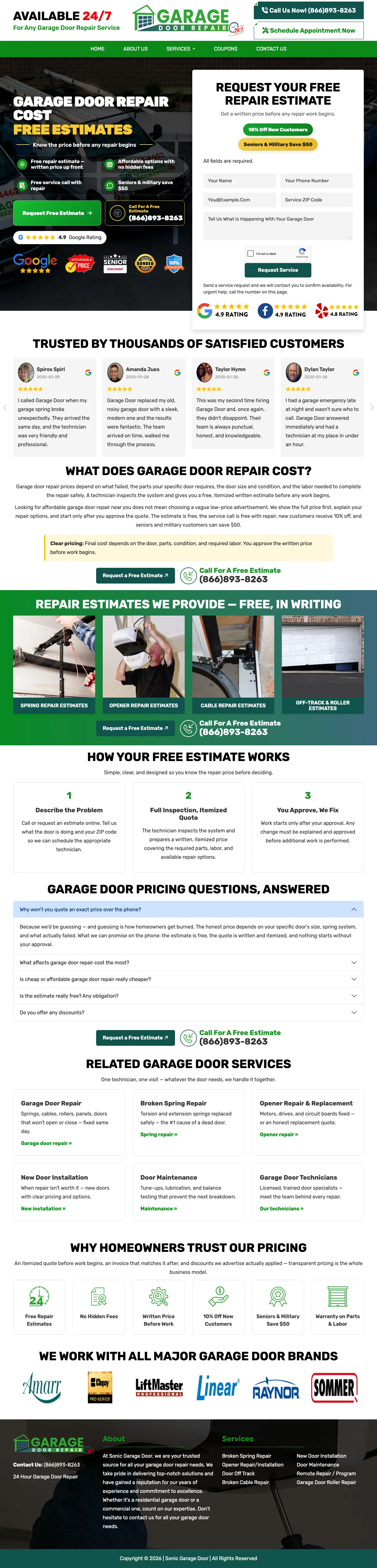
Publish your actual service prices as a plain HTML table on your landing page. Every competitor in garage door PPC hides pricing behind a form because they think it protects their margin. It doesn't, it just tells the visitor you're the bait-and-switch they're already afraid of. Sonic's table is the single most effective scam-fear-killer we saw in the entire sample.
'Garage Service Prices (All Inclusive)' table with 25 line items (spring replacement, cable repair, opener install, panel replacement) turns the most-feared question in the category into an above-the-fold content asset
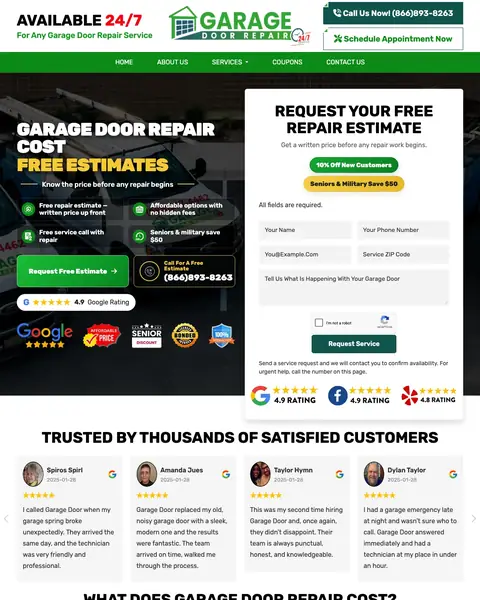
'Call Now' button with phone number (866-895-8263) rendered in 24pt green on white is impossible to miss, the phone number IS the page's H2
Header bar '$50 Off For New Customers' ties a specific dollar discount to new-visitor intent without making it the whole hero, the price table is the hero, the discount is the closer
The price table is a plain HTML grid without any visual hierarchy, the highest-margin services (spring replacement, opener install) could be highlighted to nudge the visitor toward the higher-AOV call
Testimonial cards at the top are labeled 'Quality Review' with generic text instead of actual Google Reviews pulled live. For a category this scam-sensitive, real-review widgets would out-trust fake-looking testimonial blocks
'Why Choose Garage Door & Estimate Services' section is generic reassurance (24/7, Licensed, Friendly) without any specific differentiator, the price table does the real selling and this section is filler

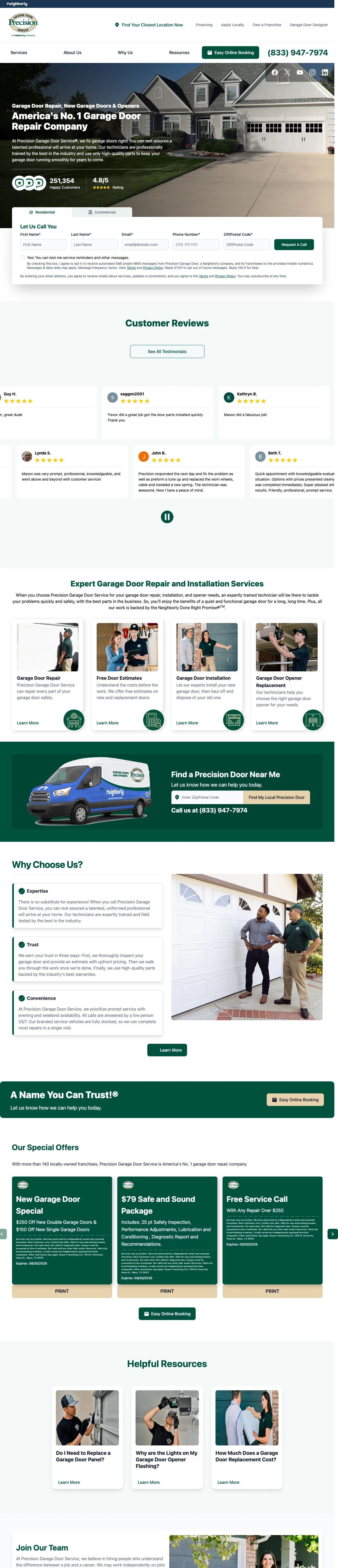
For emergency repair traffic, put a free-quote form and a phone number at the same visual weight in the hero, both large, both high-contrast, both above the fold. Different visitors convert on different rails. The form captures researchers who want a callback; the phone captures panic-mode callers with broken springs. Same keyword, two intents, one page.
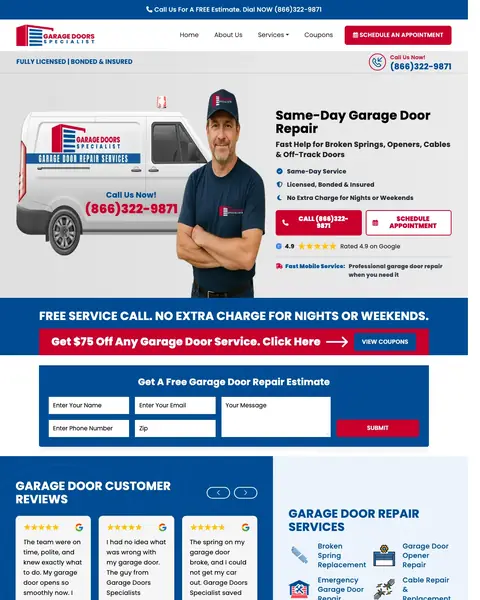
Hero form ('Request a Free Quote') and '$75 Off Any Garage Door Service' banner are visually equal-weight, the visitor chooses the mode without the page nudging either way
'Reliable Garage Door Repair Right When You Need It' headline explicitly owns the emergency frame rather than dancing around it. 'Right When You Need It' is the 'we'll be there now' promise that emergency traffic looks for
Trust-badge row (Google, BBB, Angi, HomeAdvisor) sits directly under the hero where the scam-fear objection is at its peak, badges right where the doubt would otherwise be
The big yellow/orange bar 'GET $75 OFF' competes with the page's primary red color, the offer pops but not in a way that reinforces the brand hierarchy
'What Our Satisfied Clients Are Saying' testimonial cards are blank on this capture (likely a template issue or deferred-load), which is the single worst failure mode for a scam-sensitive category
'Professional Garage Door Repair For Any Brand' footer belt with brand logos repeats the 'we work with major brands' claim but the logos are small and washed-out against the red background

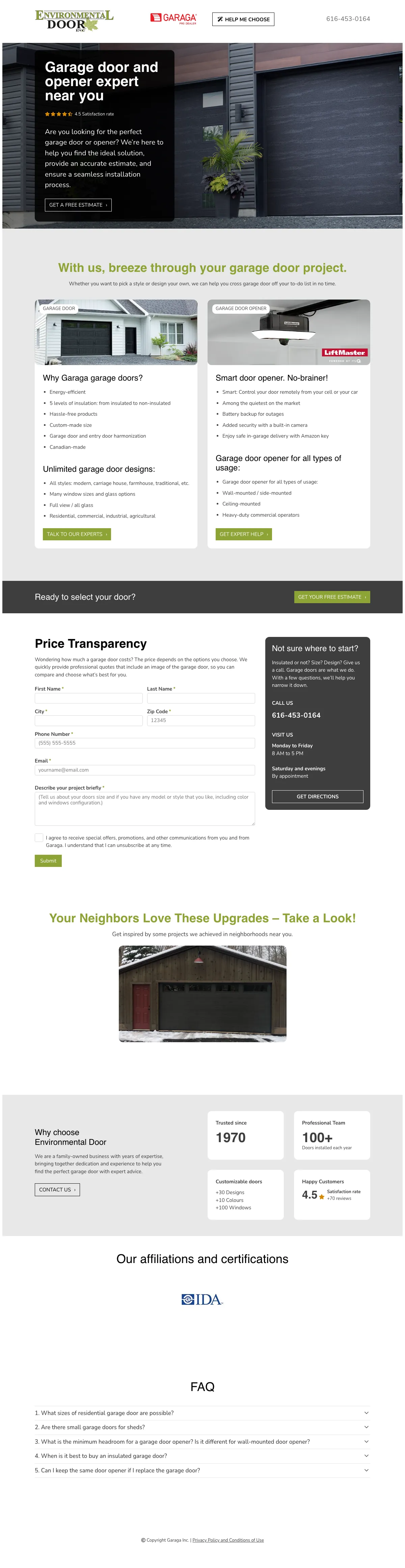
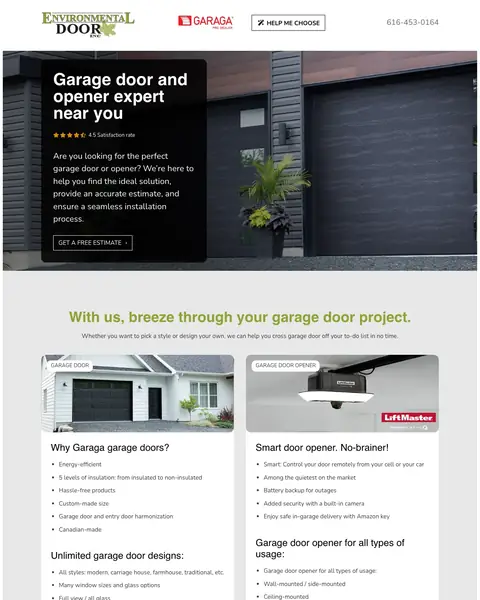
For replacement-intent searches (not emergency), lead with the door style decision, not the service pitch. Environmental Door's page is structured as a visual door catalog with 'Carriage House' and 'Contemporary' options followed by a price-transparency form. This is replacement-buyer psychology: they're shopping a product, not hiring a contractor.
Two large tile images (Carriage House / Contemporary) immediately under the hero let the visitor self-identify their style before the form asks for their info. Most repair pages force the form first
'Price Transparency' section with an inline quote form explicitly names the bait-and-switch fear and frames the form as the honest way to pricing
'Your Neighbors Love These Upgrades' social proof section uses a recent-installation photo with neighborhood context, local-specific in a way that generic testimonials aren't
The hero photo is a generic garage-door-fronted house that could be anywhere, local specificity is promised in the social-proof section but the hero doesn't deliver it
'BIDA' certification badge at the bottom is industry-insider and won't register with homeowners. A plain-English 'We're certified by [association]' translation would do more trust work
Phone number at the top is small and gray, for homeowners who'd rather call than form-fill, the phone CTA is underpowered for a replacement-AOV page
Pages that break the playbook in interesting ways

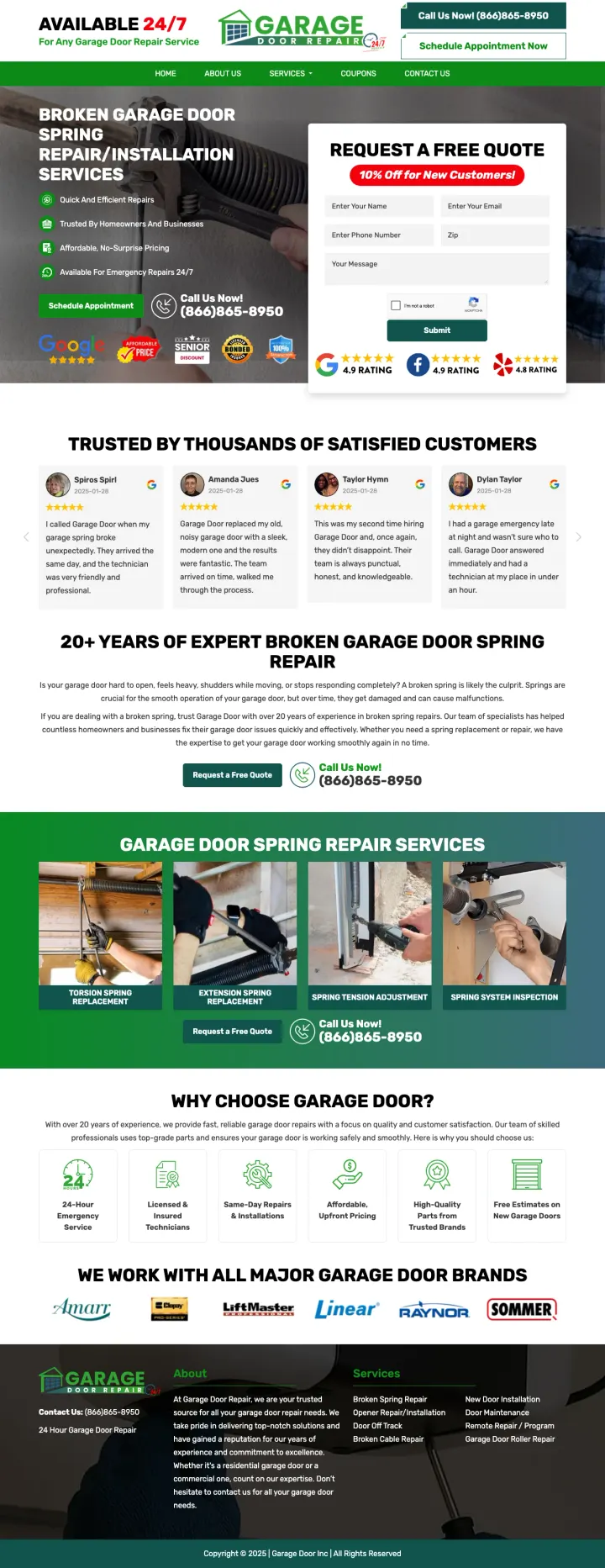
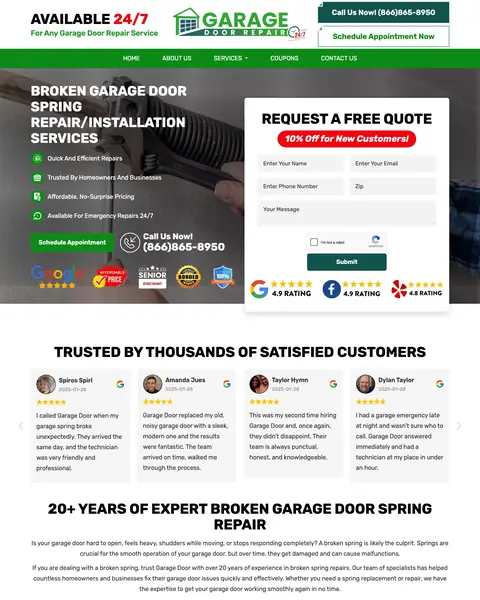
Build separate emergency-intent and considered-intent landing pages with different hero framing but the same trust foundation. Sonic's spring page leads with 'Broken Garage Door Spring Repair / Installation Services' for the panicking caller, while their estimates page leads with a price table for the planner. Two intents, two pages, one trust system.
'20+ Years Of Expert Broken Garage Door Spring Repair' subheadline pairs service specificity with authority, the visitor learns you do springs specifically, not just doors generally
Spring-repair image hero with a technician inspecting the spring assembly is functional (shows the actual part that broke) rather than decorative
'Get $50 Off For New Customers' header banner carries the same discount as the estimates page, keeping the offer consistent across intent variants
The 20-year expertise claim is prominent but no specific credentials back it up, years in business is table stakes in this industry, a license number or master-tech certification would do more
No price range for spring repair on this page. The estimates page HAS the price but the spring-specific page doesn't link or show it, a visitor bouncing between Sonic's pages has to hunt
Testimonial cards at the top are the same four names as the main price-estimates page, reused testimonials across service pages undercut the social-proof mechanic

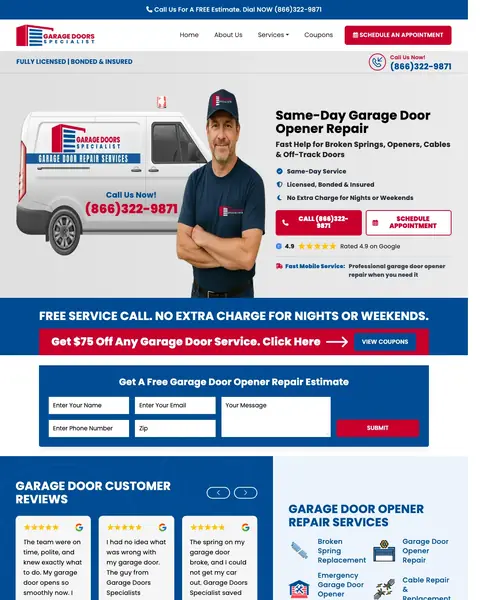
Build service-specific landing pages for your 3-5 highest-volume keyword groups (spring, opener, install, replacement). Specialist's opener page shows the template with real service-specific copy rather than location-swapped filler, and the conversion math is visibly better because the visitor's search intent is directly answered.
'Garage Door Opener Repair / Installation Services' hero headline matches the ad keyword one-for-one, no guesswork about whether the page serves the intent
Opener-specific photos in the services grid show different opener mount styles, which helps visitors self-diagnose which repair they need before the technician arrives
The opener-section content has actual depth (drives, rails, remotes, smartphone integration) rather than the generic 'we do garage door things' copy on the location variants
Testimonial cards are still blank on this variant, the template flaw that plagues the location pages also affects the service-specific pages
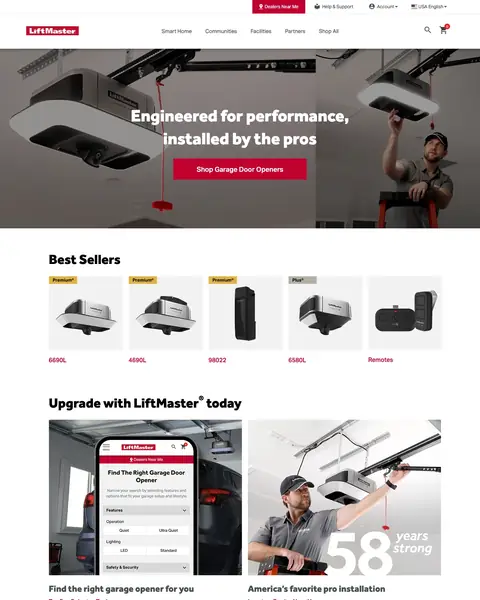
No opener-brand-specific trust signals (LiftMaster authorized dealer? Chamberlain certified?) even though the brand-logo belt at the footer includes these names. Missing middle-of-funnel credentialing
The '$75 Off Any Garage Door Service' banner is generic, an opener-specific offer ('$50 off new opener install') would hit harder on this intent-matched page

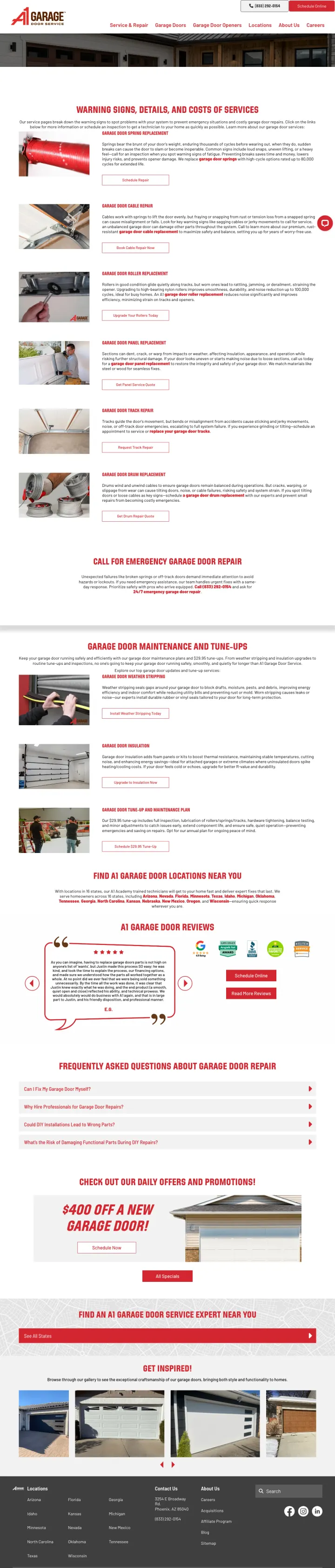
For 'garage door repair near me' traffic, A1 stacks 8 service modules (springs, cables, rollers, panels, tracks, drums, weather stripping, insulation) each with warning signs the homeowner can self-diagnose BEFORE calling. Most repair pages compress to a hero form and a phone number. A1 bets that the visitor who can name their problem converts harder than the visitor who can't, and sells diagnostic depth as the trust signal.
Each service module opens with symptoms ('loud snaps, uneven lifting, or a heavy feel' for springs) before naming the fix. Self-diagnosis content converts the confused homeowner who doesn't know whether a spring or a cable is the culprit
'Call For Emergency Garage Door Repair' band sits mid-page as a rescue CTA for visitors who hit information overload and just want the phone number
Specific cycle-life numbers ('high-cycle options rated up to 80,000 cycles', 'nylon rollers up to 100,000 cycles') replace the generic 'quality parts' claim with a quantified upgrade pitch
Hero above the fold is a small logo band, a thin headline, and a generic garage-door photo. The phone number is in the header but not large. Emergency callers who want a number in 3 seconds get buried under an educational essay
Every service module ends with three different CTA variants (Call Now, Schedule Repair, and a third action button per service). Decision fatigue kicks in by the third module and the page teaches the reader to scan past CTAs
Reviews carousel is buried below 6 screens of service copy. In a scam-fear category this is the single most important trust signal and it's hidden where most visitors never scroll
4 pages burning ad spend with fundamental issues
Every click to these pages costs real money. We found broken trust signals, mismatched intent, weak CTAs, and messaging that ignores what the searcher actually typed. Here is what to avoid.

Specialist bids on location-specific keywords like 'garage door repair port charlotte' and lands visitors on a template page where only the city name changes. The testimonial cards are empty placeholders, the 'What Our Valued Customers Are Saying In Port Charlotte' section has no content specific to Port Charlotte, and the team photos are stock. Local-intent visitors who see obvious template-clone patterns feel tricked, and the scam-fear bounce is instant. CPC for 'garage door repair [city]' keywords runs $15-25, making each wasted click expensive.
Testimonial cards in the 'What Our Satisfied Clients Are Saying' section are completely blank, the template was deployed without actual testimonial data
The 'What Our Valued Customers Are Saying In Port Charlotte' section promises location-specific social proof but delivers generic placeholder text
'Why Use Us' and 'Our Services' sections are identical across the 6+ city variants we captured, which is an SEO-first template strategy that fails sophisticated-visitor inspection

Specialist's Highland page is byte-for-byte the Port Charlotte page with the city name changed. If you capture a third variant (Elgin, Baker), you'll see the same template with the same blank testimonial cards. Each variant bids on its city's local keywords, pays per click, and lands visitors on a page that fails the local-specificity test. The overall budget waste scales linearly with the number of cities, a 40-city deployment of this template multiplies the wasted-click problem 40x.
Zero location-specific content. The Highland page has no Highland addresses, no Highland reviews, no Highland technicians named, only the city tag in the URL and page title differentiates it
'Trusted Garage Door Experts with 20 Years of Experience in Highland' is copy-paste with the city name swapped, which reads as AI-generated filler even though it's a hand-coded template
No map, no service area radius, no 'we serve these zip codes' detail, for a location page, the geographic proof is the whole conversion mechanic and it's absent

Emergency garage door repair CPCs run $20-40. Sending panic-mode clicks to a page with obvious broken review placeholders telegraphs that the business is not attentive to basics, and visitors choose the competitor with filled-in reviews in under 10 seconds.
Three empty quote boxes render under the customer reviews heading. The CMS field was never populated for the Elgin city page and the page shipped anyway. For a visitor deciding between 3 local companies, empty testimonials are worse than no testimonials at all.
'Elgin' city name is templated into the hero and middle band, but the rest of the page is identical to dozens of other city pages on the same domain. The boilerplate reads as a keyword-stuffed doorway page rather than a local business.
Form above the fold asks for name, email, phone without a clear value promise. No 'Get your free estimate in 60 seconds' framing to match the emergency intent.

Louisville-specific opener repair searches cost $25-45. Burning that click on a page that drops the ad's 1-hour promise means the visitor calls a competitor whose landing page reconfirms the speed claim they clicked for.
The paid ad promises '1-Hour Response Time' on high-intent keywords like 'garage door repair in louisville ky'. Nowhere on this landing page does the visitor see a time-to-arrive promise, so the ad's strongest claim is orphaned.
The testimonial carousel uses generic quotes ('This was the second time...', 'Garage Door delivered to our home'). No customer name with the opener brand they service, no photo, no location. Feels like stock copy.
Service grid below the hero lists four opener services in identical blue tiles with stock icons. No pricing, no response time, no named technician. Same visual weight on every service makes it hard to scan for what the visitor actually needs.
Sonic, Garage Doors Specialist, and other local-service winners all feature a phone number rendered as large as or larger than the H1 in a contrasting color. For emergency traffic, the phone number IS the conversion. Hiding it behind a 'Request Quote' form or a secondary nav item is how you lose ...
Sonic's 'Garage Service Prices' table shows 25+ services with actual dollar amounts, spring replacement, opener install, cable repair, while most competitors refuse to list any price. In a category defined by scam fear, transparent pricing is a moat. Visitors who see the numbers stop worrying abo...
Every garage door winner in our sample ends with a 'We Work With All Major Garage Door Brands' logo row: LiftMaster, Chamberlain, Amarr, Clopay, Genie, Linear, Raynor, Sommer, Stanley. These aren't endorsements, they're compatibility claims, but they signal 'we're legitimate' the way NATE or EPA ...
Garage Doors Specialist runs an identical template across Port Charlotte, Elgin, Highland, and Baker, same hero, same form, same testimonials, only the city name varies. This is standard SEO practice for local keyword rankings, but when these pages run as PPC destinations, the blank testimonial c...
Winners put the phone number, the price range, and the local team photo in the hero. Losers either hide the price behind a form (scam fear unresolved) or run city-swapped templates where the testimonial cards are blank because no location-specific reviews exist..