 Our AI Tools
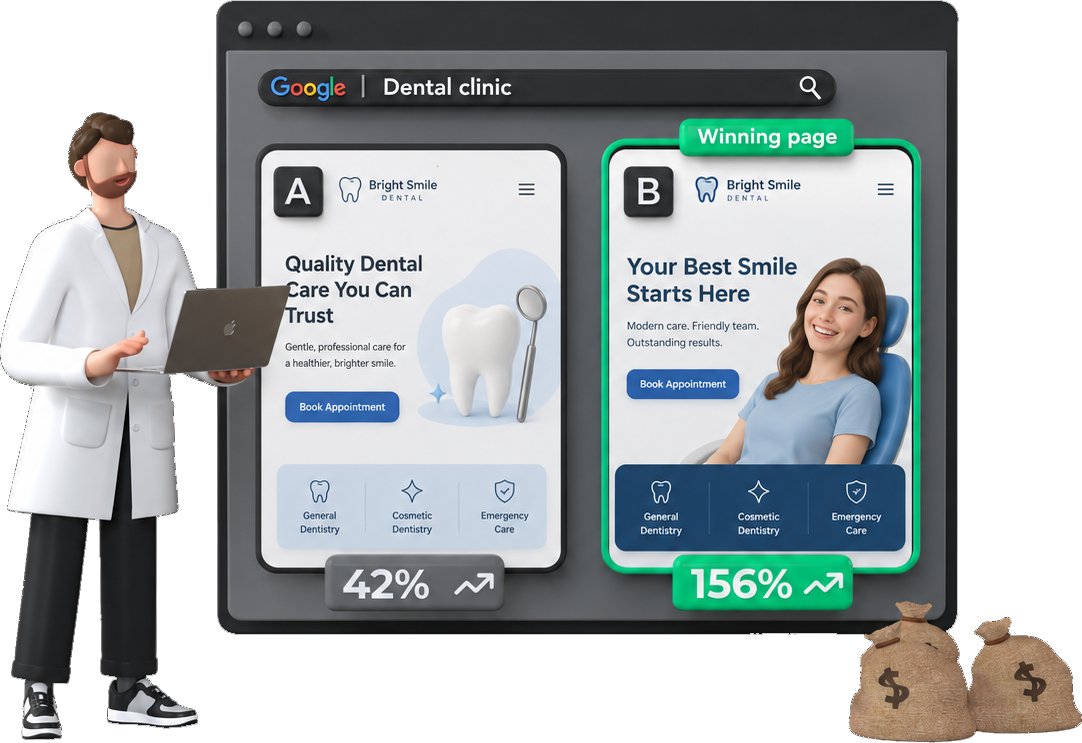









Understanding your conversion rates is absolutely crucial for Google ads success. (For the wider view across every platform, see our PPC conversion-rate benchmarks.)
The conversion rate reflects the percentage of people who click on your Google ad and then take a conversion action, such as submitting an enquiry or requesting a quote.
- High conversion rate = more sales.
- Low conversion rate = less sales.
If your conversion rate is low, then you’ll end up spending a ton of money on Google ad clicks only to realize that nobody is converting into a new customer (or that your conversion tracking was never firing to begin with).
On the other hand, if your conversion rate is higher, then you’ll end up getting a better return on your Google ads investment and acquiring many more customers.
What’s a Good Conversion Rate for Google Ads?
Roughly 4% to 7.5% on the Search Network, and the average is close to useless until you know how the source defined a conversion.
That is the honest answer, and it is worth understanding why the number moves so much. Four sources that all rank for this question publish four different figures:
| Source | Their number | Why it differs |
|---|---|---|
| Databox | around 1.2% | Skews toward purchase-only ecommerce tracking, the strictest definition |
| Lebesgue | 2% to 4% | Mixed account types, no single definition stated |
| FirstPageSage | 4.8% | Lead-gen weighted, ranges 1.8% for IT services to 6.5% for HVAC |
| WordStream by LocaliQ | 7.52% | Counts calls and form fills as separate conversions, the loosest definition |
Nobody on page one explains that gap, so readers come away more confused than when they started. The gap comes from what each source counts as a conversion.
An account counting newsletter signups will show a “great” 9% while its real purchase rate sits under 1%. An ecommerce account counting only completed checkouts will look broken at 1.5% while making money. Both numbers are true and neither is comparable to the other.
The conversion rates in the accounts I can see
I pulled the same number from the US Google Ads accounts I can see through the Google Ads API, for 30 May to 28 August 2026. I kept accounts that spent $1,000 or more on a campaign type and recorded at least one conversion. Across the 53 Search accounts, the median conversion rate was 7.13%, and the middle half ran from 4.45% to 12.22%.

Search converts best because the person typed what they want. Performance Max and Shopping sit around 5.4%. Demand Gen is 1.20%, because most of its clicks come from people scrolling YouTube and Gmail who weren’t looking for anything.

The spread shows the definition problem from the table above. 3 of the 53 accounts converted under the 1.2% Databox figure, and 25 converted above the 7.52% WordStream figure. A rate as high as 53% usually means the account counts light actions, such as page visits or clicks on a phone number. A rate under 2% usually means it counts only sales.
So the only benchmark worth managing against is your own trailing 90 days. Beat that, and let the industry average be a sanity check rather than a target.
Important
We’re counting Google search ads in this case, and NOT Google display ads.
This is because conversion rates for Google display ads are significantly lower at around 0.55%, which ends up massively skewing the average conversion rates downwards after you take that into consideration.
Google Ads Conversion Rates By Industry

Our methodology involved looking at all of the latest studies compiled by various reputable sources, including Wordstream, SmartInsights and Local IQ, all of whom have access to reliable Google ads conversion data for each industry.
Average Google ad conversion rates in each category from highest to lowest:
- Animals & Pets: 13.41%
- Physicians & Surgeons: 13.12%
- Cars, For Sale: 12.61%
- Dentists: 10.40%
- Home & Home Improvement: 10.22%
- Automotive, Repair, Service & Parts: 10.22%
- Personal Services: 8.70%
- Health & Fitness: 8.40%
- Beauty & Personal Care: 8.16%
- Industrial & Commercial: 7.91%
- Education & Instruction: 7.07%
- Arts & Entertainment: 7.00%
- Attorneys & Legal Services: 5.72%
- Sports & Recreation: 5.69%
- Restaurants & Food: 5.06%
- B2B & Business Services: 4.94%
- Finance & Insurance: 4.11%
- Travel: 3.87%
- Shopping, Collectibles & Gifts: 3.69%
- Career & Employment: 3.11%
- Real Estate: 2.88%
- Furniture: 2.57%
- Apparel / Fashion & Jewelry: 1.57%
How Buyer Behavior Impacts Conversion Rates
Certain industries such as home services, physicians and dentists have a higher Google ad conversion rate than others.
This is because all of these industries solve a problem that people typically want to solve very fast.
If you have a problem at your home that needs fixed - Let’s say your AC unit is broken or you have a faulty appliance - You’re going to need to purchase a local service very fast.
On the other hand, with industries like travel and furniture shopping, buyes are much more methodical and research-driven. You’re far more likely to shop around and spend more time before making your final purchase decision.
So it’s important to consider the buyer’s psychology, because that plays a massive role in Google ad conversion rates.
👉 Next, the industries that convert best and worst on Google Ads.
Why some industries convert better than others
Two variables explain almost every row in that table, and neither is about advertising skill.
High converting: urgent, local, and one decision. A broken boiler in February, a toothache, a car that failed its MOT. The searcher has a problem now, the provider is chosen on availability and proximity, and one person decides. Home services, dentists, physicians and auto repair all sit at the top of the table for this reason.
Low converting: considered, comparison-heavy, or multi-stakeholder. Buying a house, replacing a sofa, choosing an insurer, signing a B2B contract. The purchase is deferrable, the searcher will visit six sites before deciding, and often more than one person has to agree. Real estate, furniture, fashion and finance sit at the bottom, and no amount of ad copy changes that.
This matters because it tells you what a bad conversion rate means. A 3% rate in real estate is normal. A 3% rate for emergency plumbing means something is broken, and it is almost certainly the landing page or the tracking rather than the ads. Working out which takes about twenty minutes.
Let’s look more specifically into some of the sub-niches and their average conversion rates, so that we can examine what the cause of different conversion rates would be for these Google ad campaigns.
Healthcare Conversion Rates Google Ads
More reliable data from LocalIQ shows us the conversion rates for Google ads in the healthcare space.
- Addiction Recovery - 7.34%
- Assisted Living, Elder & Home Care Services - 6.12%
- Chiropractic Care - 8.18%
- Dentists & Dental Services - 10.40%
- Health Clubs & Gyms - 7.26%
- Hearing Aids & Care - 4.87%
- Hospitals & Clinics (Specialized Services) - 12.33%
- Personal Fitness Trainers - 3.60%
- Cosmetic Surgery - 3.97%
It makes sense that specialized hospitals would be significantly higher, because people know they need a very specific treatment.
Legal Conversion Rates Google Ads
Again, more data from LocalIQ reveals that average conversion rates from Google ads for law firms.
- Accidents & Personal Injury Law - 5.45%
- Criminal Law - 9.90%
- Bankruptcy Law - 13.56%
- Estate & Probate Law (incl. Wills) - 9.65%
- Family Law (incl. Divorce) - 8.52%
- Tax Law - 13.30%
- General Practice Law 5.52%
What Qualifies As a Conversion in Google Ads?
Google ads professionals normally talk about macro conversions vs. micro conversions, also known as primary vs. secondary conversions.
Primary conversions are pretty obvious - Somebody buys a product from your website or schedules an appointment.
Secondary conversions are other events that take place, for example if somebody downloads a PDF guide from your website or perhaps adds an item to their shopping cart but doesn’t check out.
It’s very important to track both of these conversion actions within Google ads.
Primary Conversion Actions in Google Ads
These are the actions you want to bid towards. They are the ones tied to revenue, so they belong in the Conversions column and they drive Smart Bidding.
- Buys a product from your website
- Books and confirms an appointment
- Submits a qualified lead form
- Calls the business and stays on the line long enough to count
- Starts a paid subscription or trial that requires card details
Secondary Conversion Actions in Google Ads
These are worth measuring but not bidding towards. Track them as secondary so they inform your decisions without distorting the bidding.
- Signs up for a free account on your website
- Adds a product to cart but doesn’t check out
- Signs up for a newsletter
- Downloads a gated content asset
- Live chat engagement with your customer support
- Clicking on key pages e.g. pricing
- Requests a callback without picking a time
Always Set Up Secondary Conversions!
You should set up secondary conversions (also known as micro conversions) as actions in Google ads.
These secondary conversions will remain for observation purposes only, meaning that they won’t impact your main bidding strategy and won’t count towards primary conversions.
However, they are still incredibly important to track and useful to understand what other secondary conversion actions people are taking after clicking on your adverts.
Additionally if you want, you can in fact attach a value estimate to secondary actions.
For example, if 10% of newsletter signups lead to $100 in revenue, assign a $10 value to each newsletter signup.
Google Ads Conversion Rate Formula
Conversion rates for Google ads are calculated by dividing the number of conversions by the total number of ad interactions that led to those conversions. My conversion rate calculator does the sum and compares your rate with 53 US Search accounts.
For instance, if you had 50 conversions from 1,000 clicks on your advert, your conversion rate would be 5%.
This is calculated by dividing 50 conversions by 1,000 clicks = 5% conversion rate.
How To Improve Your Google Ad Conversion Rates
👉 There are some very simple things you can do to improve your conversion rates.

Optimize Your Landing Pages
We see so many Google advertisers with terrible landing pages.
First and foremost you need to make sure you have the basics right - a quick landing-page audit will flag them in seconds. For the next step up, these are the CRO tools I’d use for paid traffic.
Make sure you have incredibly clear call to actions buttons that push the visitor towards a specific action such as filling out a form or making a phone call.
Make sure the messaging on your landing page is consistent with the advert as well, and that you have a well-designed landing page that matches the product or service you’re offering.
Improve Your Offer
This is one under appreciated lever you can pull to massively improve your Google ads conversion rates.
For example, if you’re a dental practice, your offer might be to give a free consultation worth $200 to all new visitors - You can be absolutely certain an attractive offer like this will massively increase your conversion rates!
So consider the offer for your particular industry and come up with something that makes it very difficult for a potential new customer to ignore.
Add Social Proof
People are social creatures, and we all want to know that a product or service we’re buying is well respected and reviewed from others.
To improve conversion rates, add customer testimonials and reviews to your website.
Show real photos of happy customers and real photos of your team - This is the easiest way to instantly build trust with new customers.
A/B Test Your Ad Copy
Testing the ad copy itself can lead to conversion rate gains.
You want to make sure that you add in some headlines in your Google ad copy which stress urgency to the person viewing them.
Think about ad copy headlines such as:
- Limited Time Offer
- 40% Summer Discount
- Free Consultation
- Get a Call Back in 2 Hours
- Book a Meeting Today
These headlines all suggest urgency in solving the problem of the customer, and should therefore lead to higher conversion rates from your Google ads.
Remarketing
Remarketing is where you target people with adverts who have already visited your website.
It’s an incredibly popular strategy for good reason - It works!
People who are already acquainted with your brand and website are much more likely to convert, and remarketing allows you to essentially send a follow up advert with an offer they can’t refuse.
Before you blame the benchmark
Message match between the ad and the landing page is the most common cause of a conversion rate that looks broken. If your ad promises one thing and the page opens with another, you pay for the click twice. Run the page through our landing page relevance prompt and it scores that match for you.
Frequently asked questions
- What's a good conversion rate for Google Ads?
- Between 4% and 7.5% on the Search Network depending on whose data you trust, but that number is close to useless until you know how the source defined a conversion. Published benchmarks range from about 1.2% to 7.52% because some count every call and form fill while others count only completed purchases. The only rate worth managing against is your own trailing 90 days.
- Why do published Google Ads conversion rate benchmarks disagree so much?
- Because they are measuring different things. WordStream's 7.52% counts calls and form fills as separate conversions, which inflates the figure. Databox's 1.2% skews toward purchase-only ecommerce tracking, which deflates it. Neither is wrong, and neither is comparable to the other. Always check the conversion definition before comparing your account to any benchmark.
- Is a 9% conversion rate good?
- Not necessarily, and it is often a warning sign. A 9% rate usually means the account is counting micro conversions such as newsletter signups or PDF downloads as primary conversions. Accounts showing 9% frequently have a real purchase rate under 1%. Check what actions are in your Conversions column before celebrating the number.
- Which industries have the highest Google Ads conversion rates?
- Urgent, local, single-decision services convert highest: animals and pets at 13.41%, physicians and surgeons at 13.12%, and dentists at 10.40%. The pattern is that the searcher has a problem now, chooses on availability and proximity, and decides alone. Considered purchases with long sales cycles sit at the bottom, with apparel at 1.57% and furniture at 2.57%.