Free: 96 PPC tools + my AI Playbook book
Built for online stores.

Where Ecommerce Ad Accounts Lose Money

A 6x ROAS can still lose you money. If the products doing the volume are your thinnest margins, the dashboard says winning while the bank account says otherwise. Most ecommerce accounts we open have never fed margin data into a single bidding decision.

That is the first leak: ROAS as a vanity target. A blended ROAS goal treats a $90 sale at 60 percent margin the same as a $90 sale at 8 percent. Google optimizes toward the revenue it can see, and if it cannot see margin it will happily scale your least profitable bestsellers while your genuinely profitable products starve for impressions.

The second leak is Performance Max on autopilot. PMax bundles Shopping, Search, Display and YouTube into one campaign and hands back one blended number. Left unstructured, it leans on brand searches you would have won anyway, spends where you cannot see it, and takes credit for the lot. PMax is not the villain; blind trust in it is. Without structure and guardrails, you cannot tell what the budget actually bought.

The third leak is the product feed. Most feeds were set up in a rush before launch and never touched again. Product titles that do not match how people actually search. Missing attributes that cost you placements. Disapprovals nobody noticed because nobody was looking. In Shopping, the feed is the ad. A neglected feed pays more for worse positions on every auction, every day.

None of this shows up in the ROAS column. It shows up in search term reports, product-level margin math and feed diagnostics, which is where our free audit starts. The full teardown of how ecommerce accounts should be structured is in our ecommerce PPC guide - free, no email gate.

What the engagement covers.

What We Run for Your Store

Percentage-of-spend agencies earn more when you spend more. Read that again, then ask why their answer to every plateau is a bigger budget. We charge a flat fee, so the only way we keep the account is by making it more profitable.

Every engagement opens with an audit of the account you already have. Where the spend went, which products carried the revenue, and what your conversion tracking actually recorded. That last one surprises most store owners: tracking that counts revenue but knows nothing about margin, so every bidding decision so far has optimized the wrong number.

So tracking is rebuilt first. Conversion values that reflect what a sale is worth after margin, so the account can tell a profitable order from an expensive one and bid accordingly. The math behind this is in the profit framework we use for Google Ads.

Then the feed and Shopping strategy. Product titles rewritten around real search behavior, product groups structured so budget flows to the items you want more of, and Merchant Center kept clean instead of quietly bleeding disapprovals. Shopping is enough of a discipline that we run a dedicated Google Shopping service for stores where the feed is the whole battle.

The ongoing work is unglamorous and compounding. Negative keyword management that keeps bargain hunters and irrelevant queries from draining budget. Ad copy written for buyers, then A/B tested rather than kept because someone liked it. Bidding strategy adjusted from the margin data your tracking now captures. Competitor reconnaissance: who bids on your terms, what they promise, and where their offer is beatable on something other than price.

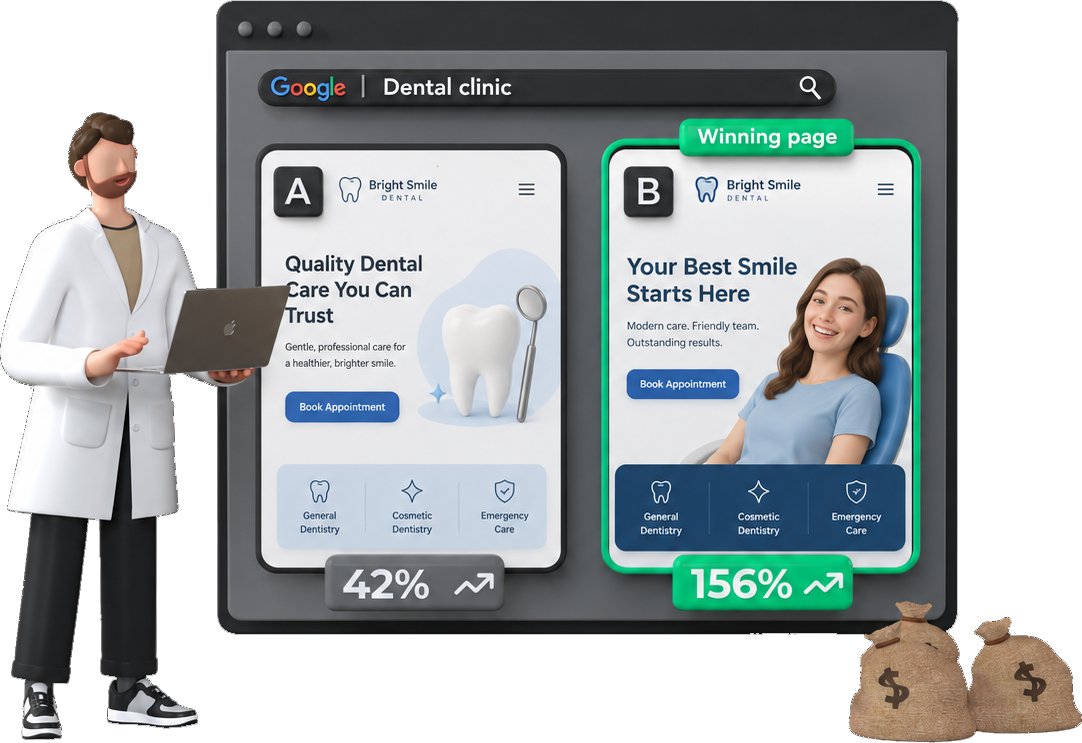
A good click deserves a page that sells, so we analyze how your landing pages perform too. We publish that homework: we also score DTC landing pages from live Google Ads - see what the winners do after the click.

Every month you get a report in plain numbers: what was spent, what it produced in profit terms, and what changes next.

Pricing without a percentage.

One Flat Fee, However Much You Spend

$2,000 a month on Starter, $4,000 on Advanced, and never a percentage of your ad spend. For an online store this matters more than most: ecommerce budgets scale with revenue, and a percentage deal quietly gives your agency a raise every time you have a good quarter. Under a flat fee, the incentive points one way - make the same spend produce more profit.

We would rather show one real account than ten adjectives, which is why the engagement starts with a free audit of your account instead of a pitch deck. The proof is in your own data, the method is published in the guide and profit framework linked above, and the reviews further down this page speak for the rest.

Everything both packages include is on our PPC consulting page.

Starter
$2,000 /month

Full Google Ads management for your store: keyword research, negative keywords, ad copywriting and A/B testing, bidding strategy, conversion tracking and competitor reconnaissance.

Advanced
Most Popular
$4,000 /month

Everything in Starter, plus social ad platforms, unlimited ad creative design and unlimited landing page design.

FAQ

Doug Haines, PPC.io client
2000
traffic increase

Doug Haines

You need to get your paid channel working. The results with PPC.io have been amazing and the demand has outstripped what we can deliver.

David Dinsmore, PPC.io client
200
traffic increase

David Dinsmore

They've helped us consult on PPC efficiency for some of our billion-dollar clients. Next-level strategies.

Kathryn Wiley, PPC.io client
850
traffic increase

Kathryn Wiley

Helped scale my travel business to heights I never thought possible. I almost can't handle the number of new leads we're getting.

Arlene McCoy, PPC.io client
250
traffic increase

Arlene McCoy

Helped us massively scale our eCommerce store. Nothing but glowing praise for them - Highly recommended.