We analyzed 42 electrician landing pages. Only 7 are worth stealing from.
We pulled 42 electrician pages that were paying for Google Ads clicks, and read them all. These 7 are the ones worth your time. Everything we found is on this page, free.

42 landing pages screened
From real electrician services Google Ads campaigns in the US
7 winners curated
The landing pages actually worth stealing from
2 burning money
So you know exactly what to avoid
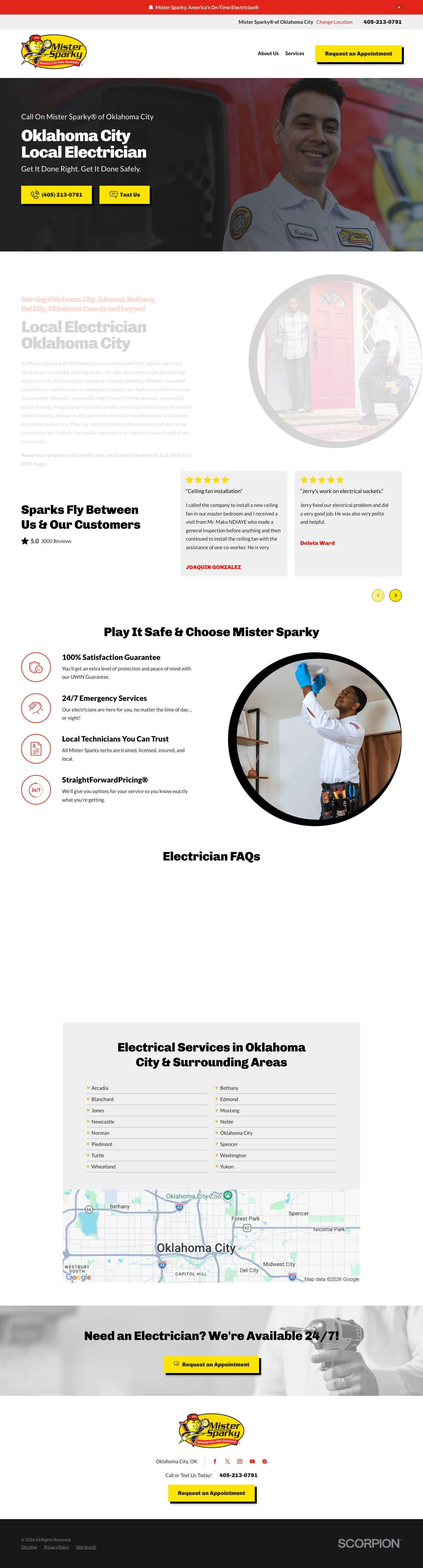
Mister Sparky runs a page per city, and the Oklahoma City one earns its place by making the call the whole point. The hero gives you a phone button and a Text Us button, and the header above it keeps a short nav and a Request an Appointment button. Their score and their customer stories are real, but they sit under the fold, so the first screen asks you to trust a promise instead of a rating.
Lead your electrician hero with the safety angle ('Get It Done Right. Get It Done Safely.') paired with a real uniformed technician photo - it addresses the core fear (electricity is dangerous) before the visitor even reads the body copy.
- +
Text button stands beside the number two ways ineasy
Text UsA buzzing outlet is hard to describe out loud, and plenty of your buyers will not ring a stranger at all. Put a text button next to your phone number and you catch both. You also get the symptom in writing before the van leaves the yard.
- +
Pricing promise carries a brand name answers a worryone afternoon
StraightForwardPricing®Everybody worries about the upsell once the technician is inside the house. Mister Sparky answers with a branded name and a line saying you get options before the work starts. Give your own pricing model a name and it reads as a policy rather than a claim.
- +
Review headings name the actual job reviewshard to earn
Ceiling fan installationTheir headings say what was done: a ceiling fan, then Jerry's work on a set of electrical sockets. Somebody who wants that exact job finds their own story in your reviews. Ask customers to name the work when they write one, and lead with those.
- ✕
Licensed claim carries no number no proofeasy
All Mister Sparky techs are trained, licensed, insured, and local.That is the strongest claim on the page and no number sits under it. A licence number is the thing a homeowner can verify while still on your page, and it costs you a line of text. Put yours in the hero and repeat it in the footer.
- ✕
Town list and map eat a screen wasted spaceeasy
A block of town names in two columns, and a Google map under it, fill the last screen before the footer. Somebody who clicked a geo-targeted ad already knows you cover them, because that is why they saw it. Put your score and reviews there instead.
- ✕
First screen offers nothing to take no offera pricing call
Get It Done Right. Get It Done Safely.Safety is the right angle for an electrician and it is still not a reason to ring today. No price, no coupon and no free check appears anywhere, while Hutchinson and Bassett both open with money off. Paying for the click means putting something in the first screen.
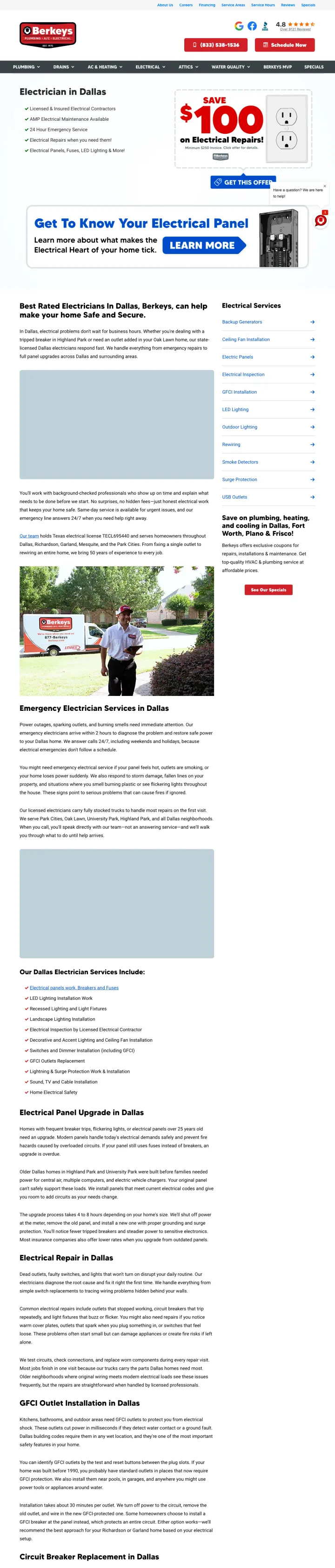
Berkeys is a Dallas home services group, and this is the only page in the file that prints its Texas licence number in body copy you can read, rather than in the legal line at the foot. A money-off coupon sits in the first screen with the minimum invoice printed under the amount and its own button below that. Behind that, the page is the full company website, nav and all.
Display your actual electrical license number (e.g., TECL695440) on the page instead of just saying 'licensed' - a homeowner can look the number up with the state, and almost no competitors show theirs.
- +
Licence number runs in the body copy credentialseasy
All our electricians hold Texas license TECL695440 and pass background checks before entering your home.Other pages here keep a registration in the legal line at the bottom, or in small print inside a coupon image. Berkeys writes its number into the paragraph above its van photo, and again near the foot. Type yours into the copy and the claim stops being an adjective.
- +
Coupon lands before any reading the offera pricing call
Save $100 on Electrical RepairsMoney is on the table before the visitor reads a word, and small print under the number names the minimum invoice, so nobody feels tricked at the door. An electrician is a commodity to a stranger, so the page carrying a number wins. Print it where Berkeys prints theirs.
- +
Photograph shows their own technician looks realone afternoon
A Berkeys technician walks across a front lawn with a tablet, in cap and shirt, branded van at the kerb behind him. Nothing came from a stock library. Send somebody out with a phone and get the van, the uniform and a real house, because Hutchinson is missing that.
- ✕
Whole site nav sits above the offer exit routesone afternoon
Plumbing, Drains, AC and Heating, Attics, Water Quality and the membership plan all run above it. Every link is a way off the page you just paid to land on. When a page serves an ad, cut the header back to your logo and your phone number and nothing else.
- ✕
Three things compete for one click focuseasy
Get To Know Your Electrical PanelThe coupon, the bullet list beside it and a Learn More banner about your panel all fight in the same screen, with a chat bubble opening over the corner. When three things ask for the click, none of them gets it. Pick the coupon and push the rest down.
- ✕
Half a century hides mid-paragraph no proofeasy
we bring 50 years of experience to every jobFifty years of trading is a claim a stranger cannot argue with, and here it is the last clause of the paragraph above the van photo, in the same type as the sentence before. That belongs in a badge beside the logo. Say it where they land.
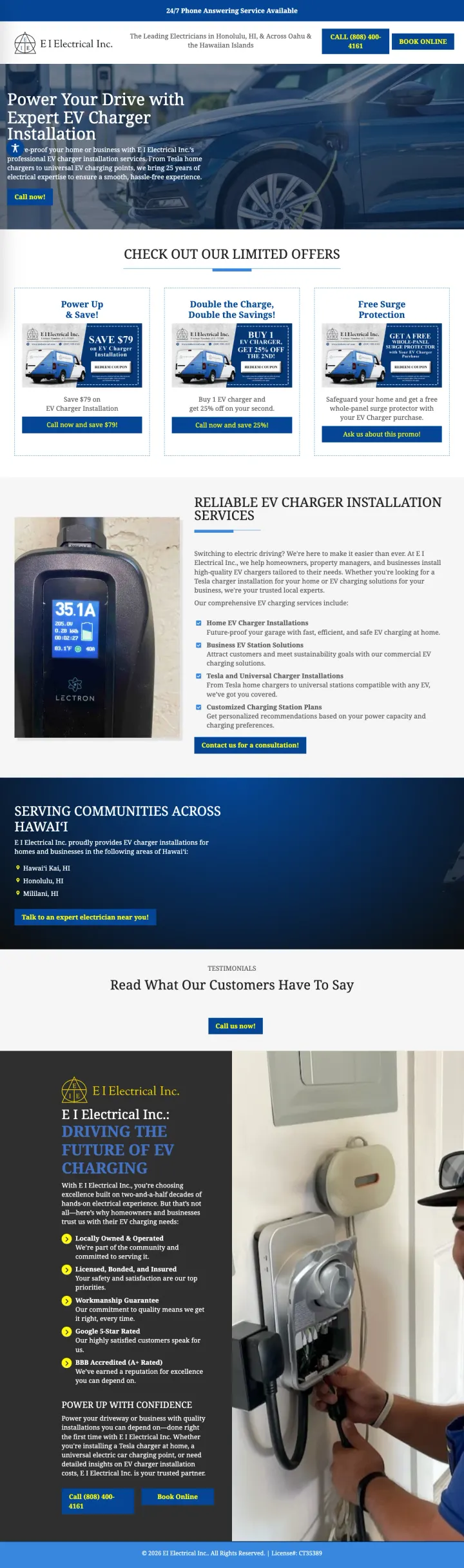
An EV charger install is a planned purchase, and this Hawaii page is built for that search rather than for electrical work in general. The header pairs the number with a Book Online button. Three coupon headings show at the bottom of the first screen, and the buttons under them say Call now and save, or ask us about the promo. Nothing on the page lets you type.
Build a dedicated landing page for each high-value electrical specialty (EV chargers, panel upgrades, generators) with service-specific offers rather than listing them as bullet points on a general electrician page.
- +
Three coupons split three buyers the offera pricing call
Free Surge ProtectionThe offers cover the single car household, the two car household, and the buyer worried what a charger does to the rest of the house, who gets a free whole-panel surge protector. Each is a different reason to ring today. Write an offer per buyer and they sort themselves.
- +
Opening line names charger brands answers a worryeasy
From Tesla home chargers to universal EV charging pointsAn EV owner wants to know their own charger is supported before ringing anybody. Naming Tesla and universal points settles it immediately. Name the brands you actually install, because we install EV chargers leaves the question open and sends them to the next result.
- +
Credentials gather in one dark block credentialshard to earn
BBB Accredited (A+ Rated)The accreditation, the Google line and the years in the trade sit together, so a visitor reads them as a single story. Yours are probably scattered across three sections of the page. Put them together and they carry more weight than any of them does alone.
- ✕
Nothing on this page takes typing extra stepsneeds a developer
Call now!There is no form anywhere. Book Online sits in the header and again at the foot, and everything else asks you to ring: Call now, call now and save. The emergency caller is happy, but somebody pricing a charger install wants to send a photo of the panel.
- ✕
Saving arrives without a base price missing mathsone line
Call now and save $79!Money off what, exactly. EV buyers research the install cost hard, and a saving with no base price beside it says nothing about the bill they are about to get. Print your starting price next to the discount, even as a from figure, and let the saving argue.
- ✕
Utility rebates go unmentioned entirely local detailone afternoon
The page names the towns it serves and stops there. Utility rebates and state incentives for home charging are the strongest local argument an electrician has, and there is not a word about them. Look up what your utility pays out this year and put the figure on the page.
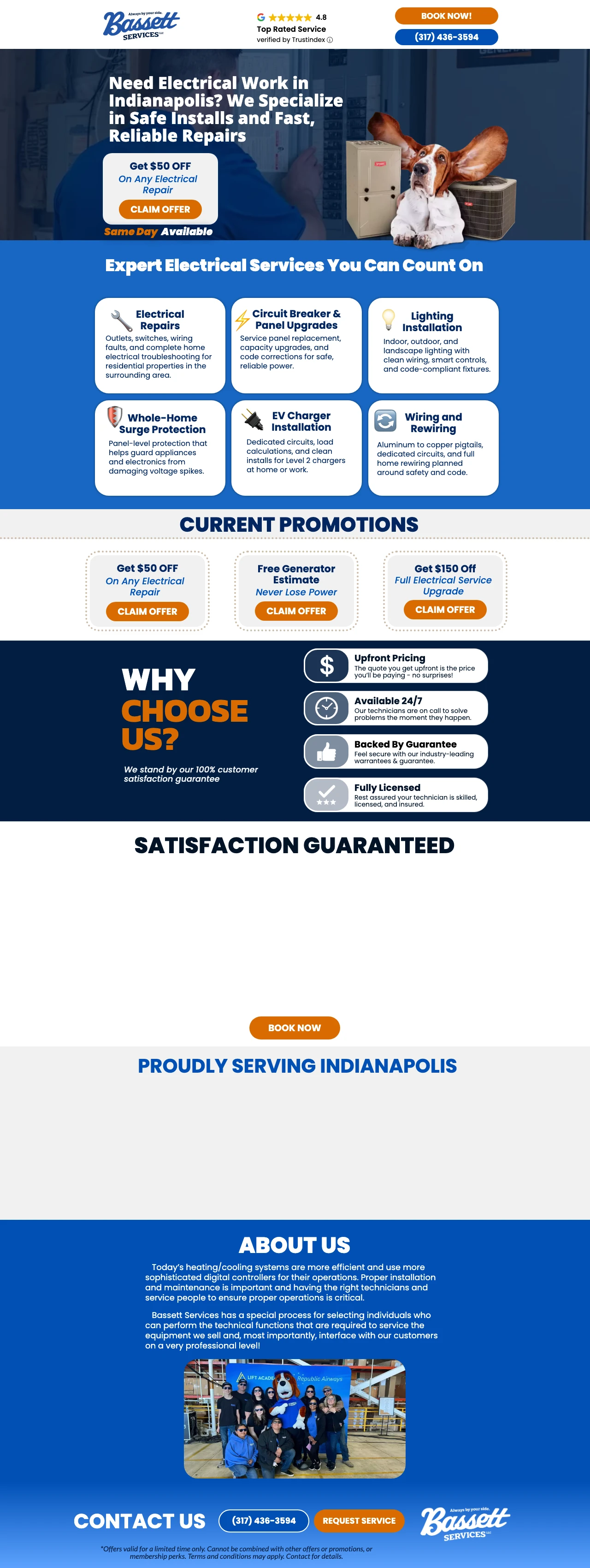
Bassett put its electrical offers on a separate subdomain, so nothing in the header leads back to the main site. The promotions repeat down the page, each with a Claim Offer button. Then the About Us block near the foot talks about heating and cooling systems, which is not the trade this visitor typed.
Use an icon grid showing your 6 core electrical services (repairs, panels, lighting, surge protection, EV chargers, wiring) immediately below the hero to let visitors instantly confirm you handle their specific need without scrolling through paragraphs.
- +
Service grid confirms the job fast makes it easierone afternoon
Circuit Breaker & Panel UpgradesRepairs, panel upgrades, lighting, surge protection, EV chargers and rewiring, each with an icon and a line under it. A visitor confirms you do their job without reading a paragraph. List the work you want to sell. Everything you are capable of is a different page.
- +
Each job gets its own offer the offera pricing call
Free Generator EstimateA repair discount, a free generator estimate and an upgrade discount, each with its own Claim Offer button. The visitor takes the one matching what brought them here. A single blanket coupon makes every visitor do that sorting in their head instead.
- +
Paid page lives on its own subdomain focusneeds a developer
The header carries the logo, the rating, a Book Now button and the number, and no nav at all. Nothing to wander into and no blog to fall down. It still carries the brand colours, so nothing feels like a trap. Build paid pages where the site cannot leak in.
- ✕
Hero picture shows the other trade wrong promiseeasy
Need Electrical Work in Indianapolis? We Specialize in Safe Installs and Fast, Reliable RepairsBehind the headline a technician works at an open breaker panel, which is exactly right. In front of it the basset hound lies between a furnace and an outdoor air conditioner. Your visitor decides in a second whether they are in the right place. Take that kit out.
- ✕
Badge stack offers nothing checkable no proofeasy
Rest assured your technician is skilled, licensed, and insured.Upfront pricing, always available, backed by guarantee, fully licensed, stacked down the right of the Why Choose Us band. No licence number anywhere, no review count, no year they started trading. Swap any tile for something a stranger can check.
- ✕
Guarantee never says what it covers vague promiseone afternoon
We stand by our 100% customer satisfaction guaranteeThe tile says backed by guarantee, the line beside it promises satisfaction, and neither names the remedy. Free rework? Money back? Somebody out the same day? Write the terms in a sentence, because a guarantee nobody can picture reads as decoration.
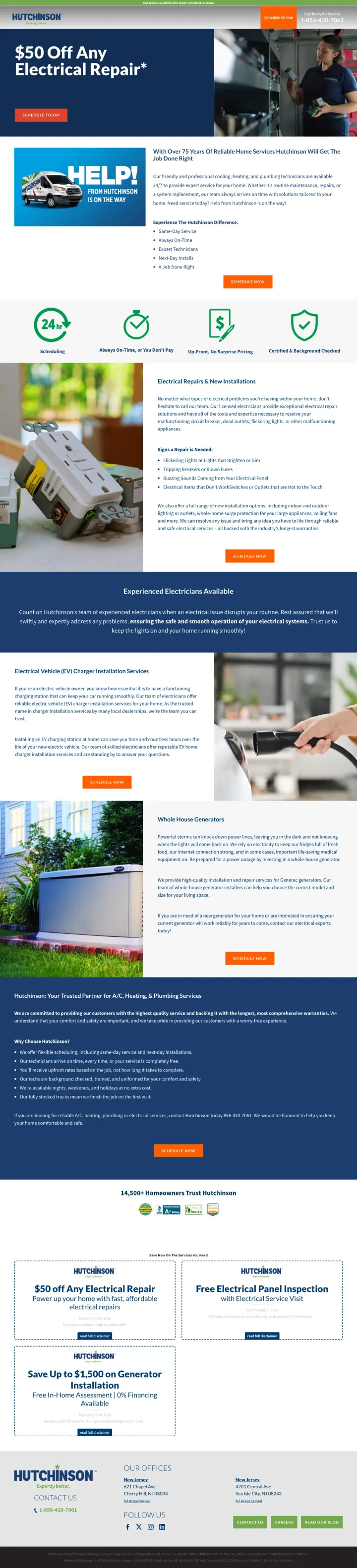
Hutchinson leads with money off and backs it with a guarantee that costs them something: turn up late and you do not pay. A row of green icons one screen down answers scheduling, on-time arrival, pricing and background checks with no paragraph in the way. Their years in the trade reach the first screen too, but as a section heading in the same blue as the paragraph under it.
Lead with a specific dollar-off coupon as your hero headline ('$50 Off Any Electrical Repair') rather than a generic service description - it gives the visitor a concrete reason to engage with THIS page instead of going back to search results.
- +
On-time promise costs them the job risk reversala pricing call
Always On-Time, or You Don’t PayEverybody has waited in for a tradesman who said morning and arrived at teatime. Hutchinson turns that into a promise with a cost attached, and the cost is the whole job. If your team already runs to time, say what happens on the day it does not.
- +
Four worries answered in green icons answers a worryeasy
Up-Front, No Surprise PricingRound the clock scheduling, on time or free, upfront pricing, certified and background checked. Four answers in a row with no paragraph anywhere near them. Write down what your customers ask on the phone this week and turn those answers into your own row.
- +
Coupon stack splits three buyers the offera pricing call
Save Up to $1,500 on Generator InstallationA repair discount, a free panel inspection and a generator saving. Those are three different people: the dead socket, the homeowner who suspects the panel is old, and the person about to spend serious money. Give each their own offer and their own button.
- ✕
Van picture holds nobody at all looks offone afternoon
Help from Hutchinson is on the way!Under the hero sits an empty van cut out on a blue panel with HELP! set across it. No technician, no house, no work being done. A phone photo of your own crew at a real panel beats it, and you can take that this afternoon.
- ✕
Generator saving closes the page wrong ordereasy
0% Financing AvailableThe biggest job Hutchinson sells is a whole-house generator, and its coupon is the last thing before the footer. The line making a bill that size affordable is the small subhead under the coupon heading, above the expiry date. Money that big is a headline.
- ✕
Their longest claim sits in a subheading no proofeasy
With Over 75 Years Of Reliable Home Services Hutchinson Will Get The Job Done RightSeventy-five years in the trade is the strongest thing on this page, and the only place it appears is a section heading partway down. Their hero says nothing about it and it never becomes a badge. Put the figure beside your logo and use the same one everywhere.
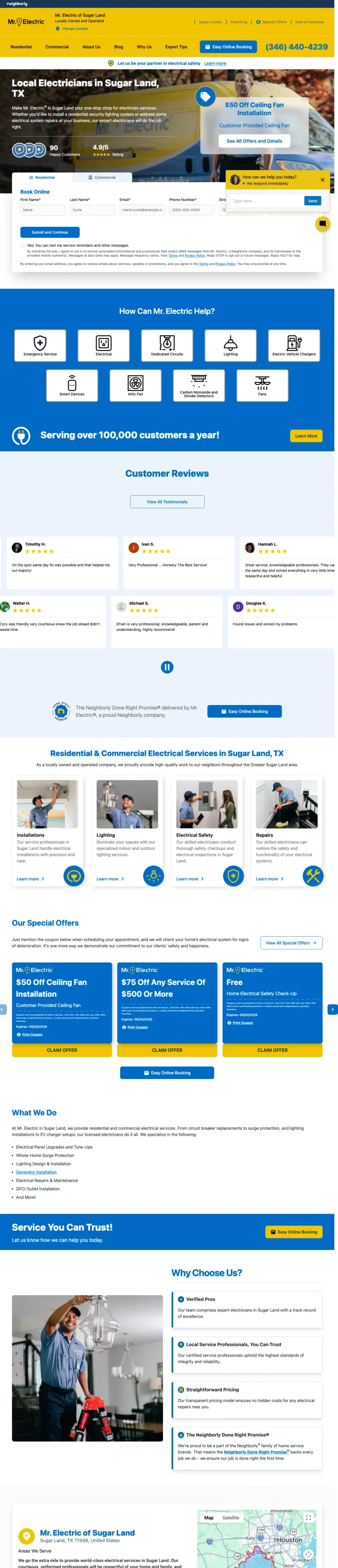
Mr. Electric hands the first screen to a booking form, and that is rare here - most electricians in this file want the call. The rating sits just above it, so the proof and the action share a screen. Then the form asks for a street address before anybody has spoken to you, and the chat window opens over that end of the row.
Put a multi-field booking form (name, email, phone, address, zip) directly in the hero section so the visitor can start converting before they scroll - it signals 'we are ready to help you right now' rather than 'read about us first.'
- +
Booking form opens in the hero fewer stepsneeds a developer
Book OnlineNobody has to scroll to start. The residential and commercial tabs sort the lead before it reaches your office, so the quote goes to the right team without a phone call. If your page makes the visitor hunt for a Contact link, you lose the ones in a hurry.
- +
Discount attaches to a named job the offereasy
$50 Off Ceiling Fan InstallationMoney off a named job beats money off anything. It tells the visitor you do the exact thing they came for, and it gives your ad a matching promise to land on. Pick the job you most want to sell and build the discount around that.
- +
Score sits directly over the form reviewshard to earn
Happy CustomersThe rating and the stars run in the line above the first box, so the visitor reads the proof on the way in. Most pages here bury reviews far below, where the person who already left never sees them. Move your score next to whatever you want pressed.
- ✕
Franchise nav opens six doors out exit routesone afternoon
Residential, Commercial, About Us, Blog, Why Us and Expert Tips, plus a top bar offering financing and franchise ownership. Every item is a door out of the page your click paid for. A franchise page has to carry the brand furniture. Yours does not.
- ✕
Chat widget covers the last fields two things at onceeasy
It opens on top of the booking form and hides the last boxes in the row. We had to read the same form further down the page to see what it asked, and your visitor will not bother. Pick the form or the chat, and keep them apart.
- ✕
Form wants an address before contact too much at onceeasy
Street AddressTheir booking form asks first name, last name, email, phone, street address and a postcode before anybody has spoken to you. A street address is a survey question, and nobody needs it until the van is booked. Ask for a name and a number instead.
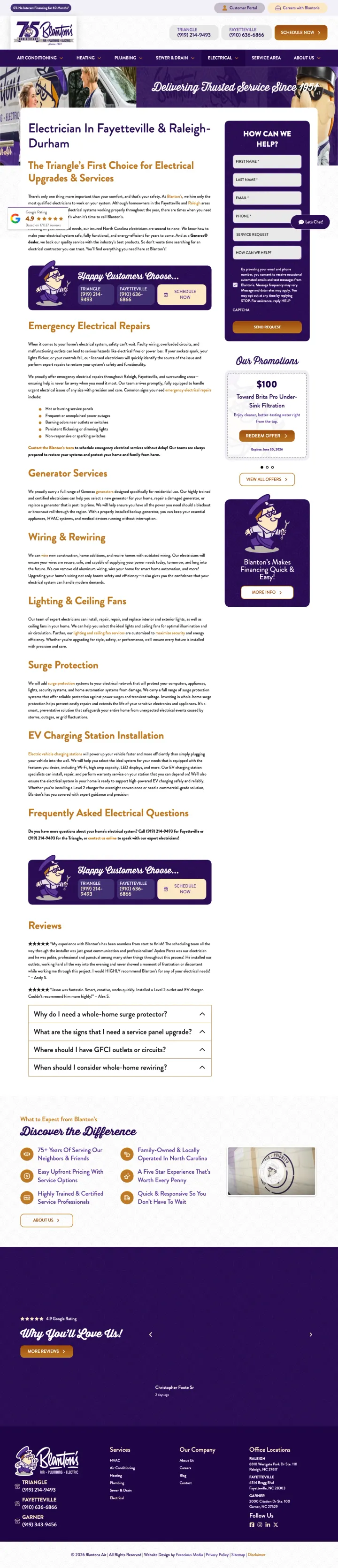
Blanton's is an air conditioning, plumbing and electrical company, and the header leads with air conditioning. The headline underneath answers the search anyway: the trade, both towns, a lead form in the right rail and a Google rating badge in the corner. Everything a nervous homeowner needs is in the first screen. Then the promotion further down the page is a coupon for a water filter.
Blanton's built a standalone /electrical URL under a company most homeowners know as an air-conditioning brand. The hero wordmark 'Blanton's Electric' and the headline 'The Triangle's First Choice for Electrical Upgrades & Services' rebrand the multi-trade parent into a dedicated electrical division in one paragraph. If you run a multi-trade shop, stop sending electrician traffic to the generic service area page and build this page instead.
- +
Headline leads with trade and towns matches the searcheasy
Electrician In Fayetteville & Raleigh-DurhamSomebody who typed electrician in Fayetteville does not want an air conditioning company, and this header leads with air conditioning. The headline underneath answers the search anyway: the trade first, then both towns, in the biggest type on the white card.
- +
Right rail catches them before scrolling fewer stepsneeds a developer
How Can We Help?It asks for a name, an email, a phone number, the service and what has gone wrong. No street address, no postcode. If your form only appears at the bottom, it only works on the people who got there.
- +
Rating badge floats in first screen reviewshard to earn
4.9 Google RatingElectrical work carries fire and shock risk, so a stranger wants proof before handing over the keys. The badge sits in the bottom corner of the first screen, across from the form, with the score and review count. Pull yours off Google and put it where the decision happens.
- ✕
Header lists five trades above it wrong promiseone afternoon
Air Conditioning, Heating, Plumbing, Sewer and Drain, then Electrical. The headline names the one trade they searched for and the header lists them all, in a solid purple band above it. Somebody comparing tabs reads the header and goes back.
- ✕
Six service blocks carry no photographs looks offone afternoon
Emergency repairs, generators, wiring, lighting, surge protection and EV charging each get a heading and a block of text, and not one picture between them. Electrical work is invisible once the plate goes back on, so a finished panel does the arguing for you.
What the winners keep doing
Wildcards
Pages that break the playbook in interesting ways
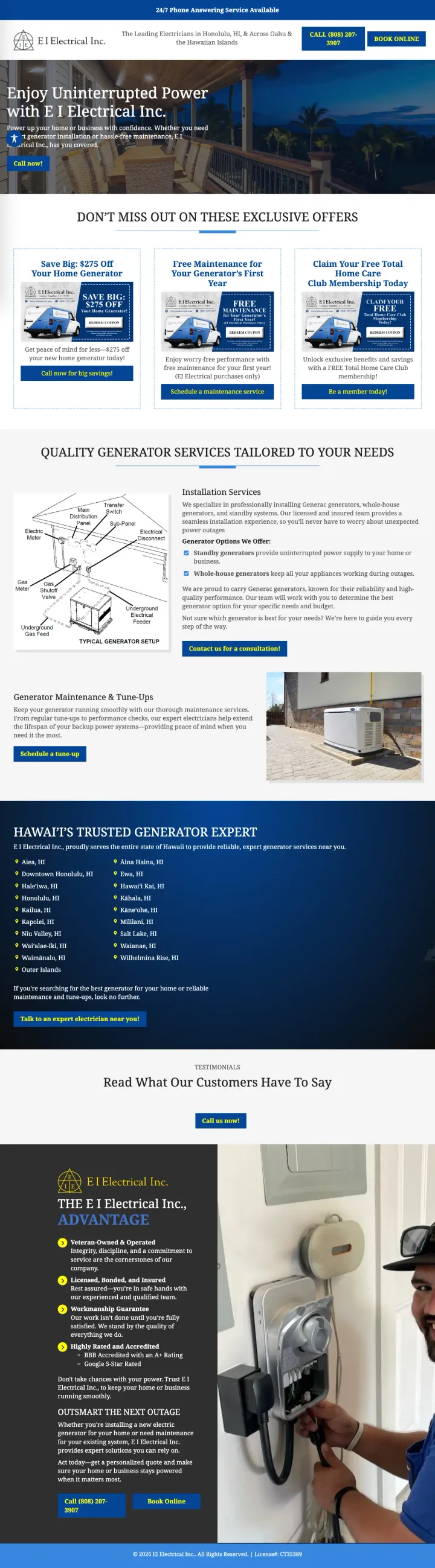
Make every link on the page a tel: link. EI Electrical's generators landing page wires the headline offer, every coupon tile, every service block, and even the hero image into a single phone number - no forms, no chat widget, no email capture. For a high-ticket considered purchase (standby generators in a hurricane-prone market), betting everything on the phone call is an unusual commitment that filters out tire-kickers.
- answers doubts
Three stacked coupon tiles ($275 off home generator, free first-year maintenance, free Total Home Care Club membership) give the visitor three reasons to call - each tile addresses a different buyer hesitation (price, maintenance worry, ongoing relationship)
- layout
The hero image itself is a tel: link - clicking the photo of the generator dials the company. This is an unconventional UX choice that captures accidental clicks from visitors who would not have tapped a labeled button
- reviews
Local service-area list with Hawaiian place names (Aiea, Kaneohe, Mililani, Kahala) signals genuine local knowledge in a way that 'serving the greater Honolulu area' never could - it also makes the brand feel earned rather than franchised
- extra steps
Zero form, zero chat, zero email capture - a $5K-$20K generator is rarely a same-day phone purchase, and visitors who want to compare quotes at 11pm have no way to engage without calling during business hours
- no proof
The coupon tiles are visually decorative but the actual discount terms (does $275 off stack with free maintenance? is the club membership locked to EI purchases?) are not explained above the fold - vague terms erode trust for a considered purchase
- looks off
The page serves only Hawaii but uses generic stock photography of a mainland-style single-family home - a genuine Oahu or Big Island home photo would reinforce the hyper-local positioning
Compare the winners
The same questions asked of every winner, so you can find the row that matches the clicks you are already buying.
| Page | What it asks you to do | Licence or rating body | Rating in the first screen | Named offer | Standout move |
|---|---|---|---|---|---|
| #1Mister Sparky | Call or text | Nowhere | No | No | A text button beside the number |
| #2Berkeys | Call or claim a coupon | First screen | Yes | Yes | Its licence number in the copy |
| #3E I Electrical | Call, or book online | Footer only | No | Yes | Coupons stacked for a single job |
| #4Bassett Services | Claim an offer | Nowhere | Yes | Yes | Its own subdomain, no site nav |
| #5Hutchinson | Schedule online | Footer only | No | Yes | Late and you do not pay |
| #6Mr. Electric | Fill the hero form | Nowhere | Yes | Yes | Rating and form on the same screen |
| #7Blanton's | Fill the rail form | Nowhere | Yes | Yes | The trade and the towns in the headline |
Read the keywords you are buying before you pick a row. Somebody typing sparking outlet wants a number to ring and a licence they can check, and your coupon means nothing to them at that moment. Somebody typing EV charger installation cost is shopping for next month, and that person wants a price and a way to type. You paid the same for both clicks, so stop sending them to the same page.
The copy bank
Lines lifted word for word off the pages above. We tell you whose page each came from, and a click copies it.
SCHEDULE TODAY
Call now!
REQUEST SERVICE
Book Online
Losers
2 pages burning ad spend with fundamental issues
Every click to these pages costs real money. We found missing reviews, mismatched intent, weak CTAs, and messaging that ignores what the searcher actually typed. Here is what to avoid.
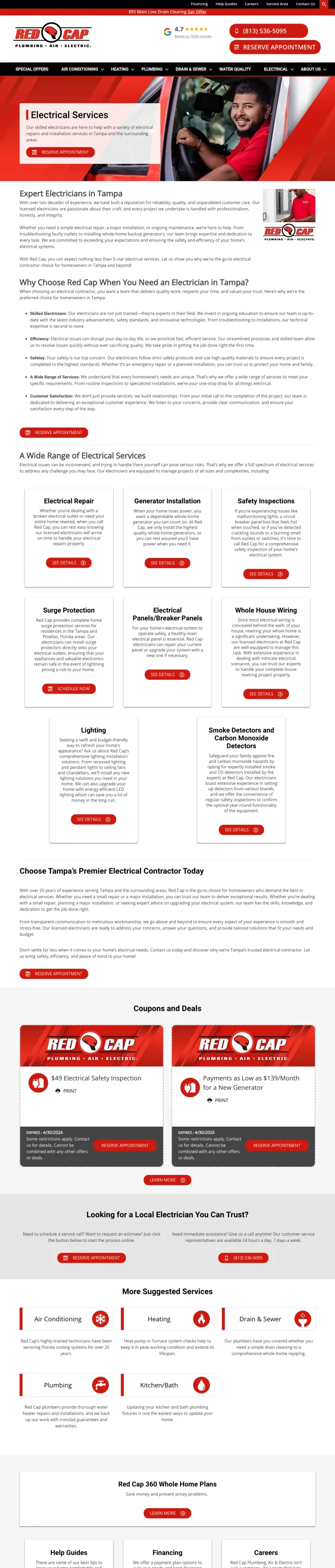
Ad promises 'Red Cap Electrical - There in Minutes, Not Days' but the page is a full website service page with 8-item mega navigation, no specific offer above the fold, and walls of generic copy about 'why choose us.' The visitor who searched 'electrician near me' expecting fast service gets a brochure-style page that requires scrolling past 5 sections to find the $49 safety inspection coupon buried at the bottom. Every paid click at electrician CPCs funds a website tour, not a conversion.
- wrong promise
Full site navigation with 8 top-level items (Special Offers, Air Conditioning, Heating, Plumbing, Drain & Sewer, Water Quality, Electrical, About Us) tells the visitor this is a multi-trade company that happens to do electrical, not an electrical specialist - and each nav link is a paid-click exit path
- missing proof
The hero section says 'Electrical Services' and 'Our skilled electricians are here to help' followed by a 'Reserve Appointment' button - but the ad promised 'There in Minutes, Not Days' and the generic hero copy never repeats that speed promise
- missing proof
Five 'Why Choose Us' bullet points (Skilled Electricians, Efficiency, Safety, Wide Range of Services, Customer Satisfaction) are generic enough to apply to any trade in any city - none mention Tampa-specific expertise, license numbers, or quantified claims
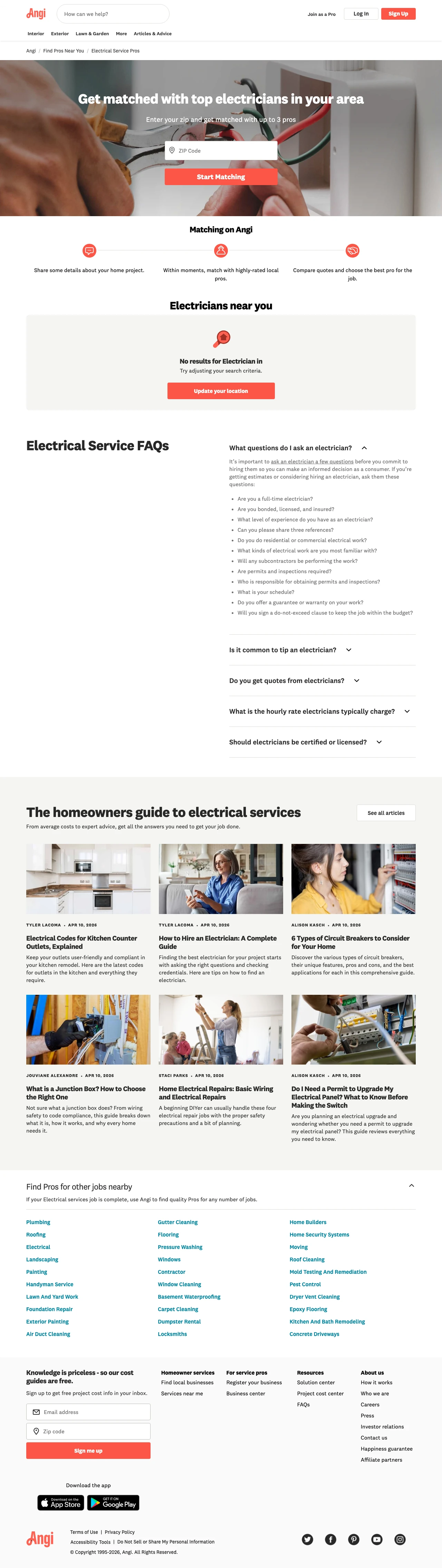
Ad targets people searching for 'electrician near me' at emergency-repair intent but the page is a directory funnel. Hero reads 'Get matched with top electricians in [city]' with a ZIP field before the visitor sees a single pro, their price, or their availability. The searcher paid Angi a click to then paid Angi a lead form. Below the fold there is a listing of 2,409 electricians with no way to filter for who can come today, and each 'Request Quote' button reroutes into a separate onboarding flow. The searcher who wanted a working outlet fixed today ends up marketed to by 3 pros over the next week.
- extra steps
Hero requires a ZIP before showing any pro, price, or response time - the same ZIP-first setup as Google's own 'local services' feature except Angi charges the searcher AND the pro, where Google only charges the pro
- too much at once
'Showing 1-10 of 2409' with no sort by availability, emergency-service, or distance reduces the directory to a decision-fatigue wall; any pro-matching value gets lost in choice paralysis
- too much at once
Every Request Quote button lands on a separate '/service-request-pro-direct' funnel, meaning each prospect needs to fill the same form repeatedly to message multiple pros - the platform charges Angi CPCs for leads that generate lead-gen work
What we learned
Dedicated electrical landing pages outperform multi-trade service area pages
Pages built specifically for electrician searches (Bassett, Hutchinson, EI Electrical) deliver a focused message that matches the ad promise. Multi-trade service-area pages (Blanton's) bury electrical content below HVAC and plumbing sections, forcing the visitor who searched 'electrician near me' to scroll past air conditioning content to find what they came for. At electrician CPCs of $15-40, every second spent hunting for relevant content is wasted spend.
A dollar-off coupon above the fold turns a commodity service into a specific offer
Hutchinson ($50 off electrical repair) and Bassett ($50 off any electrical repair) lead with a concrete discount. This works because electricians are perceived as interchangeable by most homeowners. The $50 off converts a 'get quotes from three electricians' mindset into 'this one already has a deal' - it gives the visitor a reason to stop comparison shopping. The $50 amount appearing across multiple advertisers suggests it is the industry-standard offer threshold.
Phone number + online booking side by side capture both emergency and planned-work visitors
Mister Sparky and Mr. Electric both offer phone and online booking prominently above the fold. This matters because electrician searches split between emergency (sparking outlet, power out - these visitors will only call) and planned work (panel upgrade, EV charger - these visitors prefer scheduling online at their convenience). Pages with only a phone number lose the planned-work segment; pages with only a form lose the emergency segment.
EV charger installation pages are the highest-intent specialist opportunity most electricians miss
EI Electrical built a dedicated EV charger landing page with specific offers ($79 off installation, BOGO 25% off second charger, free surge protector). This is a growing, high-value segment where the buyer profile is tech-savvy and willing to pay for quality. Most electricians lump EV charger installation as one bullet point on a general services page. A dedicated page with charger-specific offers, Tesla compatibility mentions, and amperage details converts the research-heavy EV buyer who needs specifics, not generalities.
Winners build dedicated electrical landing pages with a specific dollar-off offer, two CTAs (phone for emergencies + online booking for planned work), and at least one thing a visitor can verify (license number, Google rating with review count, or years in business with a specific number). Losers send paid electrician traffic to multi-trade service-area pages where electrical is third or fourth in the headline after HVAC, plumbing, and drains, with no electrical-specific offer and no conversion path that acknowledges the visitor searched for an electrician specifically.
If you're building a page like these yourself, here's my comparison of AI landing page builders, with prices and what each one is best for.
What the electrician winners taught us
An electrician click is two different people. The outlet is sparking and they need a number now, or the rewire is next month and they need to believe you. The winners here pick a side and answer it in the first screen. The losers send both to a service area page and let them work it out.
- 1
Print the licence number itself. Nearly every page in this file says licensed and insured. The pages that print an actual number keep it in the legal line at the very bottom, or in the small print inside a coupon image. Berkeys puts its Texas number in the body copy and again in the footer, and it takes a line of text. A homeowner about to let a stranger into the house can check a licence number in a minute. They cannot check an adjective.
- 2
Move the rating into the first screen. Mister Sparky keeps its score and its review count in a band under the fold, where a paid visitor may never reach. E I Electrical keeps its Google line and its BBB line even further down, near the foot of the page. Stars take up almost no room, you already own them, and the decision happens next to your phone button.
- 3
Give the planner a way to type, not just a way to call. Most of these pages are built for the emergency caller, and at two in the morning that is right. The person pricing an EV charger or a rewire wants to describe the job and get a reply. Mister Sparky puts a text button beside the number. Mr. Electric and Blanton's run a form. Everybody else loses that buyer to whoever answers in writing.
- 4
Take the street address off your first form. Mr. Electric asks for a street address before anybody has spoken to the customer, and a street address is a survey question. Your office can get it on the callback. Ask for a name, a phone number and what has gone wrong, and let your team do the rest.
Score your own electrician page
Every line below came off a screenshot somebody sat and measured. Open your own page beside it and tick what it already does.
Now point postclick at your electrician page
We screened 37 electrician pages running live on Google Ads. Berkeys was the only one that printed a real license number: Texas electrical license TECL695440. Everyone else just said 'licensed'. So give postclick the URL your own electrician ads point at. It reads that page the way a homeowner with a dead breaker panel reads it, names what's costing you the call, then draws you new versions to pick from. The first audit and two concepts are free.