We analyzed 27 accounting landing pages. Only 7 are worth stealing from.
We pulled 27 accounting, bookkeeping and tax pages that were paying for Google Ads clicks, and read all of them. These 7 are the ones worth your time. Everything we found is on this page, free.

27 landing pages screened
From real accounting / tax services Google Ads campaigns in the US
7 winners curated
The landing pages actually worth stealing from
3 burning money
So you know exactly what to avoid
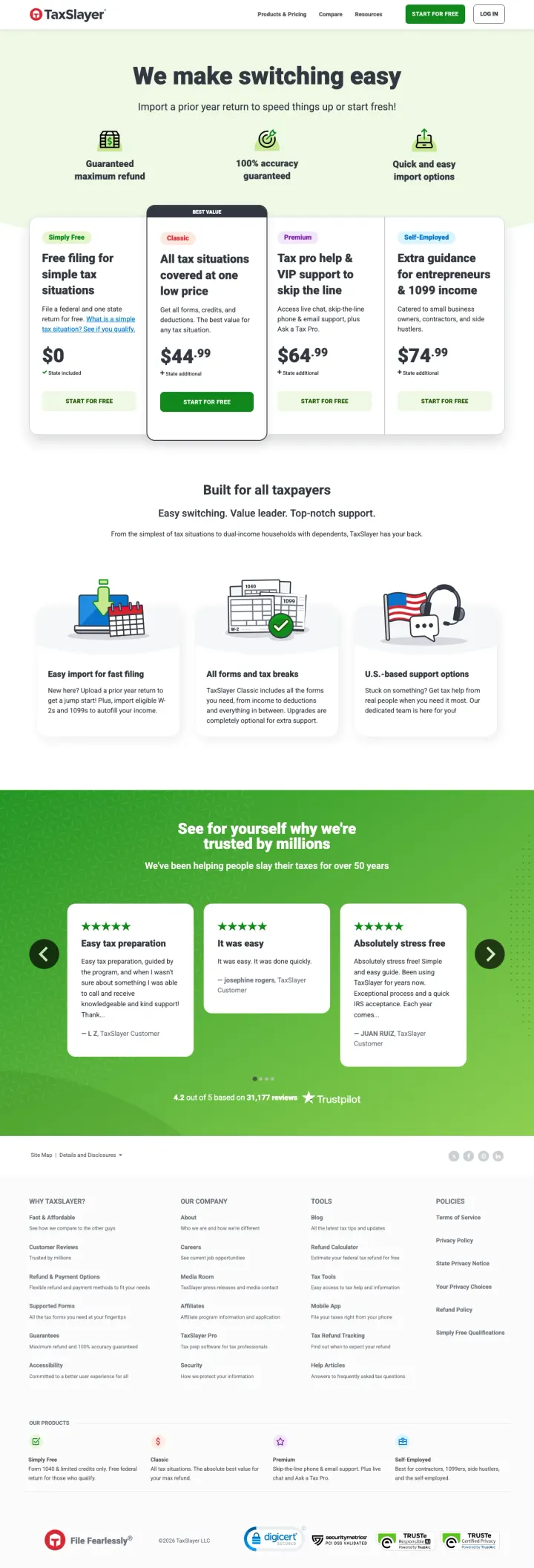
TaxSlayer built this page for people who already file somewhere else, and the headline and the line under it are about the move rather than the software. The tier prices sit in the first screen, from the free option up to self-employed, so the cost of switching is answered without a call and without a scroll. What the page never explains is how to get your old return out of the product you are leaving.
Build your entire landing page around the switching experience, not the product features. TaxSlayer's headline is 'We make switching easy' - not 'File your taxes' - because they know the visitor has already decided to switch; they just need reassurance that the transition is painless.
- +
Every tier prices itself up front prices up frontone afternoon
All tax situations covered at one low priceFree through self-employed all price themselves in the first screen, and a line under each says whether the state return is included or extra. A visitor weighs the cost of switching against what they pay now, before scrolling. Put your tiers side by side, priced.
- +
Guarantee icons answer switching fears answers a worryeasy
100% accuracy guaranteedSomebody leaving a tax product they trust worries about getting it wrong. Features are a later question. TaxSlayer answers under the headline with icons: guaranteed maximum refund, accuracy guaranteed, quick and easy import. Every one lands before the prices start. Put your guarantee where the hesitation happens.
- +
Reviews repeat the word being sold reviewshard to earn
It was easy. It was done quickly.Quotes sit in a green band near the foot, each with a name under it, and the same word keeps coming back: easy. That is the exact promise in the headline, so customers make the argument instead of the copywriter. Search your reviews for the word you sell on.
- ✕
Import step never says how missing stepone afternoon
Import a prior year return to speed things up or start fresh!Switching is the whole promise, and the page says to import a prior year return without saying how to get that file out of TurboTax or H&R Block. Name the product they are leaving and show the export in two steps. Whoever cannot picture the move does not make it.
- ✕
Old returns go unmentioned entirely unanswered worryeasy
Nothing here says what happens to the years you already filed somewhere else. That is the second thing anybody asks before switching, right after the price, and this page leaves it hanging. Answer it beside your switch button and you keep the people who would close the tab.
- ✕
Tier names describe the product, not you unclear tierseasy
Tax pro help & VIP support to skip the lineClassic says it covers all tax situations and Premium sells tax pro help, and a first-time filer cannot tell which sentence describes them. When tiers are named after your product, the nervous buyer picks nothing. Label each tier with the person it suits.
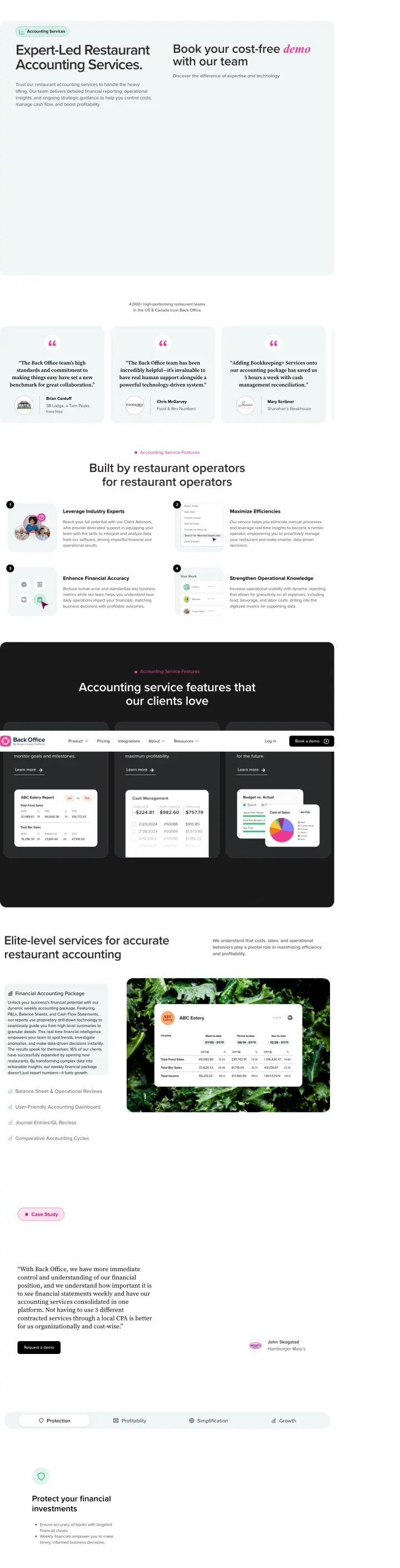
Restaurant accounting is all Back Office does, and that narrowness is what put it in the file. Under the hero runs a row of quote cards from named operators with their venues attached, which is proof a generalist firm cannot assemble. Their ad sells a flat monthly rate and the page never says what it is.
Position your accounting service around the reporting cadence, not just the deliverables. 'Weekly financials so you know your numbers while they still matter, not 45 days after close' reframes speed-to-insight as the competitive advantage, making monthly accountants sound obsolete by comparison.
- +
Restaurant count sits under the hero market proofhard to earn
4,000+ high-performing restaurant teams in the US & Canada trust Back OfficeA generalist firm can only say it serves small businesses. This says restaurants, and it counts them, in the line right under the hero above the quote cards. An owner reading it knows they will not be the experiment. Count your customers in the trade you dominate.
- +
Quote cards name the actual venues reviewshard to earn
The Back Office team’s high standards and commitment to making things easy have set a new benchmark for great collaboration.Every card carries a person, their logo and the venue they run: a Twin Peaks franchise, a steakhouse, a restaurant numbers firm. Nobody fakes a row like that. Ask your best clients for a line each and print the business name, because a first name reads like you wrote it.
- +
Profit claim hides inside an FAQ outcome claimhard to earn
First-year Back Office members typically see a 14% increase in net profit.Steal the strongest sentence on this page and move it. It sits in a closed FAQ row near the bottom, read only by somebody who scrolls past everything and clicks. An owner who saw it could work out whether the fee pays for itself. Yours belongs beside the demo button.
- ✕
First screen holds only the ask no proof yetone afternoon
Book your cost-free demo with our teamA headline, a paragraph and a request for a demo. The operator count, the named venues and the weekly reports all start below the fold, so the only thing above it is the ask. Somebody who clicked an ad for restaurant accounting gave you one screen. Lift one proof up.
- ✕
Flat monthly rate goes unnamed message matcha pricing call
Their own ad sells a single flat monthly rate for bookkeeping across every location, and nothing here says what it is. Somebody who clicked on flat rate must sit through a demo to hear a number. Put a figure on the page your ad points at, even a starting-from one.
- ✕
Page keeps going past the testimonials too much pageone afternoon
Below the quotes come numbered feature blocks, a dark product section, a case study, a tab bar and a stack of closed FAQ rows. That is a page built for organic search. Somebody who typed restaurant accounting services and clicked an ad wants the price and the form.
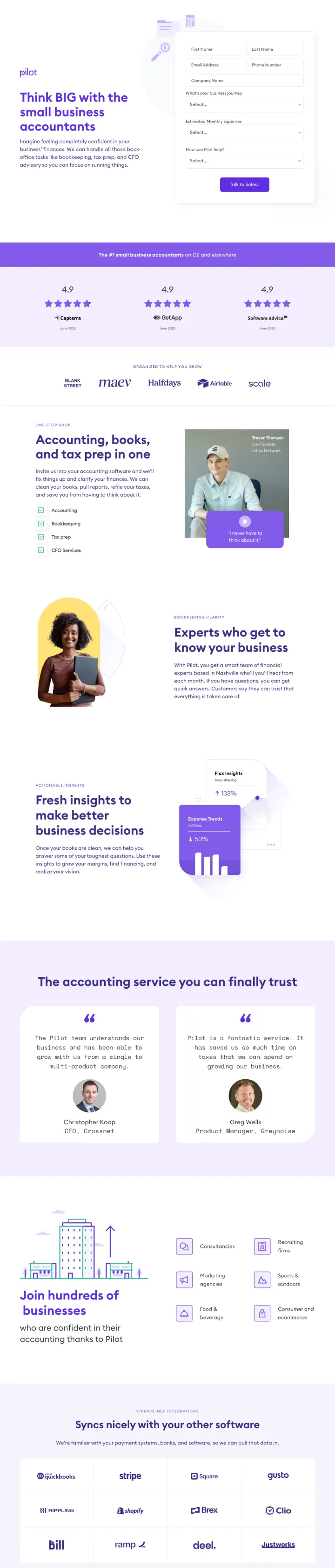
Pilot sells bookkeeping to funded startups and asks for the lead straight away, with the form in the hero rather than at the bottom of a long scroll. The client logos are doing a job most pages never think about: they say who this is for and, quietly, who it is not. The ad feeding it promises flat rate pricing that the page puts no figure to.
Name the city where your accounting team is based and make it part of the brand identity. 'A smart team of financial experts based in Nashville' does three things: proves the team is real people in a real place, signals US-based (not offshore), and creates a sense of knowing exactly who handles your books.
- +
Review boards agree on one score reviewshard to earn
Capterra, GetApp and Software Advice all carry the same score, each one dated, in a row just below the first screen. One badge reads as bought. Three boards agreeing takes work to disbelieve. Collect yours elsewhere, then drag the set above the fold, where Pilot does not.
- +
Logo row filters out the wrong buyer who it is forhard to earn
Airtable, Scale, Blank Street, Maev and Halfdays are venture-backed names, and running them is a filter as much as a boast. The bargain hunter reads that row and leaves, which is the point. Choose logos that look like the client you want more of. The biggest name you have billed is not the point.
- +
Tick list ends the hiring question scopeeasy
Accounting, books, and tax prep in oneAccounting, bookkeeping, tax prep and CFO services sit in a short stack of ticks under the heading, so nobody works out whether they still need to hire somebody else. That is the real objection from an owner who already has a bookkeeper. Write the jobs they get to stop doing.
- ✕
Affordable pricing carries no figure message matcha pricing call
The ad that brought you here says flat rate affordable pricing, and the page puts no number to either word. Affordable means one thing to a solo consultant and another to a funded startup. Match the page to the ad, or stop making the claim in the ad.
- ✕
Closing button points back upward conversion patheasy
Get in TouchThe purple band at the foot ends in a Get in Touch button, and the link points back up at the hero rather than doing anything. Below it is an email address and no phone number. Repeat the form at the bottom rather than making them scroll back up.
- ✕
Quoted voices work at funded startups wrong voicesone afternoon
The Pilot team understands our business and has been able to grow with us from a single to multi-product company.A CFO at a startup and a product manager at another are the people quoted, and the search that brought this visitor was small business accountant. A sole trader reads those titles and decides the service is not aimed at them. Quote customers who look like your keywords.
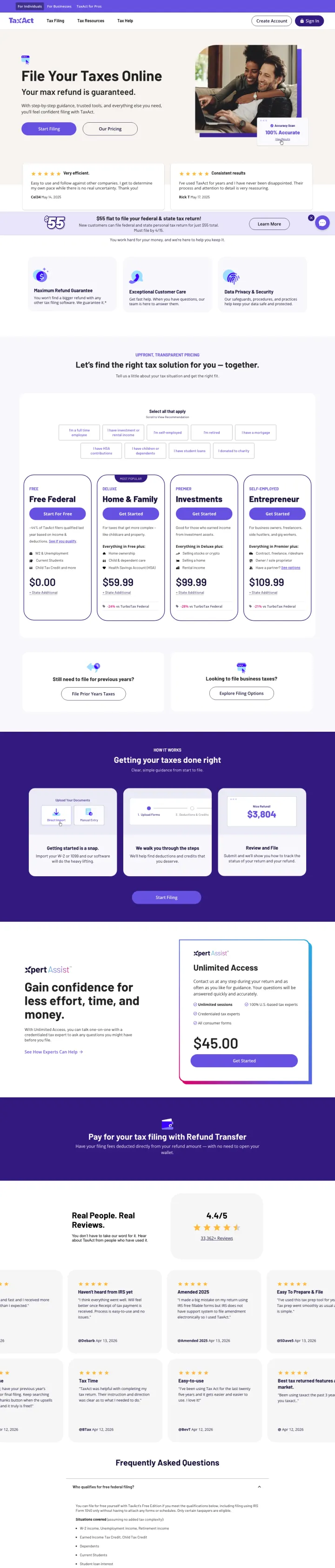
The guarantee comes before the price here, which is unusual for a tax product and it is why TaxAct made the list. Customer reviews sit in the first screen with a name and a date on each, and hardly anybody else in this file manages that. A flat-rate band in that same screen then promises a single price for federal and state, while the tier table further down prices them apart.
Lead with the guarantee ("Your max refund is guaranteed.") rather than the price. Then show transparent tier pricing below: Free ($0), Deluxe ($29.99), Premier ($49.99), and Self-Employed ($64.99) with clear feature differentiators. The guarantee removes the risk of trying a new tax platform.
- +
Refund promise answers the price fear risk reversaleasy
Your max refund is guaranteed.Under the headline, before the buttons and before any price, TaxAct answers the fear that a cheaper product leaves money on the table. The price turns up further down the same screen, doing its job second. Answer your category's standard worry in the line under your headline.
- +
Chips ask what a salesperson asks makes it easierone afternoon
Select all that applyAhead of the pricing cards is a bank of chips: full time employee, self-employed, rental income, student loans. Select all that apply, says the line above, then scroll to the recommendation. Build the same thing if your pricing needs explaining before anybody can buy.
- +
Review cards print a name and date reviewshard to earn
Consistent resultsThe cards in the first screen carry both, which almost nobody else here does. Then read the dates: the pair up top is nearly a year older than the wall of reviews further down. A quote with no date could be from any year, and readers treat it that way.
- ✕
Stock couple fills half the screen generic imageone afternoon
A couple hugging on a sofa over a laptop is the picture every tax product uses, so it says nothing. The only product in shot is a small Accuracy Scan chip. Turn that round. Anything a competitor could run unchanged is wasted room on your page.
- ✕
Four tiers arrive all at once too much choicea pricing call
Free, Deluxe, Premier and Self-Employed sit in a row, each with a feature list, a price, a state add-on line, and a discount against TurboTax. Flagging Deluxe as most popular is the only help anybody gets. Let the ticked chips choose the tier and fold the rest away.
- ✕
Flat price contradicts the tier table mixed messageeasy
A coloured band in the first screen promises a single flat price covering federal and state. Scroll on and the table prices tiers separately, with state added on top of each. The first number a visitor sees is not what they pay, and that surprise abandons checkouts.
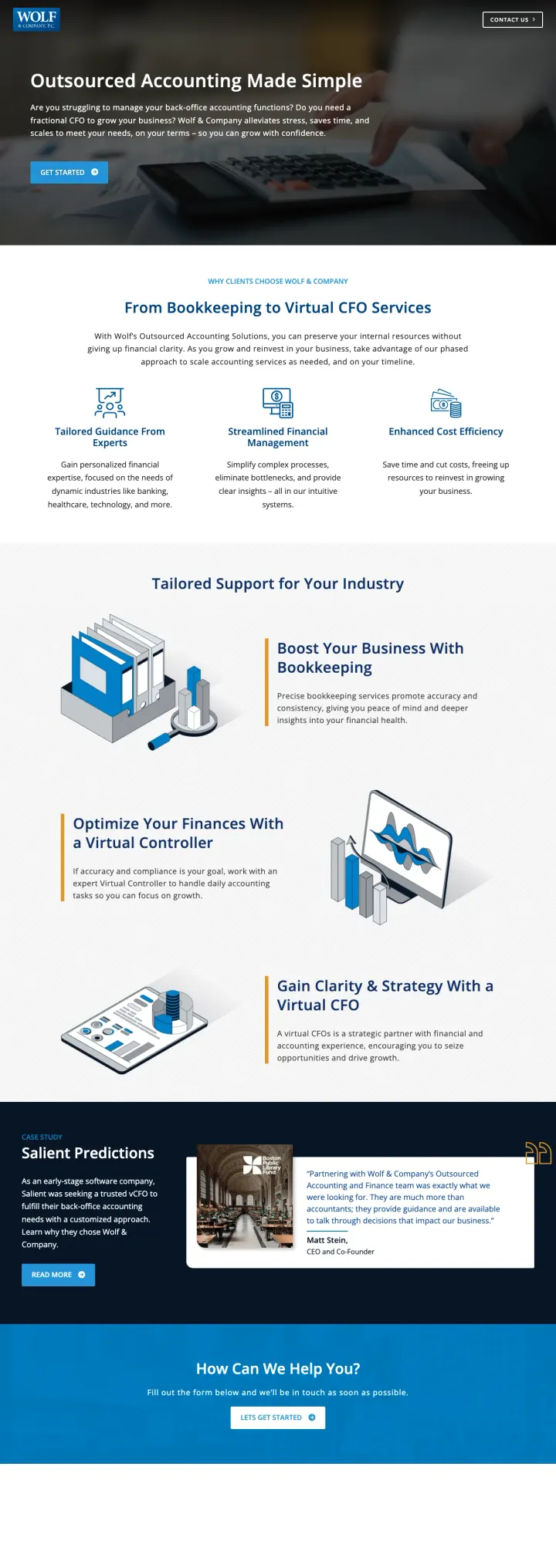
Wolf & Company is a CPA firm rather than a software product, and it earns its place with the ladder it draws from bookkeeping up to a virtual CFO. A visitor can see where they get on and where they would end up, which makes the first step feel small. Nothing from the hero down to the closing form hints at what any rung costs.
Frame outsourced accounting as "getting your business back" rather than "cutting costs." Wolf opens with "Outsourced Accounting Made Simple" and the value proposition "so you can grow with confidence." Then show three service tiers (Bookkeeping, Virtual Controller, Virtual CFO) that scale with the client's growth, making it feel like a partnership rather than a vendor relationship.
- +
Services climb from books to CFO growth pathone afternoon
From Bookkeeping to Virtual CFO ServicesBookkeeping, then a virtual controller, then a virtual CFO. An owner sees where they get on and where they end up, which turns the first purchase into a start rather than a commitment. Draw the same ladder and let people join at the bottom rung.
- +
Headings name worries, not features answers doubtseasy
Enhanced Cost EfficiencyTailored Guidance From Experts, Streamlined Financial Management and Enhanced Cost Efficiency are what an owner fears before handing over the books: will they understand my business, will this be a mess, will it cost more than my bookkeeper. Name your headings after the worry.
- +
Opening block names three industries made relevanteasy
Tailored Support for Your IndustryBanking, healthcare and technology get named up front, and a reader in any of them stops skimming. Everybody else keeps skimming, and that is the trade you make on purpose. If your ad group targets an industry, name that industry on the page the ad points at.
- ✕
Outsourced accounting shows no price no pricinga pricing call
This work runs from a few hundred a month to a serious retainer, and the page will not hint at which end it sits at. Outsourced accounting buyers split two ways: the small budget books a call and leaves disappointed, the real budget wonders whether you are big enough.
- ✕
Button label says nothing about next vague CTAeasy
GET STARTEDStarted with what, and what happens after I press it. The label answers neither, and on a page selling a professional service the unknown next step stops the click. Say what the button does: book a call, get a quote, see the pricing.
- ✕
Case study finishes on another page proof one step awayone afternoon
Learn why they chose Wolf & Company.Salient Predictions gets a heading, a paragraph of setup and a READ MORE button. Beside it a quote signed with a job title and no company sits over a photo badged for a library fund, so nobody can tell whether the words are Salient's. Put the outcome in the block.
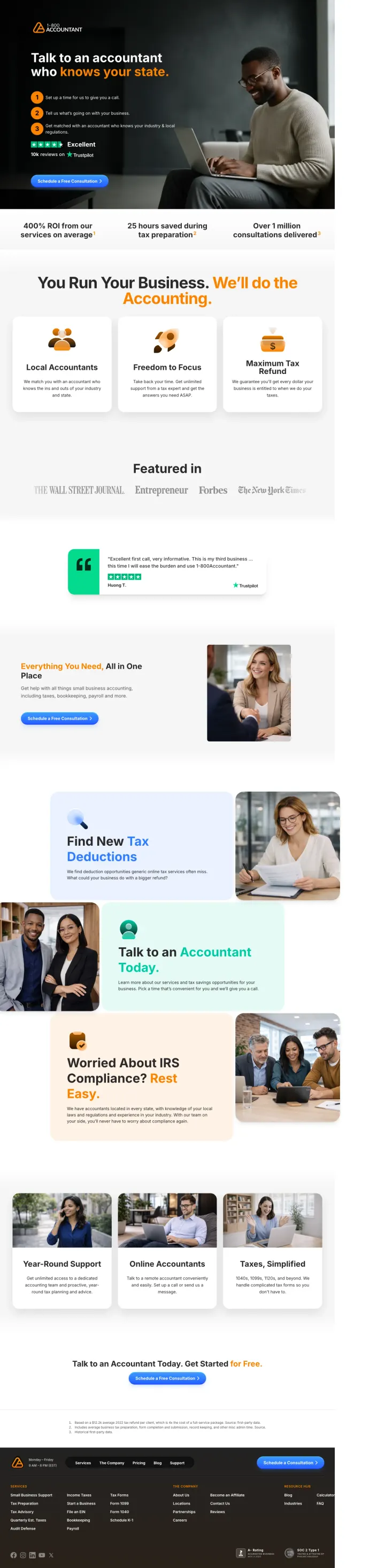
A national service that reads as a local one is a hard trick, and this page pulls it off in the headline alone. The Trustpilot rating sits in the first screen where the doubt is, not down near the footer where most of this file keeps its reviews. The catch is that the same template answers a San Diego search and every other city too.
Lead with "Talk to an accountant who knows your state" to create localized relevance from a national service. Then show a 3-step process (Set up a call, Tell us about your business, Get matched with a state-specific accountant) to make the conversion path feel simple and structured.
- +
Headline answers what local search asks message matcheasy
Talk to an accountant who knows your state.The ads behind this page are bought on city and state terms, and the headline answers what a local search really asks: will this person know my rules. It costs nothing to write and beats a national tagline. Put the searcher's own words at the top.
- +
Trustpilot rating lands in first screen reviewshard to earn
ExcellentIt sits under the steps, and it comes from a board this company does not control. That is the difference between a score and a testimonial you wrote yourself. Almost every other page here keeps reviews below the fold, so the top is cheap ground to take.
- +
Stat bar footnotes its own claims quantified proofhard to earn
25 hours saved during tax preparationReturn on the fee, hours saved at tax time, consultations delivered. The band sits straight under the hero, every claim is countable, and each carries a marker pointing at a footnote. Read them and the source is their own data, thinner than it looks. They still printed it.
- ✕
Local promise names no state anywhere unproven claimone afternoon
We have accountants located in every state, with knowledge of your local laws and regulations and experience in your industry.The promise is strong and the page never backs it up: no state named, no accountant named, no office anywhere, and the faces in the photographs are stock. A visitor from San Diego takes it all on faith while deciding. Name the people, or at least the places.
- ✕
National template serves the geo ads message matchneeds a developer
The ad says San Diego and the page says your state, which is a national template doing a local page's work. It converts worse and always will, because your visitor can tell. Buying city keywords means building the city page: a local number, local names, the city in the headline.
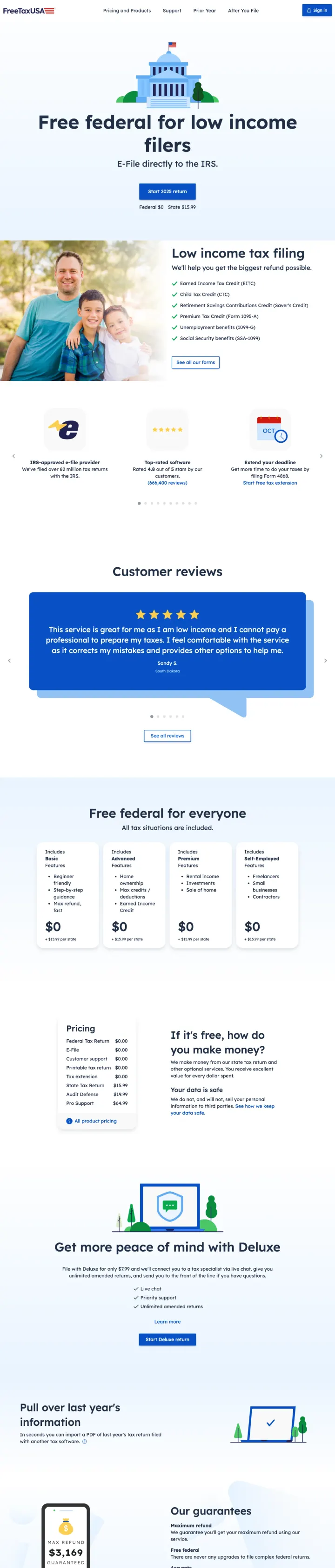
FreeTaxUSA leads with a price and lets the price do the whole job, which is how it sits in this file beside pages carrying far more. Federal costs nothing, the state fee is printed right beside it, and a line further down promises there will never be an upgrade to file a complex federal return. The page then widens the same free offer to everybody, which quietly undoes the targeting in its own headline.
Why this breaks the rules: Every other tax software page in this set uses tiered pricing to capture value at multiple levels. FreeTaxUSA leads with 'Free federal for low income filers' and means it - $0 federal, $14.99 state. This radical price transparency eliminates the entire pricing objection and the entire comparison-shopping behavior because there is nothing cheaper than free. The page does not need testimonials, credentials, or a badge wall because the price IS the proof.
- +
Promise names what they never charge answers a worrya pricing call
There are never any upgrades to file complex federal returns.Everybody who used a free tax product has been walked into a paid one halfway through a return. This page says flatly it will not happen. If your free tier really is free, say what you will never charge for. That beats another feature bullet.
- +
Opening review uses the bid keywords reviewshard to earn
This service is great for me as I am low income and I cannot pay a professional to prepare my taxes.The carousel opens on a customer using the exact words the page bids on: low income, cannot pay a professional. Her first name and her state sit under it. That is ad copy written by somebody with nothing to gain. Search your reviews for the phrase you are buying.
- +
Page asks about the catch itself prices up fronteasy
If it's free, how do you make money?It asks how a free product makes money and answers in a sentence, with a price list beside it: federal, e-file, support and a printed return at nothing, then state, audit defence and pro support priced. The Deluxe tier sits further down. Nobody hunts for the catch.
- ✕
Same page widens its own offer mixed messageeasy
Free federal for everyoneUp top the offer is free federal for low income filers. Further down it becomes free federal for everyone. Both are true, and together they undo the targeting: the visitor who clicked because the ad spoke to them learns the deal was never theirs. Keep the wider offer elsewhere.
- ✕
Low income goes undefined throughout unanswered questioneasy
Free federal for low income filersThe block under the hero lists the credits it covers, from the earned income credit to Social Security benefits, and never says what counts. Doubt at the moment of choosing loses the click you paid for. Put the qualifying line under the offer and let people rule themselves in.
- ✕
Header carries the whole site menu exit routesone afternoon
Pricing and Products, Support, Prior Year, After You File, and a Sign in button. Every item on this paid landing page is a way out before the visitor starts. Somebody arriving from an ad has one job. Cut the header back to your logo and the start button.
What the winners keep doing
Wildcards
Pages that break the playbook in interesting ways
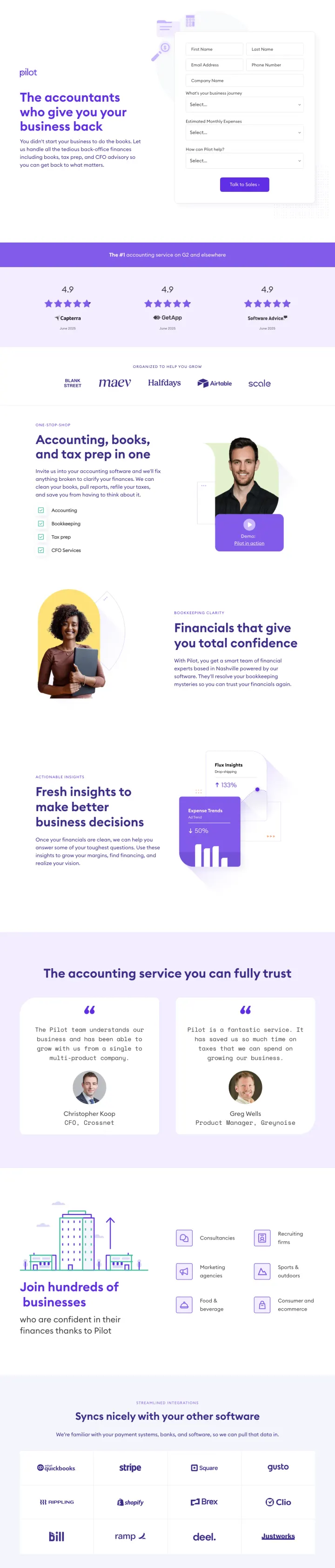
Why This Is Interesting: Pilot's form asks for First Name, Last Name, Email, Phone, Company Name, Business Journey Stage, Monthly Expenses, and "How Can Pilot Help?" - 9+ fields. For a consumer tax product this would be conversion suicide. But for a B2B accounting service targeting startups spending $10K-$500K/month, aggressive qualification makes sense because each lead is worth $3K-$50K/year in revenue. The form IS the qualifying mechanism.
- answers doubts
"The accountants who give you your business back" headline reframes accounting from a cost center to a value enabler. The visitor thinks "I am losing my business to bookkeeping" and this page says "we give it back."
- price framing
"What's your business journey?" and "Estimated Monthly Expenses" dropdown fields pre-qualify the lead for the sales team, ensuring the conversation starts at the right level
- reviews
Triple review platform display (Trustpilot, Clutch, G2) below the fold with star ratings from three independent B2B review platforms creates enterprise-grade trust
- extra steps
9+ form fields will produce a high abandonment rate. Even for high-value leads, fields like "Estimated Monthly Expenses" may feel invasive before any relationship is established.
- wrong promise
No pricing or pricing range visible. Startup founders comparison-shopping bookkeeping services want at least a ballpark before committing to a sales call.
- wrong promise
"Talk to Sales" CTA button feels transactional rather than consultative. "Schedule a Free Strategy Session" would better match the advisory positioning.
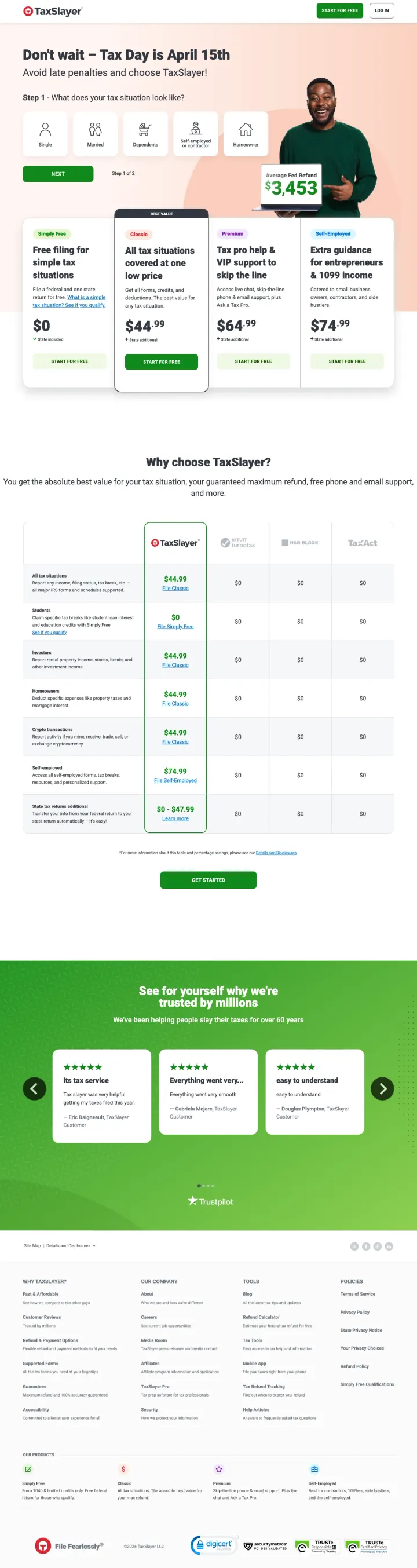
Why this breaks the rules: Most tax software landing pages open with a three-column Simply Free / Classic / Premium plan table. This page opens with five persona icons (Single, Married, Dependents, Self-Employed, Homeowner) and asks 'What does your tax situation look like?' The persona picker front-loads qualification so the recommendation feels custom, not sold. It also lets the $3,453 average refund figure appear once, centrally, rather than being repeated per-plan.
- made personal
Persona icons (Single / Married / Dependents / Self-Employed / Homeowner) replace the generic plan comparison. The visitor's life situation is more memorable than a feature matrix, and the click that follows self-segments them into the right plan path
- guarantee
A single central stat ('$3,453 average refund') with a photo of a happy filer anchors the page emotionally in a way that the usual three-tier price table cannot. Repeated stats across plans become noise, one central stat becomes a promise
- answers doubts
The Step 1 of 2 progress indicator at the bottom reframes the landing page as the first step of the product, not a marketing page. The commitment to continue feels smaller because the visitor is already inside the experience
- wrong promise
Hero headline 'Don't wait, Tax Day is April 15th' sells the deadline, not what you get. A benefit headline ('Find the filing option that matches your life in 30 seconds') would serve the persona-picker design better
- focus
The plan cards below the persona picker (Simply Free / Classic / Premium / Self-Employed) reintroduce the feature-matrix logic the persona picker was trying to replace, which dilutes the wildcard approach
Compare the winners
The same questions asked of every winner, so you can find the row that matches the traffic you are already buying.
| Page | Entry path | Named offer | Rating in the first screen | Phone in the first screen | Standout move |
|---|---|---|---|---|---|
| #1TaxSlayer | Straight into filing | Yes | No | No | Tier prices in the hero |
| #2Back Office | Book a demo | No | No | No | Quotes from named venues |
| #3Pilot | Lead form in the hero | No | No | No | Logos that pick the buyer |
| #4TaxAct | Start Filing button | Yes | Yes | No | Guarantee before price |
| #5Wolf & Company | Get Started button | No | No | No | Bookkeeping to CFO ladder |
| #61-800Accountant | Schedule a free consultation | No | Yes | No | Local promise, national page |
| #7FreeTaxUSA | Start the return | Yes | No | No | Free federal, priced state |
Read the keywords you are buying, then find the row that matches them. Somebody typing a brand name and the word login is already a customer, and the page they land on should get out of the way and start the job. Somebody typing accountant near me has not chosen anybody yet, so they want a name, a place, a credential and a price. You paid the same for both clicks.
The copy bank
Lines lifted word for word from the pages above. We tell you whose page each came from, and one click copies it.
GET STARTED
Get in Touch
Book your cost-free demo with our team
Losers
3 pages burning ad spend with fundamental issues
Every click to these pages costs real money. We found pages with no reviews or badges anywhere, headlines that ignore what the searcher actually typed, and CTAs that give no reason to click. Here is what to avoid.
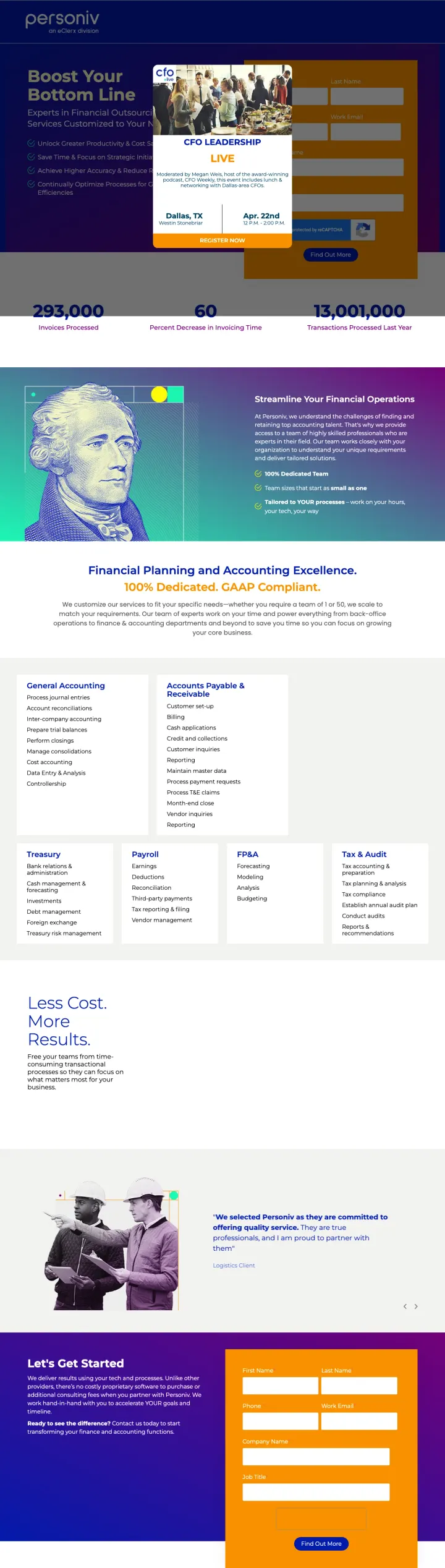
At $15-40 per click for accounting keywords, sending traffic to a page with a dark blue/purple/gold color scheme, a stock photo of a US dollar bill with Benjamin Franklin, and a headline that says 'Boost Your Bottom Line' is paying premium CPCs for a page that looks like it was built in 2015 and says nothing specific about what the service actually does.
- looks off
The hero section uses a dark gradient with a stock image of US currency (Benjamin Franklin on the $100 bill) that looks like a 2010-era financial services template - this visual execution actively undermines any trust the page tries to build because it signals 'we have not invested in our own marketing'
- wrong promise
The headline 'Boost Your Bottom Line' could apply to literally any business service - it communicates zero about what Personiv does, who they serve, or why their accounting outsourcing is different from any other provider
- wrong promise
'100% Dedicated GAAP Compliant' appears mid-page as a highlighted banner but GAAP compliance is the legal minimum, not a differentiator - advertising GAAP compliance is like a restaurant advertising that they wash their hands
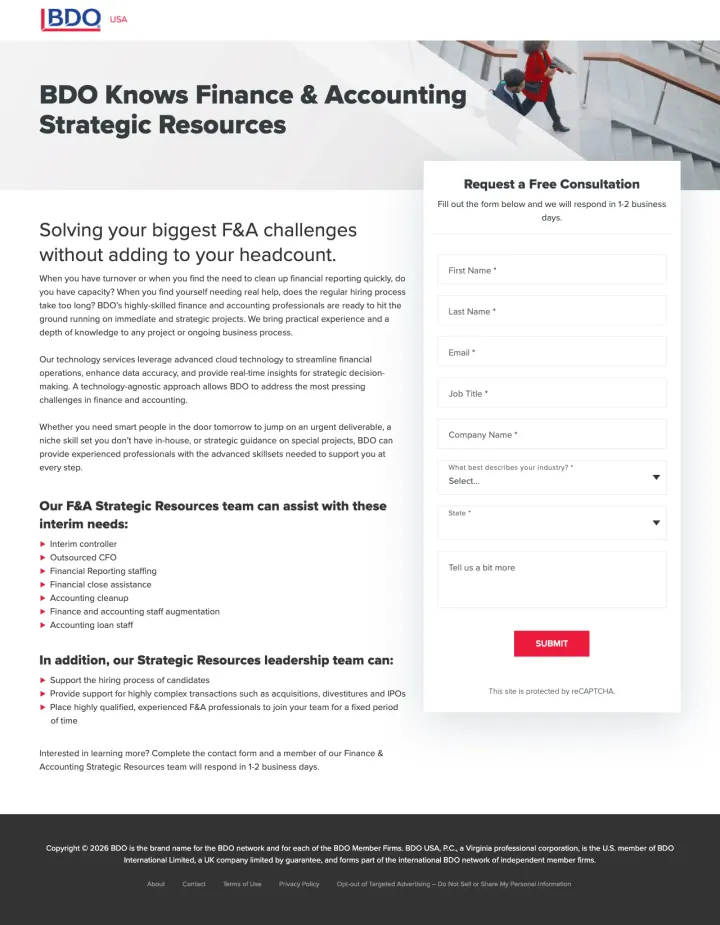
At $15-40 per click for bookkeeping keywords, BDO sends traffic to a single-page form with dense paragraph text and zero visual proof of capability. The page asks for first name, last name, email, job title, company name, industry, and state before the visitor has any evidence that BDO can solve their problem. This is a lead capture page, not a landing page.
- looks off
The page is a single-column form with dense paragraph text and one stock photo of a woman jogging up stairs - there are no testimonials, no client logos, no case studies, no credentials, and no evidence that BDO has ever successfully delivered F&A services to anyone
- no proof
The form demands 8 fields (name, email, job title, company, industry, state, description) before the visitor has seen any proof of BDO's capability - this is asking for maximum information while providing minimum value in return
- wrong promise
The ad targets small business queries like 'bookkeeper for shopify' but the page language is enterprise B2B ('F&A challenges,' 'headcount,' 'strategic resources') creating a jarring mismatch between the visitor's context and the page's tone
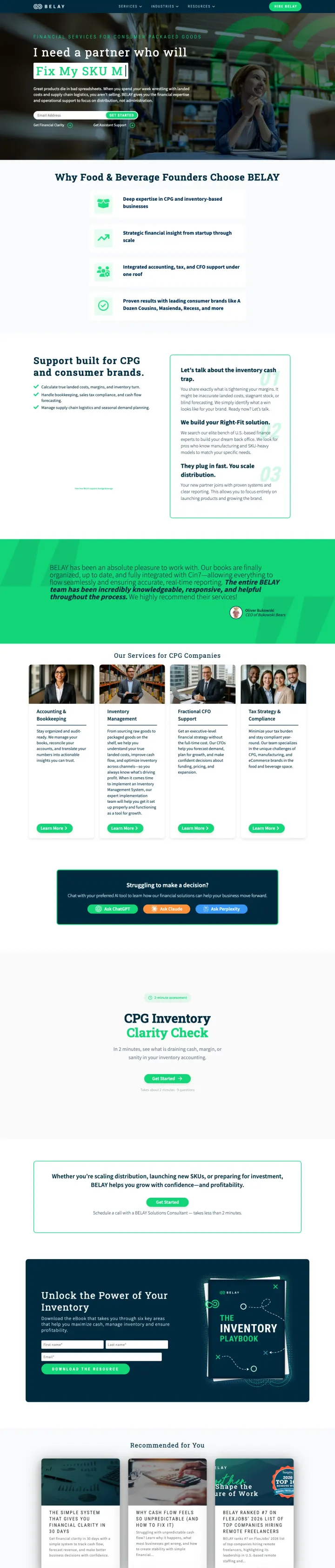
At $15-40 per click, the page targets 'retail accounting help' and 'CPG inventory experts' but leads with a dark hero asking visitors to 'Book a consult' before explaining what BELAY actually does differently. A CPG brand owner searching for accounting help gets industry buzzwords ('multi-warehouse reports,' 'SKU-level cost accounting') without any evidence of outcomes or pricing.
- extra steps
The page uses alternating dark green/teal panels with light sections creating a fragmented visual experience - the visitor's eye has no clear path from headline to value proposition to form, and the dark panels make body text difficult to scan
- missing proof
The hero section says 'Financial Services for Consumer Packaged Goods' but the ad copy promises 'Multi-Warehouse Reports' and 'CPG Inventory Experts' - the page headline is generic category labeling while the ad makes specific capability claims that are not immediately visible on the page
- too much at once
The form appears mid-page but is preceded by multiple content sections that explain what CPG accounting involves rather than why BELAY is the right provider - the visitor already knows they need CPG accounting (they searched for it); they need to know why BELAY specifically
What we learned
Tiered pricing cards with feature comparisons let visitors self-select without calling sales
The strongest tax software pages display 3-4 pricing tiers side by side (Free / Classic / Premium / Self-Employed) with feature bullet points under each tier. This works because the comparison-stage accounting buyer needs to compare options systematically, and pricing tiers let them do that comparison on YOUR page rather than opening a competitor tab. Pages that hide pricing behind 'Get a quote' or 'Talk to an expert' force the methodical buyer to leave and find a competitor who shows the numbers.
Industry-specific accounting pages outperform generalist pages by matching the search query exactly
When someone searches 'restaurant accounting services' and lands on a page headlined 'Expert-Led Restaurant Accounting Services' with restaurant-specific metrics (food cost, labor percentage, 13-period accounting cycles), the message match is immediate. When the same person lands on 'Boost Your Bottom Line' with generic outsourcing language, they have to determine whether this firm even understands their industry. The restaurant-specific page (bepbackoffice.com) has 4,000+ restaurant operators as clients; the generic page (personiv.com) claims 293,000 transactions but in what industry?
Named team members with credentials build trust that brand logos cannot replicate
Pilot.com shows a named co-founder testimonial ('I never have to think about it' - Trevor Thomson, Ethos Network) and names their team as 'financial experts based in Nashville.' 1800accountant.com leads with 'Talk to Your Advisor' and shows a photo of a specific person. In accounting, you are trusting someone with your financial records and tax filings. A named person with a location makes the relationship feel real; a faceless brand with client logos makes it feel like a call center.
Switching-focused messaging addresses the inertia that keeps people with bad accountants
TaxSlayer's entire landing page is built around 'We make switching easy' with a 3-step process (import prior return, upload W-2, start filing). This is brilliant because the biggest barrier in accounting is not finding a new provider, it is leaving the old one. The Green-secondary persona in accounting dreads the transition and will stay with a mediocre accountant for years rather than face the perceived hassle of switching. Pages that explicitly address the switching process convert the large segment of visitors who have already decided to leave but have not yet overcome the inertia.
Winners lead with specific guarantees (max refund, flat-rate pricing, state-specific expertise) and transparent pricing tiers that let visitors self-select. Losers send paid traffic to generic content pages, gated whitepapers, or educational articles that explain accounting concepts without enabling the visitor to take action.
If you're building a page like these yourself, here's my comparison of AI landing page builders, with prices and what each one is best for.
Building pages like the winners is half the job - our accounting PPC team handles the other half, the traffic.
What the accounting winners taught us
The pages that work here pick the question the visitor actually came with (what does it cost, will you know my rules, can I trust you with my books) and answer it in the first screen. The ones that struggle sell a demo instead, and the price the ad promised turns up nowhere on the page.
- 1
Put the price on the page, or stop promising it in the ad. Back Office and Pilot both bought clicks with the words flat rate, then made the visitor book a call to hear a number. That is the most expensive gap in this file: you pay for the click, you match the ad, and then you break the promise in the first screen. A starting-from figure costs nothing and it filters out the people who were never going to pay it.
- 2
Not a single page here puts a phone number in the first screen. A company in this file carries a toll-free number inside its own logo, and even that page prints nothing you can ring. These firms are asking for your bank feeds, your payroll and your tax records. A business owner handing that over wants to know a human picks up. Put a real number in the header at a size you can read, give it its own tracking, and you will find out quickly how much of this traffic wanted to talk rather than fill in a box.
- 3
Show something a stranger could go and check. A review score is the only proof anybody here puts up top. Not a first screen in this file carries a practice licence, a state registration or an accreditation, and where one turns up at all it is a small badge in the footer. Most of what sits down there is a padlock anyway: DigiCert, PCI, TRUSTe. Those say the connection is encrypted, not that anybody is qualified. Your licence takes a line, and that line is the difference between a claim and a fact.
- 4
Move the reviews above the fold. Most of these pages have plenty of reviews and keep them a long scroll down. TaxSlayer runs a review carousel and a Trustpilot score right down beside the footer, and gives the first screen to guarantee icons and price cards instead. Accounting is bought on trust before it is bought on price, so the score belongs beside the button.
Score your own accounting page
Every line below came off a screenshot somebody sat and counted. Open your own page beside it and tick what it already does.
Now point postclick at your own page
Accounting clicks cost $15-40 each. Personiv pays that, then lands people on a stock photo of Benjamin Franklin and a headline reading 'Boost Your Bottom Line'. That headline could be a gym, a law firm, anyone. So what's yours doing? Give postclick the URL your accounting ads point at. It reads that page cold, the way someone who just clicked does, names what's costing you the enquiry, and draws new versions you can build.