We analyzed 71 cleaning service landing pages. Only 5 are worth stealing from.
We read 71 cleaning pages that were paying for Google Ads clicks, top to bottom. These 5 are the ones worth your time. Everything we found is here, free.

71 landing pages screened
From real cleaning services Google Ads campaigns in the US
5 winners curated
The landing pages actually worth stealing from
2 burning money
So you know exactly what to avoid
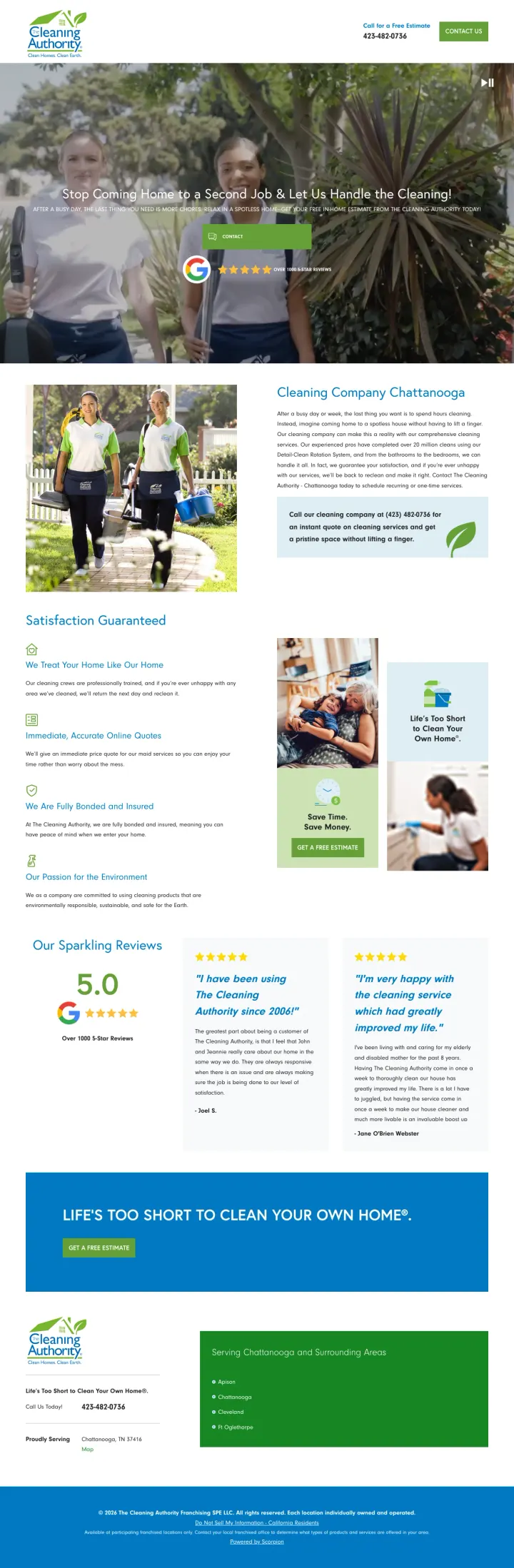
The Cleaning Authority runs the Chattanooga franchise page, and it took the top slot on proof rather than price. The hero video plays two uniformed cleaners standing in a front garden with their equipment, and under the headline sits the Google mark, a row of gold stars and a review count, all inside the first screen. What follows is the reason the whole page holds together: a guarantee that names the recourse, come back the next day and reclean it, instead of a badge saying satisfaction guaranteed.
Lead with a specific satisfaction guarantee that names the exact recourse ('we will return the next day and re-clean it') rather than a vague 'satisfaction guaranteed' badge. The specificity is what converts nervous first-time buyers.
- +
Guarantee names the crew's next move guaranteeeasy
Our cleaning crews are professionally trained, and if you’re ever unhappy with any area we’ve cleaned, we’ll return the next day and reclean it.Every cleaner on the results page says satisfaction guaranteed, so the words stopped meaning anything. This one says what happens instead: the crew comes back, the next day, to the area you complained about. Write out what you do when somebody is unhappy, and put the deadline in the sentence.
- +
Google stars sit inside the first screen reviewshard to earn
Over 1000 5-Star ReviewsThe Google mark, gold stars and the review count all sit under the headline, above every explainer on the page. It comes from a place your visitor can go and read without taking your word for anything. Get the badge above the fold.
- +
Four worries answered down one column answers doubtsone afternoon
We Are Fully Bonded and InsuredUnder the fold the page stacks four headings: they treat your home like theirs, quotes come back immediately, they are bonded and insured, the products are safe. Each one is a different reason somebody hesitates before letting a cleaner in. List your own four objections and give each a heading.
- ✕
No lead form sits anywhere on this page hard to actone afternoon
Get A Free EstimateEvery ask is a link: contact in the header, contact in the hero, get a free estimate in the green card, and again in the blue band at the foot. Somebody comparing three cleaners at eleven at night cannot leave a name. Put a short form on the page.
- ✕
Review score links nowhere at all weak proofeasy
The block headed "Our Sparkling Reviews" draws the score big in green with the Google mark and the count under it, and none of it links anywhere. Two quotes sit beside it, signed "Joel S." and "Jane O'Brien Webster". Link the score to the profile.
- ✕
Franchise brochure replaces local detail loses focusone afternoon
Detail-Clean Rotation SystemBelow the hero comes what the rotation system is, how many cleans the company has done nationally, a passage on environmental products. None of it belongs to Chattanooga and none says what a clean costs or covers. Everything under your offer should still be selling the offer.
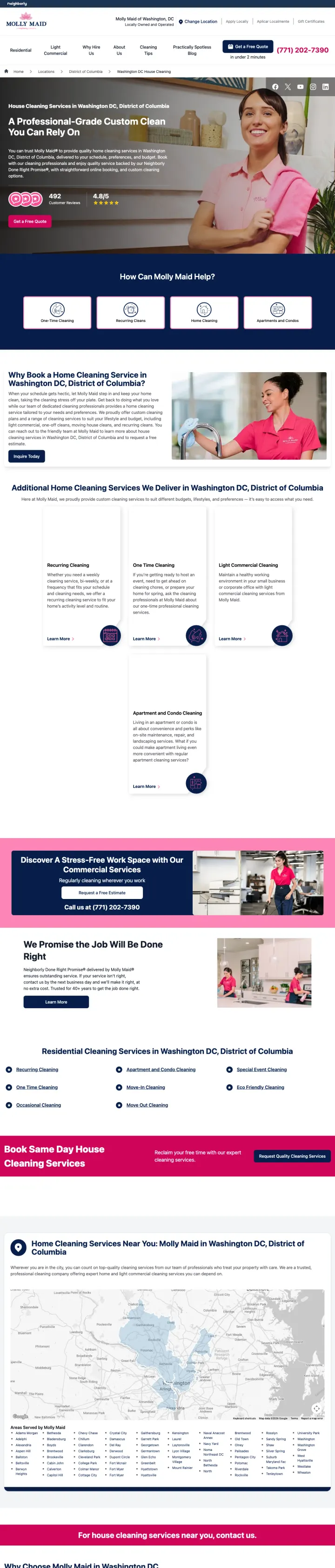
Molly Maid of Washington DC gives the fold more work than anybody else here. The pink phone number sits at full size beside the quote button, the review count and the score sit under the paragraph with their stars, and a promise of a quote in under two minutes rides under the button. Then the page keeps going for a very long way, through service cards, a service area map, a gift certificate block and a stack of frequently asked questions, and every exit in the site navigation stays open the whole time.
Display your exact review count with star rating immediately below the hero headline (not in a sidebar or footer). '492 Customer Reviews, 4.8/5' with visual star icons is more persuasive than a generic 'highly rated' claim because it gives the visitor a real number to compare every other cleaner against.
- +
Count, score and stars share one line reviewshard to earn
Customer ReviewsThree things sit side by side under the opening paragraph, with a divider between them. Any one alone can be waved away. A count with a score on it is a claim somebody could go and check. Put all three in your own hero.
- +
Quote button promises how long it takes fewer stepseasy
Under the quote button in the navigation is a small line saying the quote takes under two minutes. The fear is not the form, it is that a form starts a phone call you did not want. Time your own form, then print the number.
- +
Navy strip lets visitors sort themselves makes it easierone afternoon
A band under the hero asks how the company can help and gives four outlined cards: one time, recurring, home cleaning, apartments and condos. A move out clean and a weekly subscription are different purchases. Split the visitor early, then write the ad group around whichever card gets clicks.
- ✕
Whole website navigation rides on top too many linkseasy
This paid landing page carries residential, light commercial, why hire us, about us, cleaning tips and a blog, plus change location, apply locally and gift certificates in the row above. Every one is a door out, paid for by you. Strip the header to the logo and the quote button.
- ✕
Office cleaning band interrupts a home page wrong audienceeasy
Halfway down, a pink band headed "Discover A Stress-Free Work Space with Our Commercial Services" sells to somebody who searched for a house cleaner, with a photograph of an office and its own estimate button. Every block under your headline should answer the search that paid for the click.
- ✕
Every quote link loads a separate page extra stepsone afternoon
There is no form anywhere, on the longest page in the file. Get a free quote, inquire today, request an estimate and request quality cleaning services all load the same estimate page. Put the first field where the visitor already is.
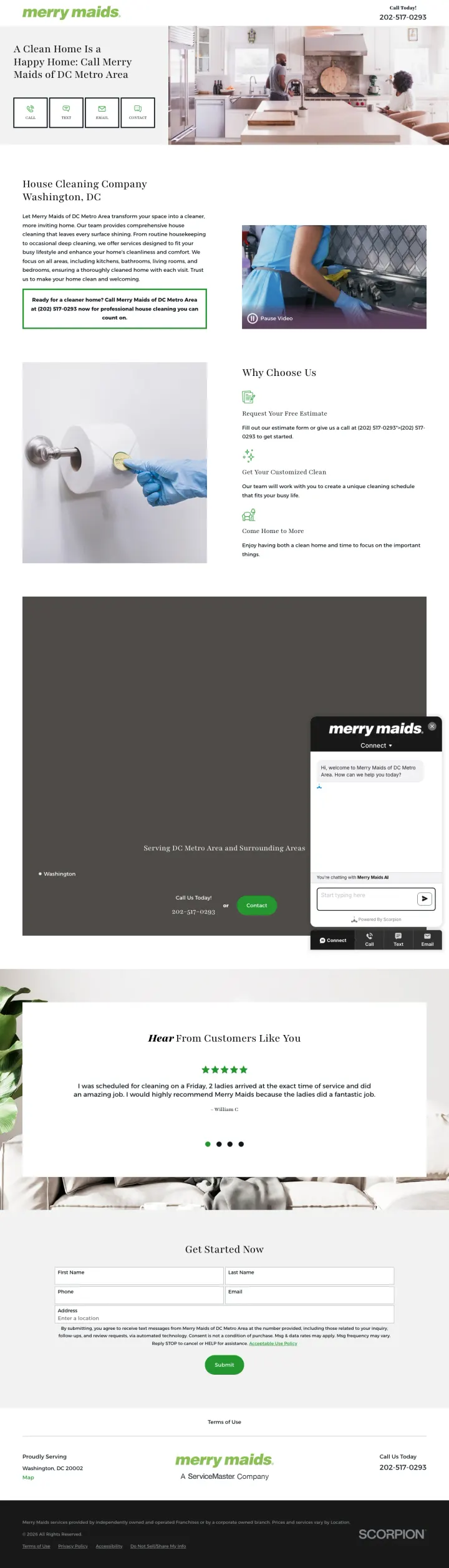
Merry Maids of DC Metro Area answers a question the other pages leave hanging: how do you want to get in touch. Under the headline sit four outlined tiles reading CALL, TEXT, EMAIL and CONTACT, the same size as each other, so the person who will not ring and the person who will not type both get a door. The rest of the page is a short explainer, a three step how it works, a testimonial slider and then the form, right down at the foot.
Deploy a branded AI chat widget that opens automatically with a localized greeting ('Hi, welcome to Merry Maids of DC Metro Area. How can we help you today?'). The visitor who hates filling out forms and hates waiting on hold gets an answer straight away, with nothing to fill in and nobody to call.
- +
Call, text, email and contact drawn level fewer stepseasy
Under the headline sit four outlined tiles, the same size with the same border. Nobody is nudged. The person ringing round on a lunch break takes the first one, the person who will not speak to a human takes the last. Draw yours level.
- +
Three steps run beside the photo makes it easiereasy
Come Home to MoreRequest an estimate, get a customised clean, come home to more. Three headings with a line each and a green icon on top, run down the right of a photo, headed Why Choose Us. Booking a cleaner feels complicated. Write your own three.
- +
Phone number repeats inside the body copy hard to acteasy
Ready for a cleaner home? Call Merry Maids of DC Metro Area at (202) 517-0293 now for professional house cleaning you can count on.A boxed line in the reading carries it again, rather than up in the header where headers get ignored. Somebody scanning a paragraph and deciding to act should not travel back to the top to find you. Drop your number where they convince.
- ✕
Form asks for a street address up front too many stepseasy
AddressIt ends on a full width box labelled Address, with "Enter a location" sitting in it in grey. That is a survey question, and it lands on what makes people nervous about this purchase. Ask for the address on the phone instead.
- ✕
Only form sits right above the footer hard to actone afternoon
It waits below the explainer, the reasons block, the map band and the testimonial slider. Everything before it is a tile or a link. Somebody who wanted to type rather than ring reads the whole page first. Repeat the form beside the headline.
- ✕
Chat widget opens itself over the page covers the pageeasy
You're chatting withThe assistant takes the bottom right corner, and on our capture it sits on top of the band it interrupts. A visitor who wanted to read gets a decision first. Measure the bookings it produces against the ones it interrupts.
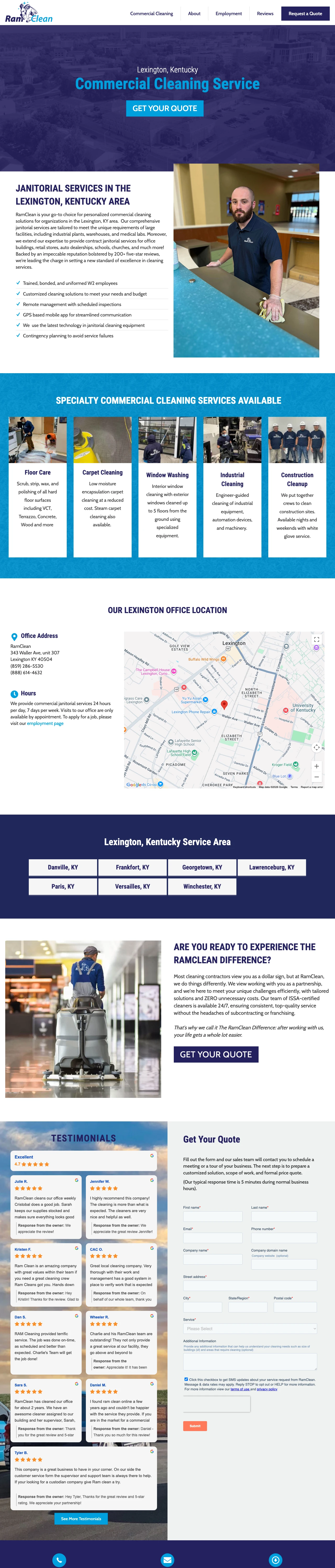
RamClean is the only commercial page in this file, and it sells to a facility manager rather than a householder. The hero over a purple washed aerial of Lexington names the city and the service and nothing else. The argument arrives in the ticked bullets underneath, W2 employees, scheduled inspections, a GPS based app, contingency planning, which is the language somebody buying a cleaning contract actually uses. The Google review wall further down sits directly beside the quote form, and that is the best piece of staging on the page.
Lead with your employment model ('trained, bonded, and uniformed W2 employees') as the primary differentiator rather than burying it in a bullet list. For commercial cleaning buyers evaluating janitorial contracts, employee-vs-contractor status is the single biggest liability and quality signal.
- +
Bullets speak to whoever signs the contract positioningone afternoon
Remote management with scheduled inspectionsTrained, bonded, uniformed W2 employees. Remote management with scheduled inspections. A GPS based mobile app. Contingency planning against a no show. Commercial buyers worry about the crew not turning up before a Monday audit. Write your bullets for whoever has to justify you.
- +
Review cards run down beside the form proof placementone afternoon
Response from the owner:The Google cards fill the left column and the quote form fills the right, so the last thing read before the first field is named reviewers with the owner replying underneath. Everybody else files reviews in a section of their own. Move yours closer.
- +
Reply time prints above the first field answers doubtseasy
(Our typical response time is 5 minutes during normal business hours).The doubt on a long form is not the questions, it is whether anybody reads it. A response time in brackets answers that at the moment it occurs to somebody. Measure your own reply time honestly, then print it above the first field.
- ✕
Quote request reads like a credit application too many stepsone afternoon
By the time somebody reaches the service dropdown they have given a street address split across separate boxes for city, region and postal code, plus their "Company domain name". Ask for the company, the name and the email. Get the rest on the call.
- ✕
Header carries no phone number at all hard to contacteasy
It holds the logo, four navigation links and a quote button. The first number turns up mid page in the office location block. A facility manager with an urgent problem is the buyer who rings. Put the number in the header, big enough to read.
- ✕
Review count arrives before the evidence proof too lateeasy
Backed by an impeccable reputation bolstered by 200+ five-star reviewsIt is asserted in a body paragraph just under the first screen, so the visitor meets the claim first. Everything checkable should arrive early. The Google wall carrying the score sits most of the way down. Put the score in the hero instead.
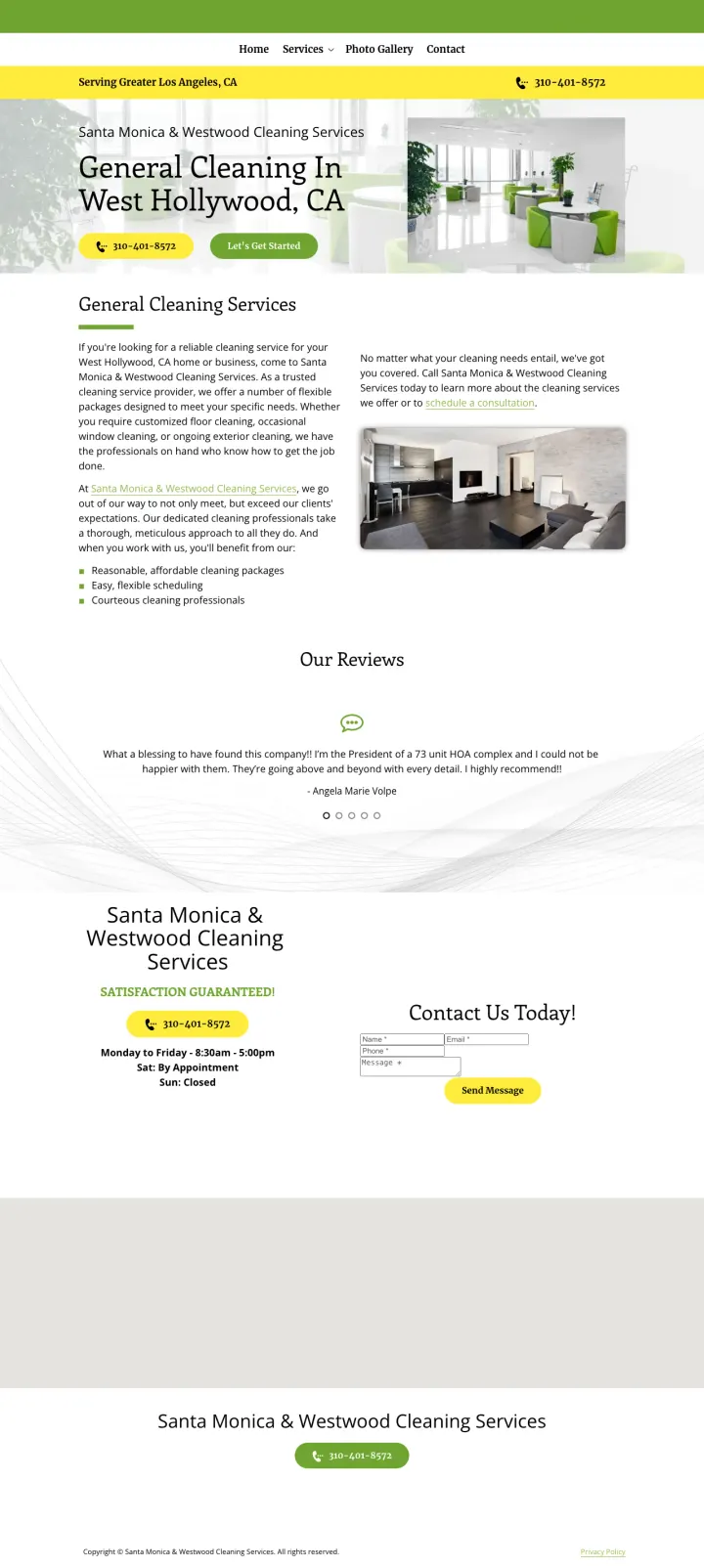
Santa Monica and Westwood Cleaning Services runs the shortest page in the file and the fastest one to read. A yellow strip across the top carries the service area on the left and the phone number on the right, and the hero underneath repeats the number as a button beside Let's Get Started. The form is the shortest here too. What it never does is give a stranger a single checkable reason to let a cleaner into the house.
Place a tappable phone-number button next to a 'Let's Get Started' button directly below your hero headline. Cleaning searchers split sharply between the 'I need someone today' caller and the 'I am comparing three companies' form-filler, and one CTA cannot serve both.
- +
Yellow strip puts the number above everything hard to acteasy
A band runs full width above the hero, service area on the left and phone on the right, and it is the brightest thing on the screen. The number repeats underneath as a yellow button, beside Let's Get Started. Yours costs an afternoon.
- +
Form asks four things and stops fewer stepseasy
Name, email, phone and a message. No address, no dropdown, no company field. It is the shortest form in this file, and the only one with a form at all that does not make a visitor hand over their street first. Cut yours down to what you need to reply.
- +
Opening hours print under the phone button answers doubtseasy
Monday to Friday - 8:30am - 5:00pmWeekday hours, then Saturday by appointment, then Sunday closed. Somebody deciding whether to ring at ten past five wants that answer before they dial. After it rings out is too late. Publishing the closed times reads as more honest than publishing the open ones. Put your hours under every phone number.
- ✕
Carousel hides reviews one slide at a time weak proofhard to earn
What a blessing to have found this company!!The section headed Our Reviews shows one quote at a time, with small dots underneath and nothing else: no stars, no score, no source. Whatever is on the other slides, a stranger will not click. Print a wall and link your Google profile.
- ✕
Packages promised but never named or priced no priceone afternoon
we offer a number of flexible packages designed to meet your specific needsThe page offers flexible packages, then never names one and never says what a general clean covers. Somebody choosing between you and two others this afternoon can only compare you by ringing. Name your packages, price them from, and list the rooms.
- ✕
Empty grey slab fills the space below the form looks brokeneasy
Contact UsToday!Below the contact form the page renders a tall rectangle with nothing in it, taller than the form above. A visitor reads a blank slab as a broken page, and that reads as a company that will not turn up. Open yours cold and scroll.
What the cleaning winners do
Wildcards
Pages that break the playbook in interesting ways
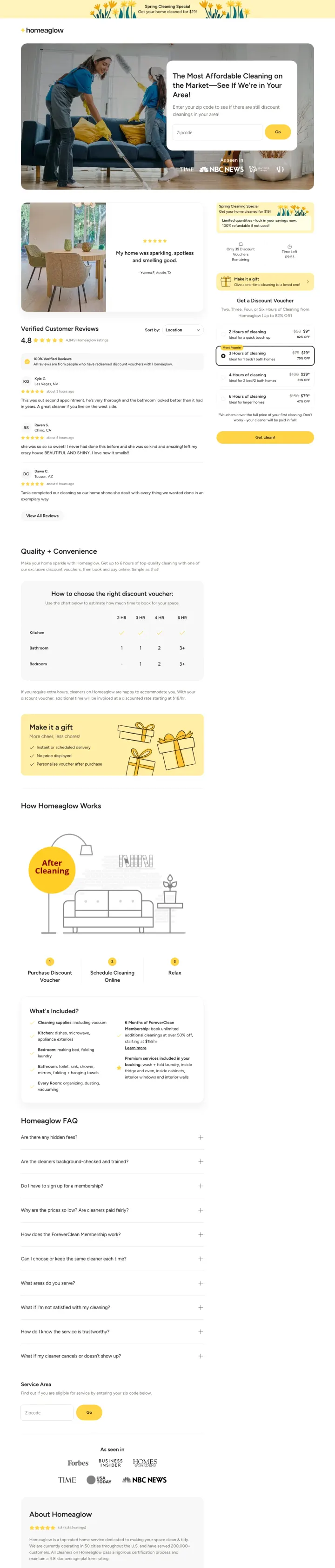
Lead with a price so low it feels impossible ('$19 for a 3-hour cleaning') and use a zip code checker as the primary CTA instead of a booking form. The zip code gate creates curiosity ('are they even in my area?') and micro-commitment simultaneously - the visitor is invested before they see the membership terms.
- made personal
Zip code checker as the hero CTA instead of a booking form - 'See If We're in Your Area!' turns availability into a discovery moment rather than a sales pitch, and the micro-commitment of entering a zip code makes the visitor more likely to continue through the funnel
- reviews
Time estimation chart (2 HR / 3 HR / 4 HR / 6 HR mapped to bathroom count and bedroom count) answers the 'how long will this take?' question with a visual matrix that helps visitors self-select the right service tier without calling to ask
- reviews
Media logo bar (TIME, NBC News, Forbes, Business Insider, USA Today) positioned immediately below the hero creates instant authority for a brand most visitors have never heard of - this is borrowed credibility that a local operator can never match but any VC-backed cleaning startup should replicate
- wrong promise
The '$19 first cleaning' requires a ForeverClean membership at $59/month, and canceling before 6 months means the first cleaning gets charged at full price - this is buried in fine print and will generate chargebacks and BBB complaints from visitors who feel tricked
- wrong promise
'Only 7 Discount Vouchers Remaining' with a 09:59 countdown timer resets on every page load - anyone who refreshes sees the trick, and then stops believing the parts of the page that are true
- no proof
No mention of background checks, insurance, or employee vetting anywhere above the fold - for a marketplace that connects strangers with your home, this is a critical trust gap that the media logos and review count cannot fully compensate for
Compare the winners
The same questions asked of every winner, so you can find the row that matches the traffic you are already buying.
| Page | The hook | Form fields | Rating before the scroll | Phone in the first screen | Asks for a street address | Standout move |
|---|---|---|---|---|---|---|
| #1The Cleaning Authority | A guarantee with the recourse named | No form | Yes | Yes | No form | The Google mark and the stars in the hero |
| #2Molly Maid | The score and the count under the headline | No form | Yes | Yes | No form | A quote promised in under two minutes |
| #3Merry Maids | Pick how you get in touch | 5 | No | Yes | Yes | Call, text, email and contact, all one size |
| #4RamClean | Bought like a contract, not a chore | 12 | No | No | Yes | The review wall sits beside the form |
| #5Santa Monica & Westwood | The number before the headline | 4 | No | Yes | No | A yellow strip carrying the phone |
Read the keywords you are buying, then find the row that matches them. Somebody typing house cleaning near me wants a price bracket and a phone number, because they are ringing round this morning and the cheapest one that answers gets the job. Somebody typing commercial janitorial services is buying a contract, sends it past a procurement person, and needs W2 employees, inspections and a named account manager. You paid the same for both clicks.
The copy bank
Lines lifted word for word off the pages above. We tell you whose page each came from, and one click copies it.
General Cleaning in West Hollywood, CA
House Cleaning Company Washington, DC
Reasonable, affordable cleaning packages
Get a Free Quote
Losers
2 pages burning ad spend with fundamental issues
Every click to these pages costs real money. We found pages with no reviews or ratings on them, mismatched intent, weak CTAs, and messaging that ignores what the searcher actually typed. Here is what to avoid.
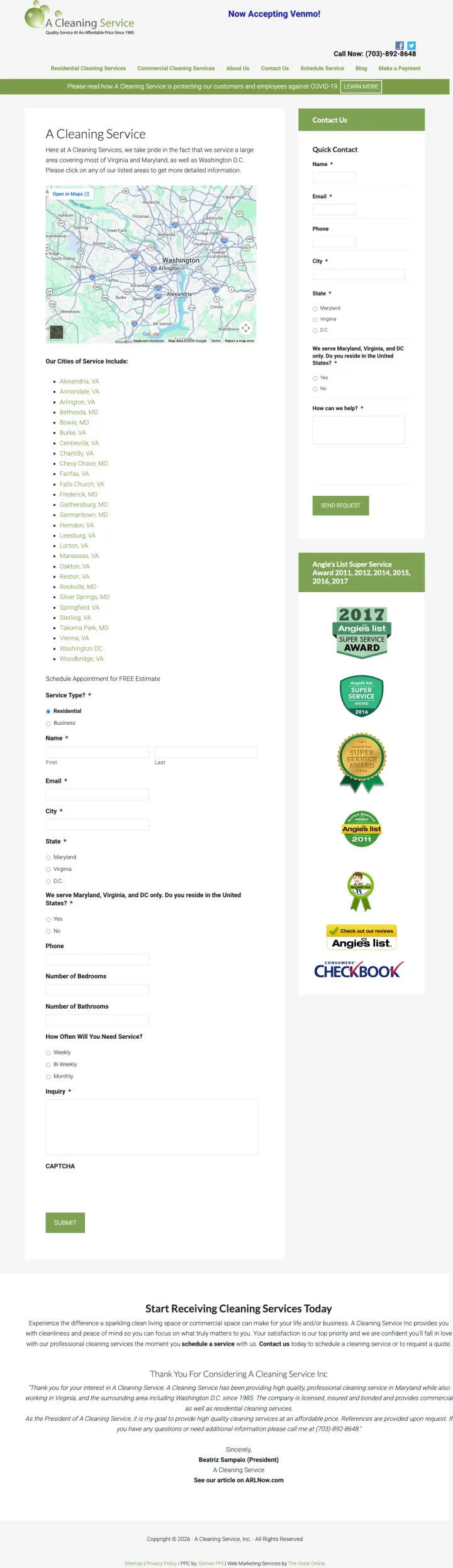
The ad promises 'DC's Best Housekeeping - Weekly and Monthly Cleanings' with '29 Years of Dependable Cleaning. We're Thorough, Consistent, Bonded, and Insured.' The page delivers an interactive Google Maps embed with a list of city links. None of the ad's promises (bonded, insured, 29 years, consistent) appear on the landing page at all. The visitor clicks expecting to book housekeeping and lands on a geographic directory.
- no proof
Ad claims 'Bonded and Insured' and '29 Years of Dependable Cleaning' but the landing page contains zero mentions of either - the strongest trust differentiators from the ad copy are completely absent from the page
- extra steps
The hero content is a Google Maps embed and a list of 50+ city links - the visitor searching 'house cleaning services montgomery county md' sees a geography lesson instead of cleaning service information
- wrong promise
The 'Now Accepting Venmo!' banner at the top of the page is the most prominent element - for a cleaning service, leading with a payment method rather than a service benefit signals misplaced priorities
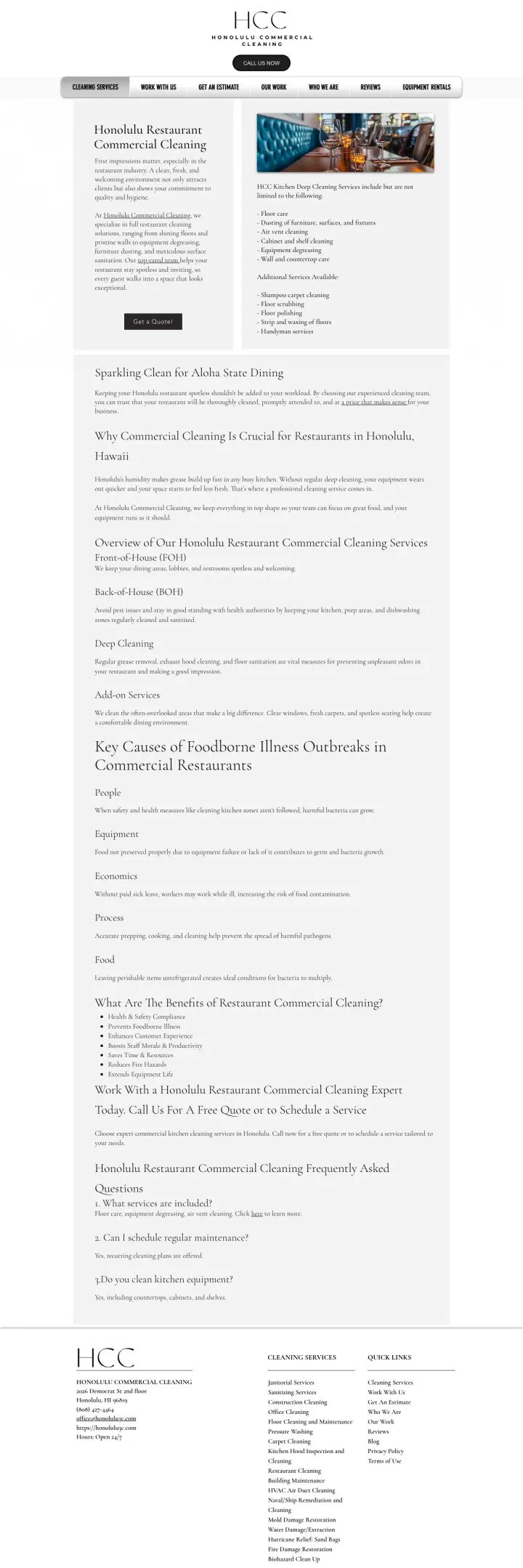
Ads target 'rangehood cleaning' and 'exhaust cleaning services' with headlines like 'Vent Hood Cleaning Services' and 'Kitchen Hood Cleaning.' The page is titled 'Honolulu Restaurant Commercial Cleaning' but reads like a health department educational pamphlet - sections on 'Key Causes of Foodborne Illness Outbreaks in Commercial Restaurants' and 'Overview of Hawaii Restaurant Commercial Cleaning Services' fill the page with SEO content instead of service details, pricing, or booking mechanisms.
- wrong promise
Clinical microbiology sections on 'Norovirus,' 'Salmonella,' and 'E. coli' fill the page where booking details should be. A restaurant manager under an inspection deadline needs a price and a window, not a CDC briefing on foodborne illness
- extra steps
No form, no phone number visible, no chat - the only conversion path is a 'Get a Quote!' button and a 'Call Us Now' button in the header, but no phone number is displayed anywhere on the page itself
- wrong promise
The FAQ section asks 'What is included in a restaurant cleaning service in Honolulu?' and 'Is it safe to use chemical cleaning products?' - these are SEO filler questions, not real customer objections that would help close a sale
What we learned
Satisfaction guarantees with specific re-clean policies convert trust into action
The strongest cleaning pages do not just say 'satisfaction guaranteed'. They spell out the recourse: 'if you are ever unhappy with any area we have cleaned, we will return the next day and re-clean it.' This matters because the number one buyer objection in residential cleaning is 'what if they do a bad job?' A vague guarantee is marketing fluff. A specific re-clean policy is a risk-reversal mechanism that makes the first booking feel safe.
Aggressive introductory pricing with a membership trap converts price-shoppers into recurring revenue
Homeaglow leads with '$19 for a 3-hour cleaning' which is dramatically below market rate. The catch: it requires a ForeverClean membership at $59/month, and canceling before 6 months means the first cleaning gets charged at full price. This is the cleaning industry's version of the gym membership model. Acquire at a loss, retain through inertia. Whether you approve of the ethics, the conversion mechanics are undeniably effective at capturing the price-driven segment.
Named reviewers with specific cleaning details outperform star ratings alone
The Cleaning Authority shows named testimonials ('Joel S.' describing John and Jeannie's responsiveness, 'Jane O'Brien Webster' explaining 8 years of elderly care). Merry Maids names specific cleaners ('Kendal and Haley'). MaidPro Phoenix leads with owner Kathy Ward's personal story. These work because cleaning is intimate. Someone is in your home touching your things. Knowing that 'Brandi was very professional and efficient' carries more weight than '4.8 stars from 492 reviews' because it makes the service feel personal rather than corporate.
W2 employee status is the commercial cleaning trust differentiator that residential pages ignore
RamClean leads with 'trained, bonded, and uniformed W2 employees' (not contractors). Coverall positions its Health-Based Cleaning System above the fold. JAN-PRO leads with 'Disinfecting for Commercial Cleaning Services.' Commercial cleaning buyers evaluating janitorial contracts care enormously about employment status, because W2 means the company controls quality, carries workers comp, and takes liability for employee actions. Most residential cleaning pages never mention employment status at all, missing a trust lever that directly answers 'who are these people in my home?'
Winners take the 'strangers in my home' worry head-on with bonded or insured messaging, satisfaction re-clean guarantees, and named employee testimonials. They give the visitor two ways to get in touch (phone + form or phone + chat).
If you're building a page like these yourself, here's my comparison of AI landing page builders, with prices and what each one is best for.
What the cleaning winners taught us
Not one page in this file prints a price, and not one carries a licence, a certification or a rating body in the first screen. So the whole category is competing on how quickly somebody can reach you and how believable the reviews are. That is a low bar, and it is sitting there for anybody who wants to clear it.
- 1
Name the recourse, because the guarantee on its own is furniture. Satisfaction guaranteed appears on these pages as a badge, a heading and a claim, and it does nothing, because every cleaner on the results page says it. The Cleaning Authority instead writes out what happens when you are unhappy: the crew comes back the next day and recleans the area. Molly Maid promises to make it right at no extra cost if you contact them by the next business day. That is the same guarantee with a deadline attached, and a deadline is the part a stranger can hold you to.
- 2
Put a score and a source in the first screen, not a testimonial halfway down. Most of these first screens carry no rating at all, and a cleaning company is never short of Google reviews. The two that do it put the Google mark and the review count right under the headline, where the doubt is. A slider of unrated quotes further down does not replace that, because a stranger cannot check a quote and can check a Google profile. Get the badge above the fold and link it out, including the mediocre ones.
- 3
Somebody is letting a stranger into their house. Give them a name. Not one of these pages carries a licence number, a bonding certificate, a background check policy or a trade certification where a visitor can see it before scrolling. RamClean names an ISSA certification, and it sits mid page. The Cleaning Authority says fully bonded and insured with no number beside it. If you publish your licence, your insurance certificate and how you vet cleaners, up beside the headline, you are the only page on that results screen doing it.
- 4
Let the visitor choose the channel, and make every channel the same size. Merry Maids draws four equal tiles under the headline, call, text, email and contact, and that is the cheapest fix on this list. Somebody ringing round on a lunch break wants the number. Somebody comparing three quotes at eleven at night wants a form. The pages that make one route big and the other tiny are choosing for the visitor, and losing whichever half they chose against.
- 5
Stage the proof next to the ask, not in its own section. RamClean puts its Google review wall in the left column and its quote form in the right, so the cards with the owner replies are the last thing read before the first field. Every other page in this file files its reviews away in a section of their own, somewhere above a footer, doing nothing for anybody. Move your proof so it is touching the thing you want clicked.
Score your own cleaning page
Every line below came off a screenshot somebody sat and counted. Open your own page beside it and tick what it already does.
Now point postclick at your own page
Molly Maid is one of the winners on this page. It still runs full site navigation with 218 links - Residential, Light Commercial, Why Hire Us, Blog. Every one of those is another way off the page for someone who just clicked your ad. Give postclick the URL your cleaning ads point at and it reads that page cold, then tells you what's costing you the booking. It designs new versions as real images and builds the one you pick.