We analyzed 32 dental landing pages. Only 9 are worth stealing from.
We read 32 dental pages that were paying for Google Ads clicks, top to bottom. These 9 are the ones worth your time. Everything we found is here, free.

32 landing pages screened
From real dental services Google Ads campaigns in the US
9 winners curated
The landing pages actually worth stealing from
3 burning money
So you know exactly what to avoid
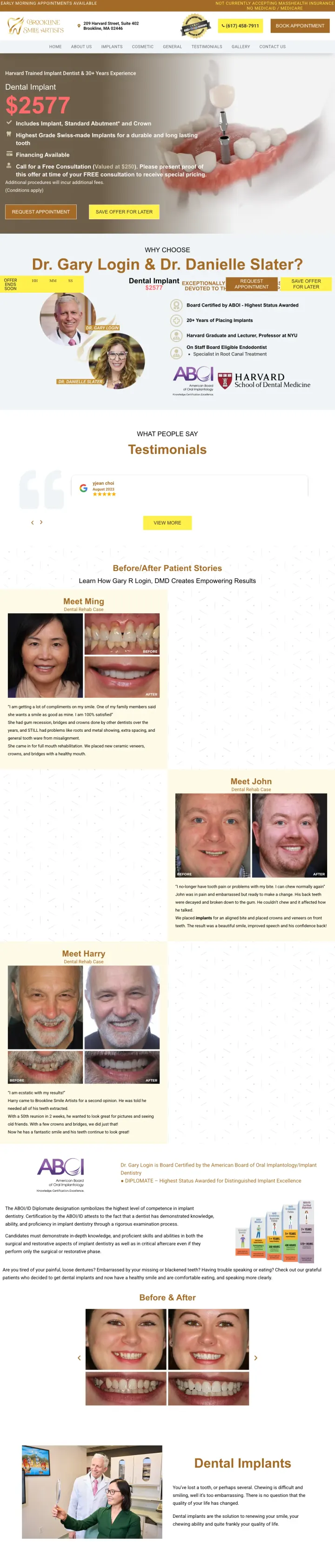
Brookline Smile Artists is a Boston implant practice, and it took the top slot by putting the price and the surgeon's training in the same screen. The line above the number says Harvard trained implant dentist, and a Google review seal, a phone button and a book appointment button sit in the header above both. Cost, proof and two ways to act all arrive before anybody scrolls.
Lead with the doctor's most impressive single credential ('Board Certified by ABOI - Highest Status Awarded') as a subhead directly under the price, so the visitor sees cost AND authority in the same glance.
- +
Implant price lists its parts price framingone afternoon
Includes Implant, Standard AbutmentThe price is not a round number, and it says what the money buys: implant, abutment, crown. Somebody pricing an implant rings several practices in a morning, and the quote they can compare wins. Break yours down the same way.
- +
Free consult carries a value offer framingeasy
Call for a Free Consultation (Valued at $250)Nothing sells until you attach a value to it. Putting a figure on the consultation turns your Free first step into something the visitor can weigh, and it sets the scale for the treatment behind it. Price your own consult, then give it away.
- +
Certification and teaching post share a block credentialshard to earn
Board Certified by ABOI - Highest Status AwardedBoard Certification, a teaching post and years in the chair, all in the same block. A stranger about to let you drill into their jaw checks for exactly those, and any one alone leaves a gap. Name the body that awarded yours so the claim can be checked.
- ✕
Only form sits past the gallery hard to actone afternoon
The only form on this page sits at the very foot, past the testimonials, the patient stories and the office gallery. Everything above it is a button. Somebody who will not ring you scrolls the whole page before leaving a name. Put a form beside the price.
- ✕
Credentials sit a scroll from the price scattered proofone afternoon
The hero carries one line about Harvard training. The board certification, the years placing implants, the professorship and the ABOI and Harvard crests all sit in the next section down, away from the price. Put every reason to trust you in the same block as the number.
- ✕
Countdown clock names no date false urgencyeasy
Under the hero runs a pale bar carrying the price and the appointment buttons, and its left end is a yellow cell reading Offer Ends Soon beside an empty HH MM SS. Everything above it is real. Put a date on the offer or take the timer off.
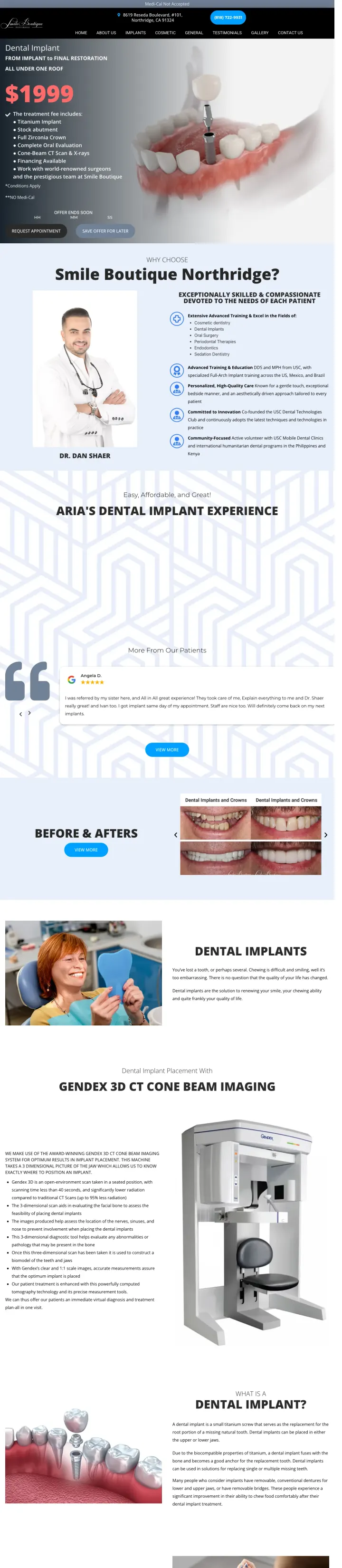
Smile Boutique Northridge sells the same kind of priced implant offer as the page above it, and wins its place on the list printed underneath the number. Titanium implant, stock abutment, zirconia crown, oral evaluation, cone beam scan, X rays: each one written out, so a price shopper knows what the fee covers without ringing to ask. The hero rules out Medi-Cal, and so does the grey strip above the header, which is blunt and saves everybody an awkward appointment.
List every component included in your implant price as bullet points (titanium implant, stock abutment, full zirconia crown, CT scan, X-rays) so price-shopping patients know exactly what they are getting without calling to ask.
- +
Whole job happens in one building answers a worryeasy
FROM IMPLANT to FINAL RESTORATIONBeing handed to a surgeon, then a prosthodontist, then back again means more appointments, more bills and nobody in charge of the result. Saying the whole job happens in your building kills that worry in a line. If it is true for you, put it under the price.
- +
Fee spells out what it covers price framingeasy
The treatment fee includes:Titanium implant, stock abutment, zirconia crown, oral evaluation, cone beam scan, X rays. Each line is something the next practice might charge extra for, and printing them stops the what does that include phone call. List yours, and include the scan.
- +
Surgeon's face follows the price made personalone afternoon
Dr. Dan ShaerPrice first, then one scroll later the face and the training of the person holding the drill. Cost and competence are the two questions in the visitor's head, answered in that order. Put your photograph and your training right below your price. An about page is a different journey.
- ✕
Browser lands below the headline price wrong first screenneeds a developer
Arrive from the ad and you land below the headline price, in the middle of the bullet list. The number that makes this whole page work is behind you before you have read a word. Click your own ad and watch where the browser stops.
- ✕
Hero turns Medi-Cal patients away wrong audiencea targeting call
NO Medi-CalHonest, and it belongs in the ad rather than the hero. A Medi-Cal patient has already cost you the click by the time they read it, and everybody else now knows there is a group you turn away. Put the exclusion in your ad copy and let the page sell.
- ✕
Result photographs hide below three sections proof too lateone afternoon
Before & AftersThe photographs that show what the money buys sit under the credentials block, a patient video and a testimonial slider, with the technology write up after them. That is a long way to scroll for the thing people came to see. Move your results up.
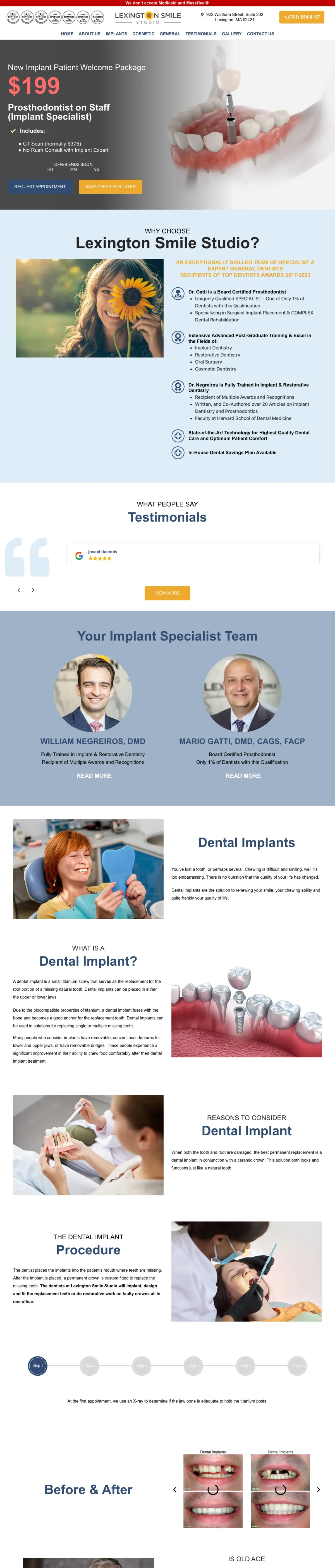
Lexington Smile Studio charges for the first appointment instead of the implant, and that is the whole idea. The welcome package covers the CT scan and a consult with the implant specialist, so the visit stops being a quote and becomes a purchase. Award seals run in a row at the left of the header, and the headline names the specialty rather than the man: prosthodontist on staff, implant specialist. The names arrive in the section below, where Dr Gatti and Dr Negreiros carry their qualifications, and again in a team block further down with photographs.
Offer a specific-dollar-value welcome package ($199 including CT scan normally $375) as a loss leader - it reframes the first visit from 'expensive consultation' to 'I am saving $176' and removes the cost barrier to the first appointment.
- +
First visit costs less than its scan the offera pricing call
CT Scan (normally $375)The scan carries its normal price beside it, and the package costs less than the scan alone, so the first visit reads as a saving instead of a bill. Somebody who would refuse a paid consultation will book a discounted one. Price your first appointment.
- +
Headline uses the word specialist credentialseasy
Prosthodontist on StaffSpecialist does a lot of work in a dental hero. It says this is not a general dentist placing implants between check ups, it is somebody whose entire training is this procedure. If you have one on staff, put the word in the headline. The team section is too far down.
- +
Faculty post beats years of practice credentialshard to earn
Faculty at Harvard School of Dental MedicineTeaching the procedure and publishing on it is a different claim from doing it often, and it lands harder, because the person about to operate on you trains the people who would otherwise be operating on you. If anybody in your practice lectures or publishes, say where.
- ✕
Before and after photos carry no story thin proofone afternoon
The Before and After block holds real mouths in a slider, each labelled Dental Implants and nothing else. No name, no case, no timeline, no word from the patient. Brookline gives its cases a name and a paragraph. Label yours with what was wrong and how long it took.
- ✕
Empty timer undercuts the award seals false urgencyeasy
Offer Ends SoonAward seals, a board certified prosthodontist, a Harvard faculty member, and then Offer Ends Soon over an empty HH MM SS with no date. The timer is the only thing a visitor can catch you out on, and it drags the rest down. Give the offer a real end date.
- ✕
Phone number vanishes after the header hard to contacteasy
The gold header button carries the number, and then nothing else does until the closing block at the foot, past the team, the results and the office gallery. Implant patients ring rather than fill in forms. Keep a call button in view the whole way down.
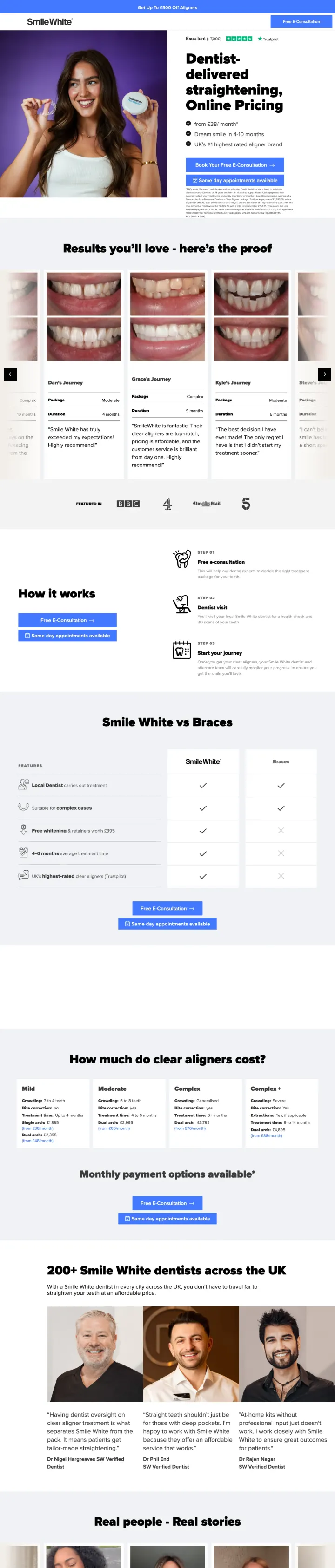
Smile White straightens teeth through local dentists across the UK, and its paid page opens with a Trustpilot row, a monthly price and a free e-consultation button. Cost, credibility and whether a real dentist is involved all get answered before the first scroll. Further down, every before and after carries the case type and how long it took, so a visitor can find somebody with their own problem.
Show your Trustpilot rating AND monthly payment price AND before/after results AND 'same day appointments available' all above the fold. SmileWhite fits four conversion triggers into one viewport because each one addresses a different objection.
- +
Trustpilot widget outranks their own words reviewshard to earn
4.8 out of five star rating on TrustpilotThe row above the headline prints Excellent, the review count in brackets, the green stars and the Trustpilot logo. All of it comes from a site the visitor can go and read without taking your word for anything. If you have the reviews, put the badge above the fold.
- +
Bullet leads on monthly payment price framingeasy
from £38/ monthA course of aligners costs far more than that, and the headline never says so. The full package price turns up only in the finance small print under the buttons. The bullet leads with the monthly figure instead. Lead with the payment and keep the total honest further down.
- +
Every case shows package and duration made personalone afternoon
Results you’ll love - here’s the proofEach before and after in the slider carries a package label and a duration, moderate and four months, complex and nine months, so a visitor can find a case shaped like theirs. Cherry picked miracles tell the ordinary case this page is not about them. Label yours.
- ✕
Address bar admits it is an advert breaks the illusioneasy
The address bar reads paid ads, which tells anybody who glances at it that this page exists because they clicked an advert. It changes nothing about the offer and it costs nothing to fix. Name the path after the treatment instead.
- ✕
Footer hands back every exit too many linksone afternoon
The header does this properly: a logo, a booking button, nothing else. Then the foot of the page offers Careers, Blog, For Dentists, Refund Policy, Join Our Ambassador Programme, the app and four social icons. Somebody who scrolls that far is close to booking. Give them the button.
- ✕
Nobody signs the dentist-delivered claim missing credentialseasy
Dentist-delivered straightening, Online PricingDentist delivered is the whole positioning, and no dentist is attached to it until a long way down, where several appear with quotes and photographs. Move a name and a registration up beside the claim. A claim with nobody behind it reads like a claim.
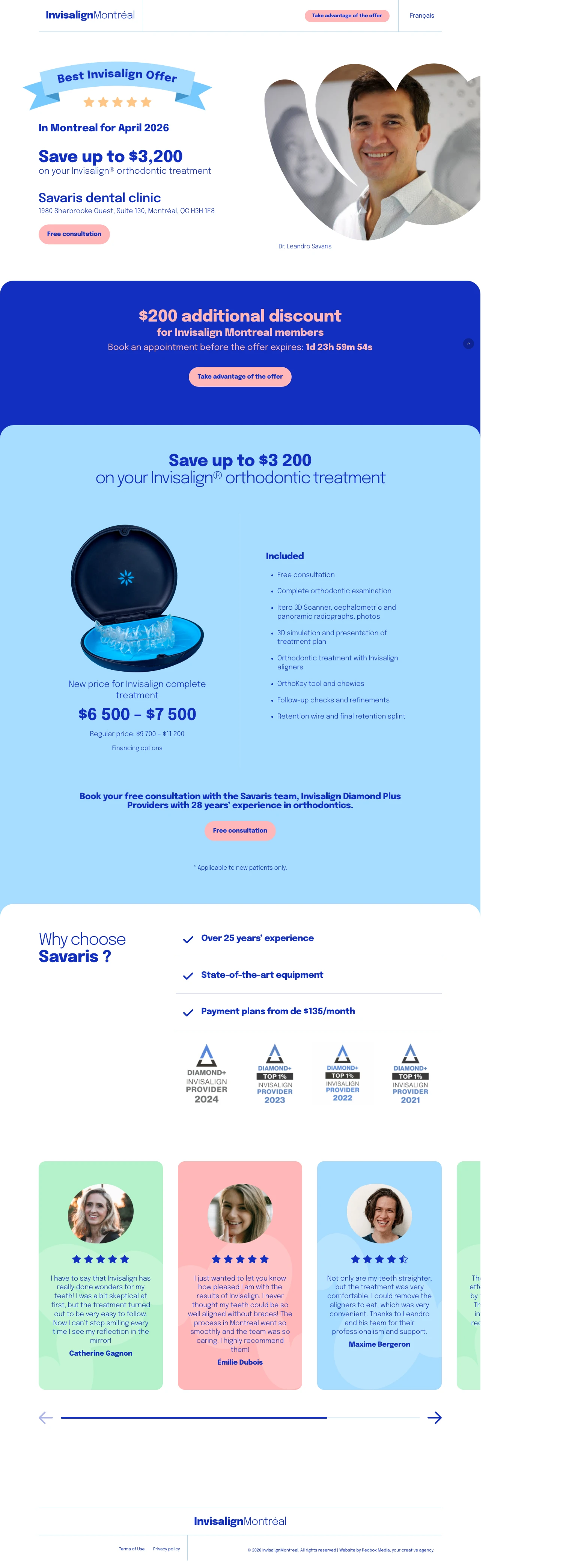
Clinique dentaire Savaris builds the entire page around a saving, and the arithmetic is the pitch. The hero states the saving, a members' discount band follows it, then a block prints the new price with the regular price under it, then the payment plan. The visitor watches the deal being built rather than reading a flat number. Dr Savaris appears with a photograph beside the saving in the first screen, which is rare on a discount page and it helps.
Layer multiple discount mechanisms ($3,200 off regular price PLUS $200 additional discount for members PLUS payment plans from $135/month) so the visitor feels they are getting a unique deal rather than the standard advertised price.
- +
Old price stays printed under the new one the offereasy
Regular price: $9 700The saving leads the page on its own, and further down the new price prints big with the regular price kept underneath in small type. Said both ways, the discount reads as real rather than a starting figure dressed up. Show the price you came down from.
- +
Manufacturer badge carries a fresh year credentialshard to earn
Invisalign Diamond Plus ProvidersThe badge comes from the brand the patient is already searching for, and the page runs a row of them, a fresh year stamped on each. Nobody claims experience when the manufacturer has ranked them and dated it. Whatever body ranks practices in your field, put the badge up.
- +
Dentist's photograph balances the discount made personaleasy
Dr. Leandro SavarisA discount on its own is a supermarket move. Here the saving fills the left of the first screen and the dentist fills the right, photograph and name, so the offer looks like a practice making a decision rather than a price off a comparison site. Yours costs a morning.
- ✕
Live clock counts to nothing named false urgencyeasy
Book an appointment before the offer expiresThe blue band under the hero runs a live clock, and it never prints the date it counts to. The nearest thing is the month named up in the hero, and a month is not a deadline. Print the date the offer ends, or drop the clock.
- ✕
Included list skips the appointment count unanswered questionone afternoon
Follow-up checks and refinementsThe page lists what the fee includes and never says how many visits that is, how long each takes, or what happens at the first appointment. Somebody weighing up months of aligners wants the diary answer as much as the price. Write the steps out with their timings.
- ✕
Testimonials link out to nowhere weak proofhard to earn
Catherine GagnonGlowing quotes with a first name and a surname, star graphics the site drew itself, and no way to check a single word of it. A stranger reads that as copywriting, because most of the time it is. Link out to your Google profile and let the mediocre reviews show.

Innovative Dental and Orthodontics prices braces and clear aligners at the same figure and then offers a licensed orthodontist to pick between them. That turns the visit from a yes or no into a which, and a which is a far easier question for somebody who has been putting this off for years. The green box under the offer names the training behind the recommendation.
Show two treatment options side by side at the same price ($1,999 for 6-month braces OR $1,999 for 6-month Invisalign) and let the visitor's licensed orthodontist recommend which one - this reframes the decision from 'should I do this?' to 'which one should I pick?'
- +
Braces and aligners carry matching prices choice architecturea pricing call
6 Month BracesBoth treatments carry the same figure, stacked one above the other at the top of the page, the same yellow numerals both times. Braces or aligners, the question shifts from whether to do this into which to pick, and answering the second answers the first. Price yours level.
- +
Hero prints the deposit figure answers the money worryeasy
With a $500 Down Payment, the RemainingFinancing available means nothing to anybody. A deposit figure and the balance in instalments, printed in the hero next to the price, lets a visitor start doing the sums before they ring. This page never names a term or a rate, which loses the careful ones. Print all three.
- +
Licence and training answer the doubt credentialseasy
Dr Sejal has 3 Years Advanced Speciality Training in OrthodonticsPlenty of general dentists straighten teeth, and the patient worrying about that cannot tell the difference from the outside. Naming the licence and the specialty training answers it before it becomes a reason to keep shopping. Say what your training is and how long it took.
- ✕
Best line lands above the browser wrong first screenneeds a developer
Ask our Licensed Orthodontist Which Option is Best for YouThat headline is the best thing on the page, and the browser lands well underneath it, on the down payment line. Both prices are above the visitor before they read a word. The whole reason this beats its competitors is the question it asks. Check where your own page opens.
- ✕
Page reverts to practice website loses focusone afternoon
Welcome to InnovativeDental and OrthodonticsBelow the offer the page turns back into the practice website: what braces are, how teeth move, why alignment matters, a welcome paragraph. None of that serves the person who clicked an advert for a priced treatment. Everything under your offer should still sell the offer.
- ✕
Three audiences share a single page too broadone afternoon
Braces patients, aligner patients and general dentistry patients all get served here, and the further down you read the less anybody in particular is being spoken to. Send each ad group to a page that answers its own search. You are paying separately for those clicks.
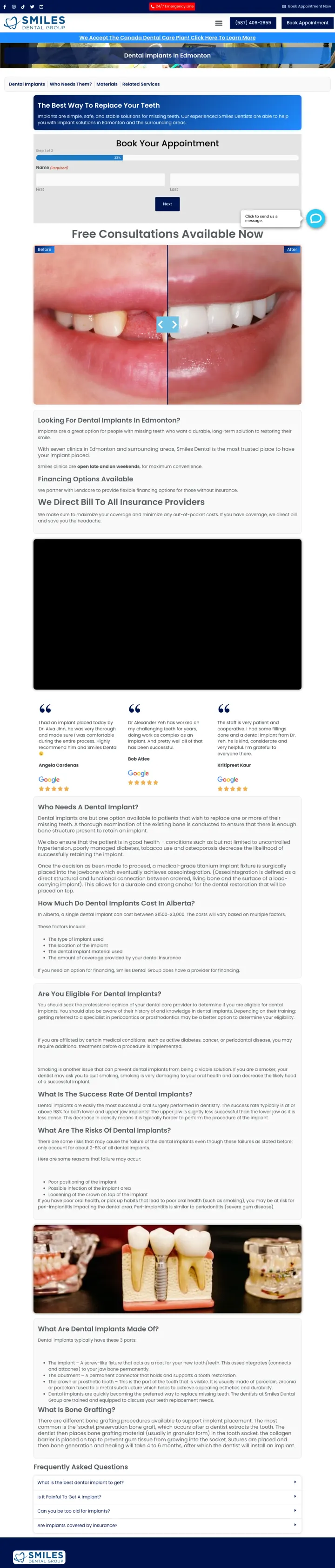
Smiles Dental Group runs clinics across Edmonton, and its page puts the booking form in the first screen rather than behind a button. The first step asks for a first name and a last name and nothing else, which is about as small as a first ask gets. The headline is the weak part: swap the logo and it would work for anybody.
Put your appointment form directly in the hero section (not behind a button click) with a location selector dropdown if you have multiple offices - visitors who see the form immediately are more likely to fill it out than visitors who have to find and click a 'Book Now' button.
- +
Booking form opens in the first screen fewer stepsone afternoon
Book Your AppointmentThe booking form is open in the first screen rather than hidden behind a button, and the first step asks for a first name and a last name. A form somebody can see gets filled in more often than one they go looking for. Ask for the easy thing first.
- +
Jump links let readers skip ahead layouteasy
Who Needs Them?Dental Implants, Who Needs Them, Materials, Related Services, in one thin strip under the page title and above everything else. A visitor still researching picks the bit they care about instead of scrolling past what they know. Add the strip, then see which link gets the clicks.
- +
Two phone routes answer both hours fewer stepseasy
(587) 409-2959The number sits in the header beside the Book Appointment button, and the navy bar above carries a red emergency line pill promising cover round the clock. Office hours and out of hours get answered in one glance. Decisive people ring. Say when the number is answered.
- ✕
Biggest line could belong to anyone no differentiatoreasy
The Best Way to Replace Your TeethSwap the logo and that headline works for any practice in any city. The band above the blue box names Edmonton, and so does the paragraph inside it. Somebody who clicked already knows they want implants. Name the price, the clinics, or the person doing the work.
- ✕
Cost answer hides in a paragraph money too lateeasy
In Alberta, a single dental implant can cost between $1500-$3,000.The cost answer does exist on this page, in a paragraph a long way down under a heading shaped like a search query. Cost is the reason most of these clicks happen at all. Take the range you already publish and put it in the first screen.
- ✕
Free consultation line straddles the fold weak offereasy
Free Consultations Available NowThe only offer here is that heading, and it lands right where the first screen ends, so whether a visitor meets it depends on their monitor. A free consultation is worth saying. Say it above the form, in the headline, where nobody has to scroll to find it.
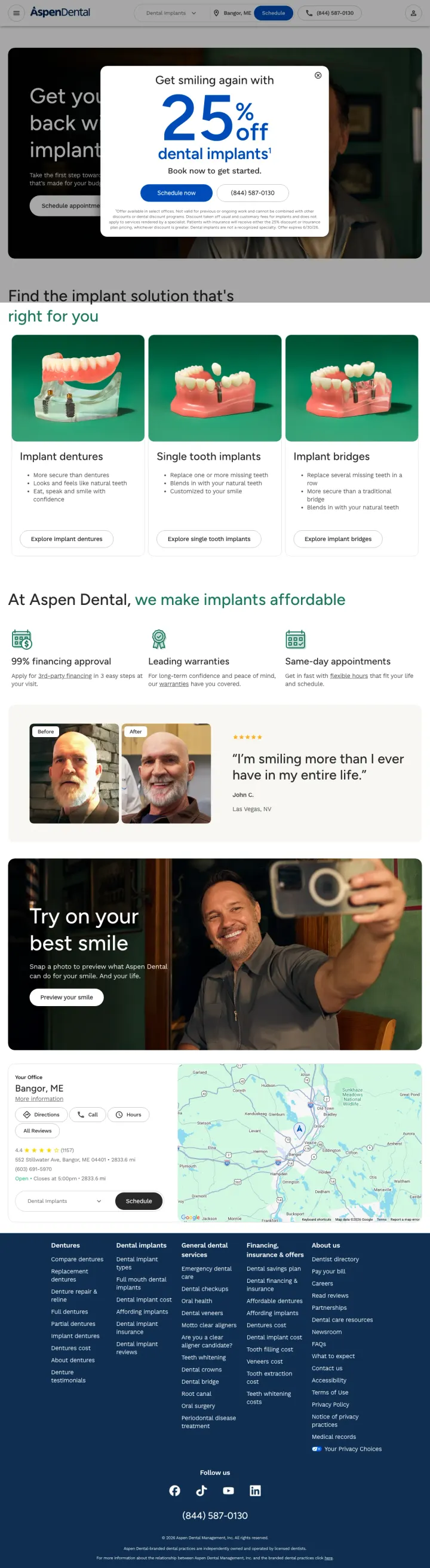
Aspen Dental buys the click and then drops a discount modal over the middle of its own hero, which is about as subtle as this file gets. It works for a national brand with the margin to discount, because the discount and a phone button land dead centre and the headline behind them gets cut mid word. What the page never does is name the dentist who will do the surgery.
If you are a multi-location brand, use a promotional popup ('25% off dental implants') that interrupts the page on entry - it trades some user annoyance for a dramatic increase in offer visibility that a hero banner alone cannot match.
- +
Modal gives call and click equal weight the offerneeds a developer
A white card lands over the middle of the hero the moment the page loads: the discount, a line telling you to book, then two buttons the same size, Schedule now and the phone number. Whichever route the visitor wants, neither is the small one. Rude, and it works.
- +
Three cards name the implant types makes it easierone afternoon
Find the implant solution that's right for youImplant dentures, single tooth implants, implant bridges, three cards in a row, each with a photograph and bullets saying who it is for. Somebody missing a tooth has not learned the vocabulary yet. Lay your options out level and put the plain English under each.
- +
Approval rate answers the unasked question answers the money worryeasy
99% financing approvalThe worry is not the monthly payment, it is being turned down in front of the receptionist. Printing the approval rate answers a question nobody wants to ask out loud. Ask your finance partner what theirs is and put it next to the price.
- ✕
Modal breaks the headline mid word covers the pageeasy
Get your smile back with dental implantsThe modal lands dead centre and the headline runs straight into it, so every line breaks mid word and the schedule button behind it is half a button. Legible enough to nag. Too small to actually read. If the offer is worth interrupting for, put it in the hero itself.
- ✕
Nobody signs the surgery here missing credentialsone afternoon
Nowhere on this page is the person who will do the surgery named. For a chain that size it half works, because the name over the door does the reassuring. You do not have that, so put your dentist's name, photograph and certification up there instead.
- ✕
Interruption never got tested unproven moveeasy
There is a close cross in the corner, so some visitors read the offer and some hit that cross and start the visit irritated. Click through rate cannot tell you which. Run it against a hero banner carrying the same discount. Count the bookings. Impressions tell you nothing here.
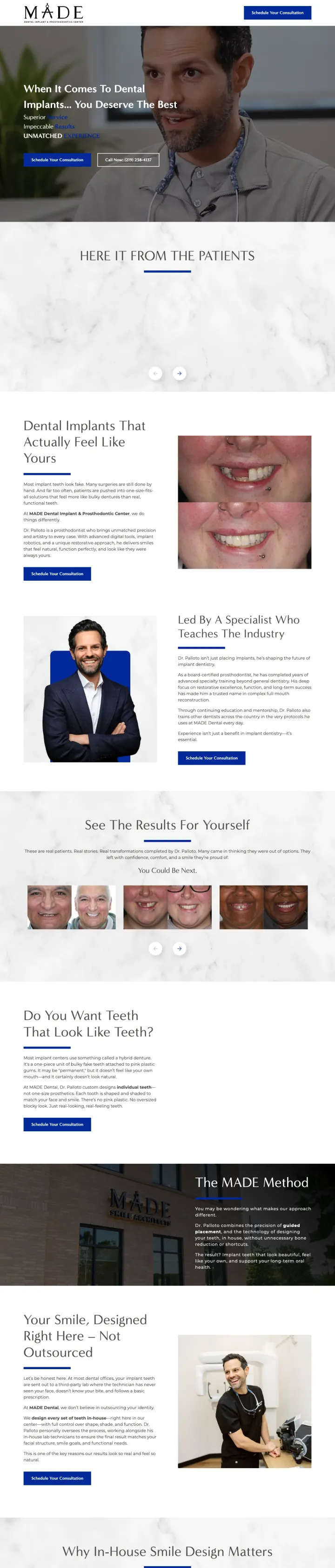
MADE Dental earns its place on proof rather than price. Named patients tell their own story on video, and a comparison table sets the practice against dentures, snap on implants and full arch hybrids with a starting price on every row. There is no offer at all in the first screen, which is the gamble this page takes.
Create a comparison table that positions your approach against the industry default - MADE Dental compares 'outsourced to 3rd-party lab' vs 'done in-house by our own lab team' across 5 dimensions, which frames every competitor as inferior without naming them.
- +
Section says what patients already suspect positioningeasy
Most implant teeth look fake. Many surgeries are still done by hand.The section under the patient videos says the thing the patient half suspects, then puts the practice on the other side of it, with a before and after of one mouth alongside. Find what everybody in your trade does badly and say it out loud. The reader agrees first.
- +
Patients speak on camera by name reviewshard to earn
The section straight under the hero is a row of patient videos, named one by one: Denise, Trish, Oscar. A written review can be typed by anybody and a face on video cannot. Ask your happiest patients for a couple of minutes each on a phone camera.
- +
Comparison table puts them last on purpose price framingone afternoon
Compare Your OptionsTraditional denture, implant supported denture, full arch hybrid, then their own work in a blue outlined row at the bottom. Removable and fake against crown level teeth, unstable against lightweight. It makes the dearest row look considered rather than expensive. Let the columns argue.
- ✕
Page opens halfway down the hero wrong first screenneeds a developer
When It Comes To Dental Implants... You Deserve The BestArrive from the advert and the page opens halfway down the hero. The headline is already above you, and what fills the screen is the bottom of a video still. Whatever positioning your hero does, it does none of it from up there. Several pages here share the fault.
- ✕
No form anywhere on the page fewer ways inone afternoon
Schedule Your ConsultationEvery button from the header to the footer says Schedule Your Consultation, with one Call Now beside it in the hero, and there is no form anywhere. A researcher not ready to talk to a human cannot leave their details. Add a short form for the careful ones.
- ✕
Dearest row shows no monthly figure money gapeasy
MADE Custom SmileTheir own row is the dearest in the table, several times the denture row above it, and the table has no finance column at all. A figure that size with no instalment beside it ends the visit. If you are the premium option, the monthly number belongs in that row.
What the dental winners do
Wildcards
Pages that break the playbook in interesting ways
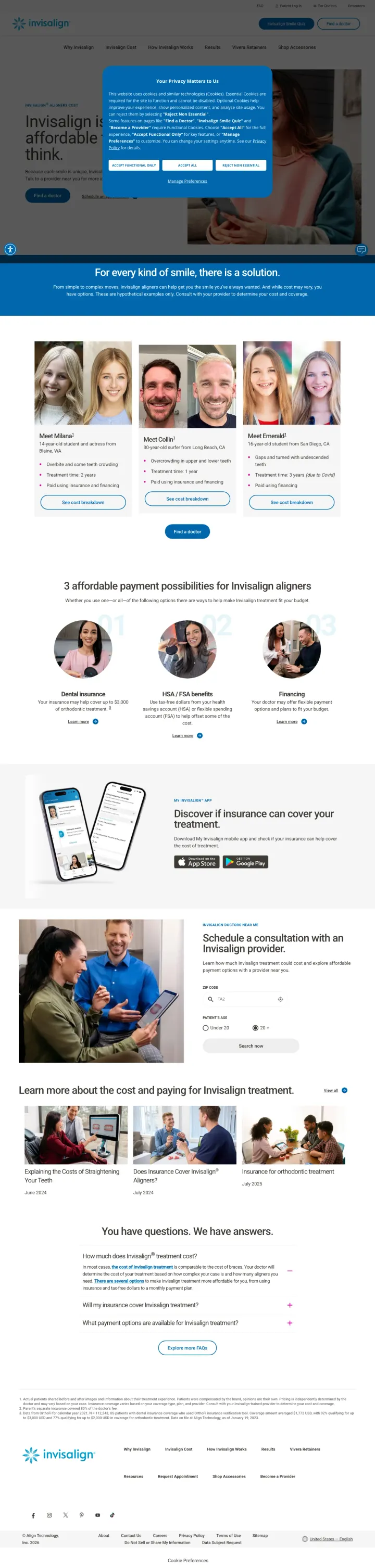
Strip your landing page down to literally nothing except a quiz. No hero image, no testimonials, no pricing, no doctor bio. Just one question at a time. Invisalign proves that when the brand is strong enough, the quiz alone IS the page - but this only works if the visitor already knows and trusts you before they click.
- reviews
The quiz starts with 'Tell us who you are' (Adult/Teen/Parent) rather than 'What is wrong with your teeth?' - this feels like personalization rather than diagnosis, which is less intimidating for first-time dental visitors who are just exploring
- reviews
No pricing, no credentials, no testimonials, no imagery - just the quiz. For a brand with near-universal name recognition, stripping the page down to the quiz leaves a visitor nothing to do but start it, and nothing to wander off to
- made personal
Step indicator (1/5) sets clear expectations for quiz length - visitors know exactly how much time they are committing, which reduces mid-quiz abandonment
- wrong promise
Cookie consent popup covers the quiz on initial load - for paid traffic, every second of delay before the visitor sees the actual content costs money
- wrong promise
If the visitor does not already know what Invisalign is, this page gives them zero reason to care - there is no value proposition, no benefit statement, no outcome promise
- wrong promise
No phone number, no chat, no alternative conversion path - if the visitor does not want to take a quiz, there is literally nothing else to do on this page
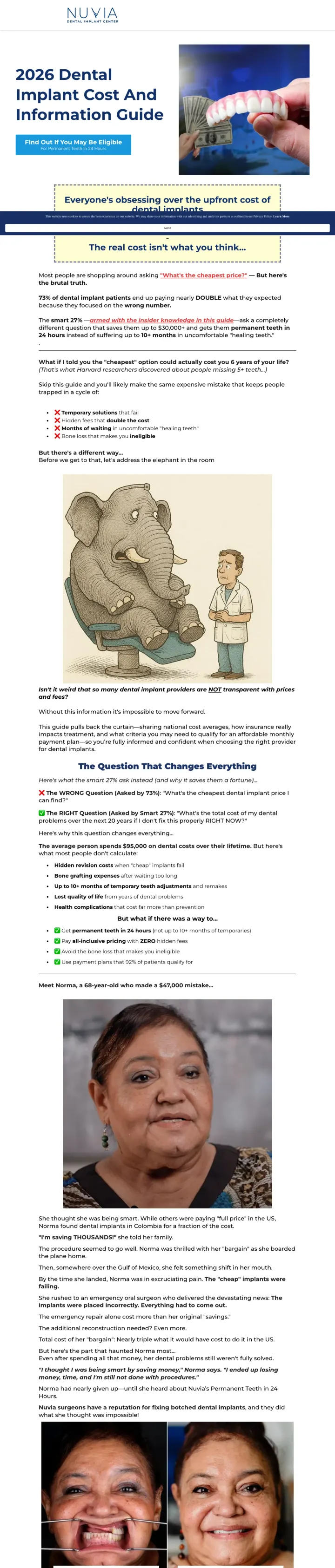
Why this breaks the rules: This page has no hero image, no doctor photo, no testimonials, no facility photos, and no visual proof of any kind. It looks like a Google Form for a $22,000-$55,000 surgical procedure. Every dental landing page convention says you need reviews and credentials above the fold. Nuvia strips all of that away and bets everything on a 10-question quiz funnel that sorts visitors by how bad the clinical problem is, how much it hurts their life right now, and whether they can pay. The quiz itself IS the conversion mechanism, and by the time visitors finish 10 questions about their teeth, providing a phone number feels natural.
- missing proof
Quiz question flow moves from clinical ('How many teeth missing?') to emotional ('Are you hiding your smile?') to financial ('Would you like to see if you qualify for payment plans?') - this mirrors how a dental patient actually thinks through the decision
- answers doubts
Headline 'Get Beautiful New Permanent Teeth in Just 24 Hours' addresses both the desired outcome AND the timeline objection simultaneously - dental patients fear weeks of recovery and '24 hours' demolishes that
- reviews
The quiz names the price range itself ('National averages range from $22,000 to $55,000. Payment plans start at $300/mo') so the visitor knows the cost before the consult call and the sales team does not face sticker shock
- looks off
The page looks like a Google Form - for a $22,000-$55,000 medical procedure, the visual execution does not match the price point
- looks off
No doctor photo, no facility photos, no patient photos - the page is 100% text and form fields, which feels impersonal for a surgical procedure
- no proof
The '57,891 reviews' claim with a 4.9 star rating is shown but with no link to verify - at this scale the number feels inflated without a Trustpilot or Google link
Compare the winners
The same questions asked of every winner, so you can find the row that matches the traffic you are already buying.
| Page | The hook | Form fields | Offer named up top | Phone in the first screen | Credential you can check | Standout move |
|---|---|---|---|---|---|---|
| #1Brookline Smile Artists | The training, then the price | 4 | Yes | Yes | Up top | Review seal in the header |
| #2Smile Boutique Northridge | One roof, one price | 4 | Yes | Yes | None | Every part of the fee listed |
| #3Lexington Smile Studio | A paid first visit | 4 | Yes | Yes | Up top | A row of award seals in the header |
| #4Smile White | Monthly price, Trustpilot above it | No form | Yes | No | None | Trustpilot row above the headline |
| #5Clinique dentaire Savaris | A saving, not a price | No form | Yes | No | None | Old price under the new one |
| #6Innovative Dental | Two treatments, same figure | 4 | Yes | Yes | Up top | Ask the orthodontist which one |
| #7Smiles Dental Group | A booking form on arrival | 2 | Yes | Yes | None | Step one asks only a name |
| #8Aspen Dental | A discount over the hero | No form | Yes | Yes | None | Financing odds, printed |
| #9MADE Dental | Patient videos, no offer | No form | No | Yes | None | A table that prices the alternatives |
Read the keywords you are buying, then find the row that matches them. Somebody typing dental implant cost wants a number and a phone button in the first screen, because they are ringing round practices this morning. Somebody typing invisalign near me is still deciding whether to bother at all, and needs the credential, the results and a cheap first step. You paid the same for both clicks.
The copy bank
Lines lifted word for word off the pages above. We tell you whose page each came from, and one click copies it.
The Best Way to Replace Your Teeth
Get your smile back with dental implants
HERE IT FROM THE PATIENTS
When It Comes To Dental Implants... You Deserve The Best
Losers
3 pages burning ad spend with fundamental issues
Every click to these pages costs real money. We found pages with no proof a stranger could check, mismatched intent, weak CTAs, and messaging that ignores what the searcher actually typed. Here is what to avoid.
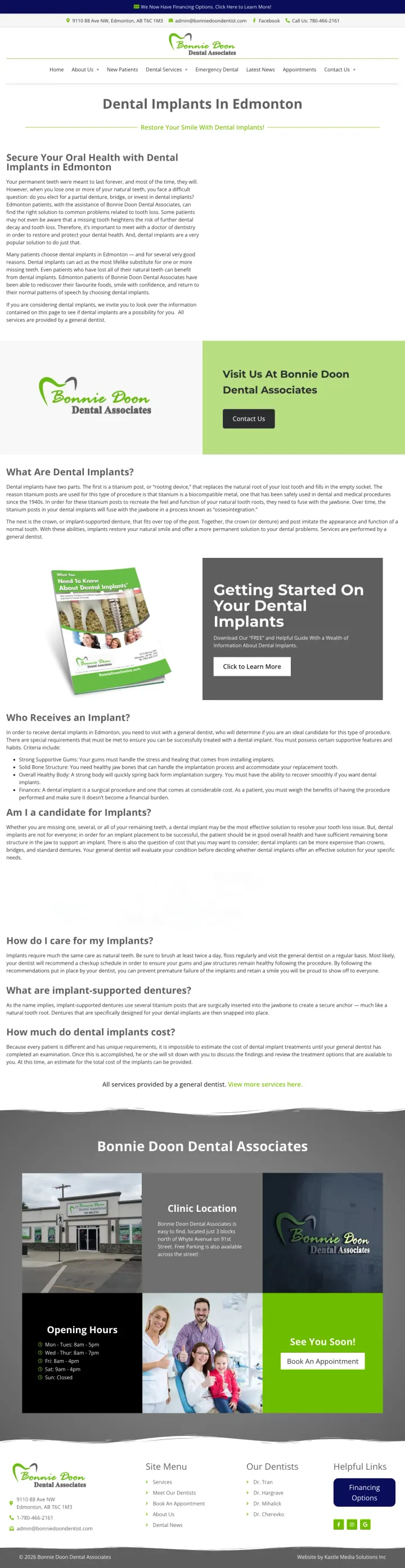
Paid ad promises 'Affordable Dental Implants - Get dental implants today' but the page delivers a 1,500-word educational article about what dental implants are, how osseointegration works, and who qualifies. No price, no named doctor, no form, no phone number visible above the fold. Every click at Edmonton implant CPCs ($15-25) pays for a Wikipedia article.
- extra steps
Ad says 'Affordable Dental Implants' but the page contains zero pricing information - no dollar amount, no range, no 'starting from', nothing. The visitor searched for cost information and got an essay about biocompatible titanium
- wrong promise
Full website navigation (Home, New Patients, Dental Services, Emergency Dental, Latest Cases, Appointments, Contact Us) gives the visitor 7 ways to leave without converting - each nav click is a wasted ad dollar
- looks off
No doctor name, no photo, no credentials anywhere above the fold - the ad is for a specific dental practice but the page could belong to any generic dental office in any city
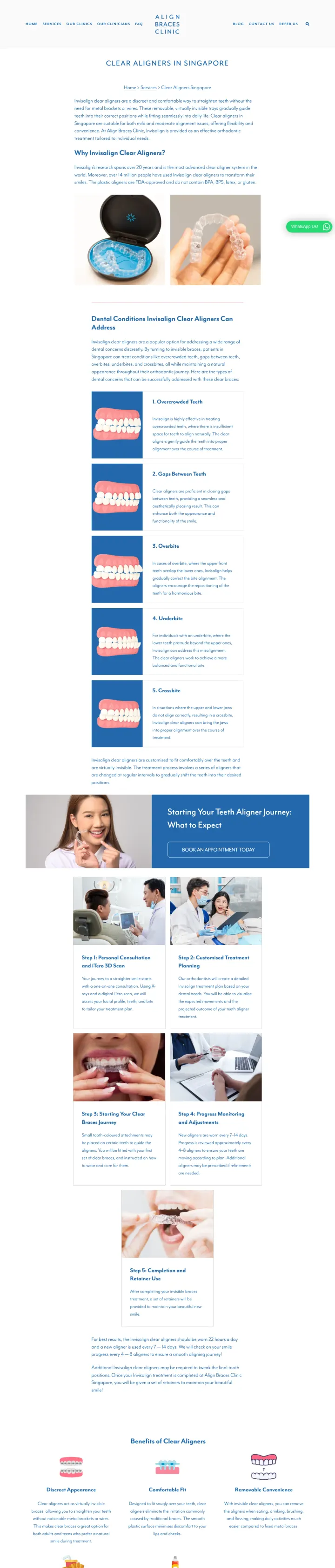
This is a service information page with full site navigation, no pricing, no named doctor, no form, and no phone number. The ad for 'invisalign singapore cost' sends traffic to a page that never mentions cost. At Singapore Invisalign CPCs ($3-8 SGD), every click pays for an encyclopedia entry about overbites and underbites.
- wrong promise
Full site navigation with 6+ links (Home, Services, Our Clinics, Our Clinicians, FAQ, Contact Us, Refer Us) on a page receiving paid traffic - every nav click is a wasted ad dollar
- extra steps
Zero pricing despite the ad keyword being 'invisalign singapore cost' - the visitor searched specifically for cost information and the page does not contain a single dollar figure or price range
- wrong promise
The page is entirely about the Invisalign product, not about why THIS clinic is the right choice - no named clinician, no case count, no specialization that differentiates from the dozen other Invisalign providers in Singapore
The ad keyword is 'invisalign cost' with the headline 'How Much Does Invisalign Cost?'. The page title promises the same. But the cookie consent modal covers the entire hero, and the underlying page leads with a generic 'Invisalign is more affordable than you think' headline, not a price range. A visitor clicking a cost-intent ad must dismiss the modal and then scroll to find any actual number. The treatment cost range that is the whole reason this page exists is buried.
- wrong promise
Cookie consent modal covers the full hero on first load. An invisalign.com visitor coming from a cost-intent ad must dismiss the modal before they can see a headline, price range, or CTA
- wrong promise
The actual hero headline ('Invisalign is more affordable than you think') is a vibe claim, not a number. Cost-intent visitors want a number, a range, or a monthly payment. The page has that information below the fold but buries it behind marketing copy
- wrong promise
'Talk to a provider' CTA passes the cost question to the dentist, which is appropriate for invisalign.com's multi-doctor network, but the page could at least offer a cost range before the provider handoff
What we learned
Itemized pricing with component breakdowns converts better than round numbers
The strongest implant pages do not just show a price - they break down exactly what is included (titanium implant + abutment + zirconia crown + CT scan + consult). This matters because dental patients comparison-shop and need to know they are comparing like-for-like. Pages showing '$1,999 includes implant, abutment, and crown' outperform pages showing just '$1,999 dental implant' because the breakdown eliminates hidden-cost anxiety.
A named doctor with photo and credentials above the fold is the least a stranger needs before they call
Every winner shows a named doctor with real photo and specific credentials (board-certified prosthodontist, Harvard-trained, ABOI-certified) within the first scroll. The losers either show no doctor at all or bury credentials below the fold. For a $2,000-$30,000 irreversible procedure, patients need to know WHO will operate on them before they will book anything.
Video testimonials from real patients outperform text reviews for high-stakes dental
smilesbymade.mydentalconsult.com uses 7 named patient video testimonials (Denise, Trish, Oscar, Terry, Jody, Mary, Adam) with visible play buttons. Video is harder to fake than text, and for dental patients who worry 'will it look natural?', seeing and hearing a real person talk about their experience is far more convincing than a 5-star text review.
Comparison tables that position against alternatives address the research-mode visitor
The best pages include a comparison table (traditional denture vs implant-supported denture vs full arch hybrid vs custom implant teeth) with columns for materials, comfort, timeline, and starting price. Implant prospects are comparison-shopping 3-5 clinics before they will book a consult, so the page that gives them the comparison structure wins the mental spreadsheet race.
Winners lead with a specific price or offer above the fold and immediately show a named doctor with credentials. Losers send paid implant traffic to content pages that read like dental textbooks - paragraphs explaining what implants are, how osseointegration works, and who qualifies - without ever giving the visitor a reason to pick up the phone or fill out a form.
If you're building a page like these yourself, here's my comparison of AI landing page builders, with prices and what each one is best for.
A strong page is step one. Dental PPC management is how the right patients find it.
What the dental winners taught us
The pages that win here answer the money question in the first screen and then say who is doing the work. Below the offer, most of the implant pages turn back into the same general explainer, what a titanium post is and how it fuses to bone, which the searcher can read anywhere.
- 1
Put the number in the first screen, and say what it covers. Somebody searching for implant cost is pricing you against the practice down the road this morning. A price with its parts listed beside it, implant and abutment and crown, is the quote they can actually compare, and it makes you the benchmark for every other call they make. A page that hides the number gets read as expensive.
- 2
Name a credential a stranger could go and check. Most of these pages carry nothing verifiable above the fold, and the ones that do are the ones you would hand your jaw to. A board, a faculty post, a specialty licence, a manufacturer ranking: something with an issuing body attached. A padlock icon and the word trusted are not credentials, and your visitor knows it.
- 3
Take the countdown off. Several pages in this file run an Offer Ends Soon over an empty HH MM SS, and the Montreal band counts down to a deadline it never dates. Implant patients are already ringing round, already suspicious, already reading everything twice. Everything above that timer is real work, and an undated deadline is the cheapest way to lose it.
- 4
Show the review count where the money decision happens. Most of these first screens carry no star rating and no review count at all, and a dental practice is never short of reviews. A score does not help you halfway down the page beside a testimonial nobody can check. Put it in the header, beside the price, with the count and the source on it, and link it out. Brookline runs a review seal up there and Smile White runs a Trustpilot row, and both read as somebody else's word rather than your own. Montreal draws a row of gold stars under its offer ribbon with no count and no source on them, which reads as your own word again.
- 5
Click your own ad and watch where the page stops. Several of these pages open partway down, and on some of them the price the whole page is built on is already above the visitor. It costs a couple of minutes to find and it is usually a scroll anchor somebody added years ago. The best hero in the world does nothing from above the fold line.
Score your own dental page
Every line below came off a screenshot somebody sat and counted. Open your own page beside it and tick what it already does.
So what would we find on your page?
All 9 winners name a price. Bonnie Doon's ad promises 'Affordable Dental Implants', then drops you on 1,500 words about how osseointegration works. No price, no phone number, no form. Every click at Edmonton implant CPCs ($15-25) pays for a Wikipedia article. Postclick reads your page the way that click reads it. It names what's costing you the consult, shows you new versions as real designs, then builds the one you pick.