We analyzed 23 eye care landing pages. Only 6 are worth stealing from.

23 landing pages screened
From real eye care / lasik Google Ads campaigns in the US
6 winners curated
The landing pages actually worth stealing from
2 burning money
So you know exactly what to avoid
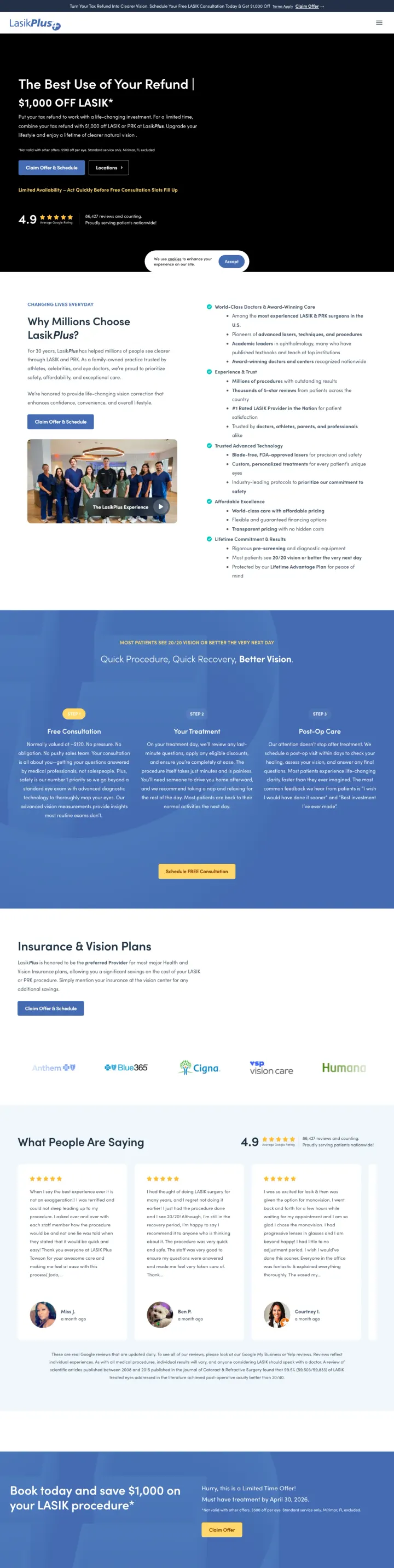
Lead with the specific dollar savings amount ('$1,000 OFF LASIK') in the hero alongside your aggregate review score and review count. The visitor sees the discount and the reviews in the same glance.
- price framing
'$1,000 OFF LASIK' in the hero headline is unambiguous and immediately tells the price-shopping visitor they have found a deal, eliminating the need to scroll for pricing information
- reviews
4.9 stars from 57,000+ reviews sit right below the hero, a review count no single practice can match
- answers doubts
Insurance & Vision Plans section with recognizable logos (VSP, EyeMed, Cigna) addresses the 'will my insurance cover any of this' question that 60%+ of LASIK prospects have
- no proof
No named surgeon anywhere on the page. For a permanent eye surgery, LasikPlus relies entirely on brand trust rather than individual surgeon credentials, which loses to practices that name their doctors
- looks off
Team photo shows 8-10 staff members in scrubs, but no individual is identified or credentialed. The visitor cannot tell who will perform their surgery
- wrong promise
The offer ('Save $1,000 on your LASIK procedure') is framed as limited-time but names no deadline, and buyers who have seen that trick before will spot it
Feature the lead surgeon's photo and name alongside a patient testimonial quote in the hero section. The combination of 'this is who will operate on you' and 'this is what a real patient says' in the same viewport is extremely persuasive for elective eye surgery.
- made personal
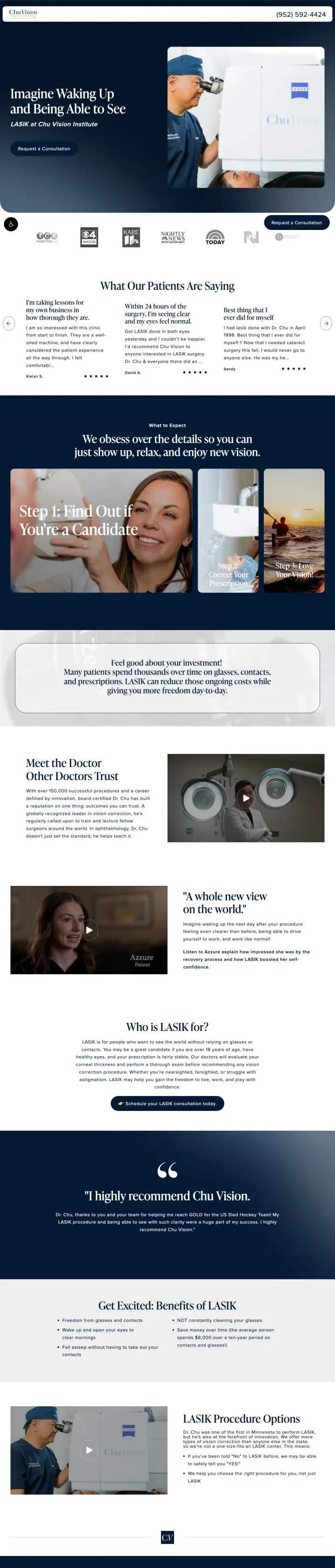
Named surgeon (Dr. Chu) with photo and credentials visible in the hero section immediately answers the 'who will operate on my eyes' question that every LASIK prospect has
- reviews
Patient testimonial video embedded above the fold lets the visitor hear a real person describe their experience, which is more convincing than any written copy for an irreversible procedure
- layout
Dark navy and white design with strategic use of eye close-up imagery creates a premium, medical feel that positions this as a serious surgical practice, not a discount LASIK chain
- wrong promise
No specific price or savings offer visible anywhere on the page. For a price-sensitive category where LasikPlus leads with '$1,000 OFF', the absence of any price reference forces the visitor to call just to find out if they can afford it
- too much at once
The consultation booking section is below the fold and requires scrolling past multiple content sections to reach
- wrong promise
Technology section ('Triple Precision, Smart Recovery, Better Vision') uses marketing language instead of specific technology names or clinical data
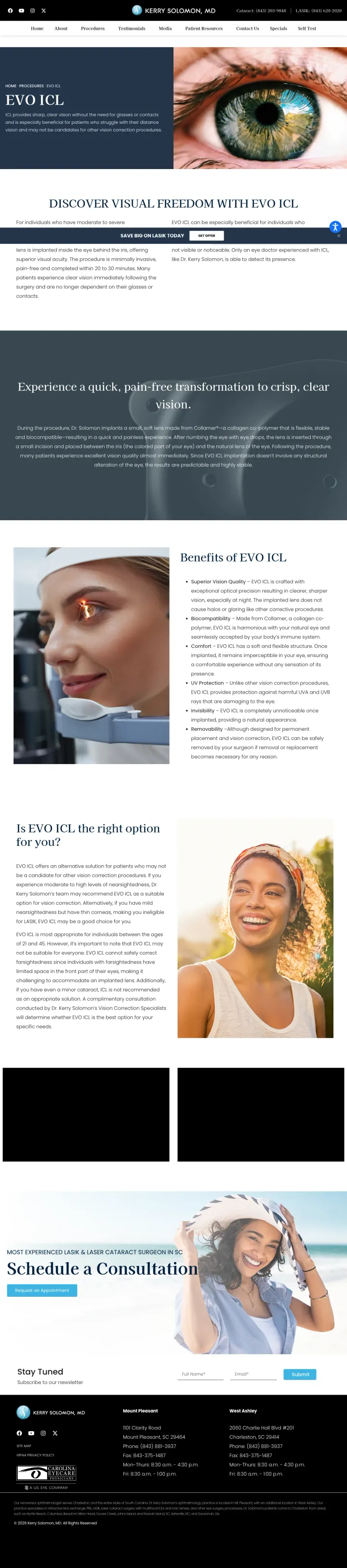
When promoting a lesser-known procedure (EVO ICL vs. LASIK), lead with the specific benefits that differentiate it from the more familiar option. 'Quick, pain-free transformation to crisp, clear vision' positions EVO ICL by outcomes rather than by technical explanation.
- layout
Hero section combines procedure name (EVO ICL) with outcome-focused subhead ('Discover Visual Freedom') and an eye close-up image that is medically relevant rather than stock photography
- reviews
'Benefits of EVO ICL' section uses specific benefit statements rather than feature lists, focusing on what the patient experiences rather than what the technology does
- answers doubts
'Is EVO ICL the right option for you?' section addresses candidacy questions proactively, which captures the 30-40% of LASIK-ineligible patients who represent the primary EVO ICL audience
- extra steps
No pricing information anywhere on the page. EVO ICL typically costs $3,000-5,000 per eye, and the absence of even a 'starting from' price means the visitor must call to discover if this is financially viable
- wrong promise
Dr. Solomon's credentials are visible in the header but not reinforced in the page body with a dedicated 'About Your Surgeon' section
- wrong promise
Blog-style navigation bar at the top with multiple menu items gives the visitor several exit paths before they reach the consultation CTA
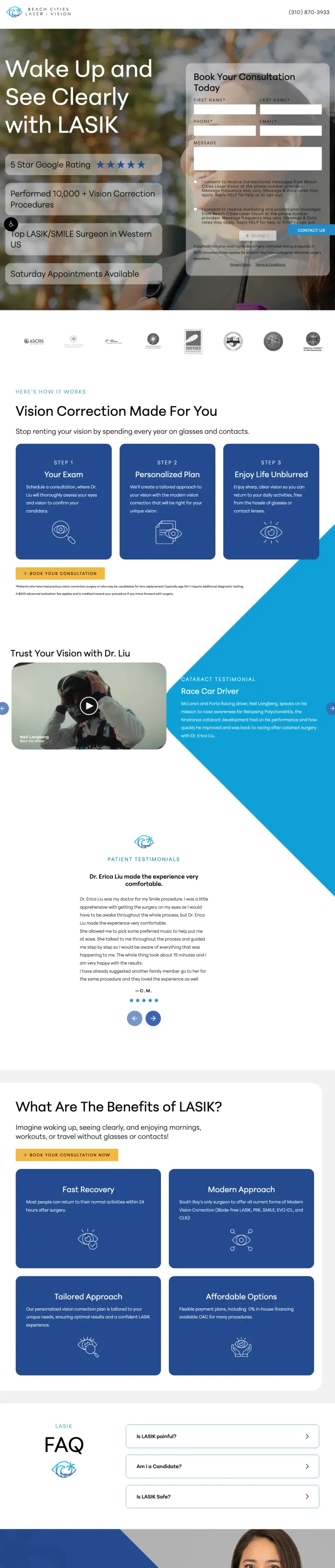
Embed the consultation request form directly in the hero section so the visitor can act immediately without scrolling. Beach Cities puts the form next to the hero image, making the conversion path zero-scroll for ready-to-act visitors.
- fewer steps
Hero form embedded beside the main headline means the visitor sees both the value proposition and the action mechanism in the same viewport, eliminating the scroll-to-CTA problem
- layout
'Vision Correction Made For You' headline with lifestyle imagery (person waking up, seeing clearly) sells the outcome rather than the procedure, which resonates with patients who are afraid of eye surgery but want the result
- answers doubts
Benefits section uses icon cards (precision, safety, comfort, speed) that are scannable and address the top four LASIK concerns in visual format
- too much at once
Named doctor section is below the fold, after the benefits and FAQ sections, which means the visitor has to scroll significantly before learning who will perform their surgery
- wrong promise
FAQ section takes up significant page real estate with general LASIK questions that could be on a separate page, pushing the doctor credentials further down
- no proof
No patient reviews or testimonials visible on the page, which is a significant gap for a local practice competing against chains with thousands of reviews
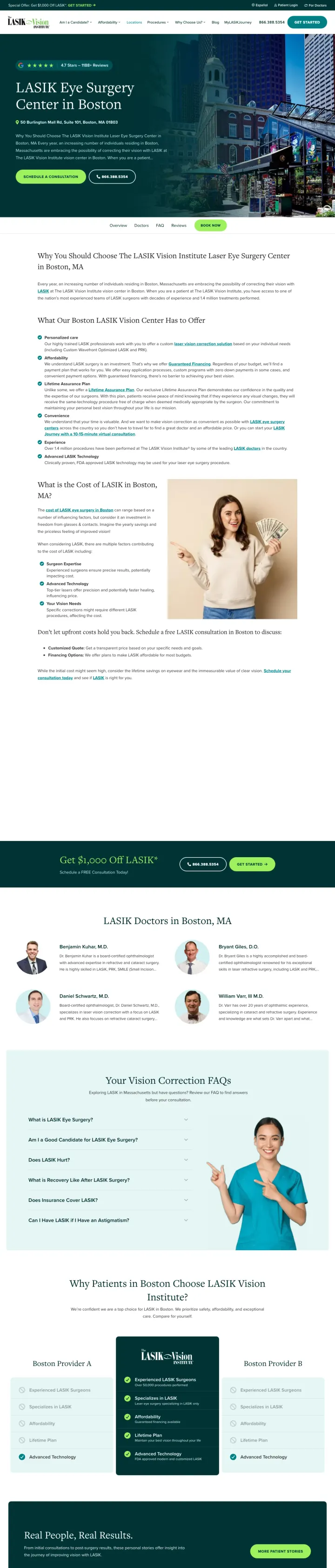
Build the page around patient video testimonials rather than procedure descriptions. LASIK Vision Institute's Boston page shows 8+ named patients with photos and review excerpts, making the patients themselves the main content rather than an afterthought section.
- reviews
8+ named patient testimonials with individual photos (Maria S., Ann P., and others) make a wall of real patients that a competitor cannot copy without earning the same reviews
- answers doubts
Local center branding ('Boston LASIK Center') with specific address and local surgeon profiles makes a national chain feel local and accessible
- reviews
Green and white color scheme differentiates from the ubiquitous navy blue of other LASIK pages, creating visual distinctiveness in a category where every page looks the same
- no proof
The page is extremely long with testimonial after testimonial, which may wear out visitors who came for quick information, not more reviews
- no proof
No specific price or savings offer visible. LasikPlus leads with '$1,000 OFF' while LASIK Vision Institute leads with testimonials, losing the price-comparison visitor
- wrong promise
Navigation bar at the top allows visitors to browse away to other center pages, which bleeds paid traffic across the site
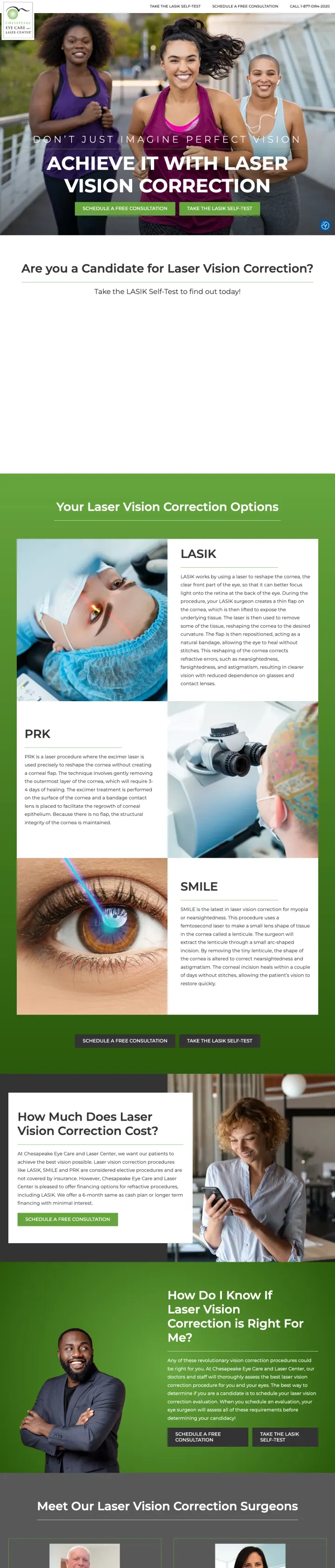
The candidacy questionnaire ('Are you a Candidate for Laser Vision Correction?') as the primary above-the-fold interaction is a smart alternative to a consultation form. It engages the visitor in a diagnostic conversation rather than asking for personal information upfront.
- made personal
Candidacy quiz as the first thing above the fold asks less of the visitor than a form, because they are answering questions about themselves rather than handing over contact details
- fewer steps
Three vision correction options (LASIK, PRK, EVO ICL) presented as card choices lets the visitor self-select their procedure interest before seeing surgeon information
- made personal
Named surgeons with photos and specific credentials at the bottom provide the trust layer after the visitor has self-qualified through the quiz
- wrong promise
Green color scheme is unusual for eye care (most use blue/white) and may feel more 'health food store' than 'surgical center'
- extra steps
No pricing or financing information anywhere on the page, which is a gap for a page targeting paid LASIK traffic
- wrong promise
The page URL ('/landing/lasik-fb') suggests this was built for Facebook ads, but if it is also receiving Google search traffic, the social-optimized design may not match search intent
What every winner does
Wildcards
Pages that break the playbook in interesting ways
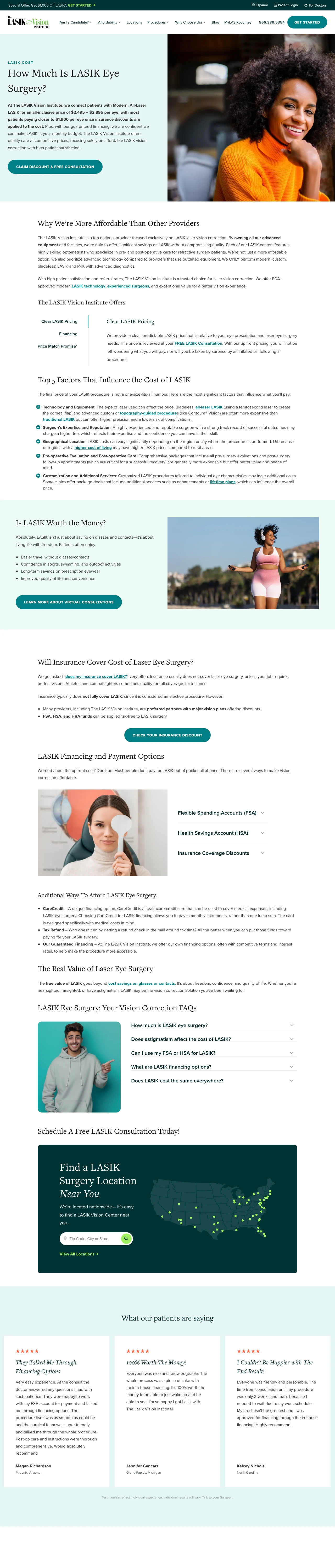
When targeting 'LASIK cost' keywords, answer the price question in the first sentence. This page dances around pricing with 'How Much Is LASIK Eye Surgery?' as the headline but never gives a specific number, which frustrates the high-intent visitor who searched specifically for cost information.
- layout
The page title ('How Much Is LASIK Eye Surgery?') matches the exact search query for cost-related LASIK keywords, which should produce strong Quality Scores in Google Ads
- made personal
Candidacy quiz CTA ('Am I a candidate?') captures visitors who are not yet ready to book but want to know if LASIK is an option for them, creating a lower-commitment conversion path
- answers doubts
Named surgeon section with photo and credentials below the cost discussion anchors the clinical authority after addressing the financial question
- wrong promise
The headline promises to answer 'How Much Is LASIK?' but the page body discusses factors that affect cost without ever giving a specific number or range. This is the ultimate message-match failure for cost-intent traffic
- wrong promise
No financing calculator or monthly payment estimator on a page specifically about LASIK cost, which is a missed opportunity to reframe a $4,000 procedure as '$X/month'
- wrong promise
Multiple navigation links in the header allow visitors to browse to other pages, bleeding paid traffic across the site
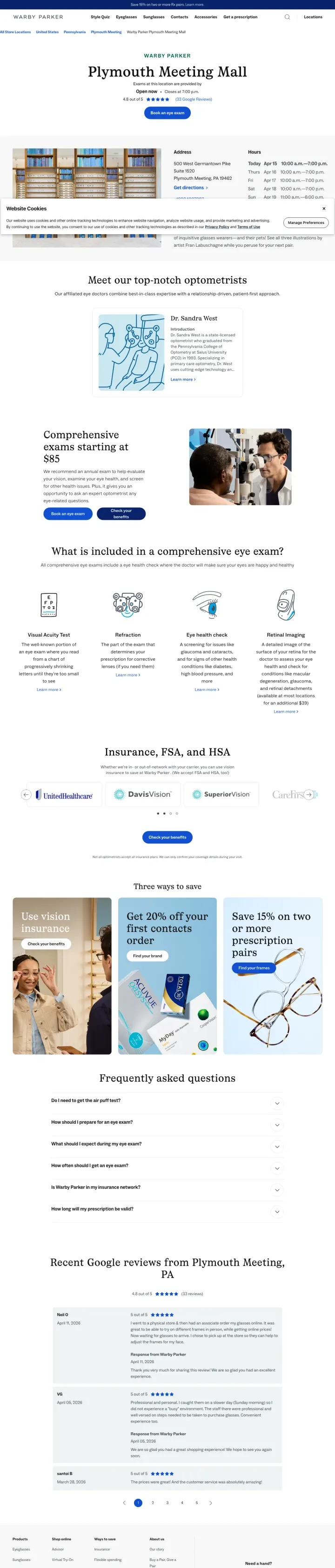
For store-level landing pages receiving paid traffic, combine location-specific details (address, hours, photos) with service-specific CTAs (Book an Exam) rather than showing them on separate pages. This Warby Parker exam page does this well.
- answers doubts
Comprehensive eye exam description ('What is included in a comprehensive eye exam?') educates the visitor on what they will receive, addressing the 'is this worth $X?' objection
- reviews
Local Google reviews embedded directly on the page put an outside score on the practice's own page, which is more credible than testimonials the practice picked itself
- layout
Dual CTA: 'Book an eye exam' for ready visitors and 'How to get a prescription' for visitors who need their prescription first but are not ready to book
- extra steps
The page serves both store information (hours, location, directions) and eye exam booking, which splits the visitor's attention between two different needs
- extra steps
No specific exam price visible on the page, which is the primary information a visitor searching for 'eye exam near me' wants to know
- wrong promise
Seasonal promotion ('Spring 2026') shown as a banner takes up visual space without a clear connection to the exam booking CTA
Losers
2 pages burning ad spend with fundamental issues
Every click to these pages costs real money. We found missing reviews, pages that don't match the search, weak CTAs, and messaging that ignores what the searcher actually typed. Here is what to avoid.
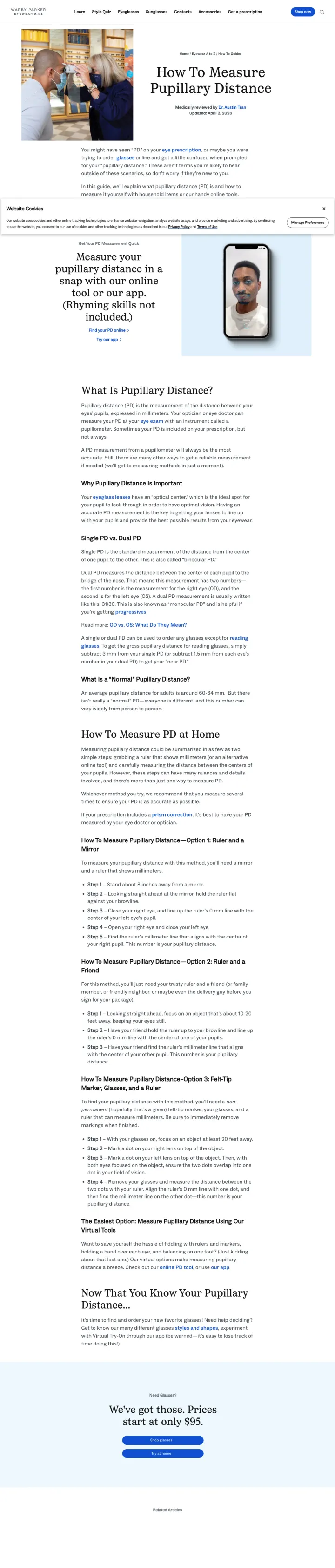
A visitor clicking a paid ad for eye care lands on a 1,500-word educational article explaining what pupillary distance is, how to measure it at home, and why it matters. The page has no product links, no 'Shop Frames' button, no exam booking CTA, and no inline purchase path. The only commercial element is a generic footer with 'Shop' navigation. At eyewear CPCs ($2-5), every click to this article is paying for content that should be earning organic traffic for free.
- extra steps
Zero product CTAs within the article body. A visitor who learns their PD has no next step on the page except navigating to the main site via the header
- wrong promise
No mention of Warby Parker frames, prices, or the try-at-home program anywhere in the article content
- wrong promise
Paid traffic to pure-educational content with no conversion mechanism is a direct waste of ad spend
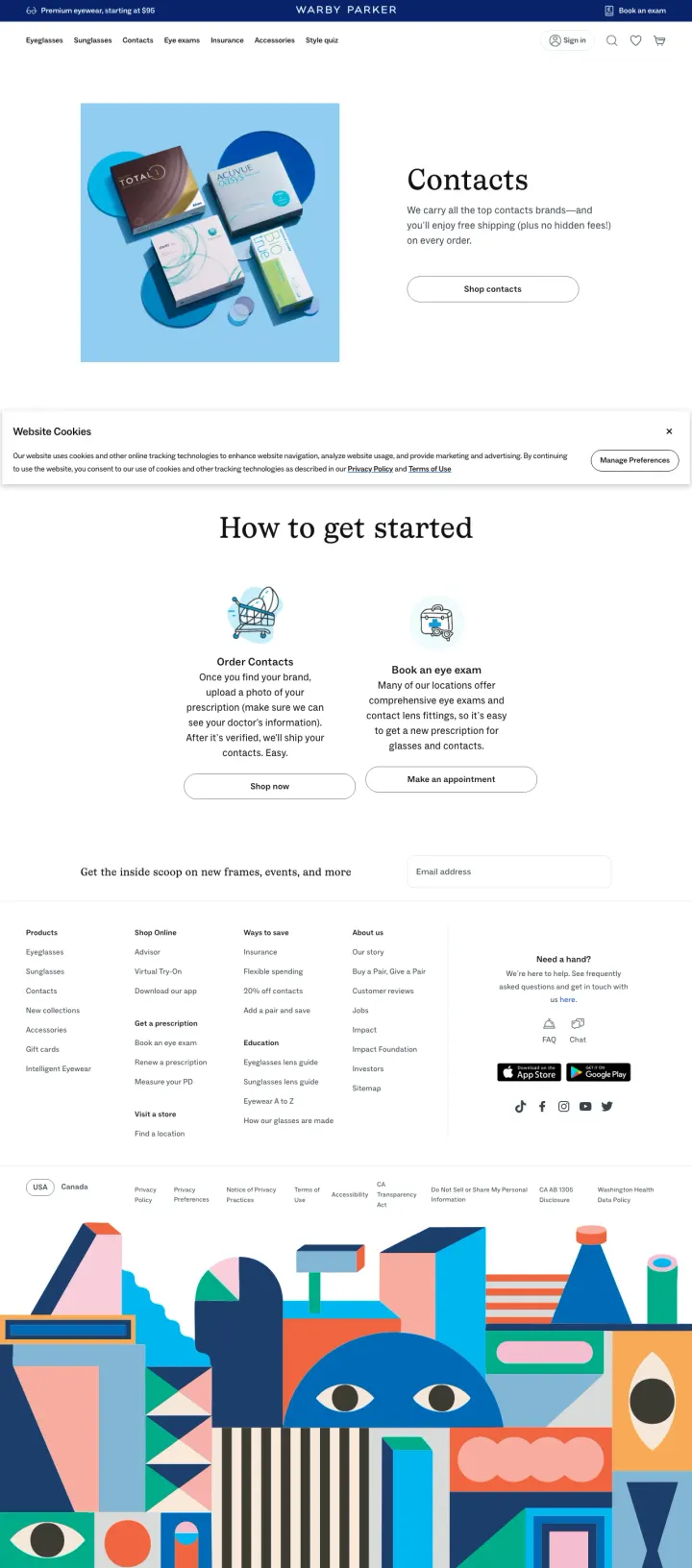
Paid traffic for contact lens keywords lands on a page showing contact lens brand boxes (Biofinity, Acuvue, etc.) with 'Shop contacts' and 'How to get started' sections. The page provides no pricing, no first-order discount, no subscription savings, and no comparison to competitors. At contact lens CPCs ($3-8), visitors who want to know 'how much do contacts cost at Warby Parker' bounce because the page does not answer the question.
- extra steps
No pricing visible for any contact lens brand, which is the single most important piece of information for a contact lens comparison shopper
- wrong promise
No first-order discount or subscription pricing, which is the primary conversion mechanism used by 1-800-Contacts, Hubble, and every other DTC contact lens competitor
- no proof
No customer reviews or satisfaction metrics for the contacts offering specifically
What we learned
LASIK pages that lead with a specific dollar savings offer above the fold outperform those that lead with procedure education
LasikPlus leads with '$1,000 OFF LASIK' in the hero and anchors every subsequent section around price savings. Their reviews page repeats 'Book today and save $1,000' as a sticky footer CTA. Contrast this with Chesapeake Eye Care, which leads with 'Achieve it with Laser Vision Correction' and a candidacy quiz. The savings-first approach works because LASIK is a considered purchase where price is the primary comparison axis. Patients have already decided they want LASIK; they are shopping on price and credentials.
Named surgeon with specific credentials above the fold is table stakes for refractive surgery, yet half the pages omit it
Dr. Kerry Solomon's EVO ICL page leads with his name and 'Kerry Solomon, MD' branding throughout. Chu Vision shows Dr. Chu's photo and credentials in the hero section. But LasikPlus, the largest LASIK chain, shows team photos rather than individual surgeons, and LASIK Vision Institute buries individual surgeon information below the fold. For a permanent eye surgery costing $2,000-5,000 per eye, patients need to know the name and credentials of the person who will cut their cornea before they will book.
Warby Parker sends paid traffic to educational content pages that build brand authority but have no conversion mechanism
Three Warby Parker pages in this sample are educational articles: 'How to Measure Pupillary Distance', 'How to Read Your Eye Prescription', and 'What is a Polycarbonate Lens'. These pages rank well organically and serve SEO purposes, but sending paid traffic to them means paying for visitors who may read the article and leave without ever seeing a product or booking an exam. The pages have no inline product recommendations, no 'Shop Now' CTAs within the content, and no form captures.
LASIK patient video testimonials with named patients outperform anonymous star ratings
LASIK Vision Institute's Boston center page shows 8+ named patients with video testimonials (Maria S., Ann P., others) with photos and full review text. LasikPlus shows '4.9 stars' with a review count and named text reviews. The video approach is stronger because LASIK patients need to see real people who had the same fear (someone operating on my eyes) and came out happy. A star rating is abstract; a named patient saying 'I can see perfectly' is concrete proof.
Winners lead with a specific dollar offer or price point above the fold and immediately show either a named surgeon or patient testimonials. Losers send paid traffic to educational content (Warby Parker articles), store locator pages (Warby Parker stores), or product catalog pages (Warby Parker contacts) that serve organic visitors well but waste paid clicks.
If you're building a page like these yourself, here's my comparison of AI landing page builders, with prices and what each one is best for.
What would we find on your page?
lasikplus.com is our #1. It leads with $1,000 OFF LASIK and 4.9 stars from 57,000+ reviews, and it still doesn't name a single surgeon. So 'who will operate on my eyes' never gets answered. Our #2, chuvision.com, puts Dr. Chu in the hero. postclick reads your page the way someone who just clicked a LASIK ad reads it. Then it designs new versions and builds the one you pick.