We analyzed 37 hotel landing pages. Only 6 are worth stealing from.
We read 37 hotel and resort pages that were paying for Google Ads clicks, top to bottom. These 6 are the ones worth your time. Everything we found is here, free.

37 landing pages screened
From real hotels / hospitality Google Ads campaigns in the US
6 winners curated
The landing pages actually worth stealing from
4 burning money
So you know exactly what to avoid

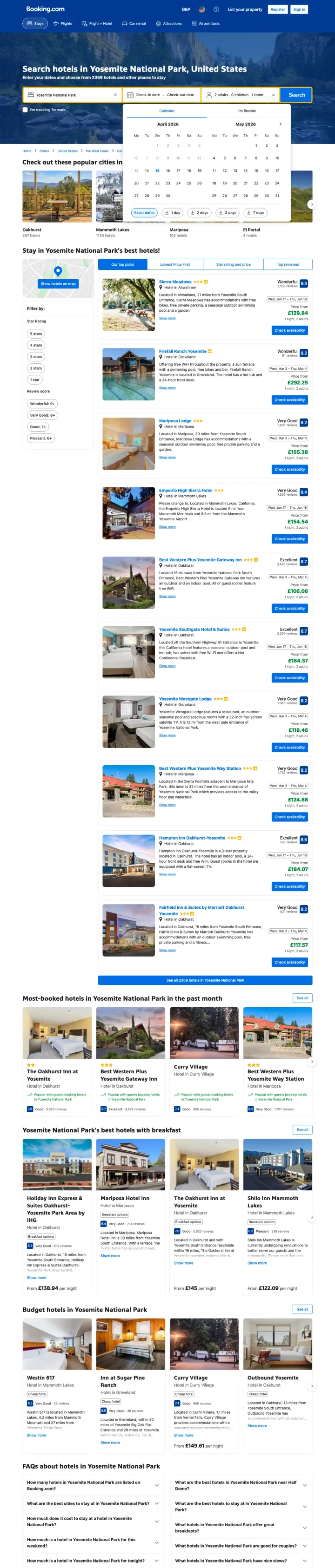
Booking.com takes the top slot because the click lands on a working shortlist, not a brochure. The destination is already typed into the search box, the calendar is already open over the right of the screen, and the hotel cards behind it carry a photo, a score, a review count and a nightly price each. The one thing it fumbles is the currency: the capture prints pounds on a page selling Ocean City, Maryland.
Show the total number of available properties in the page heading ('Ocean City - 2128 hotels and places to stay') so the visitor immediately knows they have enough options to find what they want without checking another OTA.
- + The prefilled search box fewer stepsone afternoonSearch hotels in Ocean City, MD
The destination is already sitting in the first control when the page loads, and the calendar is open before anybody touches it. The visitor arrived having already typed the town into Google, so asking them to type it again is asking them to repeat themselves. Read the destination out of your own ad and put it in the box for them.
- + The hotel card that answers everything reviewsone afternoonVery Good - What previous guests thought, 2,422 reviews
Photo, name, star class, neighbourhood, score, the word for that score, the review count, a nightly rate and what the rate buys, all inside one row you read left to right. Every question a hotel shopper asks gets answered without a click. If you run more than one property, or more than one room type, build a row that does the same and stop making them dig.
- + The filter rail beside the results layoutneeds a developerReview score
Star rating and review score sit in a rail on the left, so a visitor who only wants somewhere above a certain score can cut the list without scrolling past everything they will not book. It also tells you something for free: watch which filter gets used most and you learn what your traffic actually cares about. Add the two filters you already know your callers ask for.
- ✕ The wrong currency wrong detailsneeds a developer
The page sells hotels in Ocean City, Maryland, and the screenshot prints every nightly rate in pounds, with GBP sitting in the header beside a US flag. We pulled the same page's text on another run and got the same rooms in dollars, so the currency follows wherever the visitor appears to be, and it gets it wrong often enough that we caught it. A visitor who clicked a dollar priced advert now converts each rate in their head before they can compare anything, which is the whole job the page was built to do. Check what currency your own page serves to the country your ads run in, then check it again from a different connection.
- ✕ The calendar over the results covers the pageeasy
The date picker opens on load and sits over the right half of the screen, straight across the top hotel in the list. The score badge survives at the edge, the words beside it do not, and the visitor reads ood and iews. So the page ranks a hotel first and then puts a panel over the part that would sell it. Open your own page and check nothing you paid to show is behind something that opened by itself.
- ✕ The account buttons up top too many exitseasy
Register and Sign in sit in the header as two solid white boxes, the only boxed things in the whole blue bar and the first thing your eye lands on up there. Somebody who clicked an advert for hotels in one town does not want an account, they want a room. Every exit you put above your own booking control is an exit you paid for.
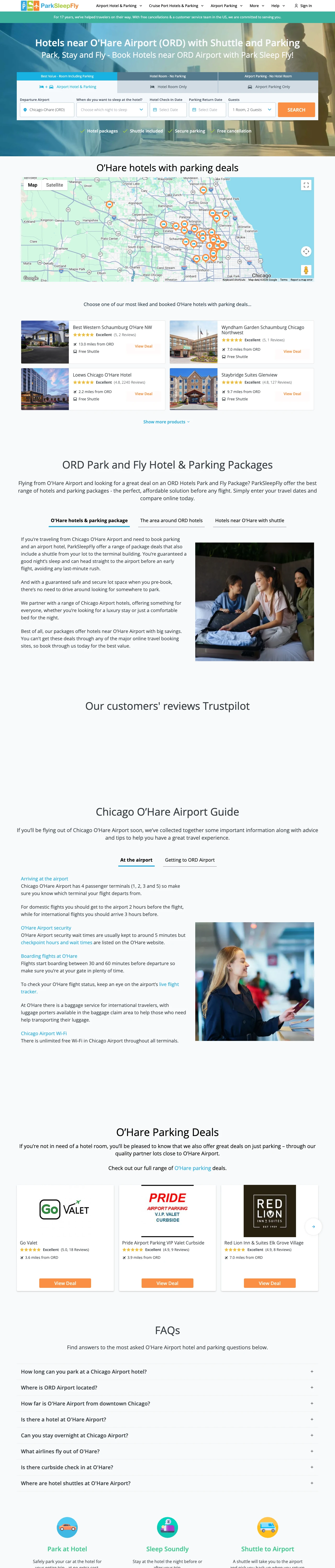
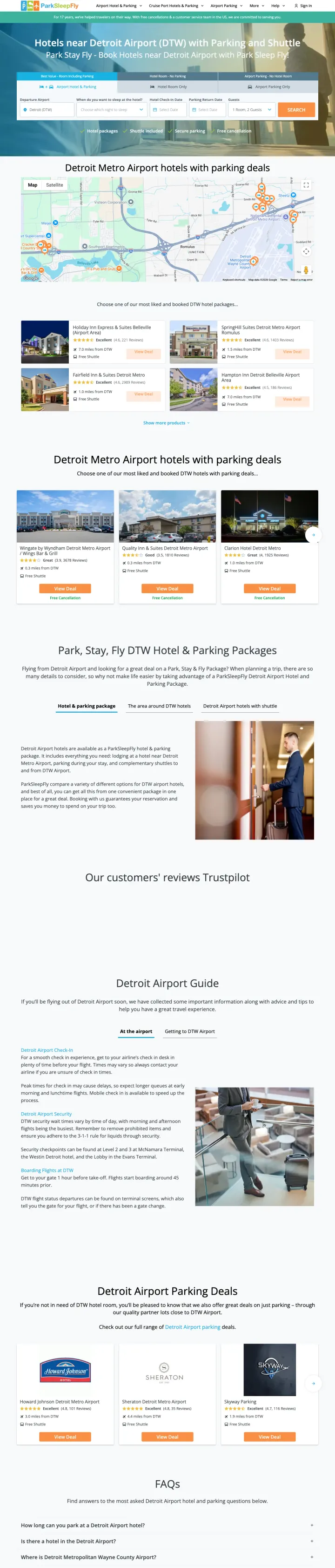
ParkSleepFly sells the airport hotel and the car park as one purchase, and the search row is built around that. The first control asks the departure airport, the second asks which night you want to sleep, and the tabs above them let somebody who only wants a room or only wants parking pick a different lane before they type anything. Under the search row a tick strip answers the shuttle, the parking and the cancellation in one line.
Bundle a commodity service (parking) with a higher-margin service (hotel room) into a single price, so the visitor cannot unbundle and comparison-shop each component separately. This is how parksleepfly.com competes against hotel sites that sell rooms and parking separately.
- + The three lanes above the search choice architectureone afternoon
Above the search row sit three tabs: the room with parking, the room on its own, the parking on its own. The one they want you to buy is highlighted and labelled best value, and the other two are still one click away. A visitor whose need is slightly different does not bounce looking for the right page. Give the partial buyer a lane instead of a back button.
- + The question in plain English form designeasyWhen do you want to sleep at the hotel?
Most booking forms would have called that field stay type and left you guessing. This one asks the question a traveller is already asking themselves, and the answers spell out the night before the flight, the night you get back, or both. Read your own field labels out loud. If they sound like a database column, rewrite them as a question.
- + The tick strip under the search answers a worryeasyFree cancellation
Hotel packages, shuttle included, secure parking, free cancellation, in a single line of green ticks directly under the search controls. Four worries answered in the space most pages give to a subheading. Write down the four things your callers ask before they book and put them exactly there.
- ✕ The empty review band proof missingneeds a developerOur customers' reviews Trustpilot
The heading renders and the reviews under it do not. The capture shows a white gap where the widget should be, and the reviews are real and glowing in the page source. So the page paid for the space, kept the heading, and shows the visitor nothing. Screenshot your own page from a cold browser and look for the blank rectangles, because a widget that fails silently is worse than one you never added.
- ✕ The airport guide in the middle loses focusone afternoon
Between the hotel deals and the parking deals the page turns into a travel guide: terminal numbers, how early to arrive, where the baggage porters are, whether the wifi is free. It is genuinely useful and it is nothing to do with booking a room tonight. Everything under your search widget should still be selling the booking.
- ✕ The buried price money too lateneeds a developer
The hotel tiles carry a score, a review count, the distance to the terminal and a free shuttle badge, and not one of them carries a rate. The visitor has to run the search and load another page before anybody tells them what this costs. Cost is the reason most of these clicks happen. Put a from price on the tile, even a rough one.

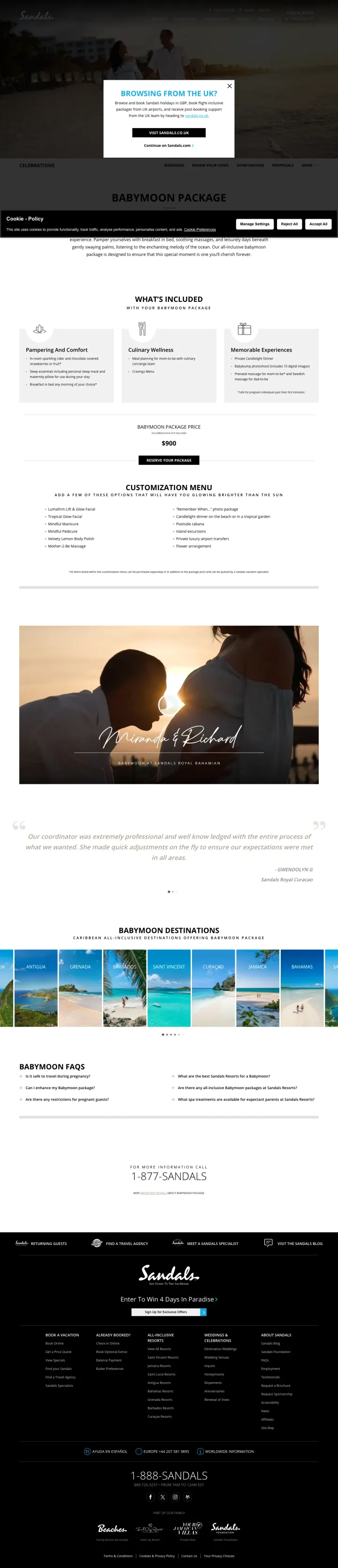
Sandals Royal Bahamian does the opposite of a search page: a full bleed resort photo, no headline over it, and the money and the booking widget waiting one screen down. What earns its place is the block on the right, where a countdown with live numbers sits above the saving, the date box and the booking button. It also runs two overlays at once on arrival, a country modal and a cookie bar, and the visitor meets both before they meet the offer.
Lead with a concrete savings number ('Save up to $1,000 + 1 Free Night') paired with a countdown timer showing days/hours/minutes. A dollar figure that exact makes the countdown feel genuine rather than manufactured.
- + The countdown that actually runs urgencyone afternoonSTAY MORE, SAVE MORE
Days, hours, minutes and seconds, each a real number ticking down over the saving and the booking button. Half the pages in our other files run the same block over an empty clock face, which a shopper spots in a second and never forgets. If you are going to run a timer, wire it to a date you will honour, and put the saving directly under it the way this page does.
- + The inclusions in three columns price framingone afternoonThe best all-inclusive value in the Caribbean for total peace of mind.
Eat and drink, play, no worries. Each column lists what the rate covers, right down to the taxes, the gratuities, the airport transfers and the boat to the island. All inclusive is a word everybody uses and nobody trusts, and this is what turns it back into a price. Write out every line item your rate absorbs, including the boring ones, because the boring ones are where the rival hotel charges extra.
- + The reviews with a mark on them reviewshard to earn10557 Verified Reviews
Every quote in the band carries a title, how long ago it was left, and the badge of the review site it came from, over a verified count you can go and check. A stranger reads that as somebody else's word, which is the only kind that counts at this price. Pull yours through from the site that hosts them and keep the source mark on every card.
- ✕ The two overlays on arrival covers the pageeasy
Land from the advert and a country modal sits in the middle of the hero while a cookie bar fills the bottom of the screen. Between them the visitor has to close two things before they can look at a photograph, and the offer is below both anyway. Load your own page cold and count what you have to dismiss before you can book.
- ✕ The headline that is not there wrong first screeneasy
The first screen is one resort photo and nothing written on it at all. No headline, no promise, no rate, no reason this resort rather than the next one. The real headline waits below the fold, so the visitor arriving from an advert gets a picture and a nav bar and has to scroll to learn what they are looking at. The photo is gorgeous and so is every photo on every resort page ever built. Put a sentence on your hero that a competitor could not paste onto theirs.
- ✕ The number in the basement hard to contacteasy
The only phone number on this page sits in the footer, past the inclusions, the rooms, the dining, the flight table, the reviews and the questions. Somebody spending this much on a holiday wants to speak to a person, and here they scroll the entire page to find one. Keep a number in view the whole way down, and put it beside the booking button.
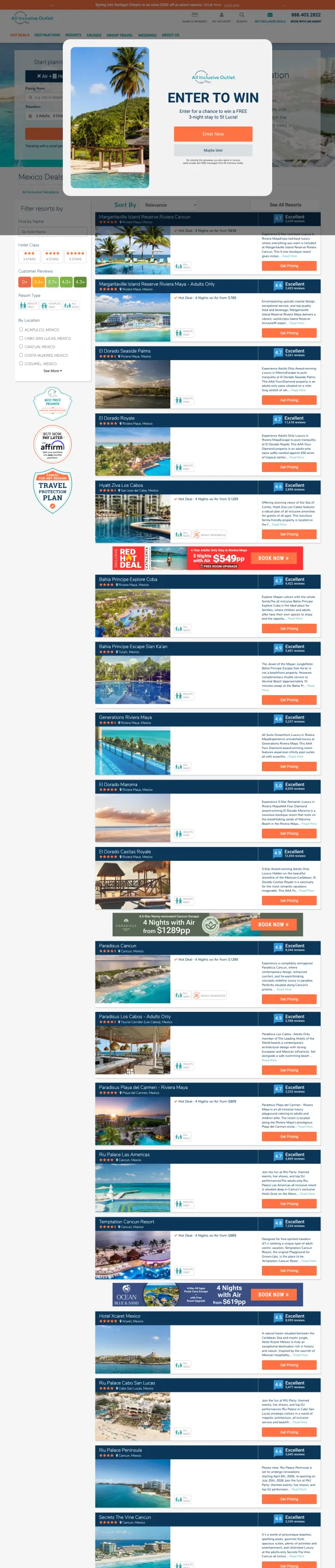
All Inclusive Outlet is the only page here that puts a phone number in the header at a size you can read, next to the words book with an agent. Below it every resort row carries a star class, a location, a score chip, a review count and an adults only or all ages badge, and the rows on a deal add a flag with the nights and the flight inside the price. Then a prize draw modal lands over the search widget and the headline before anybody has done a thing.
Show each deal as a complete package with airfare included ('4 Nights w/ Air from $839') so the visitor cannot easily comparison-shop against room-only OTAs. The bundled price makes the value proposition incomparable rather than competitive.
- + The agent in the header fewer stepseasy
The number sits top right at a size you can actually read, and the words under it say book with an agent rather than call us. That is a different offer: it tells the visitor a person will do the comparing for them. It is the only page in this file with a readable number in the first screen. If you have people answering phones, say what those people will do, not just that they exist.
- + The priced resort row price framingone afternoon4 Nights w/ Air from $839
Star class, location, score chip, review count and an audience badge saying adults only or all ages, on every row. The rows running a deal go further and add an orange flag with the nights and the flight inside the price. Somebody can rule out half the list without opening anything. Build your row so it answers who it suits and what it costs, and the visitor stops treating your list as homework. The rows with no price on them are the weak ones, and they sit in the same list looking like homework again.
- + The three badges in the rail answers a worryeasy
A best price promise, buy now pay later with Affirm, and a cancel for any reason travel protection plan, stacked as badges down the left rail beside the resort list and repeated at the foot of the page. Those are the things that stop a holiday booking, and this page answers them where somebody is actually comparing resorts rather than burying them in a policy page. The catch is that all three are drawn as pictures, so nothing in them is text a search engine or a screen reader can read. Name your deposit and your cancellation terms beside your list, and set them in type rather than in a badge.
- ✕ The prize draw on top of the search covers the pageeasy
A modal with a palm tree photo and a competition lands over the middle of the screen the moment the page opens, and behind it are the search widget and the headline. So the visitor's first decision is whether to enter a draw, not where they want to go. If the giveaway is worth having, put it in a band under the search widget where nobody has to close anything.
- ✕ The unsourced satisfaction claim weak proofeasyIndustry leading 96% customer
Every resort row on this page carries a score and a review count from somewhere else, all of it checkable. Then the site prints a satisfaction figure of its own with nothing behind it, on the please wait screen the visitor sees while the deals load. That is the one claim here nobody can check, and it gets the screen where there is nothing else to read. Either say who measured it and over what, or drop it and let the rows do the talking.
- ✕ The list with no end too much pageneeds a developer
The resort rows run on for screen after screen before the page reaches its own copy, and the filter rail on the left is the only way to cut them down. A visitor who scrolls rather than filters simply gets tired. Cap the first view at what fits on a screen or two, then let the filters do the rest.

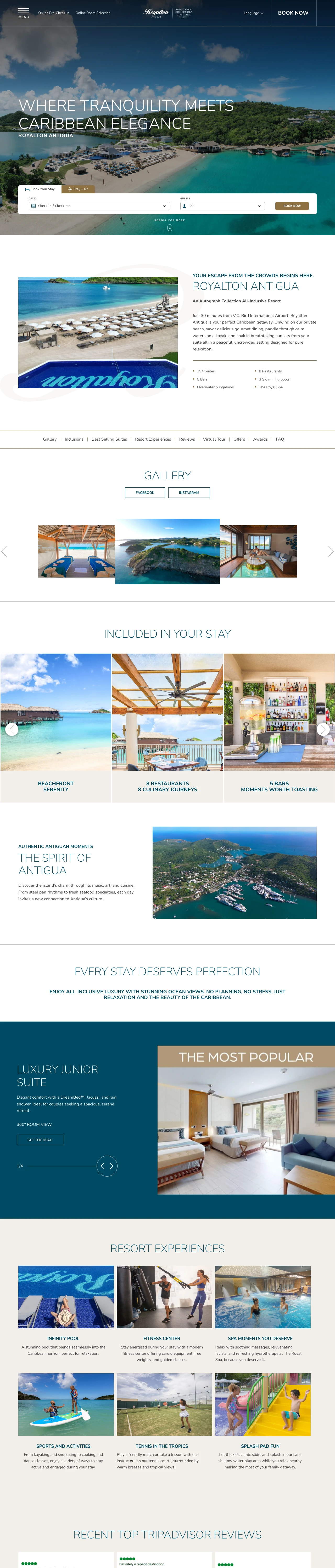
Royalton CHIC Cancun strips the page back to a logo and a picture. There is no nav bar, no phone number and no search widget in the first screen, only the pool photo, the headline over on the left and a Black Friday graphic sitting low and centre. Scroll once and the discount arrives with two buttons under it, both drawn as thin outlines in the same weight, so nothing on the screen tells the visitor which one is the main way in.
Create dedicated conversion-variant landing pages (note the '/homepage-cvr-alt2' URL slug) that strip the full site experience down to a focused sales funnel with a time-limited offer, gallery, and booking buttons. This is A/B testing infrastructure that most hotel brands skip.
- + The discount under the resort name the offereasySUMMER BLACK FRIDAY SALE
One scroll below the photo the page prints the resort name, the sale name, the discount and what it applies to, in four stacked lines and nothing else competing. It reads in about a second. When you run a sale, give it its own screen and its own name rather than tucking the percentage into a paragraph.
- + The stay written as inclusions price framingone afternoonAdults-Only
Adults only, the restaurants, the bars, the entertainment, the spa, the butler, the minibar, the room service, the wifi. Each gets its own photo card under a heading that names the thing and then sells it in the same breath, so the heading reads restaurants and global flavors with a twist rather than restaurants. The discount lands on a stay somebody can picture rather than a room. If your rate covers things, count them as things and give each one a picture and a line.
- + The virtual tour link shows the productneeds a developer
A tour of the suites, the restaurants and the rooftop, offered as a way to see the place before you arrive rather than as a gimmick. For a resort sold on atmosphere it does what the gallery cannot: it lets a stranger wander. If you have the rooms photographed already, stitching them is a smaller job than it sounds.
- ✕ The pair of matching buttons no clear patheasyPREPAY FOR LOWEST PRICE
Under the discount sit two buttons, side by side, both drawn as thin grey outlines in the same weight with the same type inside them. One is about paying now for the best rate, the other is about free transfers. Nothing on the screen says which is the normal way in, so the visitor has to read both and decide. Make the prepay button solid and let the transfers offer be a link.
- ✕ The headline the photo swallows hard to readeasy
The headline is set in thin white capitals with no backing behind it, laid straight over a pool photo of blue and orange mosaic tiles. The word Cancun runs across a swimmer's shoulder and the last letters land on pale water, so the sentence goes soft exactly where it names the place. Meanwhile the sale graphic sits lower on the same photo in solid black on acid yellow, so the loudest thing on the hero is the badge and the softest is the sentence. Put a dark panel behind your hero text, or crop to a plain part of the picture, and let the headline win the screen it is on.
- ✕ The reviews saved as pictures weak proofone afternoonRecent Top TripAdvisor Reviews
The review band is three flat images, screenshots of reviews rather than reviews. Nothing in them is text, nothing links out, and search engines and screen readers see nothing at all. A picture of proof is not proof. Pull the reviews in from the site that hosts them and let each one link back to where it lives.
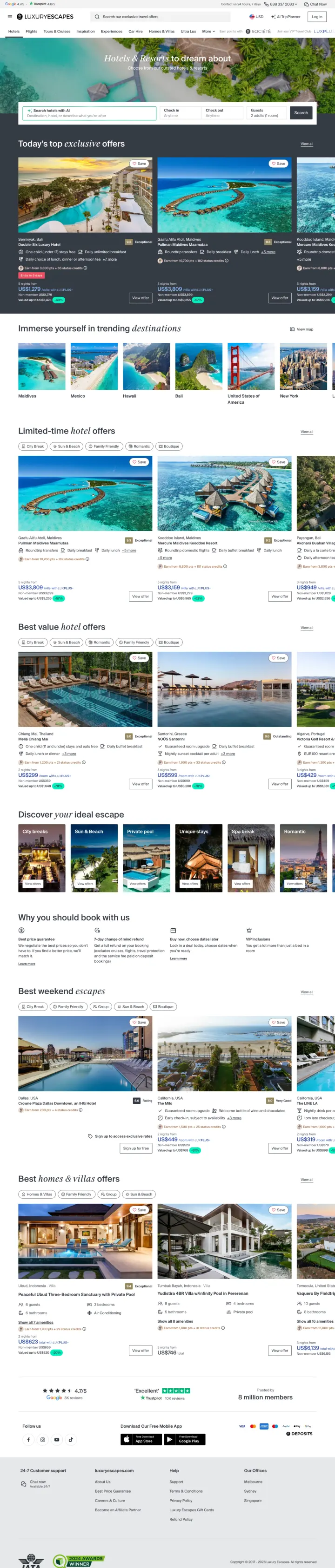
Luxury Escapes is the only page in this file carrying two named rating bodies in the first screen, and it wastes them by setting the scores in pale grey type barely taller than the brand marks beside them. The offer cards do the real work: the inclusions are listed with icons, the score chip sits beside the name, and the price is printed as a member price, a non member price and a value, so the discount is shown rather than claimed.
Use 'Today's top exclusive offers' as a section header above curated deals to create FOMO around time-sensitivity while positioning the platform as a curator, not just an aggregator. The word 'exclusive' implies these rates are not available on Booking.com.
- + The price said three ways price framingone afternoonValued up to
Each offer card prints the member price big, the non member price under it in grey, then what the stay is valued at with a discount chip beside it. The saving is shown being worked out rather than announced, which is the difference between a real discount and a starting figure dressed up. If you have a member rate, print both numbers and let the gap argue for the membership.
- + The inclusions on the card shows the productone afternoonExceptional
The good cards list what comes with the stay, each line with its own small icon, under the score chip and the nights. Transfers, breakfast, lunch, a child staying free. The visitor reads a card the way they would read a menu instead of clicking through to find out. Look at the cards that carry no inclusions and no price, only a sign up to see the rate, and you can watch the difference in your own eye. Put your inclusions on the card, not behind it.
- + The four reasons block answers a worryeasyBuy now, choose dates later
A price guarantee, a change of mind refund, buy now and choose dates later, and the inclusions promise, each with a heading and a sentence under it. The third one is the clever one, because the reason people leave a holiday page is that they have not agreed the dates yet. Find the thing your visitors cannot decide today and sell them a way around it.
- ✕ The rating bar nobody can read proof too smalleasy
Two named rating bodies with their scores sit in the top left of the utility bar, and the brand marks are in full colour while the scores beside them are pale grey and shorter than the marks themselves. Right at the foot of the page the same two scores appear again, large, with their review counts and a member count beside them. The proof that would help most is the one printed smallest and first, and the version worth seeing waits where nobody reaches. Set the scores at the size of your headline, not the size of your phone number.
- ✕ The price below the fold money too lateneeds a developer
The offers heading and the card photos land in the first screen, then the name, the score and the whole inclusions list sit between the photo and the rate, so the price falls well past the fold. The visitor sees a shelf of pictures with no rates on them. The whole positioning is that these deals are better than the booking sites, and the number that proves it is the part that got cut. Move the price up under the name, or shrink your photo until the rate clears the fold.
- ✕ The carousel that hides a card layoutone afternoon
Every row of offers is a sideways carousel, and each one shows a third card sliced down the middle at the right edge. Sideways scrolling is the interaction people are least likely to try, so a chunk of what you are selling waits behind a gesture. Show whole cards and let the row wrap, or make the arrow big enough to notice.
What the hotel winners do
Wildcards
Pages that break the playbook in interesting ways
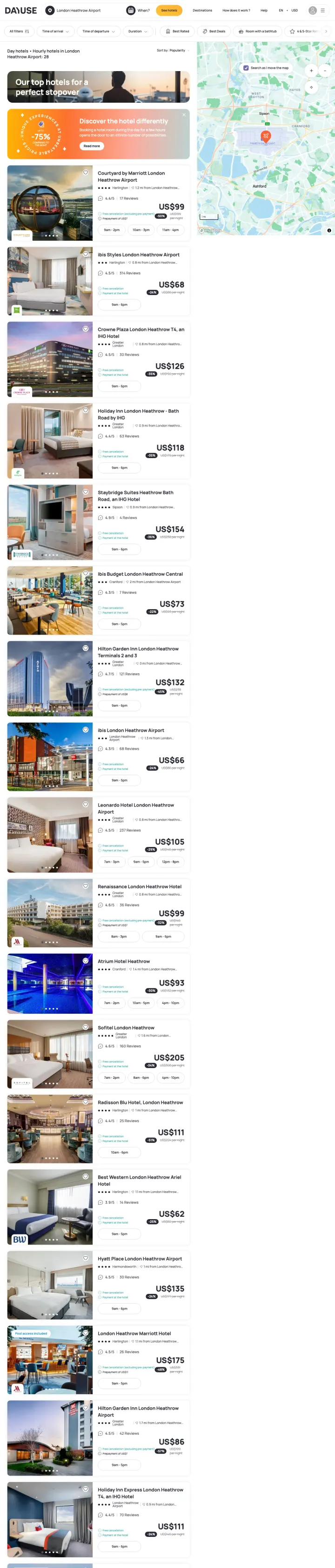
Dayuse.com breaks the convention that hotels sell nights. By selling rooms by the hour with time-slot selection (9am-2pm, 10am-5pm, 11am-6pm), they created a category that does not exist on Booking.com or Expedia. The rule they break: every other hotel page assumes the visitor wants to sleep there. Dayuse assumes they want to use the room during the day. This works because airport travelers, business professionals, and couples have genuine daytime hotel needs that overnight OTAs ignore.
- fewer steps
'-75% compared to the night rate' badge on every listing instantly communicates the value proposition - the visitor does not need to calculate the savings, the platform does it for them and displays the discount as a percentage
- exact numbers
Time-slot selectors (9am-2pm / 10am-5pm / 11am-6pm) on each listing let the visitor choose their exact window without a traditional check-in/check-out date picker - this UI innovation matches the product's hourly model perfectly
- exact numbers
Map integration with hotel pins showing exact Heathrow proximity answers the airport traveler's primary question (how far from the terminal?) before they read any listing details
- looks off
The 'Discover the hotel differently' promotional banner with a 'Read more' CTA interrupts the listing flow and feels like an educational popup - visitors who arrived via PPC for 'day room london heathrow' already understand the concept and do not need it explained
- too much at once
28 hotels listed on one page with no pagination or load-more creates an extremely long scroll - the visitor searching for 'hotel london heathrow terminal 2' wants terminal-specific proximity, not 28 options across all terminals
- no proof
Review counts are low (17 Reviews on the top listing) compared to overnight OTAs showing thousands - this is inherent to the niche but still creates a trust gap for visitors comparing across tabs
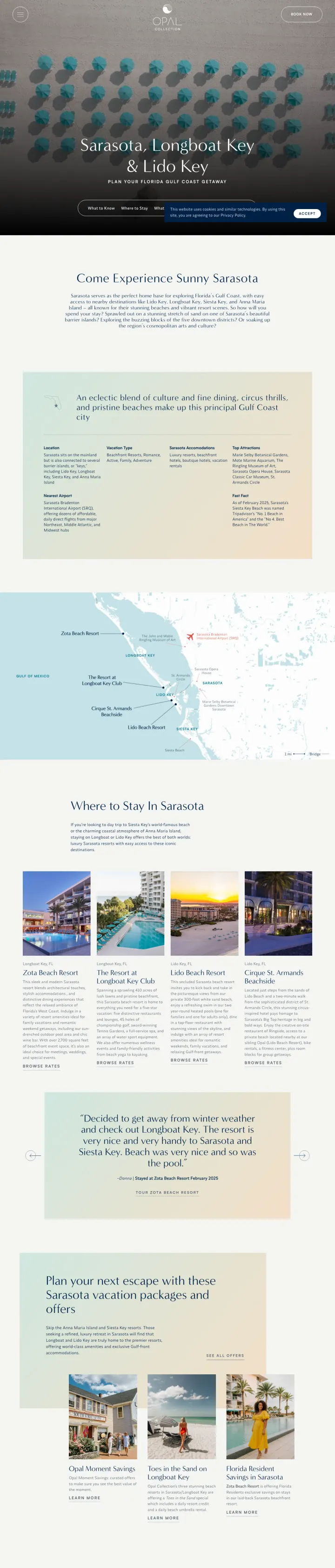
Opal Collection breaks the convention that hotel landing pages should lead with rooms and rates. Instead, they lead with the destination experience: beach umbrellas, local restaurants, art galleries, things to do. The page sells Sarasota first and their properties second. This works because the visitor searching 'sarasota fl siesta key hotels' has not yet committed to a specific property - they are choosing a destination, and the hotel group that helps them fall in love with the area earns the booking. Most hotel brands skip this step and go straight to room photos.
- fewer steps
Tabbed content navigation ('What to Know / Where to Stay / What to Do') lets visitors sort themselves - someone researching the area clicks 'What to Know,' someone ready to book clicks 'Where to Stay'
- credentials
Aerial beach photography with turquoise umbrellas creates an immediately recognizable and shareable hero image that communicates 'this is a real place with real beauty' without any text overlay needed
- reviews
'Book Now' button in the top right corner stays visible while the page content is educational and inspirational - the conversion path exists but does not interrupt the destination storytelling
- missing proof
No prices anywhere on the page - the visitor who searched 'sarasota fl siesta key hotels' (40,500 monthly volume) expects to see nightly rates, not a destination guide. The conversion path from 'I love this area' to 'here is what it costs' is entirely missing
- looks off
Destination guide content (restaurants, art galleries, things to do) appears above any hotel room photography or room types. A visitor who searched for the property wants to see where they will sleep first, not a city guide.
- wrong promise
Ad promises 'Beachfront Hotel By Siesta Key' but the page is about Sarasota, Longboat Key, and Lido Key broadly - Siesta Key is mentioned as a nearby attraction rather than the primary location, creating a subtle mismatch
Compare the winners
The same questions asked of every winner, so you can find the row that matches the traffic you are already buying.
| Page | The hook | Search or form fields | Rate or deal named up top | Phone in the first screen | Score or review count up top | Credential you can check | Standout move |
|---|---|---|---|---|---|---|---|
| #1Booking.com | A shortlist, already filtered | 3 | Yes | No | Yes | None | Destination typed in, calendar open |
| #2ParkSleepFly | Room and car park in one buy | 5 | No | No | No | None | Tabs for the traveller who wants only one |
| #3Sandals Royal Bahamian | The photo first, the money after | 1 | No | No | No | None | A countdown running real numbers |
| #4All Inclusive Outlet | Ring an agent, or browse the deals | 5 | Yes | Yes | Yes | In the footer | The deal rows price the flight in |
| #5Royalton CHIC Cancun | A picture and a discount | 3 | Yes | No | No | In the footer | The whole stay listed as inclusions |
| #6Luxury Escapes | Google and Trustpilot, then the deals | 4 | No | Tiny | Yes | In the footer | Member price and normal price together |
Read the keywords you are buying, then find the row that matches them. Somebody typing hotels near ORD with parking has a flight to catch and wants the dates, the shuttle and the price settled in one go. Somebody typing all inclusive Cancun is daydreaming at their desk and needs the photograph, the inclusions and a reason to trust the brand before any number lands. You paid the same for both clicks.
The copy bank
Lines lifted word for word off the pages above. We tell you whose page each came from, and one click copies it.
Choose from our curated hotels & resorts
Party Your Way under Cancun Skies
Enter your dates to see the latest prices and deals for Ocean City hotels
Historic Beach Club Meets Private Island
Losers
4 pages burning ad spend with fundamental issues
Every click to these pages costs real money. We found pages with no reviews or badges anywhere, pages answering a different search than the one the visitor typed, and weak CTAs. Here is what to avoid.
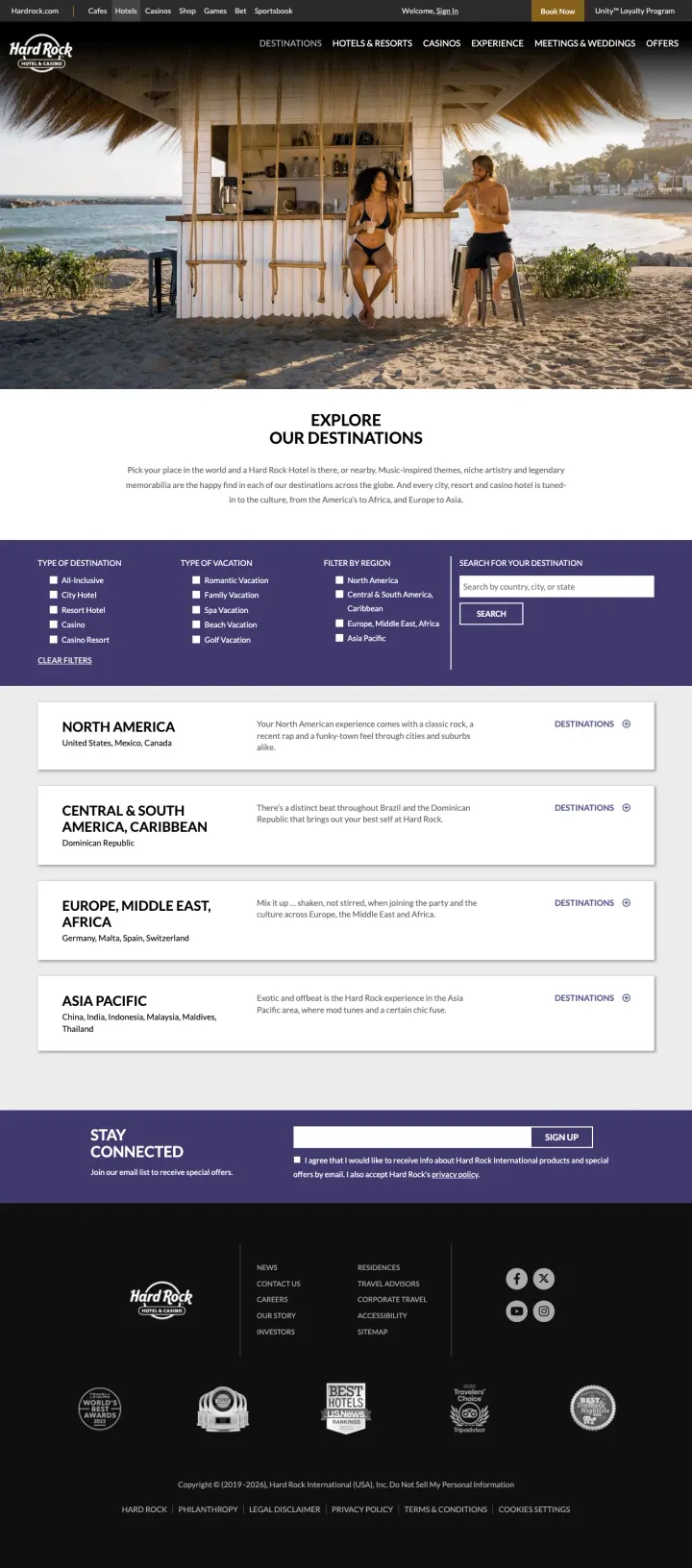
The ad targets 'hard rock cafe hotel and casino' but lands on a generic destinations index that lists continent names (North America, Central & South America, Europe, Asia Pacific) with 'Destinations' links. No hotel is shown. No price is shown. No room is bookable. The visitor searched for a specific hotel brand and received a geography lesson. Every click pays for a page that requires 2-3 more clicks to reach anything bookable.
- wrong promise
The page lists four continental regions with brief descriptions and 'Destinations' links but shows zero individual hotels - the visitor who searched for 'hard rock cafe hotel and casino' expects to see a specific property or at minimum a list of bookable hotels
- extra steps
No search form, no date picker, no booking widget anywhere on the page - the only way forward is clicking a region name to (presumably) see a list of hotels in that region
- looks off
The hero image shows a couple at a beach bar, which is lifestyle-appropriate but communicates nothing about which property they should book or what it costs
The ad targets 'all inclusive resorts in costa rica' (60,500 monthly volume) and lands on a country-level destination page that shows a single region card (Guanacaste) with no hotels, no prices, no reviews, and no booking capability. The visitor must click through to the region, then to a specific hotel, then select dates before seeing any rate. At hotel industry CPCs, every click that reaches this page and bounces is pure waste because the page does not even attempt to convert.
- extra steps
The entire page below the hero contains one region card (Guanacaste) and a newsletter signup form - for a brand running ads against 60,500 monthly searches for 'all inclusive resorts in costa rica,' this is an astonishing lack of content
- looks off
No hotel names, no room photos, no prices, no review scores, no availability information anywhere on the page - the visitor searching for 'all inclusive resorts' gets a country overview with zero resort information
- extra steps
The booking search form at the bottom of the hero asks for destination, dates, and guests but defaults to empty fields - it does not pre-populate with 'Costa Rica' despite the page being about Costa Rica
The ad targets 'all exclusive punta cana' and 'punta cana dr all inclusive resorts' (246,000 combined monthly volume) promising 'Lowest Price Anywhere,' but the landing page shows exactly one property at $442/night with no comparison options, no review scores, and no photos beyond a single thumbnail. When a visitor searches 'all inclusive resorts' (plural), they expect choice. Showing a single hotel with a cookie consent modal covering the viewport is paying premium CPCs for a bounce.
- wrong promise
Cookie consent modal fills 80% of the viewport on first load with 'Your Privacy Choices' including toggles for Required, Functional, and Advertising cookies - the actual hotel listing is completely hidden behind this modal
- wrong promise
'Showing 1 hotel' for a search targeting 'all inclusive resorts in Punta Cana' means the visitor sees zero choice - Hilton only has one all-inclusive property in Punta Cana, so this page can never satisfy the browsing intent that drove the search
- looks off
No review score, no guest photos, no amenity highlights, no 'free cancellation' badge - the single listing shows a thumbnail, a price ($442), and a 'Select Dates' button with no supporting information to justify the rate
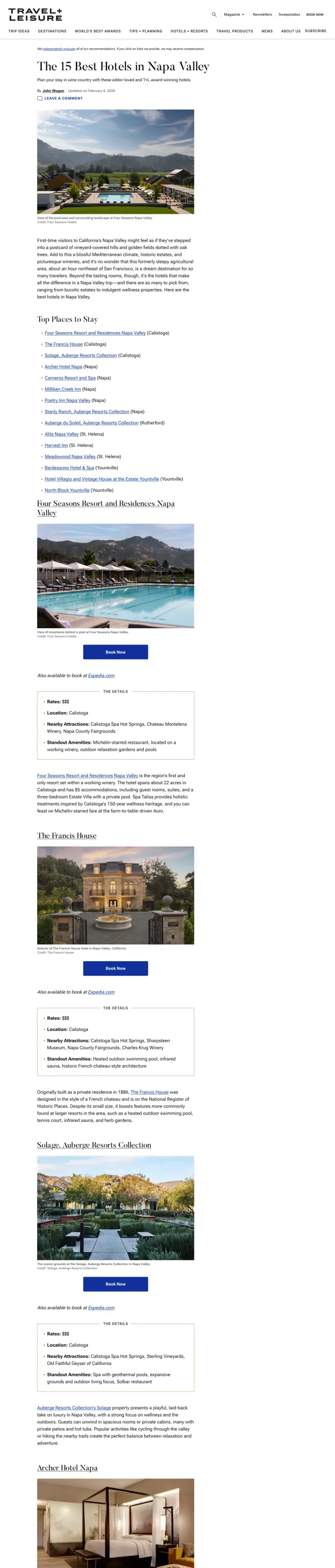
Travel + Leisure is paying for PPC clicks on 'best napa valley accommodations' to send visitors to an editorial article ('The 15 Best Hotels in Napa Valley') that contains affiliate links to Hotels.com and Expedia. The visitor pays T+L's CPC, reads a magazine-style review, then clicks an affiliate link to book on a different site. This is content arbitrage: T+L profits from the affiliate commission minus the CPC cost, but the landing page itself has no booking capability, no prices, and no conversion path beyond 'read and click an outbound link.'
- looks off
Zero prices anywhere on the page - each hotel gets a description, a photo, and a 'Book Now' button that links to Hotels.com, but the visitor never sees a rate before clicking away from T+L
- wrong promise
The 'Book Now' buttons are affiliate links to Hotels.com/Expedia rather than direct booking - the visitor who clicked a PPC ad expecting to book is actually 2 clicks and 1 site-change away from any booking action
- wrong promise
Full editorial site navigation (Trip Ideas, Destinations, World's Best Awards, Tips + Planning, Hotels + Resorts, Travel Products, News, About Us, Subscribe) provides 8+ exit paths that have nothing to do with booking a Napa hotel
What we learned
Package pricing with airfare included converts browsers into bookers
The strongest pages in this set show total package prices including flights ('4 Nights w/ Air from $839'). Hotel-only pricing forces the visitor to mentally add airfare and compare across tabs. All-in pricing eliminates that math and makes comparison shopping harder because each site bundles differently. This is why allinclusiveoutlet.com and sandals.com can compete against OTAs that have more inventory.
Review counts in the thousands signal booking volume, not just quality
A 4.5-star rating means little without volume. Booking.com showing '8.1 from 2,128 reviews' and Sandals showing '10,557 Verified Reviews' communicate something a 5-star rating from 3 reviews never can: that thousands of people have already made this same decision and were satisfied. High review counts reduce the 'will it match the photos?' anxiety that drives hotel comparison shopping.
Niche positioning beats trying to compete with OTAs on breadth
The most effective non-OTA pages in this set own a specific niche rather than competing on hotel volume. Parksleepfly.com owns 'airport hotel + parking bundles.' Dayuse.com owns 'hourly hotel rooms.' Sandals owns 'adults-only all-inclusive Caribbean.' Each solves a problem that Booking.com and Expedia handle poorly, which justifies paying for clicks against those giant brands.
Map integration above the fold answers the location question before the visitor asks it
Hotel searchers care deeply about proximity: how far from the airport, the beach, downtown. Pages that show a map with hotel pins above the fold (parksleepfly.com, dayuse.com, booking.com) let the visitor answer the location question visually without scrolling. Pages that bury or skip the map force the visitor to open Google Maps in another tab, and they may not come back.
Winners put the three things hotel searchers need in one viewport: a price, a review score, and a way to book. Losers send paid traffic to destination directories that list regions instead of hotels, editorial listicles with affiliate links instead of booking buttons, or pages so thin they show a single property for a search query that implies choice.
If you're building a page like these yourself, here's my comparison of AI landing page builders, with prices and what each one is best for.
What the hotel winners taught us
The pages that win here get the traveller moving before they get them reading. A search box with the destination already in it, a rate with the nights inside it, a score somebody else awarded. The ones that lose spend the first screen on scenery and put the decision one scroll away.
- 1
Put a rate in the first screen, and say what it covers. Half the winners here name a rate or a deal before the scroll and half do not, which is a coin toss on the one question every hotel searcher has open in another tab. A nightly figure on its own is not enough either. The rates worth stealing carry the nights, the flight, the transfers or the cancellation policy in the same breath, so the visitor can hold your number next to somebody else's and see what is different.
- 2
Borrow the score, do not write the testimonial. Only half of these first screens carry a score or a review count, and hotels are the one trade where every guest is already asked to rate the stay. Booking.com hangs the score off the hotel card and Luxury Escapes carries two named rating bodies in its top bar, both before the scroll. ParkSleepFly has the same proof and keeps it a screen too low, on the hotel tile with the distance to the terminal beside it. A quote with a first name under it is your word. A score with a count and a source on it is somebody else's, and it only works where somebody sees it.
- 3
Get something checkable above the fold. Not one page in this file puts a rating body or an accreditation in the first screen. Half of them have one and bury it: a motoring club diamond parked in a carousel most of the way down, a business bureau badge under the copyright line, an airline accreditation logo in the footer. That is proof you have already earned, sitting where nobody deciding between you and the next resort will ever see it. Move it up beside the rate.
- 4
Count what your search widget really asks. The widgets in this file run from a single date box to a full row of controls, and the long ones are not automatically wrong. ParkSleepFly and All Inclusive Outlet ask the most, tied, and ParkSleepFly gets away with it because every control is a question the traveller was going to have to answer anyway. The test is not how many boxes you show, it is whether the visitor could have answered each one before they clicked your ad.
- 5
Load your own page cold and see what lands on top of it. All Inclusive Outlet opens with a prize draw over its own search widget, and Sandals opens with a country modal and a cookie bar at the same time. Prize draws, country modals, cookie bars and chat widgets all stack up, and every one of them was signed off by somebody who never watched the page load from an advert. Open yours in a fresh browser, from the ad, and write down what you actually have to close before you can book.
Score your own hotel page
Every line below came off a screenshot somebody sat and counted. Open your own page beside it and tick what it already does.
Now point postclick at your hotel page
Booking.com is the first of the six winners here, and it still shows nightly rates in GBP on a URL targeting Ocean City, MD. Somebody paid for that click. Give postclick the URL your hotel ads point at. It reads the page like a guest who's never heard of you, then names what's costing you bookings - the buried cancellation policy, the rate that arrives too late. Then it draws better versions and builds the one you pick.