We analyzed 40 internet provider landing pages. Only 7 are worth stealing from.

40 landing pages screened
From real internet & telecom Google Ads campaigns in the US
7 winners curated
The landing pages actually worth stealing from
3 burning money
So you know exactly what to avoid
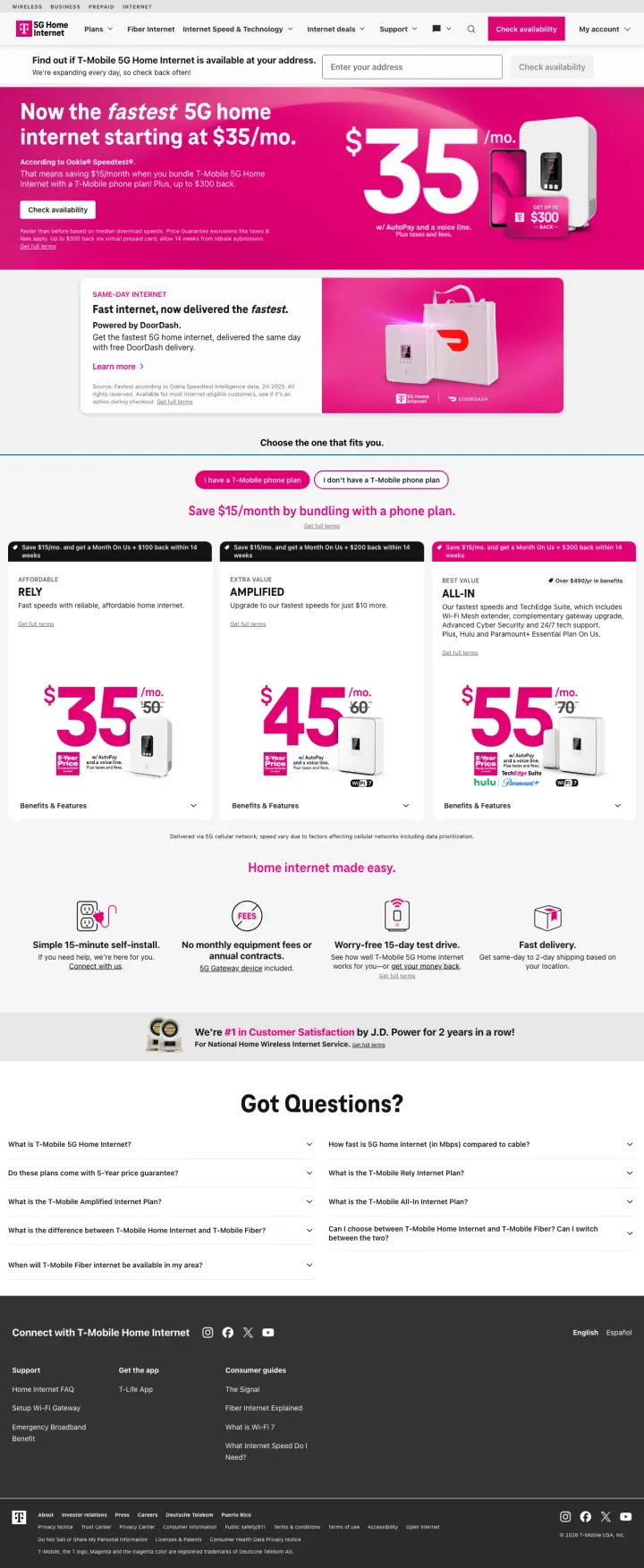
Lead with a bold price anchor ('Starting at $35/mo') in oversized type on a brand-color background, then immediately show three plan tiers with speed, price, and included features in a tabbed comparison. T-Mobile makes the cheapest plan look like a great deal while steering visitors to higher tiers with 'Most Popular' badging.
- reviews
'Now the fastest 5G home internet' claim positioned as a factual statement (not 'we think' or 'we believe') paired with '$35/mo' creates the strongest speed-for-price value proposition in the dataset
- layout
Three plan tiers (RELY $35 / AMPLIFIED $45 / ALL-IN $55) with tabbed comparison showing exactly what each tier includes - the visitor can compare in 5 seconds without reading paragraphs
- reviews
'We're #1 in Customer Satisfaction by J.D. Power for 5 years in a row' banner with the J.D. Power badge is the most credible third-party validation in the dataset - no ISP can fake a J.D. Power ranking
- wrong promise
The address check is buried below the plan comparison - for a service that is location-dependent, not knowing whether T-Mobile 5G is available at your address before seeing plans creates potential disappointment
- too much at once
The page is long and content-rich, with FAQ, articles, and additional product information that may distract from the core conversion (sign up for a plan)
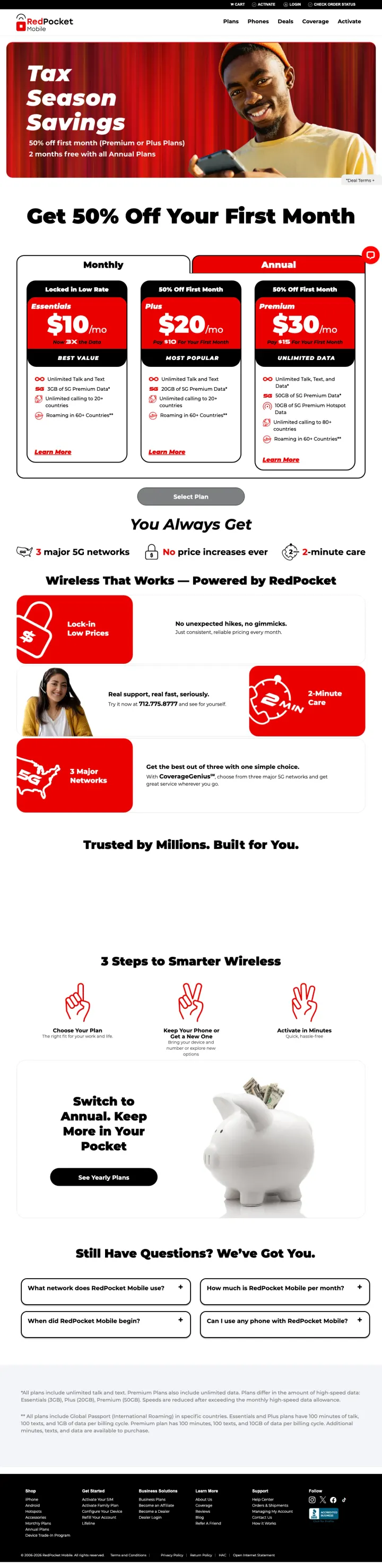
Open with a seasonal promotion banner ('Tax Season Savings - Get 50% Off Your First Month') in bold red, then show three plans starting at $10/mo. Red Pocket makes the price the hero and the carrier network coverage the supporting proof ('1 major 5G network, All phone brands accepted').
- deadline
'Get 50% Off Your First Month' seasonal promotion puts a deadline on a purchase nobody is in a hurry to make - people do not wake up thinking 'I need a new phone plan' but they do respond to time-limited savings
- deadline
Three plan cards ($10/$20/$30) with exact data amounts (3GB/8GB/Unlimited) are the simplest possible comparison - no confusing tier names, no hidden features, just data and price
- made personal
'3 Steps to Smarter Wireless' (Choose your plan > Activate > Save) shows a nervous switcher that the whole move is three short steps
- no proof
The red-heavy color scheme with promotional banners can feel aggressive and sale-focused, which may undermine trust for visitors who associate deep discounts with inferior service
- wrong promise
The 'Switch to Annual, Keep More in Your Pocket' section mid-page introduces a different pricing model that may confuse visitors who just chose a monthly plan above
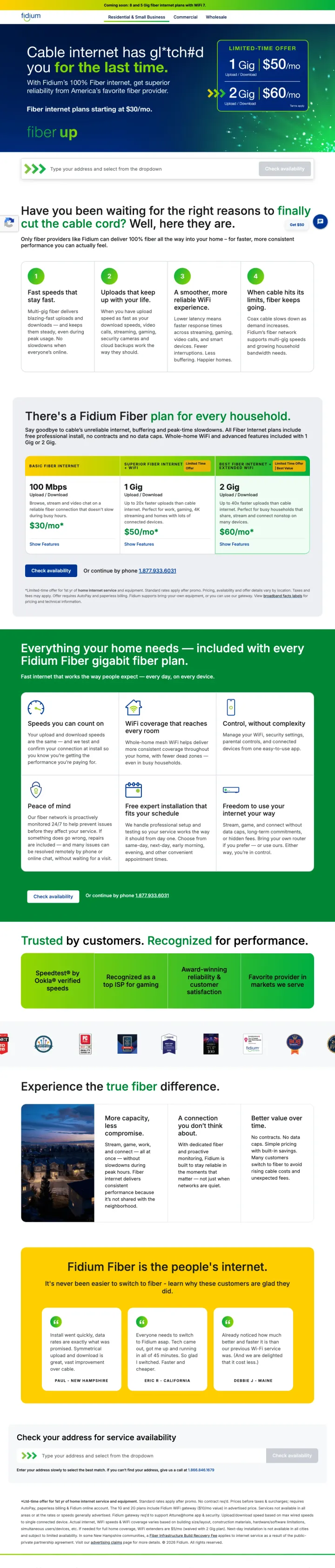
Open with a competitor attack headline ('Cable internet has ghosted you for the last time') that names the exact complaint (unreliable cable), then immediately show three fiber plans with speeds and included features. Fidium positions fiber as the escape from cable, not just another internet option.
- layout
'Cable internet has ghosted you for the last time' headline is emotionally resonant for anyone who has experienced cable outages, speed drops, or price increases - it validates frustration before offering the solution
- price framing
Three plan tiers (1 Gig / 2 Gig / 5 Gig) shown with 'Starting at' pricing and clear feature lists - the tiered approach lets visitors self-select based on their speed needs
- layout
'Included with every Fidium Fiber gigabit fiber plan' section lists no contracts, no data caps, free professional install, whole-home WiFi - these are the anti-cable differentiators in a single scannable list
- extra steps
The pricing is not visible on this page ('no-price' in the URL suggests this is a variant without pricing) - this forces visitors to click through to see costs, one extra click before anyone can decide
- wrong promise
The dark blue/green gradient hero with text overlay can feel heavy on smaller screens and the text contrast is not ideal
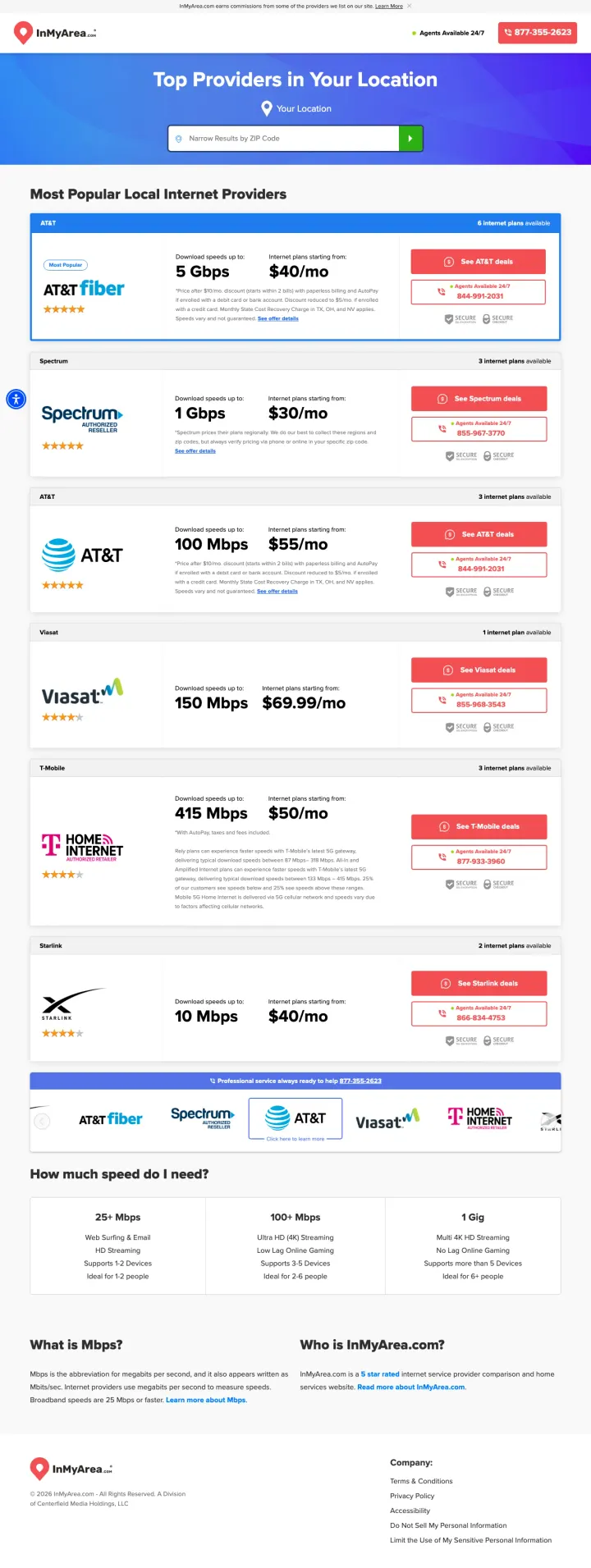
Show every ISP available at the visitor's location in a single ranked list with provider logo, speed, price, and star rating. InMyArea eliminates the need to visit 5 different provider websites by aggregating the comparison on one page.
- reviews
Provider comparison cards showing logo + speed (5 Gbps) + price ($40/mo) + star rating in a consistent format let visitors compare all local options in 10 seconds
- made personal
'Top Providers in Your Location' headline with location auto-detection personalizes the page before the visitor types anything
- reviews
'How much speed do I need?' section with use-case benchmarks (25+ Mbps for streaming, 100+ Mbps for gaming, 1 Gig for large households) helps visitors self-diagnose their speed requirements
- no proof
The 'Get MY Deal' red CTA buttons on each provider card may feel pushy and affiliate-driven, undermining the editorial credibility of the comparison
- wrong promise
The page may show providers that are not available at every address within the geo-targeted area, creating frustration when visitors click through and discover unavailability
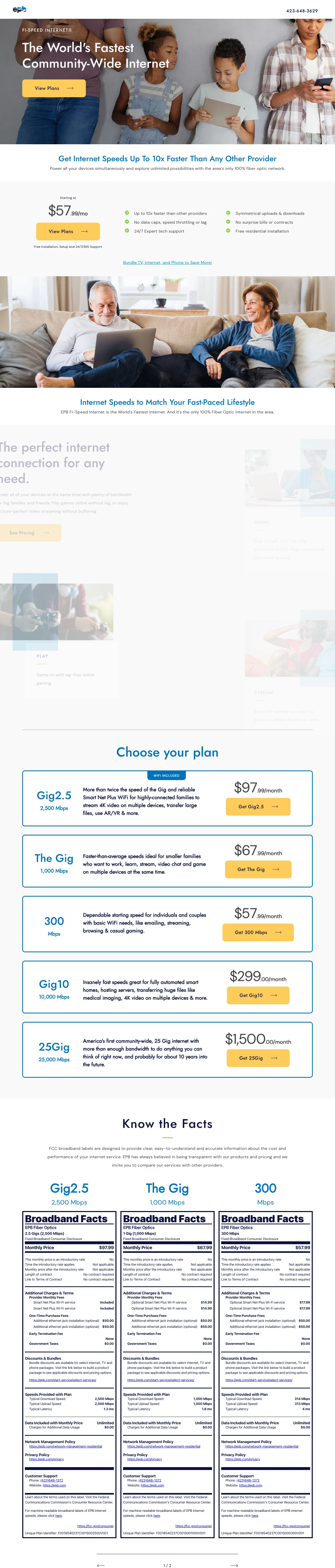
Show three internet plans in a clean comparison table with speed, price, and a 'best for' description for each. EPB's approach is straightforward: here are your three options, here is what each costs, pick one. The simplicity works because EPB is a municipal utility with built-in community trust.
- fewer steps
Three-plan comparison (Fi Speed / Fi Plus / Fi Pro) with clear speed tiers and pricing makes the decision simple and scannable
- reviews
'Choose the Best Plan' section with use-case descriptions ('Best for browsing and email' / 'Best for streaming and gaming' / 'Best for power users') helps visitors self-select without understanding technical specs
- fewer steps
Community positioning as Chattanooga's municipal fiber provider creates a trust advantage that commercial ISPs cannot replicate - EPB is owned by the city, not by shareholders
- wrong promise
The page design is clean but unremarkable - the yellow and blue palette feels more like a utility company than a modern internet provider
- no proof
Nothing from outside the company to back the claims - no speed test results, no awards, no customer reviews on the page
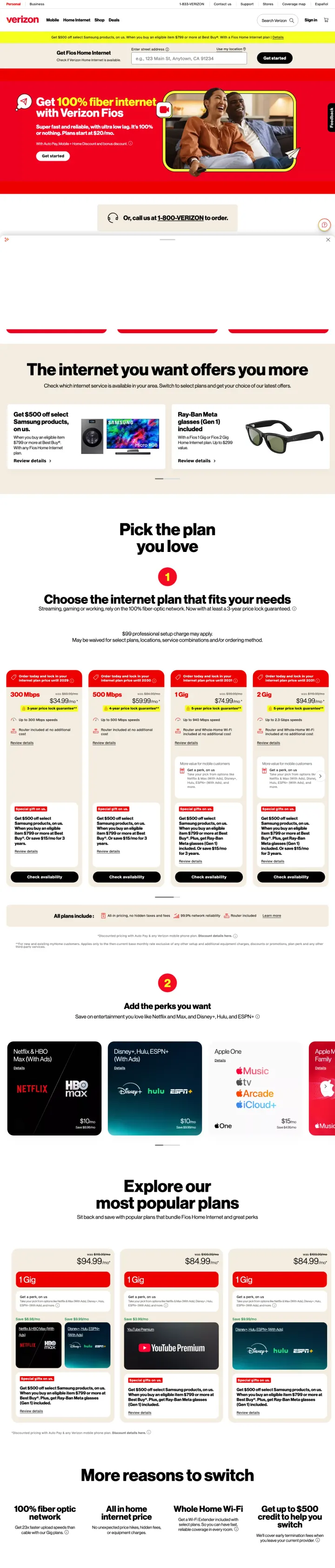
Put the address availability check as the first interaction above the fold with "Check if Fios Home Internet is available" and auto-populated address suggestions. Then show "Plans start at $20/mo" as the price anchor. The address check qualifies the visitor before they invest time researching plans.
- answers doubts
Address auto-complete with "Check availability" button is the first and only interaction above the fold. This filters visitors immediately: if Fios is available at their address, they continue. If not, they leave before wasting time.
- layout
"Get 100% fiber internet with Verizon Fios" headline makes the technology claim specific and verifiable, unlike vague "fast internet" claims from competitors
- price framing
"Plans start at $20/mo" price anchor is lower than any competitor in the dataset, creating immediate price leadership
- wrong promise
The $20/mo price requires fine print research to understand the actual cost (equipment fees, taxes, autopay discount), which may feel like bait pricing
- looks off
The lifestyle hero image (couple on couch) is generic stock photography that does not communicate "fiber internet" or differentiate from any other ISP
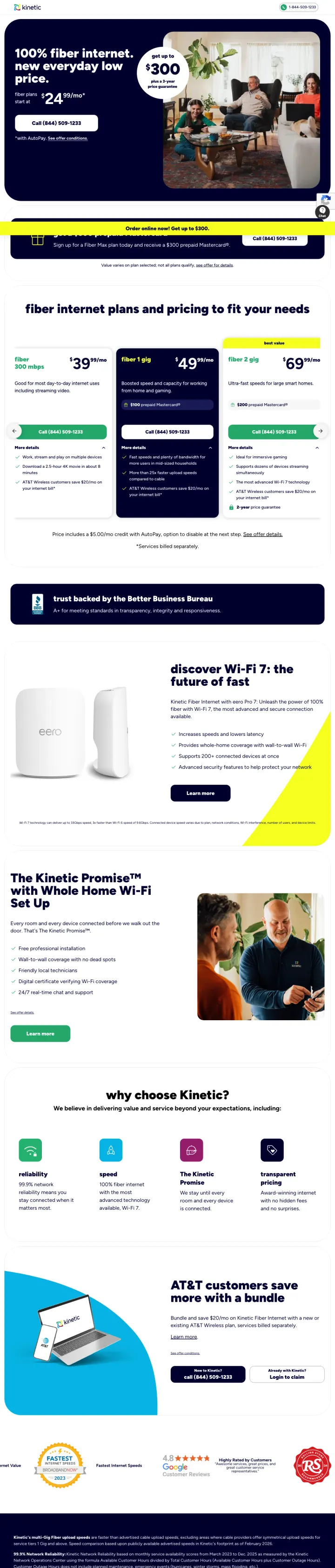
Stack three value propositions in the hero: lowest price ($24.99/mo), cash incentive ($300), and price guarantee (3 years). GoKinetic fits all three into the above-fold experience with "100% fiber internet. new everyday low price." followed by the price, then the $300 badge, then the guarantee callout.
- guarantee
"Get up to $300 plus a 3-year price guarantee" badge next to a lifestyle family photo creates both immediate incentive (cash) and long-term trust (price will not change)
- reviews
$24.99/mo price with "new everyday low price" framing positions this as a permanent price reduction, not a promotional rate that will increase after 12 months
- fewer steps
Phone number (844-509-1233) prominently displayed with "Call" CTA button above the fold serves visitors who prefer phone ordering
- no proof
The "*with AutoPay" asterisk on the price means the advertised $24.99 requires automatic payment enrollment, which some customers distrust
- looks off
The lifestyle family photo (living room scene) is generic and could be any ISP's ad. A speed test screenshot or fiber installation photo would be more relevant.
- too much at once
No plan comparison visible above the fold. Visitors who want to compare speed tiers must scroll.
What every winner does
Wildcards
Pages that break the playbook in interesting ways
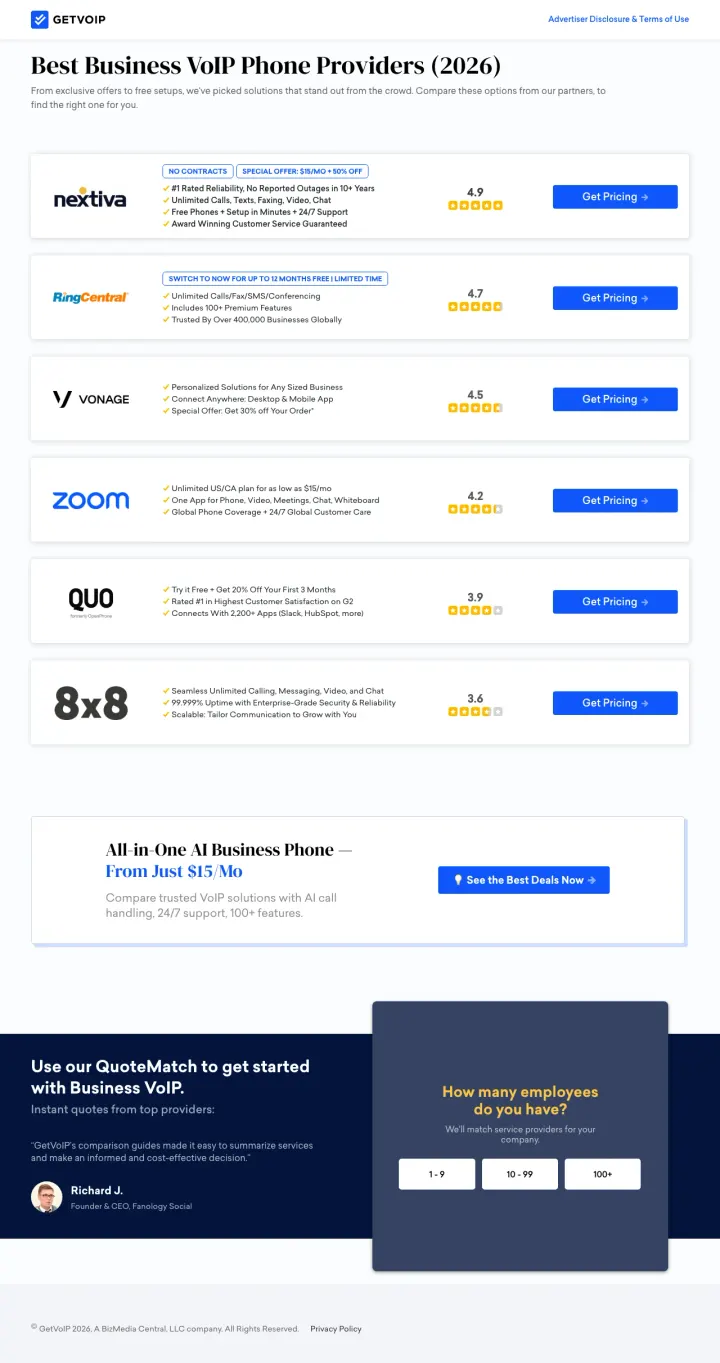
Show the top 6-8 providers in a ranked comparison list with ratings, key features, and 'Get Pricing' CTAs, then offer a QuoteMatch tool that matches businesses to providers based on employee count. GetVoIP combines editorial comparison with lead generation in a format that serves both research and purchase intent.
- reviews
Ranked provider list (Nextiva 4.7, RingCentral 4.7, Vonage 4.5, Zoom 4.3) with star ratings and 2-line feature summaries gives visitors an instant overview of the market
- fewer steps
'All in One AI Business Phone - From Just $15/Mo' aggregated offer card presents the category value proposition separate from any single provider
- fewer steps
QuoteMatch lead gen tool ('How many employees do you have?') captures business size data that qualifies the lead and enables provider matching - this data makes the lead more valuable than a generic contact form
- too much at once
The comparison list is dense and may overwhelm visitors who just want a recommendation - 'which one should I pick?' is not immediately answered
- wrong promise
The QuoteMatch tool at the bottom may not be reached by visitors who find what they need in the comparison list above
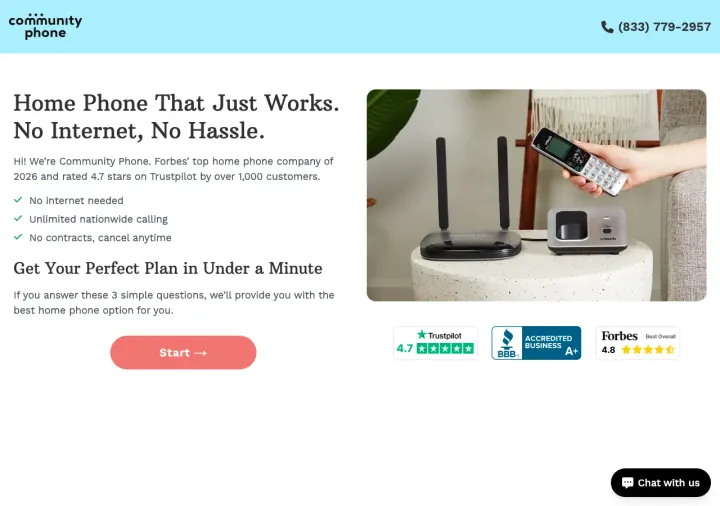
Strip your landing page down to a single headline ('Home Phone That Just Works. No Internet, No Hassle.') and a quiz-start button. Community Phone shows that for a niche product with a clear audience (people who want a landline without internet), the product description can be the page.
- fewer steps
'Home Phone That Just Works. No Internet, No Hassle.' is one of the clearest value propositions in the entire dataset - in 8 words, it says what the product is, what makes it different, and why you want it
- reviews
'Get Your Perfect Plan in Under a Minute' with a 'Start' CTA turns plan selection into a quiz experience rather than a comparison table, which may work better for the older demographic that buys landline phones
- credentials
Forbes, Trustpilot, and Consumer Affairs logos provide third-party credibility for a brand most visitors have never heard of
- extra steps
The page is so minimal that visitors who want more information before committing have nowhere to go - no pricing, no plans, no FAQ visible
- wrong promise
The chat widget in the corner is the only alternative to the quiz, which may not serve visitors who prefer to browse at their own pace
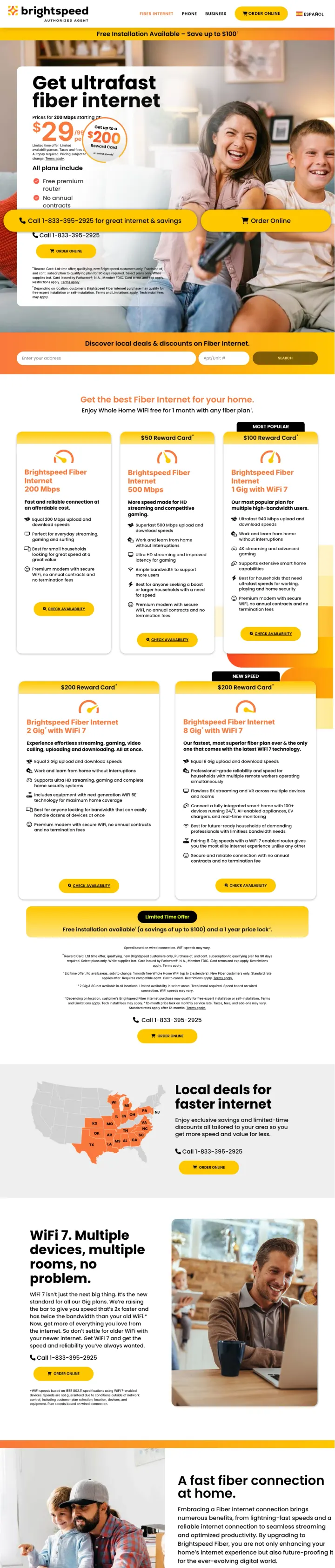
Why This Is Interesting: This is an authorized agent/reseller page, not the official Brightspeed site. The "AUTHORIZED AGENT" label in the header signals this is a sales channel partner, yet the page executes better than many official carrier pages. The aggressive stacking of three offers ($29/mo + $200 reward card + free installation) with prominent phone number and "Order Online" button creates a conversion-optimized experience.
- answers doubts
Three-incentive stack ($29/mo price + $200 reward card badge + "Free Installation Available - Save up to $100" banner) gives the visitor three separate reasons to act now, each addressing a different objection (monthly cost, switching cost, setup cost)
- answers doubts
"No annual contracts" with red checkmark below the price directly addresses the #1 ISP trust issue. Positioned next to the price, it turns the price into a no-risk commitment.
- fewer steps
Phone number CTA ("Call 1-833-395-2925 for great internet & savings") uses the word "savings" to reinforce the deal in the CTA text itself
- no proof
"AUTHORIZED AGENT" label may reduce trust for visitors who expected to land on the official Brightspeed website. The visitor may wonder if this is a legitimate channel.
- focus
The yellow and white color scheme with the Brightspeed dots logo is cheerful but the page feels like it is trying too hard to sell, with multiple offers competing for attention
- wrong promise
No address availability check above the fold, which means visitors may get excited about the price before discovering Brightspeed does not serve their area
Losers
3 pages burning ad spend with fundamental issues
Every click to these pages costs real money. We found claims with nothing behind them, mismatched intent, weak CTAs, and messaging that ignores what the searcher actually typed. Here is what to avoid.
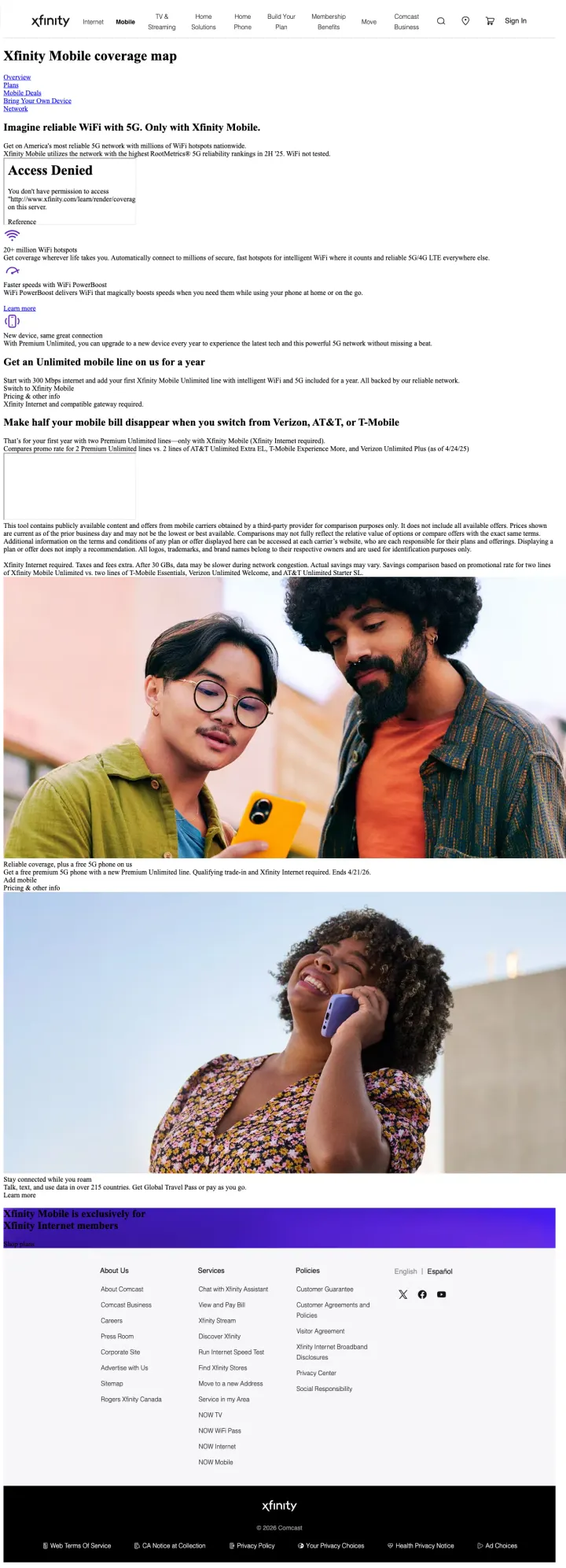
The page targets 'Xfinity mobile in Mexico' (SV: 110) and similar mobile coverage queries, but the landing page displays an 'Access Denied' error where the coverage map should be. The rest of the page contains promotional content about Xfinity Mobile deals, but the core feature the visitor searched for (coverage information) is broken. At Xfinity's CPCs, paying for clicks to a partially broken page is pure waste.
- wrong promise
'Access Denied' error displayed where the interactive coverage map should be - the primary reason for the visit is broken
- wrong promise
The page defaults to promotional content around the broken map, creating a confusing experience where the visitor sees deals but cannot check if Xfinity Mobile is available in their area
- wrong promise
Full site navigation with links to Internet, TV, Mobile, and other Xfinity products provides multiple exit paths from the paid landing page
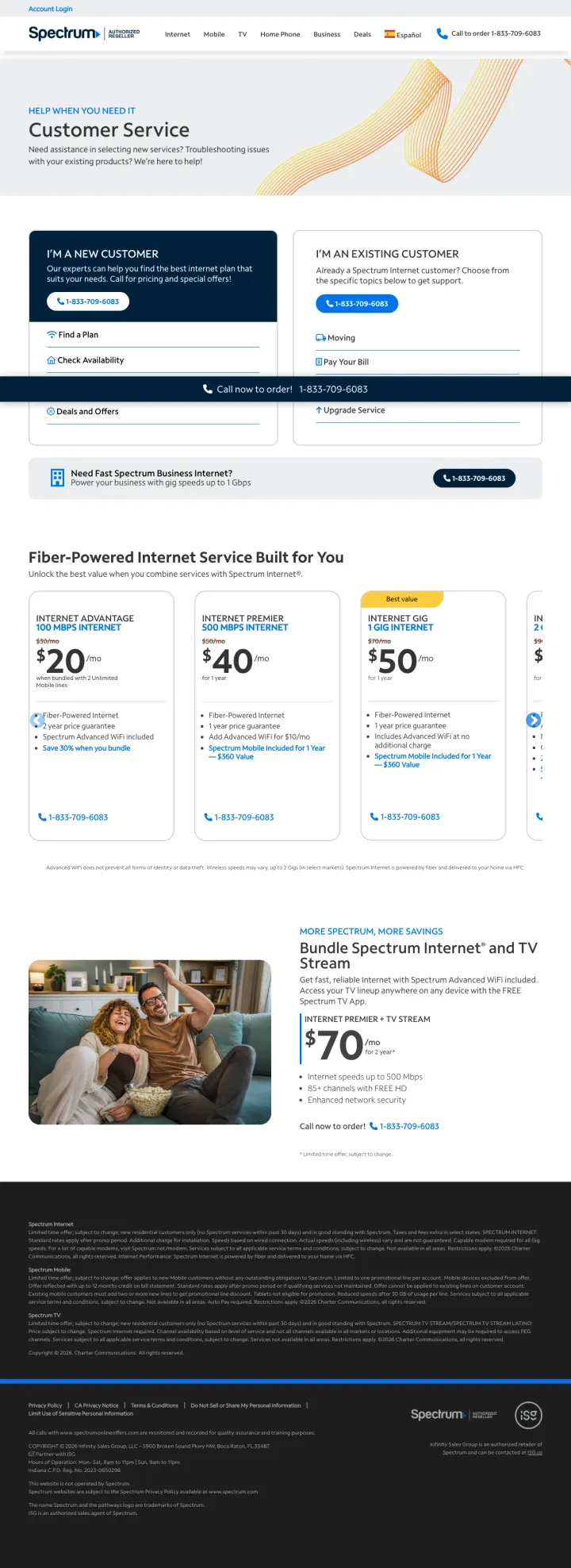
This page targets 'spectrum san antonio customer service' (SV: 590) and lands on a page that splits between 'I'm a New Customer' and 'I'm an Existing Customer.' The page is confused about who it serves. The new customer section shows internet plans ($20/$40/$50) which is functional, but the page title and framing ('Customer Service') signals support, not sales. Visitors searching for customer service are existing customers with problems, not new customers ready to buy.
- focus
The page serves two completely different audiences (new customers and existing customers seeking service) which dilutes the conversion experience for both
- wrong promise
'Customer Service' as the page title and H1 positions this as a support page, not a sales page - new customers who land here feel they are in the wrong place
- wrong promise
The 'I'm an Existing Customer' section with password recovery and troubleshooting takes up significant page real estate that could be used for acquisition content
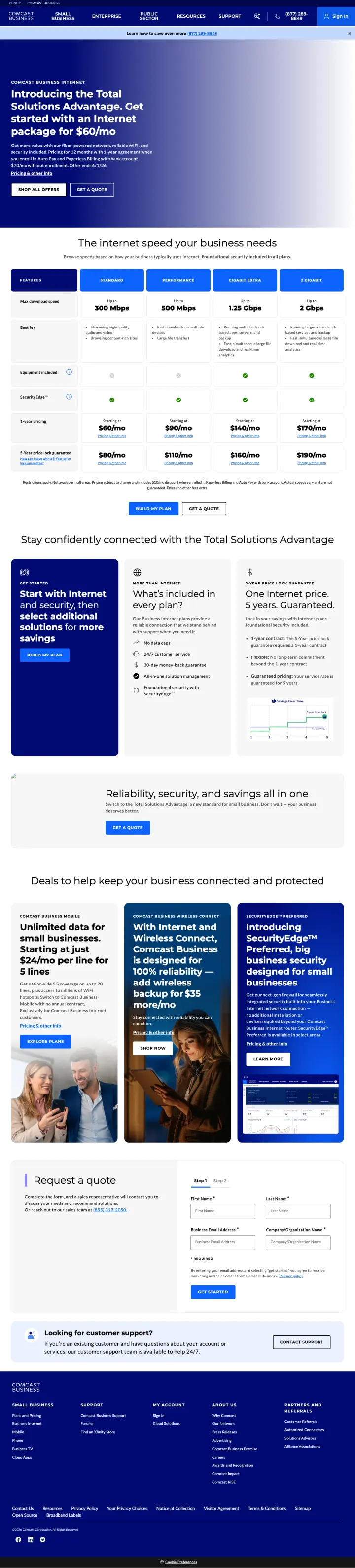
This page targets "fiber optic isp" (SV: 47,690) and delivers a page titled "Introducing the Total Solutions Advantage" with dense paragraph text about "fiber-powered network, reliable WiFi, and security included." The $60/mo price exists but is embedded in a paragraph rather than displayed as a visual anchor. For a visitor comparing fiber ISP options across 3-5 tabs, the page requires reading comprehension rather than scanning. At business internet CPCs ($15-30), every click pays for a visitor to parse corporate marketing copy.
- wrong promise
"Total Solutions Advantage" headline is corporate jargon that communicates nothing to a visitor scanning for speed and price
- wrong promise
$60/mo price is embedded in a paragraph rather than displayed as a visual anchor. The visitor comparing ISPs across tabs will miss it.
- wrong promise
Dual CTAs ("SHOP ALL OFFERS" + "GET A QUOTE") compete with each other and do not indicate which path is faster or simpler
What we learned
Address availability check as the first interaction captures intent and filters qualified visitors
The most effective ISP landing pages lead with an address input field rather than plan details. InMyArea, Fidium Fiber, and Brightspeed all open with 'Enter your address' or 'Check availability.' This works because internet service is location-dependent: showing plans the visitor cannot actually purchase is worse than useless. The address check simultaneously qualifies the lead (they are in your coverage area) and captures location data for personalization.
Speed + price at a glance is the minimum viable comparison for internet plans
Every winning page shows plans as speed (Mbps/Gbps) paired with monthly price in a side-by-side comparison. T-Mobile shows three tiers, EPB shows three plans with speed and price. Internet is a commodity purchase where the decision comes down to 'how fast and how much.' Pages that lead with brand messaging before showing speed and price lose visitors comparison shopping across 3-5 provider tabs.
No-contract and price-lock guarantees are the primary differentiators for challenger ISPs
Regional ISPs differentiate from tier-1 carriers by emphasizing what they do NOT do: no contracts, no price increases, no equipment fees, no data caps. Fidium Fiber leads with 'Cable internet has ghosted you for the last time' and promises no contracts. GoKinetic highlights '24-month price lock.' In a market where consumers distrust ISPs due to years of hidden fees and surprise rate hikes, the anti-carrier positioning is a powerful differentiator.
Comparison marketplace pages convert by aggregating competitors on a single page
InMyArea shows multiple ISPs with speeds, prices, and ratings on a single page. GetVoIP does the same for business VoIP providers. These marketplace pages capture visitors in research mode who want to see all options at once. The marketplace model works because internet shopping is inherently comparison-driven, and visitors trust a third-party aggregator more than any single provider's claims about their own service.
Winners show speed and price for every plan at a glance, start with an address availability check to qualify the visitor, and differentiate with no-contract/price-lock guarantees. Losers send paid internet traffic to corporate information pages, coverage maps with access-denied errors, or customer service pages that assume the visitor is already a customer.
If you're building a page like these yourself, here's my comparison of AI landing page builders, with prices and what each one is best for.
Now point postclick at your own page
We captured 40 internet provider pages and 7 made the cut. Fidium Fiber got in on one line: "Cable internet has ghosted you for the last time". Hand postclick the URL your internet ads point at and it reads that page the way a stranger who just clicked your ad does, then tells you what's costing you sign-ups. It designs new versions as real rendered images and builds the one you pick into a page you own. Your first audit and two concepts are free.