We analyzed 44 plumbing landing pages. Only 8 are worth stealing from.
We pulled 44 plumbing pages that were paying for Google Ads clicks and read them all. These 8 are the ones worth your time, and everything we found sits on this page, free.

44 landing pages screened
From real plumbing services Google Ads campaigns in the US
8 winners curated
The landing pages actually worth stealing from
3 burning money
So you know exactly what to avoid
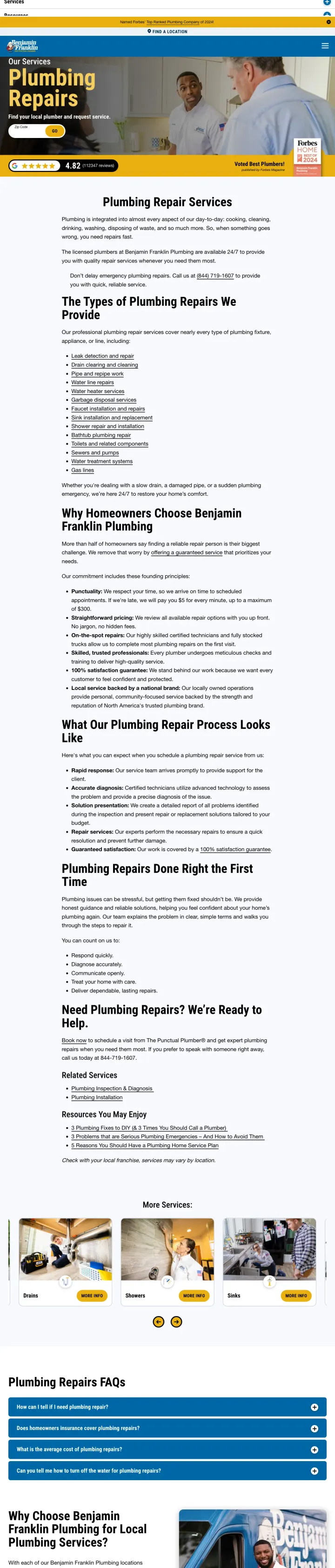
Benjamin Franklin Plumbing is the national franchise, and this page earns its place on proof alone. A gold band under the hero carries a Google badge at one end and a Forbes Home award at the other, and nothing a local plumber prints will out-argue that pair. What it never does is name a price or an offer, and it puts no phone number in the first screen either, so the only thing to do up there is type your zip code.
Display your total review count at company-wide scale (112,347 reviews) with a third-party validation badge (Forbes Home Best of 2024) side by side - the combination of volume and editorial endorsement creates trust that no local competitor can match.
- +
Google score sits in the gold band reviewshard to earn
Nobody local is out-arguing a national review pile, and this one is not dressed up: the Google G, a row of stars and the score sit in one pill under the hero. Pull your own off Google and print it where the visitor is deciding.
- +
Forbes gets named beside its own badge borrowed authorityhard to earn
Voted Best Plumbers!A magazine saying you are good beats you saying it, because the visitor can check theirs and cannot check yours. This line sits at the far end of the same gold band. You will not get Forbes. You can get the local paper or a best-of list.
- +
Zip box sorts visitors into their branch made personalone afternoon
Find your local plumber and request service.A single box and a Go button, and the visitor lands on the branch that covers their street before anybody asks for a name. If your territory has edges, that box saves your office the call that ends in sorry, we do not come out that far.
- ✕
Headline names the service, never the town wrong promiseneeds a developer
Plumbing Repair ServicesSomebody typed a town into Google and landed on a page about plumbing repairs in general. Everything under that headline is well written and none of it answers what they asked. If your ad names a place, the page has to name it back in the first line.
- ✕
Pricing promise waits a long scroll down no offera pricing call
We review all available repair options with you up front. No jargon, no hidden fees.The screen the ad pays for carries no price, no discount and no offer at all. Saying you are straightforward about pricing is not the same as showing a number. Put the cost of your commonest call where the click lands.
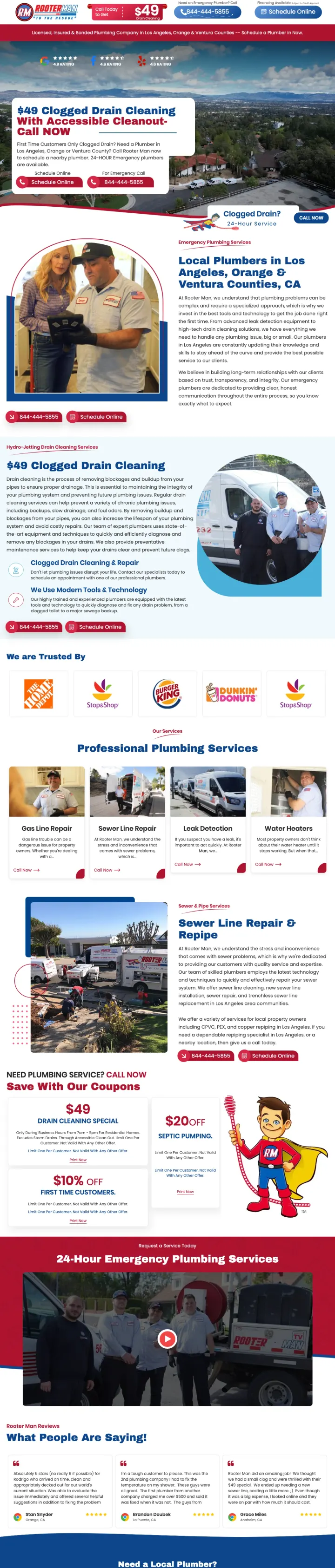
Rooter Man of Los Angeles puts a drain-cleaning price straight in the headline, which no other winner here dares to do. The hero qualifies it with first time customers only, and the rest of the conditions ride with the coupon much further down, a long way from where the price is sold. Ratings from three separate platforms run across the top before you scroll.
Lead with your lowest-commitment service at a specific dollar amount ($49 drain cleaning) as the hero headline, then repeat the offer mid-page and at bottom - the price itself reads as honest because it is too specific to be bait-and-switch.
- +
Coupon prints its limits under the price the offera pricing call
Only During Business Hours From 7am - 5pm For Residential Homes. Excludes Storm Drains. Through Accessible Clean Out.A cheap headline price makes people suspicious, and conditions in the open are what settle them. Their coupon names the hours the deal runs, the kind of home it covers and the drain it excludes. Write your own limits out like that and keep them where the price is sold.
- +
Booking button and phone number share the hero fewer stepseasy
For Emergency CallSomeone with a flooded kitchen wants to talk to a human right now. Someone booking a Saturday repair would rather not talk to anybody. This hero puts both side by side and lets the visitor choose, and neither one is the quiet option.
- +
Three platforms score them separately reviewshard to earn
4.9 RATINGScores from Google, Facebook and Yelp run across the top as separate badges instead of one blended number. Separate platforms agreeing is harder to fake, and a homeowner who has been stung before knows it. Show them all rather than picking your best.
- ✕
Drone height shrinks their vans to nothing looks offone afternoon
The hero sits on a photo of a hillside street with their own vans at the kerb, which is the right instinct. From that height each one is the size of a fingernail. Shoot those vans again from the pavement, close enough to read the door.
- ✕
Real reviews sit past a punishing scroll no proofeasy
What People Are Saying!Named customers wrote long, specific ones for this page and hardly anybody reaches them. Plumbing gets bought on trust. Move your strongest reviews up under the offer, where the decision is actually being made.
- ✕
Logo wall sells them to the wrong buyer wrong audienceeasy
We are Trusted ByHome Depot, Burger King and Dunkin Donuts logos say this firm handles big commercial contracts. A homeowner with a blocked drain reads that and wonders whether their job is too small to bother you with. If you serve both, show homeowners other homeowners.
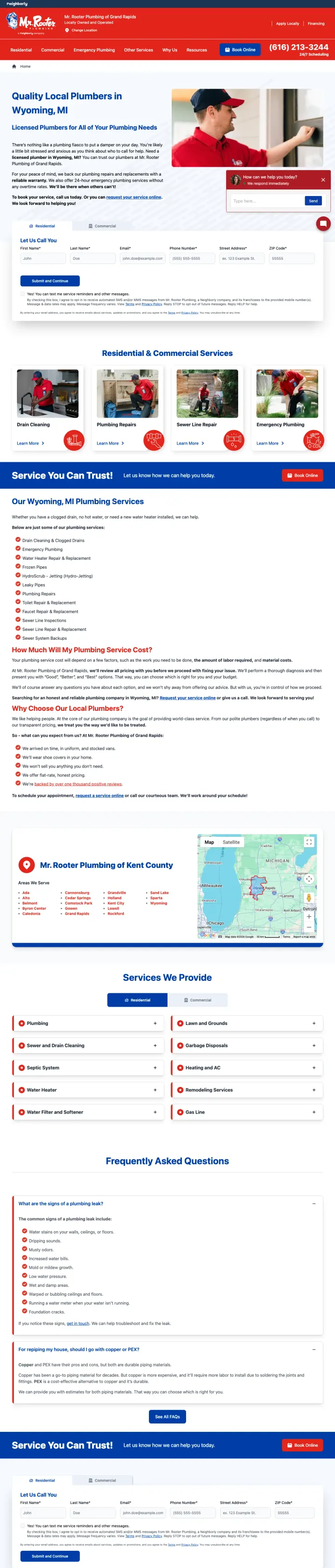
Mr. Rooter of Grand Rapids buried the best sentence in the file in its opening block: emergency service with no overtime rates. That single line answers the thing everybody dreads about ringing a plumber at night. Its call-back form is among the shortest here, and it still asks for a street address before anybody has spoken to a human.
State your warranty and pricing policies in the body copy rather than burying them in terms - 'we back our plumbing repairs and replacements with a reliable warranty' and 'no overtime rates' in the first three paragraphs answers the two biggest plumbing objections before the visitor even formulates them.
- +
Overtime rates ruled out mid-paragraph answers doubtseasy
We also offer 24-hour emergency plumbing services without any overtime rates.This is the strongest sentence on any page in the file, and it is thrown away. What people dread about ringing a plumber at night is the surcharge, and that line kills it. If your rate holds after hours, say so in your opening paragraph.
- +
Form asks residential or commercial first makes it easierone afternoon
A Residential tab and a Commercial tab run across the top of the call-back form, so the visitor says which they are before typing anything. The homeowner never reads the property manager's version, and the click you paid for never leaves the page.
- +
Chat box catches the visitor who will not phone fewer stepsneeds a developer
Some people will not ring you and will not fill in a form, and this is the only thing that reaches them. It promises an immediate answer, which is the only version worth running. If nobody is going to sit and watch it, leave it off.
- ✕
Review claim hides in a bullet list no proofeasy
backed by over one thousand positive reviewsNothing in the first screen carries a score, a star or a count. It turns up far down the page as a text link, long after the decision is made. Put your score beside your headline, even when the count is small.
- ✕
Hero column spends its height on prose too much at onceeasy
There’s nothing like a plumbing fiasco to put a damper on your day.The only ask in it is a bolded sentence at the foot pointing at a text link. Somebody watching water come through a ceiling will not read that far, and the number and the Book Online button are away up in the header. Lead with the promise and the number.
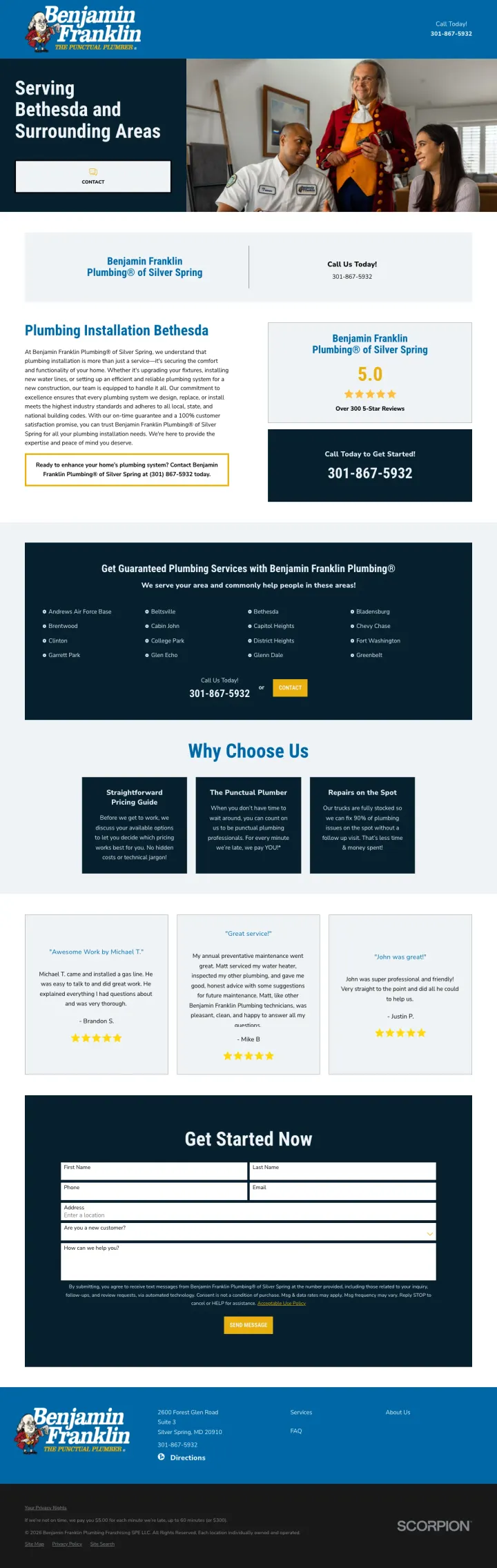
This is a Benjamin Franklin franchise in Silver Spring, and the selling happens in the ad rather than on the page. The ad rules out after-hours fees, so the visitor arrives with their worry already settled, and then the hero says nothing about it. The score and the review count sit in a box at the top of the right column, and both fall just below the first screen.
Lead your ad headline with 'There Are No After-Hour Fees' and deliver that promise visibly on the landing page - for plumbing, where 80% of emergencies happen outside business hours, this one line kills the fear of a surprise after-hours bill.
- +
Ad answers the fee question before the click message matcheasy
Their ad rules out after-hours fees, so the visitor arrives with the main worry already settled. That is the cheapest conversion work you will ever do, because it happens before you have paid for anything. Put your best objection-killer in the headline you are already buying.
- +
Star rows stack right above the form proofeasy
Awesome Work by Michael T.Named reviews and star rows sit on top of it, so the reassurance lands at the moment somebody has to hand over their name, their phone number and their address. That is when the doubt comes back. Put your proof against your form as well as up in the hero.
- +
Score box crowns the right-hand column reviewsone afternoon
Over 300 5-Star ReviewsThe rating and the review count sit in a bordered box with the phone number in a dark box directly under it. The score itself falls just below the first screen, and that is the flaw. Put yours high enough to be seen before anybody scrolls.
- ✕
First screen offers a button and nothing else no offereasy
The hero names Bethesda, shows a CONTACT button and stops. There is a phone number up in the corner and no price, no offer, and not a word about the after-hours promise the ad had just made. That screen is the only part every visitor sees.
- ✕
Costume mascot stands where the offer belongs wasted spaceone afternoon
A man dressed as Benjamin Franklin, wig, red coat and a pipe wrench, stands in the middle of the hero photograph between the technician and the customer. Brand characters work on people who already know the brand. Somebody with a leak sees a costume.
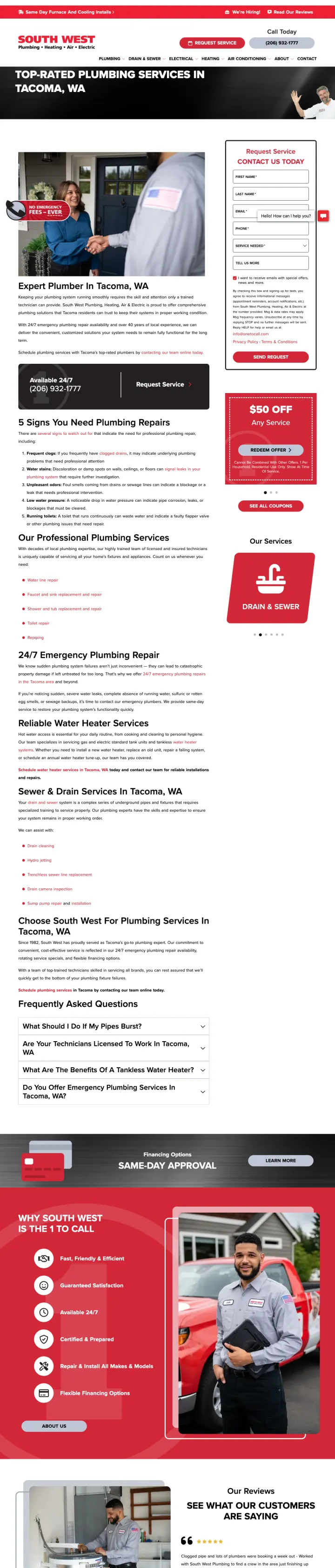
South West Plumbing trades as onetocall.com, and under a thin dark banner its Tacoma page runs a photo of a homeowner greeting a technician at her own front door, with the form right beside it. That pairing is the smartest layout in the file. A badge stuck on the left edge of that photo rules out emergency call-out fees, while the discount coupon sits below the fold where a bouncing visitor never finds it.
Turn your most common service into a money-back guarantee ('$153 Drain Clear Or It's Free') that eliminates the risk entirely - the odd, specific dollar amount ($153 not $150) signals this is a real calculated price, not a marketing round number.
- +
Odd price reads as a real quote price framinga pricing call
The drain-clear figure in their ad is not a round marketing number, and that is precisely why it lands. Odd prices look calculated. Round ones look invented on the spot. Price your commonest job to the dollar and put the money-back promise beside it.
- +
Badge rules out call-out fees on sight answers doubtseasy
It is stuck on the left edge of the doorstep photo, before the visitor has had time to start worrying. That worry is the reason homeowners ring around instead of ringing you. Answer it in the first screen, in the shortest words you can find.
- +
Doorstep photo and form split the screen layoutone afternoon
Contact Us TodayOn the left, a homeowner at her own front door shaking hands with a uniformed technician. On the right, the form. The visitor gets the reassurance and the way to act in a single glance, and neither has to beat the other for space. Copy that split exactly.
- ✕
Rating claim carries no score to prove it no proofeasy
Top-Rated Plumbing Services in Tacoma, WATop rated by whom, and rated what? The first screen holds no score, no stars and no review count to stand the word up, so it reads as something a copywriter typed. Real reviews do exist further down. Bring the number up to the claim.
- ✕
Discount hides below the first screen hidden offereasy
$50 OffIt is real and anybody who bounces never learns it existed. Plumbing gets price-checked against the next result in the list. Move your coupon up beside the phone number, where the comparison is happening.
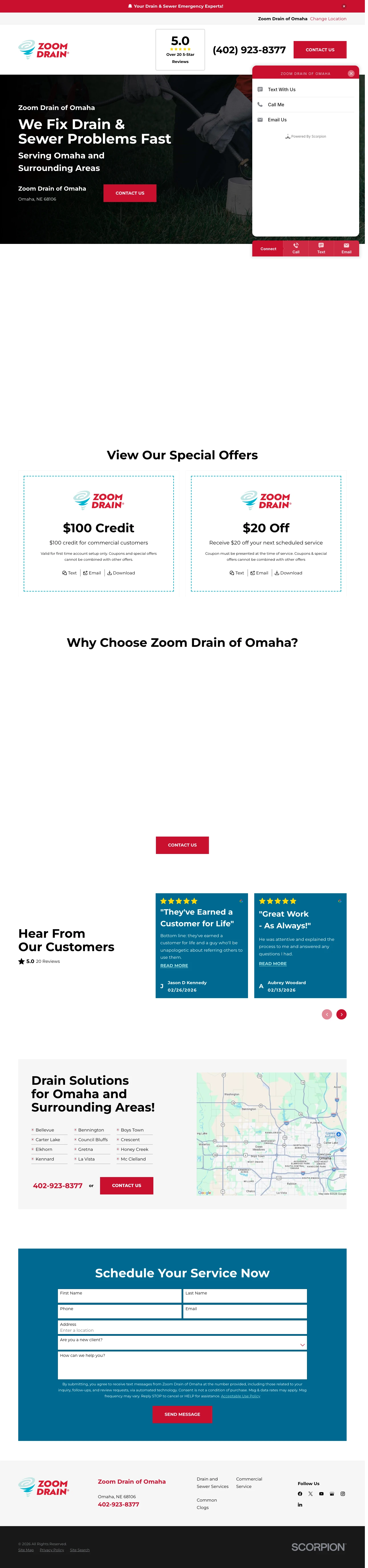
Zoom Drain only does drains and sewers, and refusing the rest of the trade is the whole pitch. The score and the review count sit in a box beside the phone number, and a widget offers a text as well as a call, which matters when the problem is embarrassing to describe out loud. The booking form waits at the very bottom.
Position as a specialist (drains and sewers only, not general plumbing) so the visitor immediately knows this company does their exact problem all day, every day - specialization is a trust shortcut in a generalist market.
- +
Perfect score sits beside the phone number reviewsone afternoon
Over 20 5-Star ReviewsA perfect score with a modest count reads as real, where a perfect score with a huge count reads as managed. It sits in a bordered box so the proof and the action land in the same glance. Put yours there and stop hiding it in a carousel.
- +
Widget lets you pick text, call or email fewer stepsneeds a developer
Some drain problems are embarrassing to describe out loud, and a text box removes that entirely. This one stacks Text With Us, Call Me and Email Us, so the visitor takes the channel they can face. Add the text option first, because most plumbers skip it.
- +
Both coupons talk to the unhurried buyer the offera pricing call
A credit for a commercial customer opening an account, and money off your next scheduled service. An emergency does not need a coupon. The job somebody has been putting off does. Price for both kinds of visitor and label which is which.
- ✕
Dark hero repeats what the ad already said looks offone afternoon
Gloved hands feed a drain cable into a cleanout in the grass, and the contact widget sits over the right of it. It says we do drains, which the visitor worked out from the ad they clicked. A van pulling onto a driveway would answer how fast you turn up.
- ✕
Brand name lands four times before any scroll wasted spaceeasy
Zoom Drain of OmahaIt runs in the location bar, above the headline, again under the headline, and in the header of the contact widget. Nobody needed telling that often, and the room it eats could hold a response time or a warranty. Say your name once and spend the rest on a promise.
- ✕
Booking form waits at the foot of the page extra stepsone afternoon
Are you a new client?Anybody who wants to book scrolls past the coupons, the why-choose-us block, the reviews and the service map to reach it. An emergency visitor will not do it. Put a short form in the first screen and leave the long one exactly where it is.
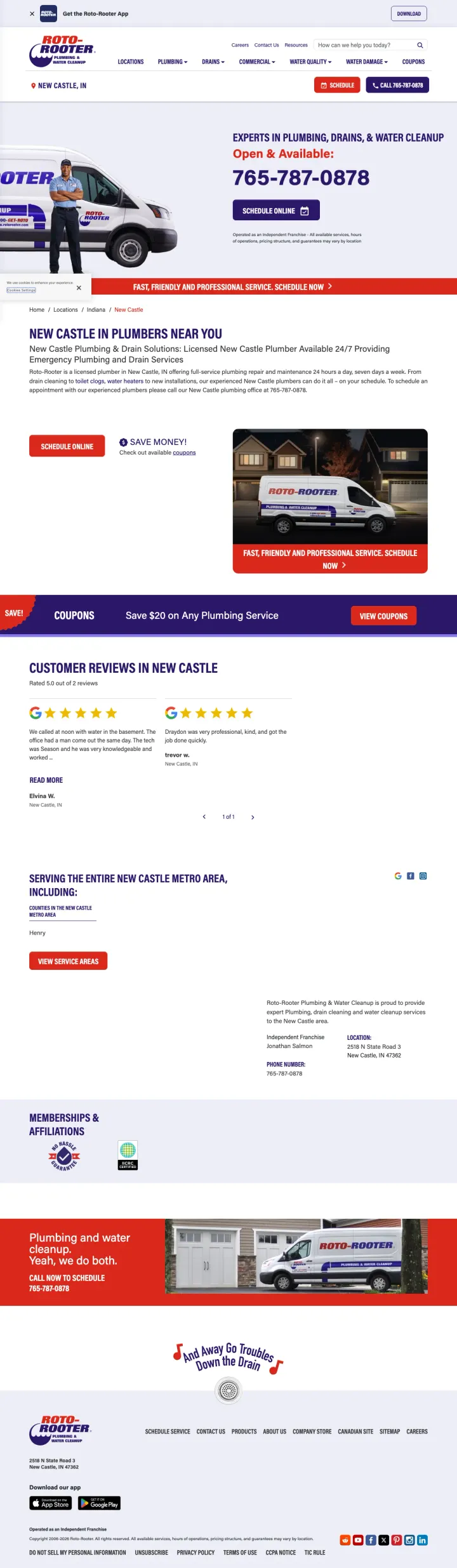
Roto-Rooter's New Castle page makes the phone number the largest thing on the screen, sitting under a line saying they are open right now. For a trade bought in a panic, that is the correct hierarchy and almost nobody else uses it. Then a franchise disclaimer under the booking button withdraws the services, hours, prices and guarantees the page just promised.
Show the phone number at full headline size directly under 'Open & Available:' - for emergency plumbing, the number being the visual anchor of the page communicates readiness more than any copy could.
- +
Phone number is the biggest thing on screen one clear actioneasy
Open & Available:It sits directly under a line saying they are open right now. Availability and the way to use it, together, in the same breath. For emergency work the phone call is the conversion, so stop styling the number like a footer detail.
- +
Voucher gives the undecided something to do the offereasy
Save $20 on Any Plumbing ServiceNot everybody who lands is ready to ring you. Somebody who takes one has half chosen you already. Offer one so the visitor who is not in trouble today still raises a hand.
- +
Reviews print the town beside each name local proofhard to earn
Customer Reviews in New CastleA national brand feels like a call centre until a neighbour turns up in them. A name and a town do that work in almost no space. Ask every customer you finish with for a review, and print where they live beside what they said.
- ✕
Disclaimer withdraws the hero's own promises undoes the promiseeasy
Operated as an Independent Franchise - All available services, hours of operations, pricing structure, and guarantees may vary by locationThe line sits in grey under the number and the booking button, and services, hours, prices and guarantees all may vary. Their own footer already carries it, which is where legal lines live. Delete the hero copy and let the hero make a promise.
- ✕
Metro area section delivers one county name wasted spaceeasy
Serving the entire New Castle metro area, Including:That heading promises the whole area and then gives you Henry and a button. Most of the band is empty white, on a page that never says how fast anybody arrives. If a section is going to take a full screen, make it earn one.
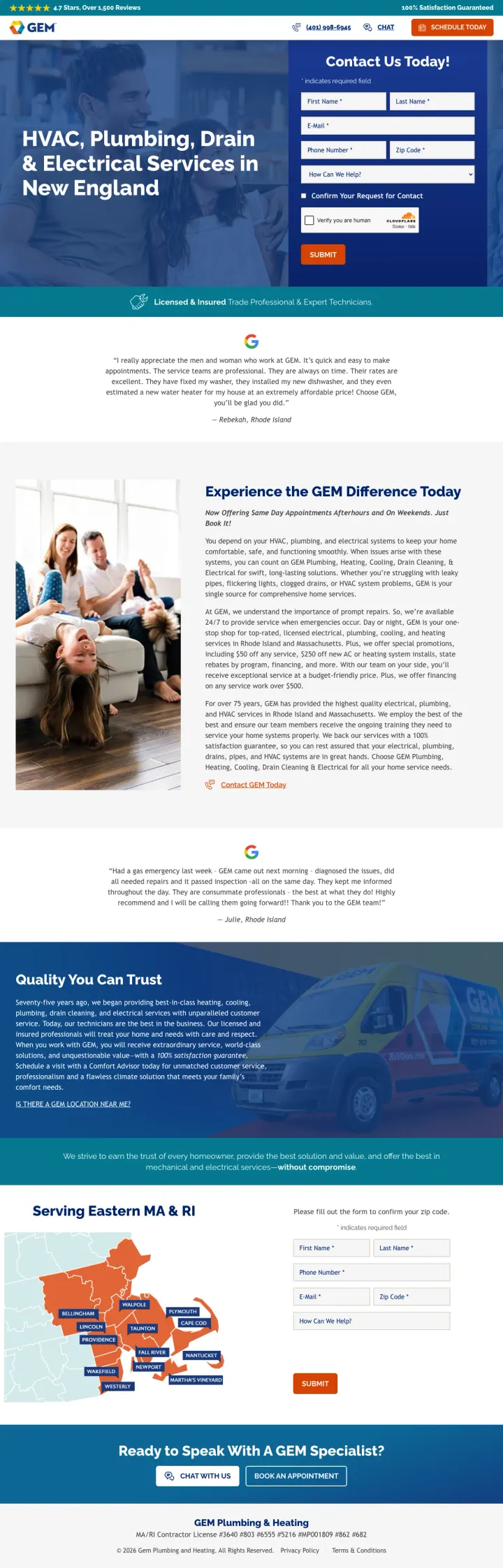
GEM sells heating, plumbing, drains and electrics off a single page, and stacks its stars, its review count and its guarantee in a strip above the headline. A visitor takes all of that in before reading a word of the pitch. The headline then makes them work out whether plumbing is the main event here or a sideline.
Stack your star rating, review count and satisfaction guarantee in a single top banner so the visitor absorbs all three before even processing the headline or form.
- +
Trust strip runs above the headline reviewshard to earn
Stars, a review count and a satisfaction guarantee all sit there, so the visitor takes the trust in before reading a word of the pitch. That strip costs almost no height on the page. Build one and put your hardest-won proof in it.
- +
One dropdown sorts the lead before dispatch makes it easiereasy
How Can We Help?It quietly tells the visitor you do the exact thing they came for, and it costs them a tap. If you run several trades off one number, this is the field worth adding, and the only extra one.
- +
Licence band runs the full page width credentialseasy
Licensed & InsuredIt sits in teal right under the hero with a line drawing of a hand gripping a wrench, where somebody is deciding whether you are a real company. Their footer carries the actual licence numbers too. Print yours, because a number can be checked and a badge cannot.
- ✕
Headline lists four trades at once wrong promiseeasy
HVAC, Plumbing, Drain & Electrical Services in New EnglandSomebody searching for a plumber has to scan it to work out whether plumbing is the main event here or a sideline. Every extra word in your headline is a word that is not about them. Give each trade its own page and let each headline say a single thing.
- ✕
Two checks stand between form and send extra stepsone afternoon
Confirm Your Request for ContactThe visitor ticks a confirmation box and then clears a robot check underneath it. Both are defensible and both cost you completed forms. Ask for a tick only where the law needs it, and let the check run quietly behind the page.
What the plumbing winners keep doing
Wildcards
Pages that break the playbook in interesting ways
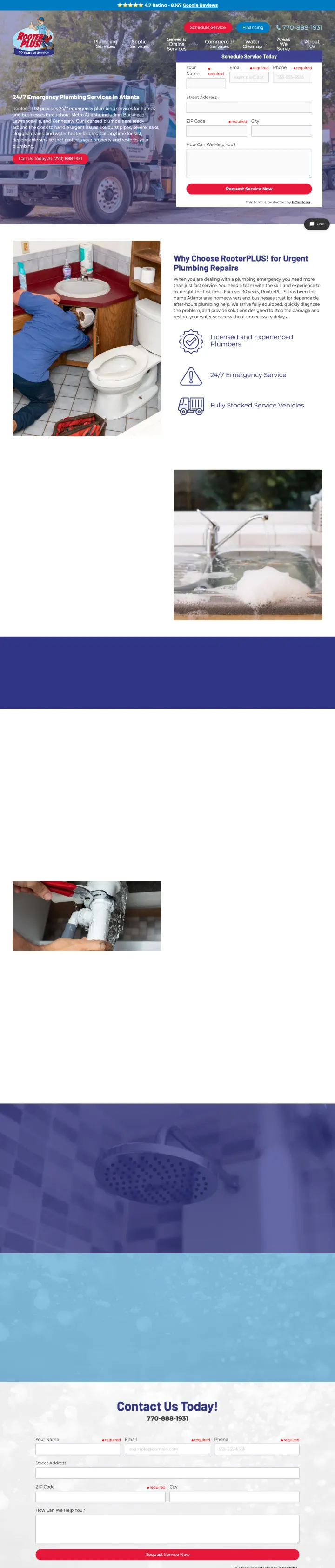
For emergency-intent keywords, let the lead form BE the hero - skip the headline-image-CTA convention entirely and put the form fields where the hero image would normally go, so the visitor's first interaction is filling out their information.
- fewer steps
The lead form occupies the entire right half of the above-fold viewport - there is no hero image, no headline section, no trust section that the visitor must process before seeing the form
- reviews
8,167 Google Reviews at scale creates an intimidation gap that no local competitor can close - the specific number (not rounded to 8,000) signals live data rather than a marketing claim
- reviews
Purple and red color scheme is visually distinctive in a market where every competitor uses blue and red - brand differentiation through unexpected color choice makes the page memorable
- wrong promise
The 7-field form (name, email, phone, address, zip, city, message) is too long for emergency intent - when water is flooding the kitchen, the visitor will call the phone number rather than type their street address into a form
- wrong promise
Below the fold, the page has sparse content with large whitespace gaps between sections - the above-fold experience is intense but the rest of the page feels unfinished
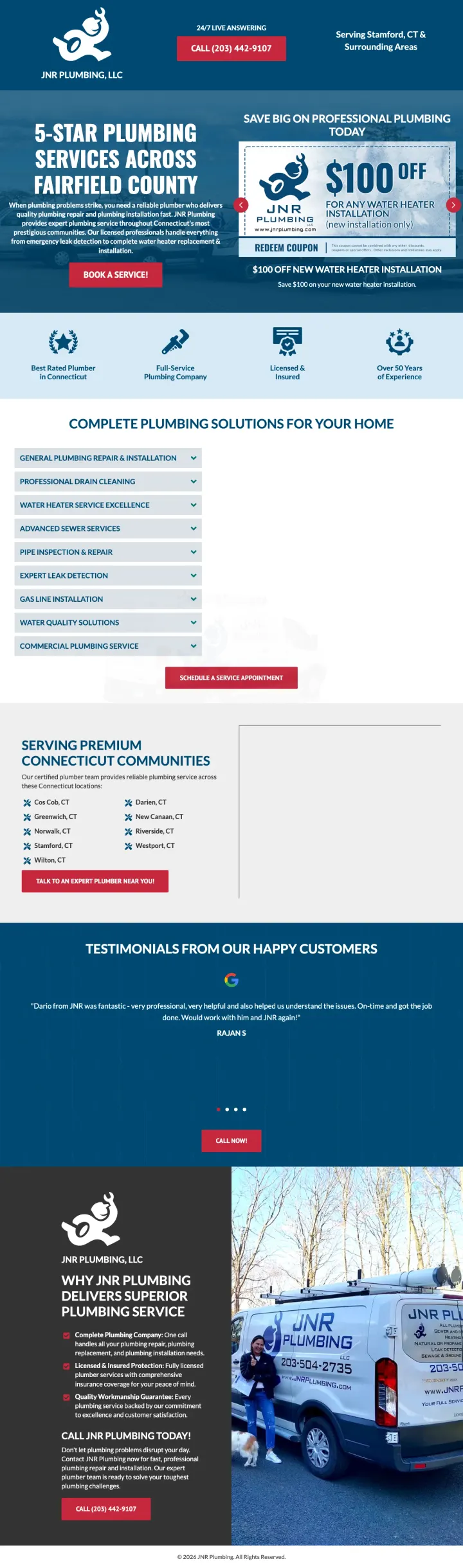
Instead of hiding your service area in a footer list, name-drop your most prestigious neighborhoods in the hero section as a positioning statement - 'Serving Connecticut's most prestigious communities' tells affluent homeowners this company understands their expectations.
- fewer steps
The coupon carousel format (rotating physical-coupon-styled cards with dashed borders) breaks the plumbing landing page convention of a single hero offer - most plumbing pages pick one price to lead with, JNR shows three and lets the visitor choose
- price framing
Naming specific affluent communities (Stamford, Greenwich, Darien, Westport, New Canaan) in the service area section is geographic targeting AND price positioning - it signals 'we serve expensive homes and charge accordingly'
- reviews
The dedicated PPC subdomain (call.jnrplumbing.com) isolates paid traffic conversion tracking from the main website, a technical sophistication most small plumbers lack
- no proof
No review score visible anywhere on the page - in a market where competitors show 4.7+ ratings with thousands of reviews, the absence reads as 'we do not have reviews worth showing'
- no proof
The testimonials section shows quotes but no star ratings, no review platform badges, and no full names - an unverifiable quote is the easiest kind of praise to fake
Compare the winners
The same questions asked of every winner, so you can find the row that matches the traffic you are already buying.
| Page | Entry path | Form fields | Phone in the first screen | Named offer | Standout move |
|---|---|---|---|---|---|
| #1Benjamin Franklin Plumbing | Zip code locator | No form | No | No | A review pile nobody local can match |
| #2Rooter Man LA | Call or book online | No form | Yes | Yes | The price sits in the headline |
| #3Mr. Rooter | Call back form | 6 | Yes | No | No overtime rates, in writing |
| #4Ben Franklin Silver Spring | Call or contact form | 7 | Yes | No | Named reviews sit above the form |
| #5South West Plumbing | Call or request service | 6 | Yes | Yes | Doorstep photo beside the form |
| #6Zoom Drain | Call, text or form | 7 | Yes | No | Drains only, and it says so |
| #7Roto-Rooter | Call or schedule online | No form | Yes | No | The phone number as the headline |
| #8GEM | Form on arrival | 6 | Yes | No | Rating and guarantee in one strip |
Read the keywords you are buying before you copy a row. Somebody typing burst pipe at midnight wants a number big enough to read on a cracked screen and a promise about what the night call costs. Somebody typing bathroom plumber is collecting quotes, and will read a price, a guarantee and a review before they ring anybody. You paid the same for both clicks, and the same page cannot answer both.
The copy bank
Lines lifted word for word off the pages above. We tell you whose page each came from, and one click copies it.
HVAC, Plumbing, Drain & Electrical Services in New England
Operated as an Independent Franchise - All available services, hours of operations, pricing structure, and guarantees may vary by location
Top-Rated Plumbing Services in Tacoma, WA
Find your local plumber and request service.
Losers
3 pages burning ad spend with fundamental issues
Every click to these pages costs real money. We found missing proof, mismatched intent, weak CTAs, and messaging that ignores what the searcher actually typed. Here is what to avoid.
- wrong promise
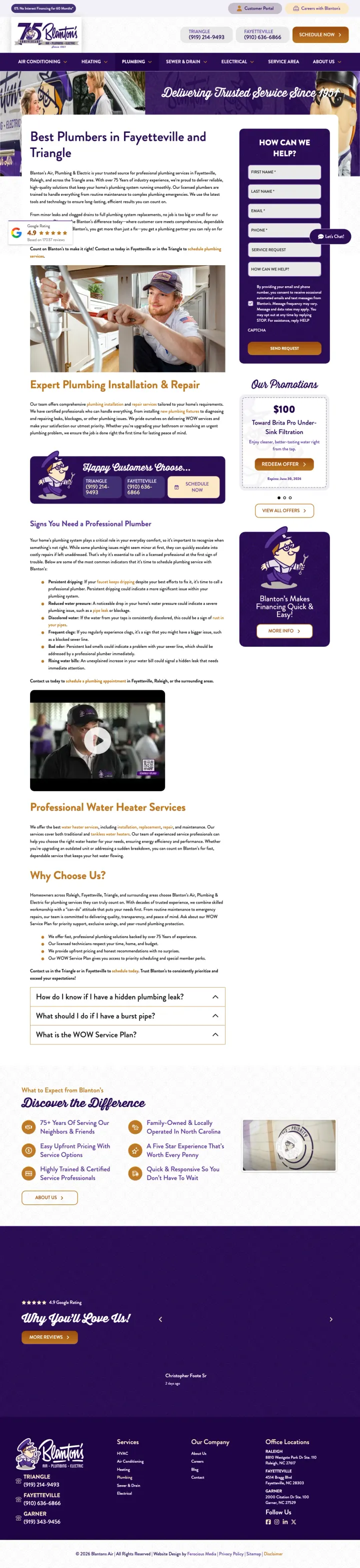
The company name is 'Blanton's Air, Plumbing & Electric' with 'Air' first - a visitor searching 'plumbers in chapel hill nc' lands on a page where the brand signals HVAC as the primary service
- looks off
The hero image shows a van with 'Air - Plumbing - Electric' branding and the hero text says 'Delivering Trusted Service Since 1951' - neither the image nor the tagline confirms this page is about plumbing specifically
- wrong promise
75 years of experience (since 1951) is buried in a anniversary badge rather than stated as a headline - this is the strongest differentiator a local plumber could have, and it is treated as decoration
- wrong promise
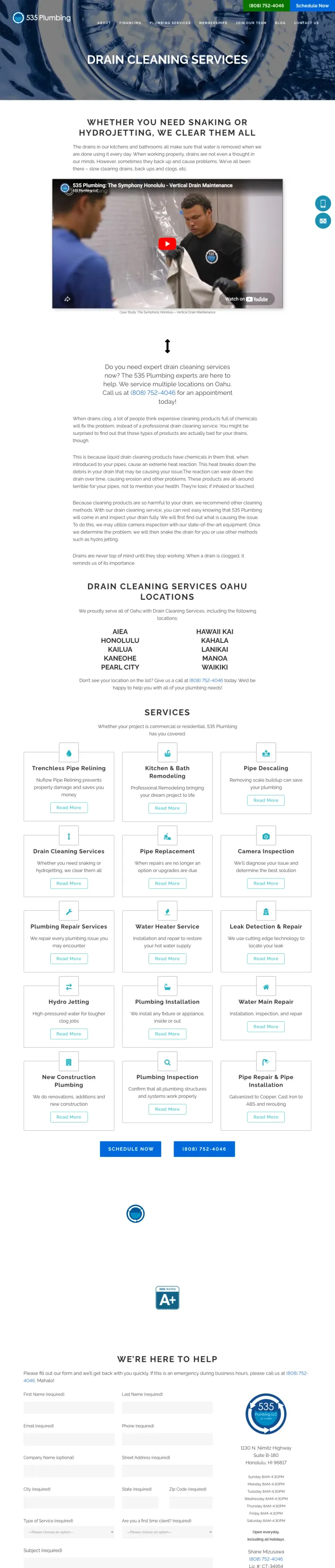
The above-fold content is a paragraph explaining why chemical drain cleaners are bad for pipes - the visitor already knows they have a clogged drain, they do not need a chemistry lesson on why Drano is harmful
- extra steps
No phone number, no form, and no pricing visible above the fold - the visitor searching 'drainage service' on Oahu at $15+ per click sees a headline and an educational paragraph before any conversion path
- wrong promise
The page headline ('DRAIN CLEANING SERVICES') is the exact same text as the service category - it confirms what the page is about but offers no reason to choose 535 Plumbing over any other drain cleaner
- looks off
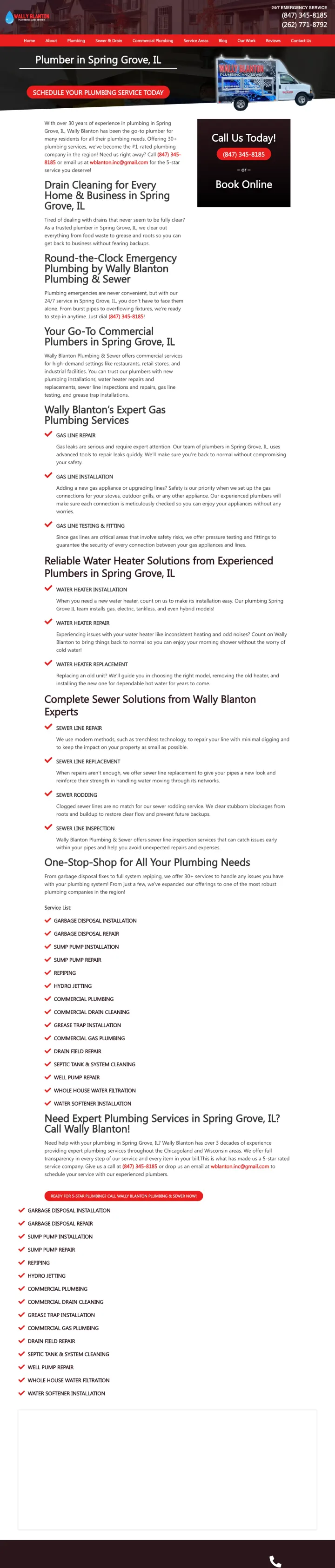
The page packs two phone numbers, a 'Schedule Your Plumbing Service Today' button, a Gmail address, a sidebar CTA, body text, and a service truck image all above the fold - the visitor processes visual noise rather than a clear message
- no proof
The company email is wblanton.inc@gmail.com (a Gmail address) which undercuts everything else the page does to look established - a 30-year plumbing company using a free email service signals that the web presence is an afterthought
- no proof
The page is a full website with 10-item navigation menu (Home, About, Plumbing, Sewer & Drain, Commercial, Service Areas, Blog, Our Work, Reviews, Contact Us) sending PPC traffic to a leaky funnel
What we learned
A specific dollar offer above the fold converts panic into action
The strongest plumbing pages lead with a concrete price ($49 drain cleaning, $153 drain clear or it is free, $100 off water heater installation) rather than vague promises. This works because plumbing searchers - especially emergency ones - have been burned by the '$29.99 service call' that becomes $500 once the plumber arrives. A specific, bounded price with conditions stated upfront (first-time customers, accessible cleanout, business hours) signals honesty and gives the panicking homeowner a number to anchor against.
Phone number size signals emergency readiness more than any badge
Pages where the phone number is visually the largest or second-largest element above the fold outperform pages where it sits in a standard header bar. For emergency plumbing callers in fight-or-flight mode, the phone number IS the conversion action. Making it massive and clickable communicates 'we are ready for your call right now' more effectively than any '24/7 Emergency Service' badge placed next to a tiny phone link.
Coupon carousels with multiple offers let visitors self-select their service
Pages that show 2-3 rotating or adjacent coupon cards ($49 drain cleaning + $100 off water heater + free sewer camera inspection) outperform single-offer pages. Plumbing searchers often know what is broken but not what the service is called. Showing multiple bounded offers lets the visitor find the one that matches their problem, and the specificity of each coupon reinforces that this company has handled their exact issue before.
Franchise location pages need local proof to avoid feeling like corporate shells
National brands (Roto-Rooter, Benjamin Franklin, Mr. Rooter) all serve localized pages, but the ones that work include local reviews with named reviewers and specific neighborhoods mentioned. The ones that fail show corporate boilerplate with a city name swapped in. Plumbing is inherently local - the searcher wants to know that a real person in their area will show up, not that a national brand has a franchise somewhere nearby.
Winners lead with a dollar-specific offer or massive phone number within two seconds of page load, serve a single plumbing intent, and reinforce trust with local reviews from named customers. Losers send plumbing search traffic to multi-service catch-all pages, bury the phone number in a standard header, and pad the page with SEO paragraphs that no emergency caller will read.
If you're building a page like these yourself, here's my comparison of AI landing page builders, with prices and what each one is best for.
Pages like these only pay off with the right traffic behind them. That's the half our plumbing PPC management covers.
What the plumbing winners taught us
Plumbing is two businesses wearing one keyword. The panicking homeowner wants a number and a promise about the bill. The person planning a bathroom wants a price, a guarantee and a review. Winners pick which one they are talking to and answer them in the first screen. Losers send both to a page about pipes in general.
- 1
Put a price on the job people search for most. Almost nobody in this file names a price in the first screen, and the page that does puts it straight in the headline. A plumber who prints a drain-cleaning price is telling you they will not invent one when they arrive. If you cannot price the whole job, price the visit, or price the diagnosis, and print the conditions beside the number rather than on a coupon further down.
- 2
Rule out the surcharge in writing. The best line we read was a plumber saying their emergency service carries no overtime rates. Everybody dreads the night-time bill and almost nobody addresses it on the page. If your rate really is the same at midnight, put that sentence above your phone number, in your own words, and stop keeping it in the terms.
- 3
Size the phone number like the thing you want them to do. Nearly every winner keeps a number in the first screen, and the strongest one makes it headline-sized under a line saying they are open now. Somebody standing in water is not filling in a form. If your number is styled like a footer detail, you are asking a panicking person to hunt for it while the next ad loads.
- 4
Cut the form back to the call. No lead form in this file is short, and several of them ask for a street address before anybody has spoken to the customer. That is a survey question dropped in front of somebody with water on the floor. Ask for a name and a number, let your dispatcher take the address on the phone, and get the phone ringing.
Score your own plumbing page
Every line below came off a screenshot somebody sat and counted. Open your own page beside it and tick what it already does.
Now check your own plumbing page
Benjamin Franklin Plumbing buys 'plumbers lafayette la'. That click lands on /services/plumbing-repairs, a page about plumbing repairs in general, with no price and no offer above the fold. We captured 44 plumbing pages and 8 made the cut. So give postclick the URL your own plumbing ads point at - it reads the page cold, tells you what's costing you calls, and draws new versions. Then it builds the one you pick.