We analyzed 31 wedding landing pages. Only 8 are worth stealing from.

31 landing pages screened
From real wedding services Google Ads campaigns in the US
8 winners curated
The landing pages actually worth stealing from
2 burning money
So you know exactly what to avoid
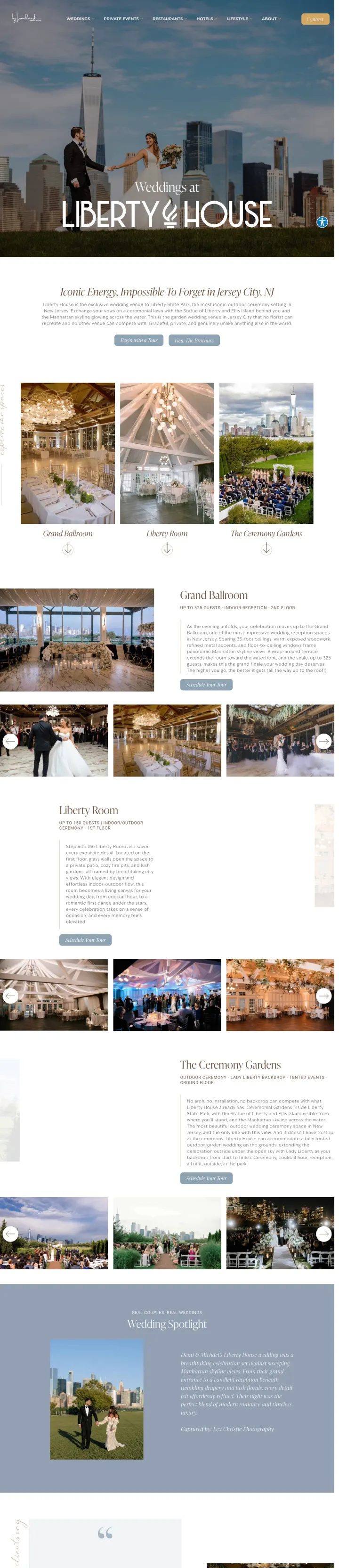
If your venue has an iconic backdrop, put a real couple in front of it as the hero image instead of an empty room. Liberty House shows a bride and groom with the Manhattan skyline behind them. The venue sells itself through what your photos will look like.
- fewer steps
Hero image is a real couple with the NYC skyline behind them. Not the venue empty, not a table setting, not a floorplan. This instantly answers 'what will MY wedding look like here?' which is the #1 question venue-shopping couples ask.
- reviews
Named testimonials from real couples (Adriana T., Devin S., Maddie L., Catie M.) with specific details ('cocktail hour room was stunning,' 'food at Liberty House was divine'). These read like friends recommending a venue, not marketing copy.
- made personal
Space breakdowns (Grand Ballroom up to 325 guests, Liberty Room up to 150 guests) with separate photo galleries per space let couples self-qualify by wedding size before scheduling a tour.
- wrong promise
The ad keyword 'liberty house wedding prices' gets 260 monthly searches, but the page contains zero cost information. Couples must fill out a Typeform just to learn what a wedding here costs - a direct mismatch with pricing intent.
- extra steps
The 'Begin with a Tour' CTA links to a Typeform with tracking parameters visible in the URL (utm_source=xxxxx). The broken tracking suggests the Typeform integration was set up but never properly configured with actual UTM values.
- looks off
A photographer testimonial (Alex K.) is mixed in with couple testimonials. A photographer saying 'one of the best venues' serves a different purpose than a bride saying 'dream come true.' Separating vendor endorsements from couple reviews would strengthen both.
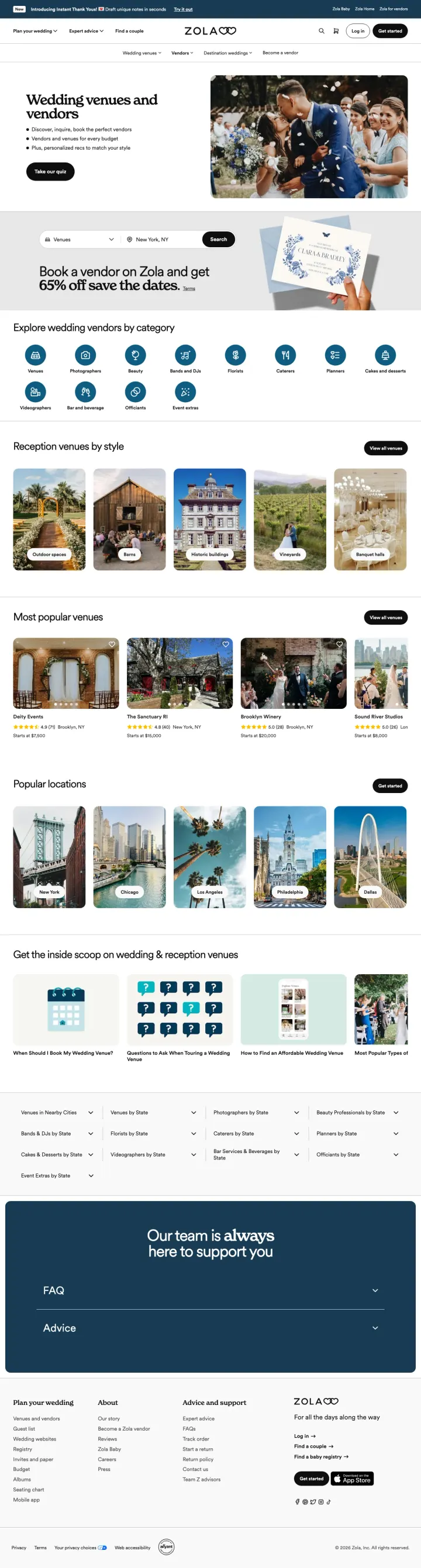
Replace your vendor search bar with a style-matching quiz ('Take our quiz') as the primary CTA. Couples who feel personally matched to a vendor are more likely to inquire than couples browsing an anonymous directory.
- made personal
'Take our quiz' as the primary CTA above fold transforms passive browsing into an active, personalized experience. For the 30% still-browsing visitor who wants to feel emotionally guided (not sold to), a quiz feels like help, not marketing.
- answers doubts
Cross-sell incentive ('Book a vendor on Zola and get 65% off save the dates') creates a platform lock-in that benefits couples financially. This addresses the overwhelm problem by rewarding couples who consolidate vendor decisions in one place.
- reviews
Vendor category icons (Venues, Photographers, Florists, DJs, Planners, etc.) let couples navigate by vendor type rather than geography. This matches how couples actually plan: by decision type, not by map radius.
- relevance
City-specific searches ('venues for weddings in chicago,' 'wedding venues in mn') land on a page defaulting to 'New York, NY' in the search bar. Chicago and Minnesota searchers see irrelevant default results.
- looks off
Despite ads promising 'Venues for Every Budget,' the listings page shows venue photos and categories without any price ranges. Budget-conscious couples comparing options have nothing to compare until they click through each listing individually.
- looks off
Hero photo shows a real couple but the image is small relative to the text-heavy left column. For a platform competing against Pinterest and Instagram, the visual-to-text ratio should lean heavily visual.
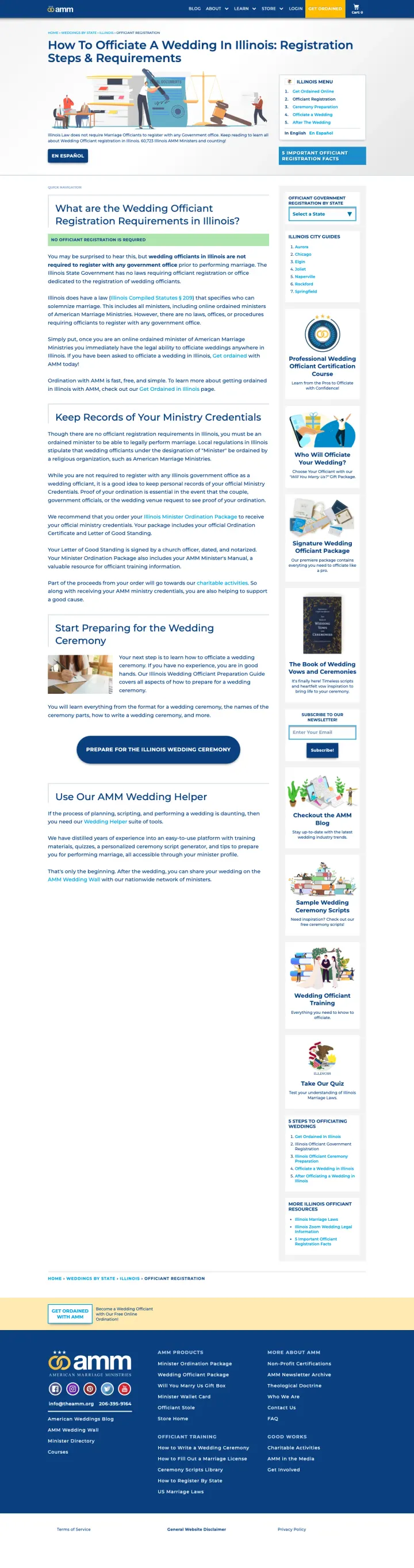
For informational-intent keywords ('how to X in [state]'), build a content-first landing page with the answer immediately visible, then embed your product as the natural next step. AMM answers 'No registration required' in the first paragraph, then positions 'Get Ordained' as the obvious action.
- fewer steps
The answer to the search query ('No Officiant Registration is Required') appears in bold within the first scroll. This builds instant trust with the 40% risk-averse visitor who needs to feel informed before acting. The page educates first, sells second.
- layout
State-specific quick facts box (ULC Ordination: Yes, Registration Required: Sometimes, Waiting Period: 1 Day) gives the 20% comparison-stage visitor a scannable reference they can screenshot and compare across states.
- reviews
'60,723 Illinois AMM Ministers and counting!' is an exact count from the visitor's own state. It is not 'millions ordained' - it is 'thousands in YOUR state,' which feels more relevant and verifiable.
- focus
The page layout is visually dated with a busy sidebar (Illinois Menu, City Guides, state selector) competing with main content. For mobile visitors, this sidebar likely pushes the primary content below the fold.
- wrong promise
The 'Get Ordained' CTA appears in the site header but is not repeated within the main content area until well below the fold. The highest-intent moment (right after reading 'no registration required') has no nearby conversion action.
- extra steps
Product upsell for the 'Illinois Minister Ordination Package' reads like an afterthought rather than a natural next step. Framing it as 'here is everything you need to officiate legally' rather than 'order your credentials' would align better with the educational tone.
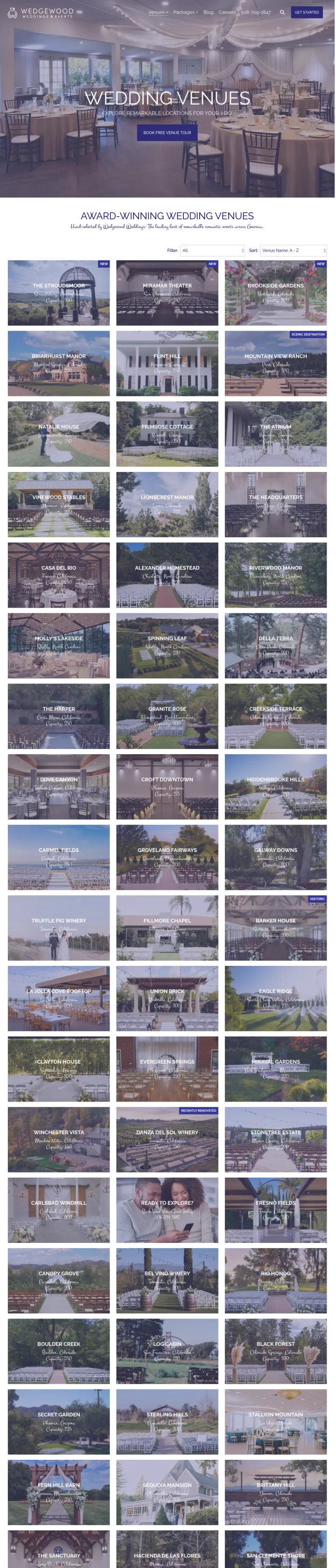
If you operate multiple venues, add location and capacity filters to your listings page so couples can narrow by their state and guest count in one click, instead of scrolling through 30+ venues hoping to find one near them.
- answers doubts
The ad promises 'All-Inclusive Wedding Packages' and the page immediately reinforces this with 'Book Free Venue Tour' above fold. The word 'free' tells risk-averse visitor (40%), the couples who worry about sales pressure, that asking for a tour will not cost them anything.
- credentials
Phone number (508-709-1847) visible in the navigation bar means couples who are ready to talk can call immediately. This serves the 10% ready-to-book visitor who wants to book fast without filling out forms.
- made personal
Each venue card shows location, state, and capacity. For couples comparing venues, seeing 'Carmel, California, Capacity: 250' at a glance is faster than clicking into each venue's page individually.
- too much at once
Keywords target 'cheap wedding halls in arizona' and 'wedding places in the bay area' but the page has no state pre-filter. An Arizona couple scrolls past Pennsylvania, California, and Georgia venues first.
- wrong promise
The ad headline promises 'All-Inclusive Wedding Packages' which sets a cost expectation, but the listings page never reveals what those packages actually cost. The all-inclusive promise without a number leaves couples guessing.
- looks off
The hero image shows an elegantly set ballroom but no people. For a company selling 'romantic wedding venues,' an empty room is less emotionally compelling than showing a real couple's celebration.
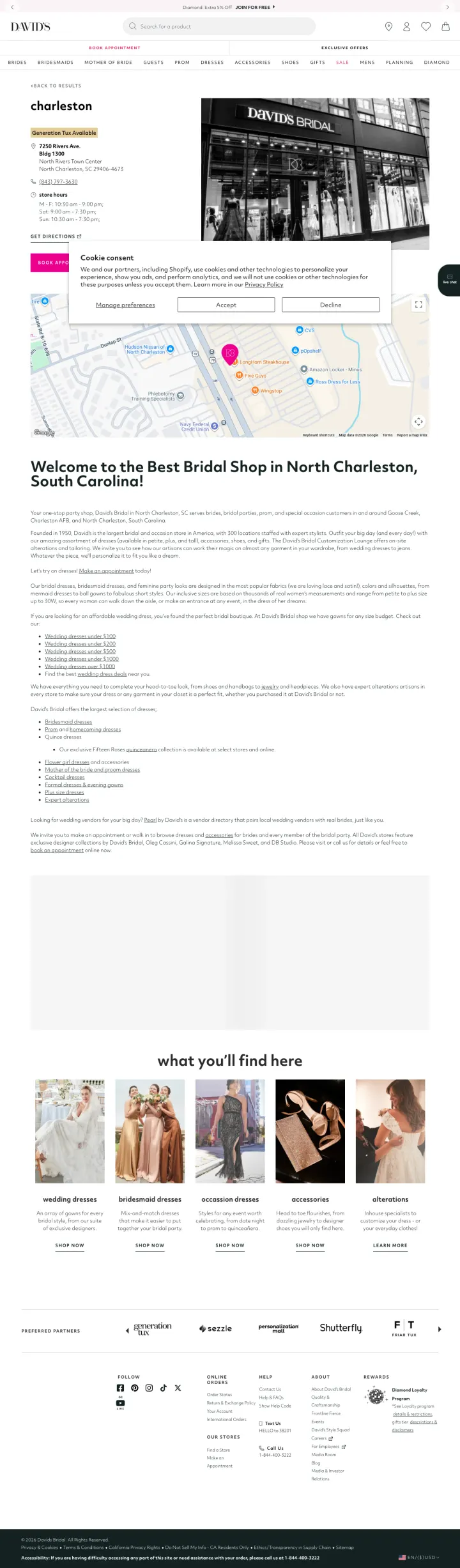
For branded local searches ('brand + city'), make the store page answer the three things every visitor needs in under 3 seconds: address, hours, and how to book an appointment. David's Bridal does exactly this.
- layout
'Book Appointment' is the primary CTA in pink, high-contrast against the white page. For a bridal shop where appointments are the conversion action, this is exactly right. Walk-ins may happen but appointments drive revenue.
- answers doubts
Store-specific details (address, phone, hours including Sunday) are all visible above fold. The 40% risk-averse visitor who wants the practical details settled before committing has nothing to hunt for and nobody to call before they book.
- reviews
'Generation Tux Available' tag signals an additional service (tuxedo rentals) that many wedding couples also need. Cross-selling at the store level reminds couples they can consolidate wedding shopping.
- wrong promise
A consent overlay blocks approximately 30% of the viewport on first load. For a branded search where the visitor already chose this store, the wall delays the one action they came to do: book an appointment.
- wrong promise
The store photo is black-and-white, which feels intentionally editorial but loses the warm, inviting feeling a bridal shop should project. Color photography showing actual dresses would create more emotional pull.
- no proof
No reviews or ratings on the store page. When a bride searches 'David's Bridal North Charleston,' she is comparing this location against other bridal shops nearby. Store-level reviews would differentiate this location.
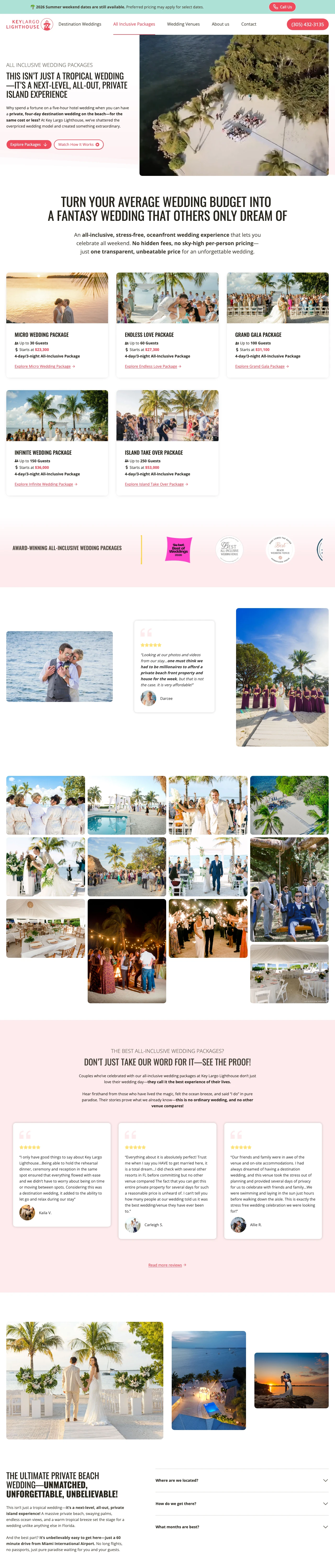
Lead with a cost-reframing headline ('Turn your average wedding budget into a fantasy wedding') instead of listing your price first. Show the price AFTER you have repositioned what the money buys.
- reviews
Five tiered all-inclusive packages ($23,300-$53,000) with guest counts let couples self-select by budget AND party size without talking to anyone. Couples running spreadsheets comparing 3-5 venues need this level of pricing transparency.
- deadline
The banner '2026 Summer weekend dates are still available' is a real deadline, not a fake countdown timer, because a venue really can run out of summer weekends. It also signals to couples that this venue is popular enough to book up.
- reviews
Testimonial from Darcee says 'one must think we had to be millionaires to afford a private beach front property... but that is not the case.' A real couple demolishing the #1 objection (cost) is 10x more powerful than the venue saying 'affordable.'
- focus
Dual CTAs above fold ('Explore Packages' and 'Watch How It Works') compete for attention. The video CTA dilutes the primary action for risk-averse couples who want to compare packages first.
- wrong promise
There is no availability checker and no calendar to back that banner up. The disconnect between 'dates are filling up' and having no way to check your date forces an unnecessary phone call.
- no proof
Award logos (The Knot, WeddingWire) are shown without context. 'Hall of Fame' and 'Couples Choice 2026' mean different things. One sentence explaining what the award means would help analytical couples evaluating credibility.
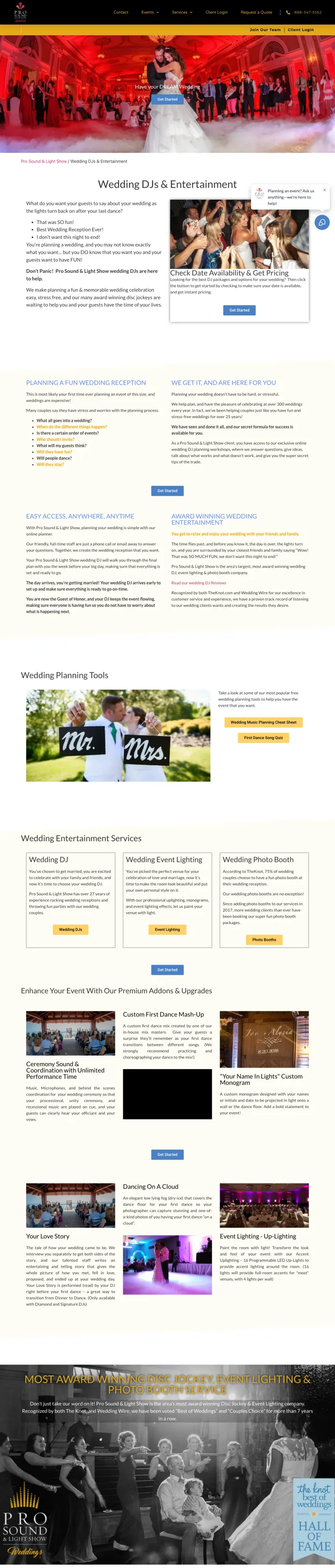
Replace your 'Contact Us' CTA with 'Check Date Availability' as the hero action. For vendors booking a fixed-inventory service (DJs, venues, photographers), availability is the real first question. Pro-1 turns the question you would normally have to call and ask into the opening line.
- price framing
The CTA 'Check Date Availability & Get Pricing' answers the two most-asked questions before a couple has to call. Every other wedding DJ makes couples fill out a contact form just to find out if their date is even open. This page respects the visitor's time.
- reviews
300+ weddings per year and 25+ years in business mentioned above fold gives the 40% Green (risk-averse) persona the volume-based proof they need. A DJ who has done 300 weddings has seen every possible problem.
- reviews
Transparent package pricing ($900 to $2,000 range visible on scroll) with ceremony and lighting add-ons listed as clear line items. Couples comparing 3-5 DJ quotes can drop this into a spreadsheet without requesting a quote.
- too much at once
The ad keyword 'dj minneapolis' (260 monthly searches) has no Minnesota-specific content above fold. A Minneapolis couple sees generic wedding copy first and has to scroll to confirm this is a local service. Pre-filtering the hero by geo would tighten message match.
- looks off
The hero video shows a crowded dance floor but no named couple, no venue credit, no wedding date. Compared to static hero images with captioned real weddings, unattributed dance-floor b-roll reads as stock footage even when it is not.
- looks off
The 'Have your DREAM Wedding' subhead is a generic promise that could belong to any wedding vendor. For a DJ specifically, a more pointed line ('Your guests will actually dance') would differentiate from every photographer, florist, and planner also promising a dream wedding.
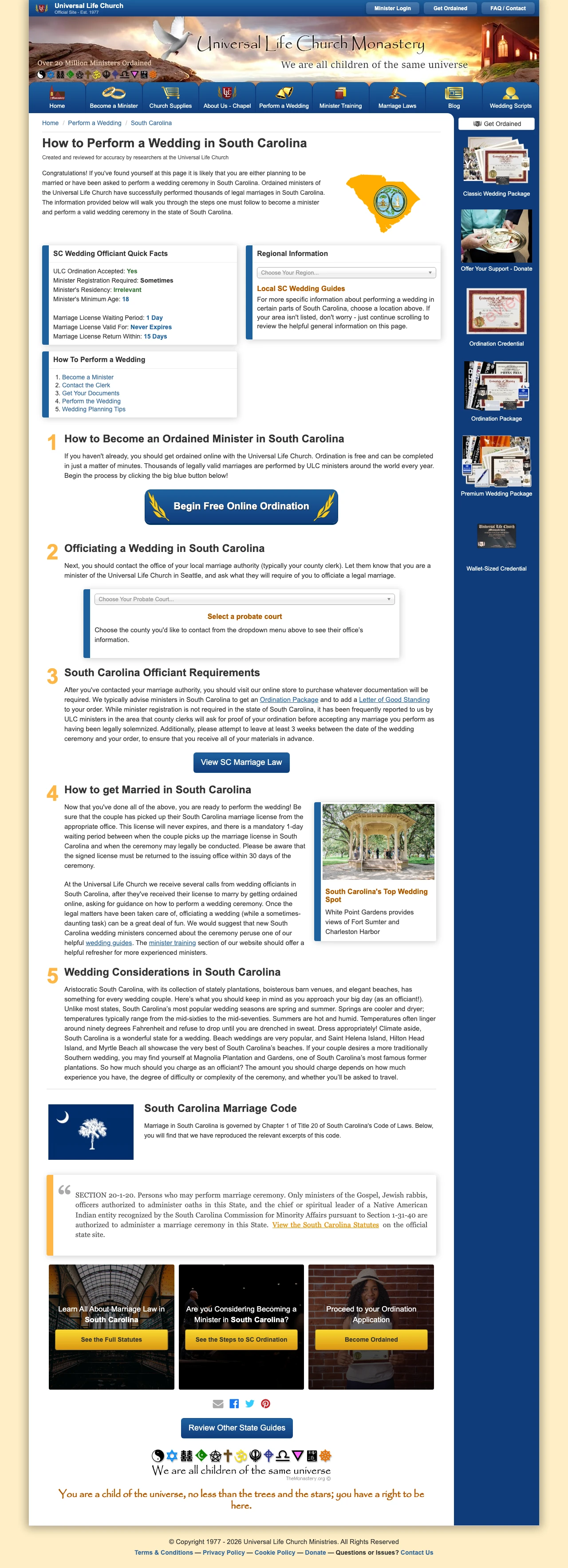
For state-specific informational searches, add county-level contact directories (addresses, phones, office hours for every county) beneath the main content. Visitors bookmark and share pages that solve their specific problem in their specific county, which compounds into organic traffic.
- layout
A state-wide quick-facts box (ULC Ordination: Yes, Registration Required: Sometimes, Waiting Period: 1 Day) gives the analytical visitor a scannable reference in under 5 seconds. This template repeated across all 50 states creates a content moat that ranks for every state+officiant query.
- layout
Full legal code citation (South Carolina Code Title 20 Chapter 1) reproduced inline builds authority trust that a competitor's 'See how to get ordained' ad copy cannot match. For the 40% risk-averse visitor who needs legal certainty before acting, quoting the statute is the unbeatable move.
- answers doubts
A complete county-level directory (all 46 SC counties with probate office address, phone, fax, website) turns the page into a reference document. Ministers bookmark this, share it, and return to it when the wedding actually happens.
- no proof
The design is visibly dated (circa 2015 palette, busy sidebar, cartoon illustrations in the nav bar). Modern couples searching from mobile will question credibility based on aesthetics before reading content.
- wrong promise
'Become a Minister' CTA is buried in the header bar with low visual weight. The highest-intent moment (after reading 'Yes, ULC ordination is accepted') has no nearby CTA. The page educates well but under-converts.
- wrong promise
The mobile experience is likely compromised by the sidebar navigation pushing main content below the fold. The sidebar adds value on desktop (state selector, local guides) but needs to collapse gracefully on small screens.
What every winner does
Wildcards
Pages that break the playbook in interesting ways
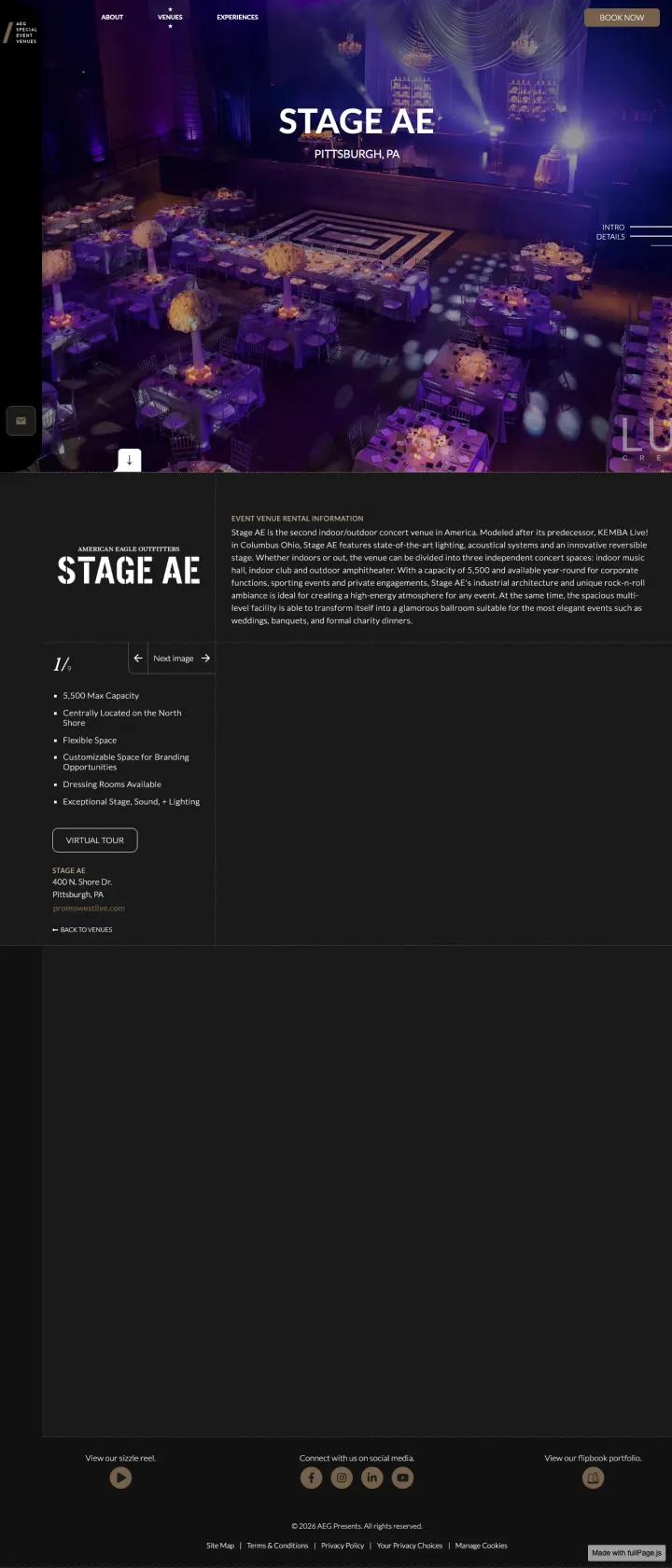
Why this breaks the rules: Most wedding venues show garden ceremonies and white tablecloths. Stage AE leads with a dramatically purple-lit concert hall set up for a formal dinner. It does not say 'wedding' anywhere above fold. It says 'Stage AE, Pittsburgh, PA' and lets the visual drama do the selling. For the couple who does NOT want a traditional wedding, this is the anti-venue-page. It breaks every wedding landing page convention and works precisely because of that.
- credentials
Full-bleed dramatic photography of the actual space set up for a formal event (purple uplighting, concert-stage dance floor, round tables with floral centerpieces) sells an experience that no traditional venue page can match. Couples who want an unconventional wedding will self-select immediately.
- fewer steps
Minimal copy. The page has almost no text above fold because the venue's visual identity IS the pitch. For a concert venue pivoting to events, letting the photography speak is smarter than trying to sound like every other wedding venue.
- reviews
AEG (Anschutz Entertainment Group) brand backing provides implicit trust for a concert venue entering the events space. This is not a random warehouse renting out space; it is a professionally managed entertainment venue.
- wrong promise
The keyword 'places for bridal showers in pittsburgh pa' has specific occasion intent, but the page is a general event venue with no mention of bridal showers, weddings, or wedding-specific packages.
- no proof
No pricing, no capacity details above fold, no testimonials. The page relies entirely on visual impact. For the 20% comparison-stage visitor who needs numbers, there is nothing to compare against other Pittsburgh venues.
- looks off
The 'Book Now' CTA is gold text on a dark background in the top-right corner. It is easy to miss against the dramatic photography. A more prominent CTA anchored within the visual would capture visitors who are sold by the image.
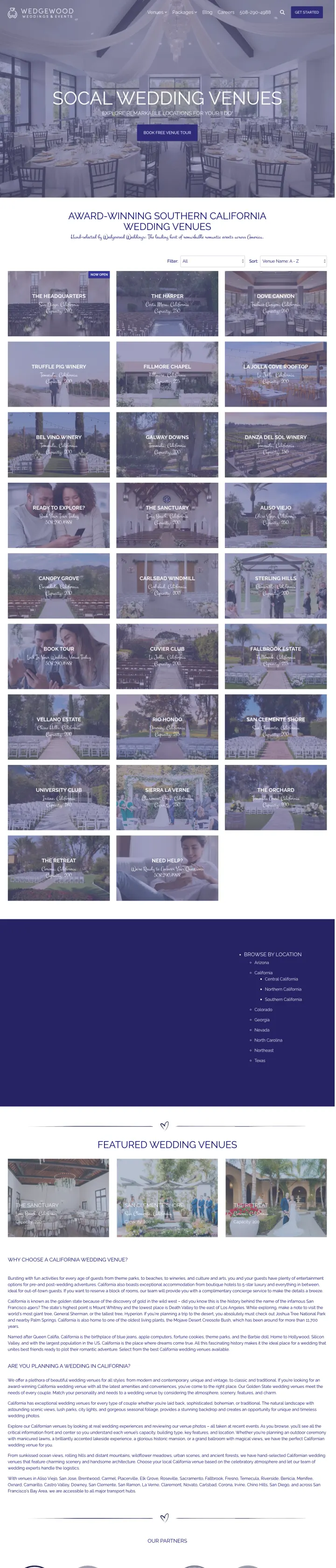
If you operate in multiple markets, build a dedicated SEO+PPC landing page per region (not just a filter on a master page). Wedgewood runs /southern-california-wedding-venues as a separate URL with California-specific hero, photos, and venue grid. The message match for 'San Diego wedding venues' searches is near-perfect.
- made personal
The hero headline 'ENCHANTING SOCAL WEDDING VENUES' speaks directly to visitors who searched a California-specific keyword. Compared to landing on a generic /venues page showing Georgia and Pennsylvania locations first, this geo-specific hero eliminates the 'am I in the right place?' bounce moment.
- price framing
The page uses the same 'Book Free Venue Tour' CTA as the master venues page. Repeating CTAs and trust patterns across geo-variants saves design time while still delivering geo-specific message match. One codebase, many landing pages.
- price framing
Regional venue grid shows only California properties with capacity and city visible. Couples comparing three California venues can stay within the Wedgewood ecosystem rather than bouncing to compare against other California brands.
- wrong promise
'SoCal' in the headline is a regional colloquialism but the ad keyword is 'places to have a wedding in san diego.' A visitor searching San Diego specifically sees 'Southern California' and wonders whether any of these venues are actually IN San Diego.
- looks off
The hero shows a single ballroom image rather than a map or collage of the region's venues. A visitor who wants to scan multiple California locations at a glance has to scroll through a text-heavy section first.
- wrong promise
No price ranges visible on the venue grid despite the ad promising 'All-Inclusive Wedding Packages.' The master /venues page has the same omission, so this is a brand-wide pattern, not a geo-page problem.
Losers
2 pages burning ad spend with fundamental issues
Every click to these pages costs real money. We found pages with no phone number and no named human, ads that promise one place and land on another, weak CTAs, and messaging that ignores what the searcher actually typed. Here is what to avoid.
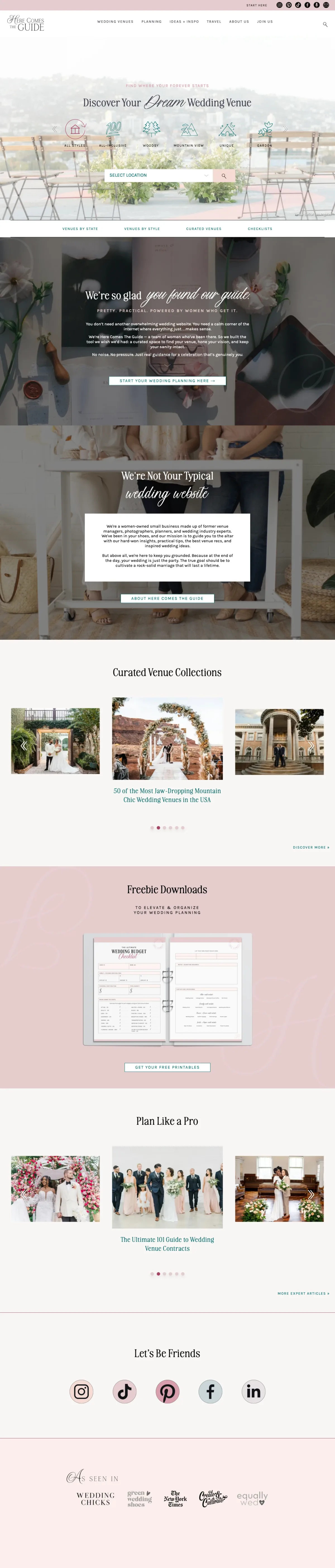
The ad sells a specific, valuable piece of content (29 affordable New England venues with prices). The landing page delivers none of it. The visitor searched for 'affordable wedding venues in MA' (880 monthly searches), clicked an ad promising exactly that, and landed on a homepage showing California venues. Every click is a complete waste of ad spend because the content the ad promised exists somewhere on the site but this page is not it.
- missing proof
The ad headline '29 Most Affordable New England Wedding Venues | See Prices' promises a specific listicle with pricing. The landing page is the site's generic homepage showing a venue discovery tool defaulting to venues in California, Texas, and Illinois. New England is not even visible.
- relevance
The homepage shows venue carousels (Sofitel Los Angeles, Firefly Gardens Texas) that are geographically irrelevant to someone who searched 'affordable wedding venues in MA.' Every second on this page confirms the visitor is in the wrong place.
- wrong promise
The 'Select Location' dropdown is the closest thing to addressing the search intent, but it requires the visitor to manually navigate to New England rather than landing directly on the promised '29 affordable venues' list.
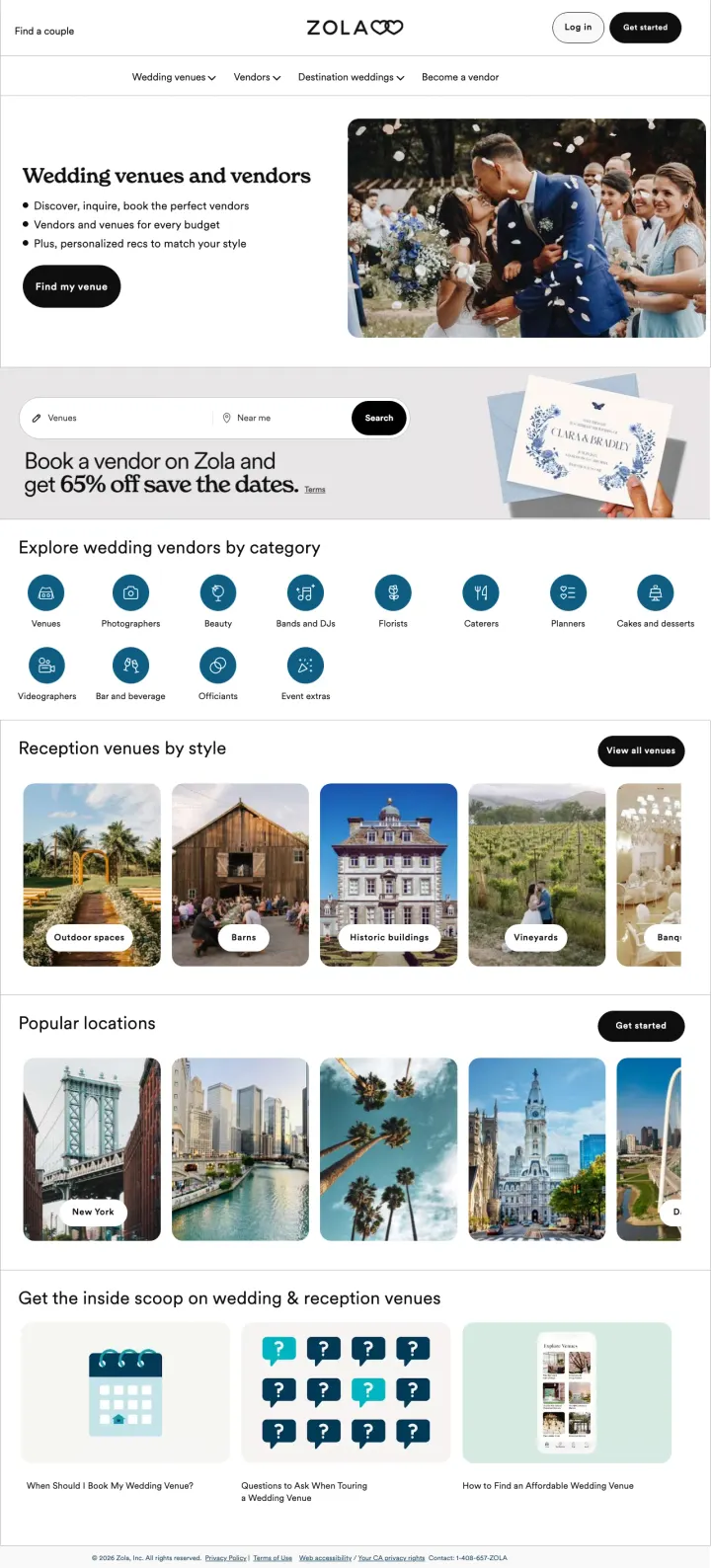
The ad spend is buying city-specific keyword traffic ('Wedding Venues In Chicago' at 9,900 monthly searches, 'Wedding Venues In Michigan' at 9,900 searches, 'wedding locations in dallas texas' at 8,100 searches) and dropping all of it on a page that defaults to 'Near me.' A Chicago searcher clicks an ad for Chicago venues, lands on a page that asks them to re-enter their location. At competitive wedding-venue CPC ($3-$8), every mismatched click is $5 of lost ad spend that could have been saved by pre-populating the location field from the referring keyword.
- extra steps
The ad copy promises 'Wedding Venues In Chicago' (9,900 monthly searches) and 'Wedding Venues In Michigan' (9,900 monthly searches). The landing page hero reads 'Wedding venues and vendors' with a location field defaulting to 'Near me.' The ad's most valuable signal (the city) is thrown away at the moment of landing.
- looks off
The vendor grid below the fold shows Venues, Photographers, and Videographers cards without any location context. A visitor searching 'wedding locations in dallas texas' sees generic vendor categories instead of Dallas-area examples. The 65% off save-the-dates banner is the only concrete offer on the page.
- wrong promise
The page has no phone number, no live chat, and no named human. For the 40% risk-averse visitor (risk-averse couples), the absence of a real person makes the 'Find my venue' CTA feel like a portal into an anonymous database rather than the start of a relationship.
What we learned
Nothing builds trust with an overwhelmed couple faster than prices printed on the page
The top-performing pages in this set all show specific dollar amounts. Key Largo Lighthouse lists five tiered packages from $23,300 to $53,000. Eventective shows per-event pricing ($225-$1,998) inline with each listing. Pro-1 leads with 'Check Date Availability & Get Pricing' as their primary CTA. In an industry where 'call for pricing' is the norm, showing numbers immediately separates you from every competitor still hiding behind a contact form. Couples are running spreadsheets comparing 3-5 vendors. If your pricing is missing, you do not make the spreadsheet.
Real wedding photos with couple names beat any styled shoot or stock image
Liberty House (bylandmark.com) has a 'Wedding Spotlight' section with named couples (Demi & Michael) and photographer credits. Their testimonials quote real people (Adriana T., Devin S., Maddie L.) describing specific details like 'cocktail hour room' and 'skyline views.' Compare this to pages using generic venue photos with no human element. Couples considering a $20K+ venue want to see what an actual wedding looked like there, not a styled table setting. The presence of real couple names transforms a marketing page into social proof.
Message match failures cost the most in wedding PPC because intent is ultra-specific
The clearest loser sends paid traffic to a completely wrong page. Here Comes The Guide advertises '29 Most Affordable New England Wedding Venues | See Prices' but lands on a generic venue discovery homepage showing venues in California and Texas. When wedding venue clicks cost $5-15 each, sending even 100 visitors to the wrong page wastes $500-1,500 with zero chance of conversion.
Availability checking is the most underused conversion mechanism in wedding PPC
Only Pro-1 makes 'Check Date Availability' the primary action. Yet availability is the #1 practical filter couples use. You can have the perfect venue at the right price, but if it is booked on your date, nothing else matters. Pages that surface availability early (even just 'Summer 2026 dates still available' like Key Largo Lighthouse's banner) reduce the biggest friction point in the wedding booking funnel. Most pages in this set force couples to fill out a generic contact form just to find out if the date is open.
Winners answer the specific question the searcher typed and show real weddings with real pricing. Losers send paid traffic to pages that have nothing to do with the ad promise.
If you're building a page like these yourself, here's my comparison of AI landing page builders, with prices and what each one is best for.
What we'd find on your page
Liberty House is #1 on this page. It still bids on 'liberty house wedding prices' - 260 searches a month - and the page that couple lands on shows no price anywhere. So even the winners leak. Postclick reads your page the way a couple does straight after they click your ad, then names what's costing you the venue tour. It designs new versions as real images and builds the one you pick.