We analyzed 43 personal injury landing pages. Only 10 are worth stealing from.
We pulled 43 personal injury pages that were paying for Google Ads clicks, and read them all. These 10 are the ones worth your time. Everything we found sits on this page, free.

43 landing pages screened
From real personal injury law Google Ads campaigns in the US
10 winners curated
The landing pages actually worth stealing from
3 burning money
So you know exactly what to avoid
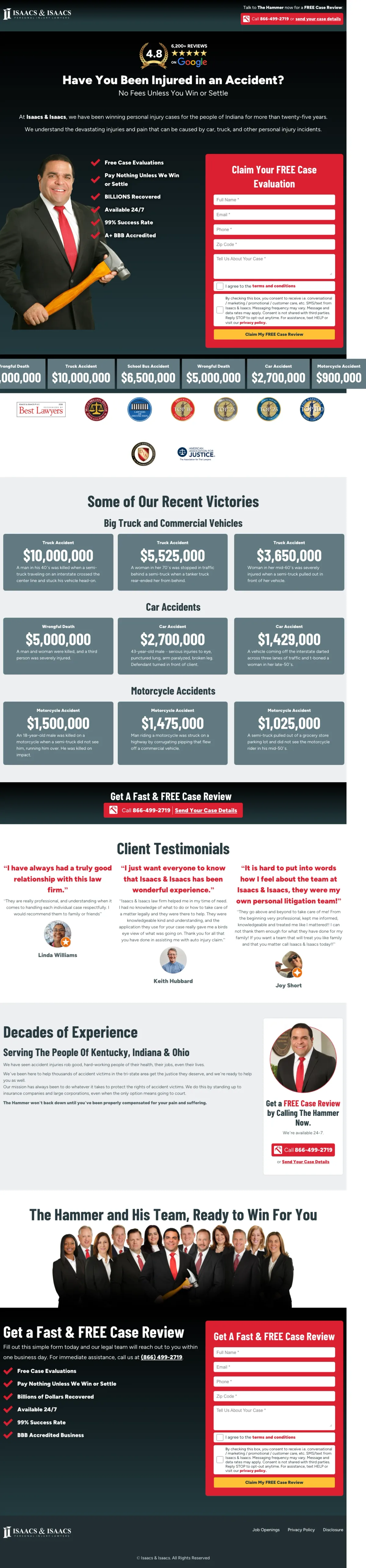
Isaacs & Isaacs bought this Indiana click and spent the top of the page on proof. A gold laurel badge, a Google score and a review count sit above the headline, and this is the only page in the file that puts them there. Under the headline the lawyer stands beside the form holding an outsized hammer, which is the nickname the top bar greets you with. His phone number is up there too, in a red bar button set small enough that most visitors will use the form instead.
Lead with Google review count (6,200+ reviews at 4.8 stars) as the very first element above the hero headline - the visitor sees the reviews before they read a single word of pitch.
- +
Tick list runs level with the form reassuranceeasy
Pay Nothing Unless We Win or SettleFree case evaluations, pay nothing unless we win, billions recovered, round-the-clock cover, a success rate and a BBB accreditation, ticked off in a red-ticked column level with the form panel. Your visitor reads the reasons while the cursor is in the first box. Put yours right there.
- +
Nickname greets you above the headline made personalhard to earn
The Hammer won’t back down until you’ve been properly compensated for your pain and suffering.Darryl Isaacs stands beside the form holding a hammer the length of his forearm, and the bar above the headline greets you with the nickname. You probably have no nickname and no prop. You do have a partner whose face and name can sit next to the form.
- +
Payouts scroll past with their accident types exact numbersone afternoon
Some of Our Recent VictoriesA row of payouts runs straight under the hero with the accident type printed over each, clipped at both edges like a ticker. Further down the same results open into a grid under truck, car and motorcycle headings. Somebody hit by a semi wants the semi number.
- ✕
Form never asks what happened lead qualityeasy
Claim Your FREE Case EvaluationThis form takes a name, an email, a phone number, a zip code and an open box asking about your case, and never asks what kind of accident it was. Your intake team then rings every enquiry cold. A dropdown of case types sorts them before anybody picks up.
- ✕
Whole page shouts at a hurt reader tonea design call
A near-black hero, a red form panel, red ticks down the middle and a man holding a hammer. It reads as a fighter, and a fighter is what some injured people want. The rest are frightened and looking for calm. Run a softer version against the loud one.
- ✕
Praise carries no date or source reviewsone afternoon
I have always had a truly good relationship with this law firm.Linda, Keith and Joy each give a warm paragraph and each gets a photograph, which is more than most of this file manages. None carries a date, a score or the mark of the site it came from. A stranger reads sourceless praise as marketing. Wire your Google feed in.
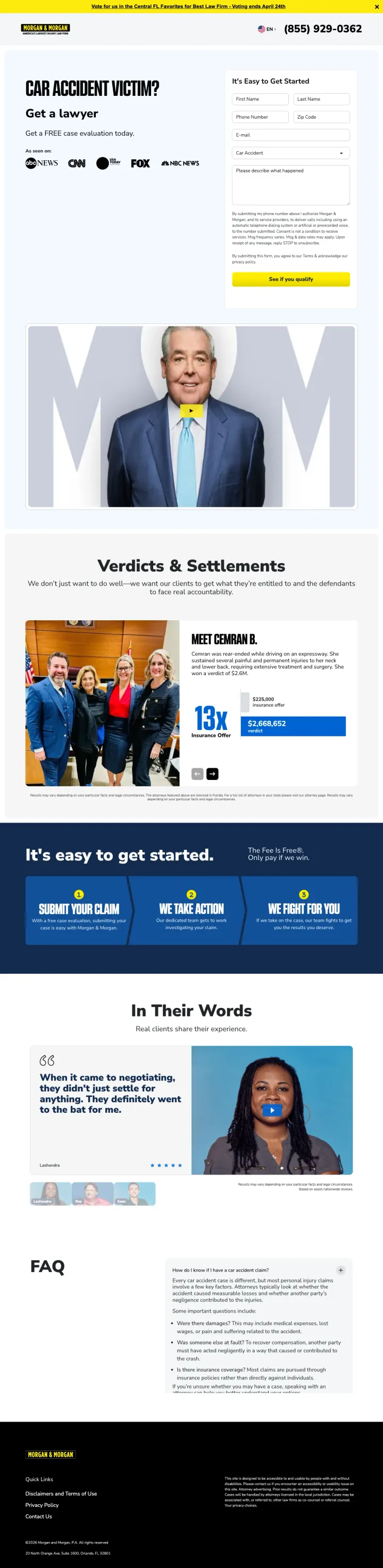
Morgan & Morgan put the claim in the logo, America's largest injury law firm, and the page behaves like it: news logos across the hero and a form that already knows you were in a car accident. The hero prints no figure at all. Further down, a client card draws the insurance offer against the jury verdict as two bars, and that is the most persuasive thing on the page. You have to press an arrow to see the next one.
Media logo strip (CNN, NBC, FOX, NBC News) directly under the headline as an 'As Seen On' row - these logos do more convincing in 1 second than a paragraph of credentials.
- +
Dropdown opens on their own accident form designeasy
It's Easy to Get StartedThe dropdown already says Car Accident when the page loads, because the ad that brought them here was about car accidents. The visitor sees their own problem in the box instead of a list to search. Pass the keyword through to your form and the field stops being work.
- +
Three lines say what happens next answers a worryeasy
The Fee Is Free®. Only pay if we win.Submit your claim, we take action, we fight for you, set in a dark blue band with the fee promise beside it. Somebody who has never hired a lawyer has no idea what happens after they press the button, and that gap is where they stall. Three lines covers it.
- +
Grey bar shows what the insurer offered exact numbershard to earn
Cemran was rear-ended while driving on an expressway.The result card names the client, shows a photograph of her with the legal team, then draws what the insurer offered as a short grey bar against a long blue bar for the jury award. The multiple sits beside them. Almost every firm shows only the second figure.
- ✕
Yellow bar links away before the headline exit routeseasy
Vote for us in the Central FL Favorites for Best Law Firm - Voting ends April 24thThe very first thing on this paid page is a yellow bar carrying an underlined link to a local popularity poll. A visitor who has just crashed is offered a way off the page before the headline. Whatever marketing wanted, run that bar everywhere except here.
- ✕
Hero prints not a single figure proof placementeasy
CAR ACCIDENT VICTIM?The hero asks whether you were in a crash, offers a free evaluation, shows the news logos and prints not a single figure. The one result this firm draws better than anybody waits until you have scrolled past the whole form. Put your headline figure where the visitor lands.
- ✕
Legal wall stands between reader and button form copyeasy
By submitting my phone number above I authorize Morgan & Morgan, and its service providers, to deliver callsUnder the textarea sits a paragraph about automatic dialling systems and prerecorded voices, then another about terms and a privacy policy, and only then the button. Put the plain promise above the button and let the legal text sit underneath in smaller type.
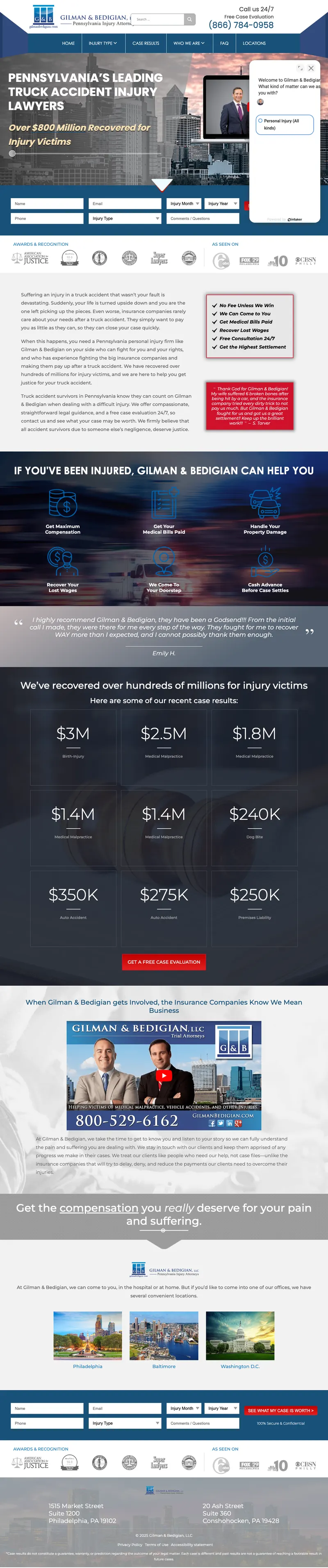
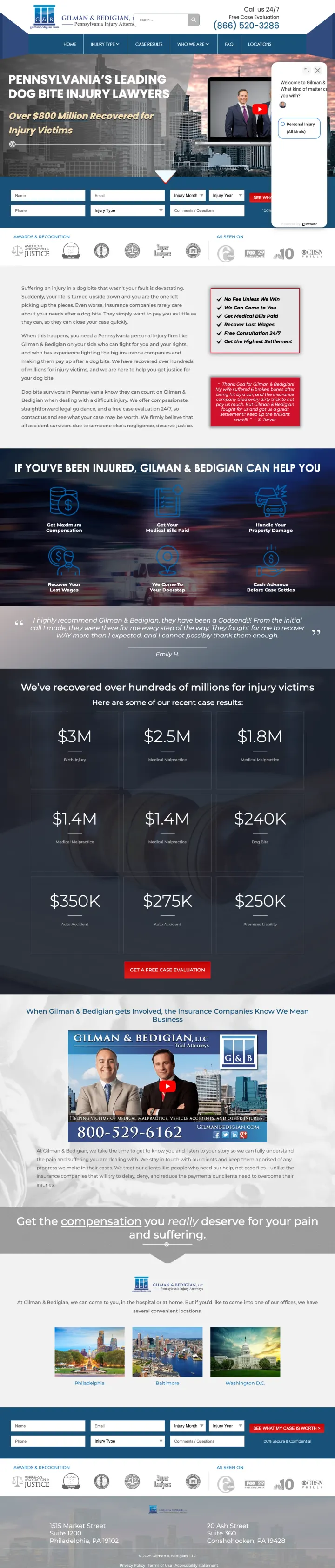
Gilman & Bedigian earn their place on geography. A greyed city skyline behind the hero, the state in the headline, and local news logos in the strip below it. Their case results grid tags every tile with the injury it came from, though a page headlined on truck accidents prints no truck result anywhere in that grid. The intake band sits right under the hero, and a chat panel lands on top of it and covers the submit button.
Inline intake form at the bottom of the hero with case-specific fields (Injury Month, Injury Year, Injury Type dropdown) - this pre-qualifies leads before they even hit submit and signals that the firm takes truck cases seriously enough to build a custom intake process.
- +
Tiles let readers find their own accident exact numbershard to earn
Here are some of our recent case results:Birth injury, medical malpractice, dog bite, auto accident, premises liability, each tile carrying its own figure. A visitor scans for the label matching their accident and stops. The catch: the grid holds no truck result at all, on a page headlined about truck accidents.
- +
Skyline and headline both name the state local proofeasy
Pennsylvania’s Leading Truck Accident Injury LawyersA greyed city skyline fills the hero and the headline names the state, so a Pennsylvania searcher lands somewhere that looks like home. The strip below carries the local news logos. The national firms bidding on your keywords cannot say this. Put your city in the headline.
- +
Four bodies a visitor could check credentialshard to earn
Awards & RecognitionAvvo, Super Lawyers, the Million Dollar Advocates Forum and the American Association for Justice, lined up where a visitor could go and check each name in turn. The strip sits just under the first screen, which is close, and close is not visible. Put yours next to the form.
- ✕
Chat panel hides the submit button widget clasheasy
Welcome to Gilman & Bedigian. What kind of matter can we assist you with?The Intaker panel opens over the right of the hero and hangs down across the intake band, hiding the submit button behind it. You paid for that click and then covered the thing the click was for. Set your chat widget to stay shut until somebody scrolls.
- ✕
No-fee promise never reaches the first screen money worryone line
No Fee Unless We WinThe line exists, first in a red bordered box below the hero, and it never reaches the first screen. Somebody who has just lost a month of wages is doing sums before they read a word about your credentials. Move no fee unless we win up beside the phone number.
- ✕
Biggest figure is set as a caption emphasisone line
Over $800 Million Recovered for Injury VictimsThe biggest number this firm owns is set in gold italic under the headline, at about half its size, where it reads as a caption. Italic says aside. Your recovery total is not an aside, so set it in the largest type on the page.
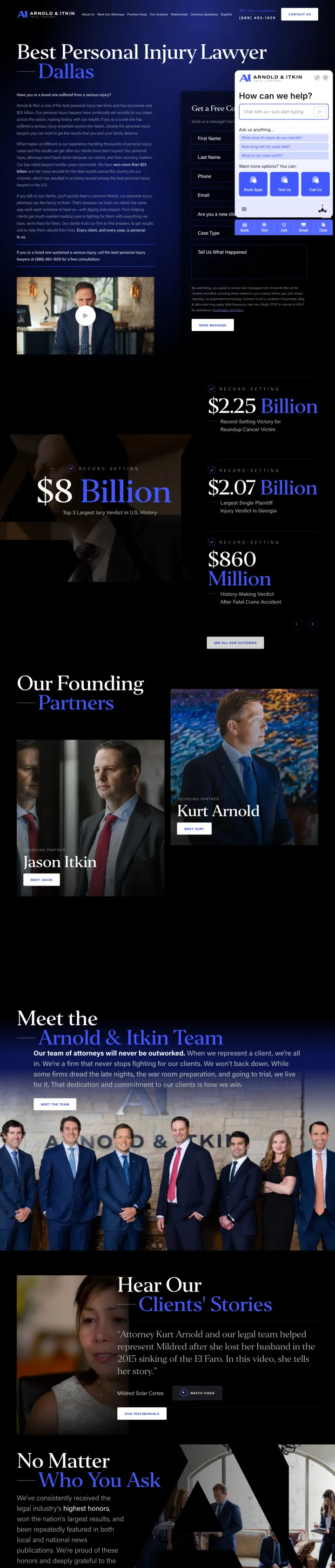
Records are the pitch here. Arnold & Itkin answered a Dallas best-injury-lawyer search with the keyword as the headline, and a wall of record verdicts follows underneath, which they can print because they hold them. Beside the form sits a column of firm philosophy nobody buying a click at these prices is going to read. The contact bar pinned to the foot of the screen is the part worth taking.
AI-powered chat widget with suggested questions ('What kind of cases do you handle?', 'How long will my case take?', 'What is my case worth?') directly addresses the top 3 PI visitor questions without requiring them to type anything.
- +
Contact bar follows you down the page more ways inone afternoon
Book, text, call, email and chat, pinned to the foot of the screen wherever you have scrolled to. Plenty of injured people will not ring a law firm cold and will happily send a text. Give them the choice at the moment they decide. A contact page is one click too many.
- +
Ranked claim beats every adjective credentialshard to earn
Top 3 Largest Jury Verdict in U.S. HistoryNo best, no leading, no trusted. A ranked claim a rival cannot copy without lying, printed as the caption under the verdict itself, and one a visitor could confirm in a minute. Whatever your firm holds a record for, say it in those terms and drop the adjectives.
- +
Dark design sets the case size design tonea design call
Blue-black the whole way down, a serif headline with the city set in blue under it, and large dark photographs carrying the record verdicts and the partners. Design tells a visitor what size of case you want before they read a word. Stop using the walk-in clinic template.
- ✕
Chat bubble repeats the pinned bar widget clasheasy
The chat window opens over the right-hand form panel, and it offers book, text and call, which is exactly what the bar pinned to the foot of the screen already offers. The visitor now picks between three ways in. Decide which one you want first.
- ✕
Essay sits beside an empty form too much at onceeasy
Every client, and every case, is personal to us.Three long paragraphs down the left about how the firm treats people, sitting beside a form nobody has filled in yet. Dallas injury keywords are among the dearest words in Google Ads and nobody reads an essay before calling. Cut it to the claim and the proof.
- ✕
Free consultation is not a free case money worryone line
The header offers a free consultation and the form heading repeats it, but that is the review being free. The case is another matter. Record verdicts fill this page and what hiring these lawyers costs is never mentioned. Print you do not pay unless we win beside the phone number.
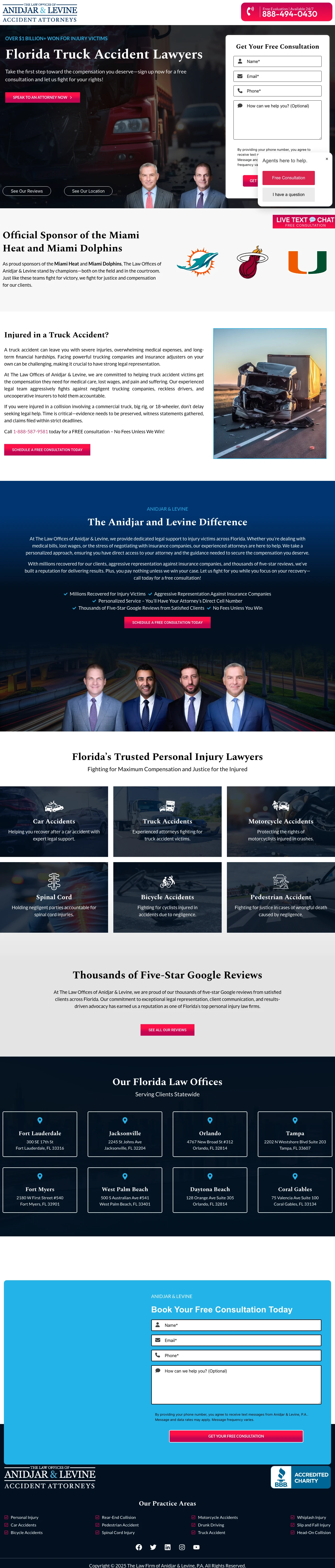
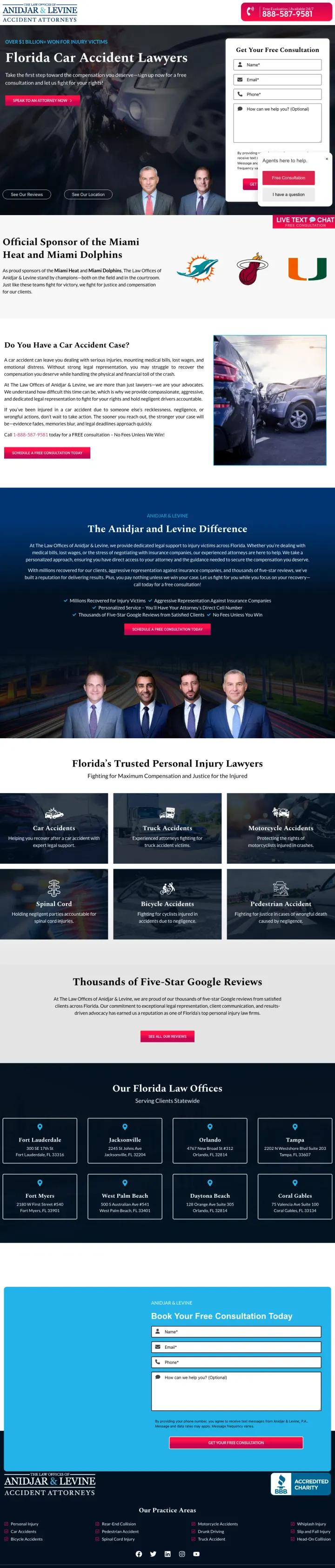
Anidjar & Levine sponsor the Miami Heat and the Miami Dolphins, and the crests take half the band directly under the hero, where a Florida firm normally stacks its award seals. The hero form asks for a name, an email, a phone number and a sentence, and nothing else. No score appears in the first screen, and the section further down that is headed on their Google reviews does not print one either. It offers a button instead.
Real 18-wheeler truck photo in the hero background with attorneys standing in front of it - visually communicates 'we handle truck accidents specifically' faster than any headline could, and creates an immediate emotional connection for someone who was just hit by a truck.
- +
Team crests replace the lawyer seals local proofhard to earn
Official Sponsor of the Miami Heat and Miami DolphinsThe band directly under the hero gives half its width to the Dolphins crest, the Heat crest and the University of Miami U. Every injury firm in Florida shows the same lawyer award seals, which is why they stopped meaning anything. Whatever you sponsor, put that logo there.
- +
Pink tab offers text, not talk more ways ineasy
A pink tab pinned to the bottom right offers a live text chat with no form and no phone call. The person reading this from a hospital waiting room will not have a conversation out loud. Offer text, then staff it, because an unanswered text is worse than none.
- +
One word does all the hurrying urgencyeasy
Speak To An Attorney NowNo countdown clock, no limited places, no offer that expires at midnight. A single word on a red button does the hurrying, and it is honest, because an injury claim really does have a deadline in law. Take the fake timer off and put the urgency in the verb.
- ✕
Five ways in ask at once focusone afternoon
A form in the hero, a chat panel that opens itself and a pinned text tab, all asking at once, with a phone button in the header and two outline buttons below. Together they read as a page that will not stop selling. Rank them, keep the strongest in view.
- ✕
Biggest number rides in the kicker slot emphasisone line
Over $1 Billion+ Won for Injury VictimsThe recovery total sits above the headline in small blue caps, in the slot most designs use for a category label. Underneath it, in the largest words on the screen, is a practice area every competitor also has. Swap them. A rival cannot print that total tomorrow.
- ✕
Chat panel cuts the consent line widget clasheasy
Agents here to help.The chat panel loads across the bottom corner of the hero form, cutting the consent line off mid-sentence and leaving one word of the submit button showing. That form is the reason this page exists. Open your own page with every widget running and see what is left.
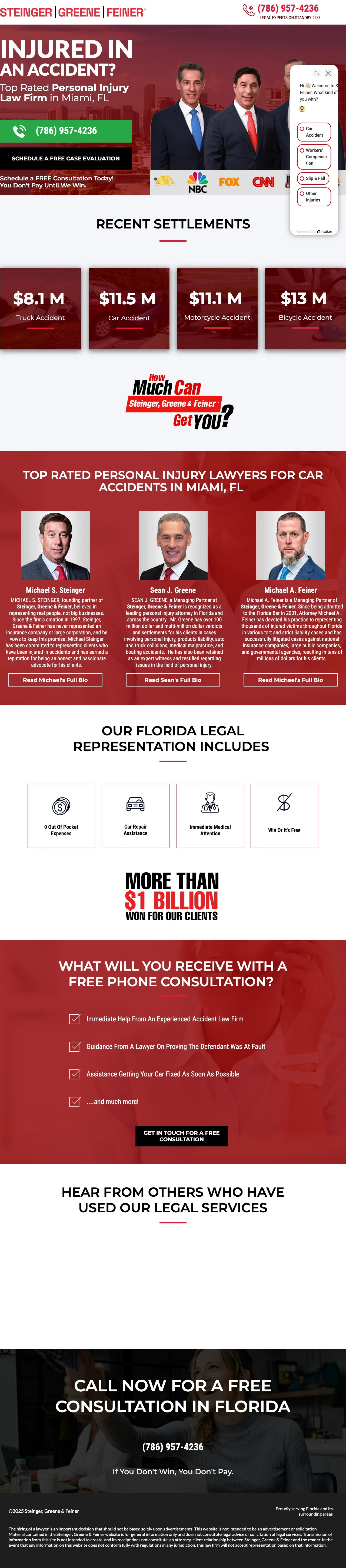
Steinger, Greene & Feiner skip the lead form completely. This Miami page is a phone number, a green call button and a settlements row, and the only inputs anywhere on it belong to a chat widget. For a firm whose visitors often ring from the roadside that is a defensible call. The bot that opens over the right of the hero is not.
Intaker chatbot with clickable case type buttons (Car Accident, Workers' Comp, Slip & Fall, Other Injuries) as the primary conversion mechanism - turns lead intake into a guided conversation rather than a form, which feels more personal for someone who just got hurt.
- +
Four payouts answer the money question exact numbershard to earn
RECENT SETTLEMENTSTruck, car, motorcycle and bicycle, four payouts running across the band under the hero with the accident type printed beneath each. It answers what is my case worth without anybody clicking. Put your biggest honest results where the visitor lands. A results page is a click away and often unread.
- +
Recovery total meets the drop-off point proof placementeasy
The recovery total is set as a graphic in the middle of the page, right where a reader who has not decided starts thinking about opening another tab. That is a good place for your strongest claim. Find where your visitors leave and put a reason to stay there.
- +
Three partners get a face and a bio answers a worryone afternoon
believes in representing real people, not big businesses.Steinger, Greene and Feiner each get a photograph, a paragraph naming what they actually do and a link to the full bio. The fear behind every injury enquiry is being handed to whoever is free. Name the lawyer who runs the case, or your visitor assumes the junior.
- ✕
Bot asks before the firm speaks widget clasheasy
The Intaker panel opens across the right of the hero and asks the visitor to pick a case type before they have read a line the firm wrote. It covers the attorney photographs and hangs there. Hold the widget back until the reader has had the first screen to themselves.
- ✕
Capitals shout at a medicated reader tonea design call
Schedule a FREE Consultation Today!A red field, white capitals across the top of it, and an exclamation mark on the line under the buttons. Your reader is hurt, probably medicated and worried about money, and the page is yelling. Show it to somebody recently in a crash, then set the type in sentence case.
- ✕
Clearest writing waits several screens down layouteasy
WHAT WILL YOU RECEIVE WITH A FREE PHONE CONSULTATION?Immediate help, guidance on proving fault, help getting the car fixed. That is the clearest writing on the page and it sits several screens down. Those lines answer what happens if I call, the question keeping a thumb off the button. Move them up beside the number.
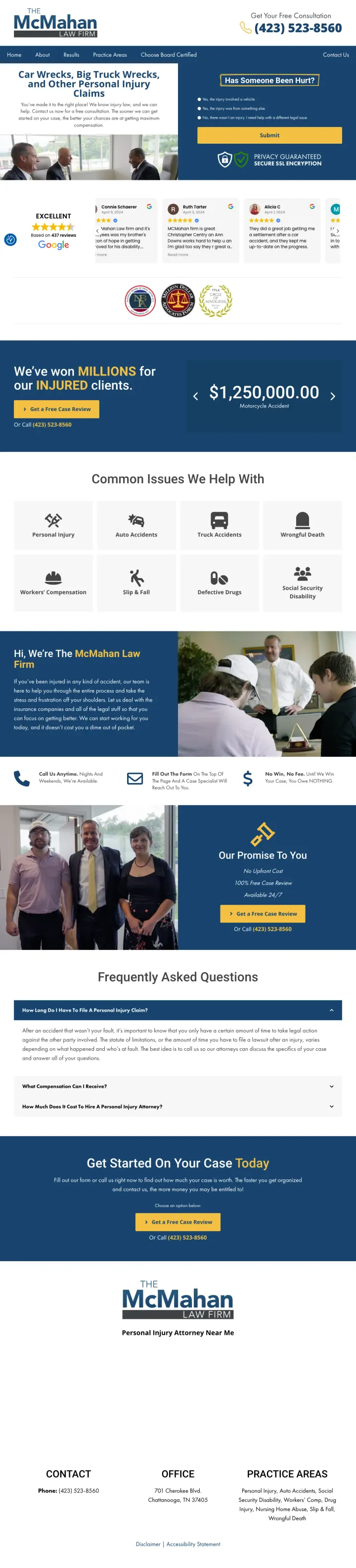
Reviews are the whole argument on this Chattanooga page. The score, the stars and the count sit in the first screen, and beside them the real reviews scroll past with names, dates and the Google mark on them. The form opens with a single question about who got hurt rather than a name and an email. Their board certification appears as a menu link and as an unlabelled seal below the fold, and never as a sentence.
Triage-style intake form ('Has Someone Been Hurt?') with radio buttons for injury context (vehicle, something else, different legal issue) - qualifies the lead AND creates an empathetic entry point by asking about the person's situation before asking for contact info.
- +
Score and reviews share the first screen reviewshard to earn
They did a great job getting me a settlement after a car accident, and they kept me up-to-date on the progress.The word Excellent, the stars, the count and the Google logo sit in the first screen, and the actual reviews scroll past beside them with names, dates and the Google mark on each card. Wire your Google feed straight in, because the live version is what a stranger believes.
- +
Padlock sits under the submit button answers a worryeasy
Privacy guaranteedRight under the submit button it says privacy guaranteed and secure SSL encryption, with a padlock beside it. That is not a credential and does not need to be. Somebody typing what happened to their body into a stranger's website wants to be told where it goes.
- +
Client names the staff who helped made personaleasy
A review sitting in the first screen names the two people at the firm who handled that case, in the client's own spelling, and the firm let it stand. A national brand cannot buy that. Pull the reviews that name your people to the front of the feed.
- ✕
Six nav links lead out of the funnel exit routeseasy
Home, About, Results, Practice Areas, Choose Board Certified and Contact Us run across the top of a page built to serve a single ad. Every link there is a way out of the funnel you are paying to fill. Keep the logo, keep the number, and delete the rest.
- ✕
Results hide one figure at a time proof depthone afternoon
The whole results section is a slider: a figure, the case type under it, and an arrow to fetch the next. No name, no sentence, nothing about what the money paid for. Take your best few, write two lines each, and lay them out where a visitor compares without clicking.
- ✕
Board certification never gets a sentence credentialseasy
Certification is the one thing here a visitor could go and verify. Board certification appears as a menu link, and again as a trial advocacy seal in an unlabelled row of badges, and never as a sentence anybody reads. Say so beside the headline and name the body.
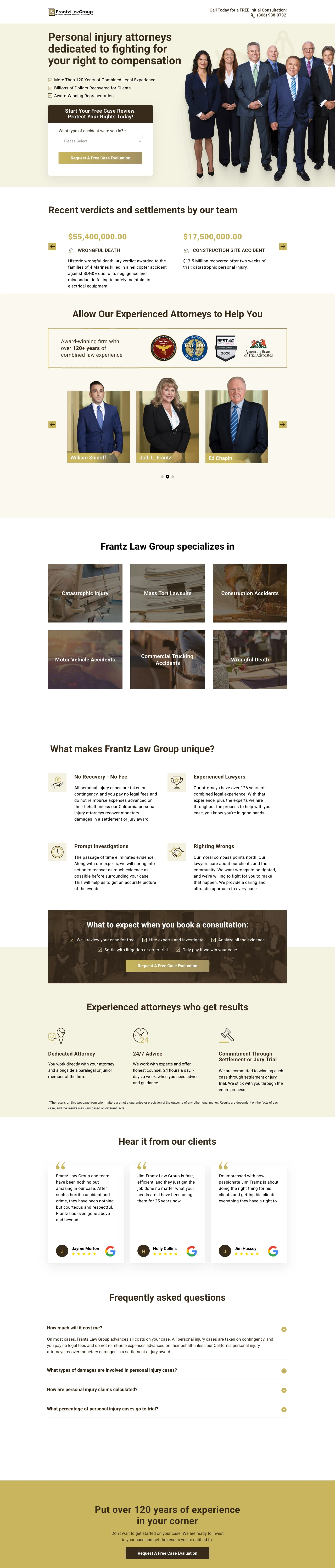
Frantz Law Group start their form with a single question: what sort of accident were you in. No name, no email, nothing else until that is answered, and it is about as small a first step as an injury page can make. The verdicts underneath are printed to the cent, which reads like a court record instead of marketing.
Case type dropdown selector ('What type of accident were you in?') as the first form field before name/phone - leads with the visitor's situation rather than their contact info, which feels consultative rather than salesy.
- +
Whole bench stands in one photograph made personaleasy
A single wide shot of the attorneys standing shoulder to shoulder fills the right half of the hero. It tells a visitor the firm has depth without a word about depth. Get your team in front of a camera on a Friday afternoon and use that instead.
- +
Verdicts keep their trailing zeroes exact numbersone afternoon
Historic wrongful death jury verdict awarded to the families of 4 Marines killed in a helicopter accidentThe verdicts carry their trailing zeroes and their decimal places, with the case type under them and a sentence under that. A rounded number looks like marketing and an exact one looks like a court record. Print yours the way the judgment printed them.
- +
Page answers the awkward questions answers a worryeasy
How much will it cost me?How much will it cost me, what damages can I claim, how are these worked out, what share of cases actually go to trial. Those are the things people search after a crash, answered on the page they landed on. Write down what your intake team hears and answer it.
- ✕
Palette points at the wrong word design tonea design call
Cream and warm brown, tasteful, and the section heading over the verdicts is bigger and darker than the verdicts themselves. The figures are gold on white, the lightest thing in view, so the eye lands on the word Recent. Your palette should point at the number.
- ✕
Combined years disagree with themselves soft proofeasy
Our attorneys have over 126 years of combined legal experience.Adding up experience is arithmetic. Combined totals are easy for any firm with enough lawyers, and this page disagrees with itself: the hero tick and the badge strip give one figure and the paragraph gives another. Name an attorney and let the reader add up.
- ✕
Header number falls under readable size call pathone line
Call Today for a FREE Initial Consultation:The invitation to ring sits in the header at a size that measures under the readable bar, and the hero itself offers only the dropdown. Somebody calling from the roadside will not pick an accident type from a list. Set the number in type you can read at arm's length.
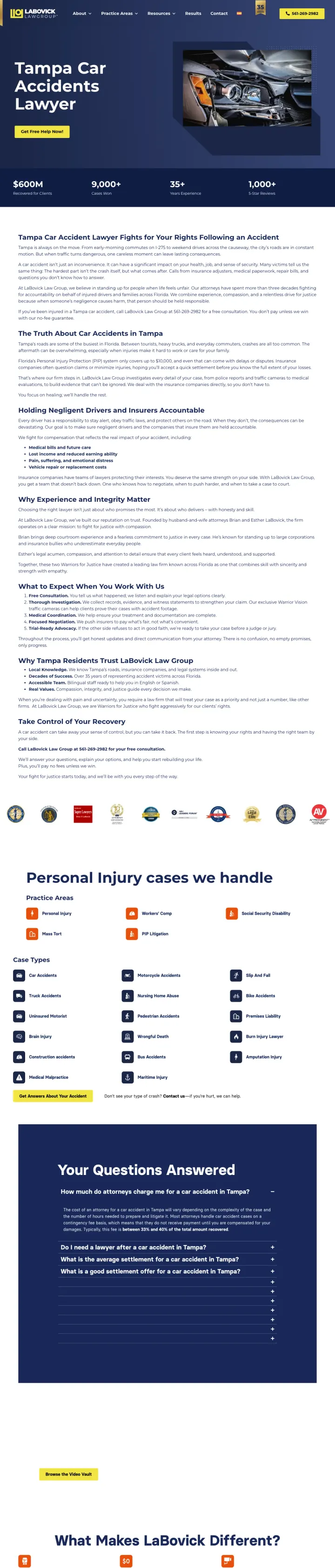
LaBovick have something no rival in Tampa can claim, access to the traffic cameras in the area, and they keep it in a block near the bottom of the page. What the first screen gets instead is a stats bar under the hero answering how much, how many, how long and who says so, all in a single strip. Then the page turns into a long read about Florida insurance law, which is the opposite of what somebody in pain wants.
FAQ section specifically about Tampa car accidents ('The Truth About Car Accidents in Tampa') with local statistics and Florida-specific legal information - creates hyper-local relevance that national firms cannot replicate.
- +
Four numbers answer four questions proof at a glanceone afternoon
Recovered for ClientsMoney recovered, cases won, years in business and five-star reviews, sitting in a single navy band straight under the hero. Between them they answer how much, how many, how long and who says so. Pick your own four and put them where nobody has to scroll.
- +
Firm pulls its own camera footage nobody else has ithard to earn
We provide proof when it matters.This firm says it can pull footage from the traffic cameras in the area, and it is the only thing on the page a rival cannot repeat. Evidence disappears within days. Find the thing your firm does that the firm down the road does not, and lead with it.
- +
Page names the roads people drive local proofone afternoon
Tampa is always on the move.The page explains what personal injury protection covers in Florida and where it runs out, and it names the interstate and the causeway people actually drive on. A national template cannot do that. Write up the part of your state's law that costs your clients money.
- ✕
Hero photograph could be anywhere local proofeasy
Everything else here is Tampa and the picture is a close-up of a smashed headlight and bumper that could be anywhere on earth. The photograph is the first thing a visitor processes. Shoot a real junction in your own city and put that in the hero.
- ✕
Seven headings run with no button too much at onceone afternoon
The Truth About Car Accidents in TampaSolid prose under seven headings about traffic, insurers and the firm's values sits between the reader and the next thing to do, with no button in the run. Somebody in pain skims and leaves. Break the blocks into scannable headings and repeat the way to get in touch.
- ✕
Founders appear a long way down made personaleasy
The stats and the headline are up there, the people are not. Both founders are named a long way down, in the middle of a paragraph, and they are the reason to pick this firm over a call centre. Put a face and a name where the visitor first looks.
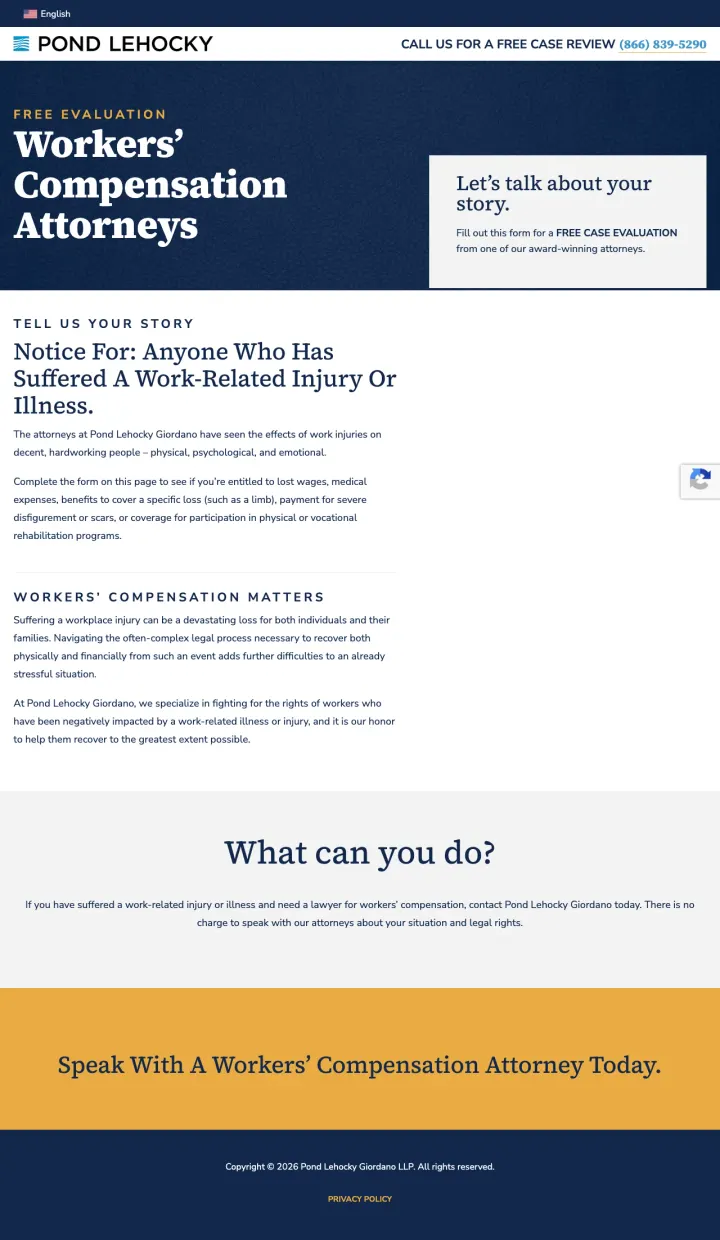
Pond Lehocky Giordano strip the page back to almost nothing. No menu, no social icons, nothing in the footer but a copyright line and a privacy link, just a workers' compensation headline, a notice and an invitation to tell your story. It is the most disciplined page in this file, and it shows no case results at all, which is a strange thing to leave out when your reader is deciding whether a lawyer is worth the trouble.
Class-action-style notice framing ('Notice For: Anyone who has suffered a work-related injury or illness') makes the visitor feel they might be part of a larger group of victims who should act now - a device borrowed from mass tort advertising.
- +
Panel asks what happened before who you are form copyeasy
Let’s talk about your story.The panel in the hero asks for your story, and the section under it repeats the words as its kicker, where almost every rival would have written Contact Us. An injured worker has spent weeks being treated as a claim number. Asking for the story costs you a heading.
- +
Cleanest page in the file focuseasy
TELL US YOUR STORYNo menu, no social icons, and a footer holding a copyright line and a privacy link. It is the cleanest page in this file and the discipline is the whole point. Strip your own ad page back until the only links left are the ones that make you money.
- +
Language switch rides above the logo makes it easierone afternoon
A language control sits in the bar above the logo and takes up almost no room. Work injuries fall heavily on people whose first language is not English, and a form in the wrong language never gets filed. If your ads run where Spanish is spoken, translate the page.
- ✕
Not one settlement figure appears proofhard to earn
There is no settlement figure anywhere on this page. A worker weighing up whether a lawyer is worth the trouble wants to see that other workers got paid, and this page asks them to take it on faith. Even a handful of anonymised outcomes beats award-winning attorneys.
- ✕
No lawyer appears on the page made personaleasy
Notice For: Anyone who has suffered a work-related injury or illness.The page reads like a legal notice, which is what its own heading calls it, and no lawyer appears on it anywhere. Somebody handing over the story of the day they got hurt wants to know who reads it. Put that attorney at the top, with a photograph.
- ✕
Closing band offers nothing to press call pathone line
The gold band at the foot tells the reader to speak with a workers' compensation attorney today, gives that line the full width of the screen, then offers no button, no number and no link. The only number is up in the header. Put the way to act beside it.
What the injury winners keep doing
Wildcards
Pages that break the playbook in interesting ways
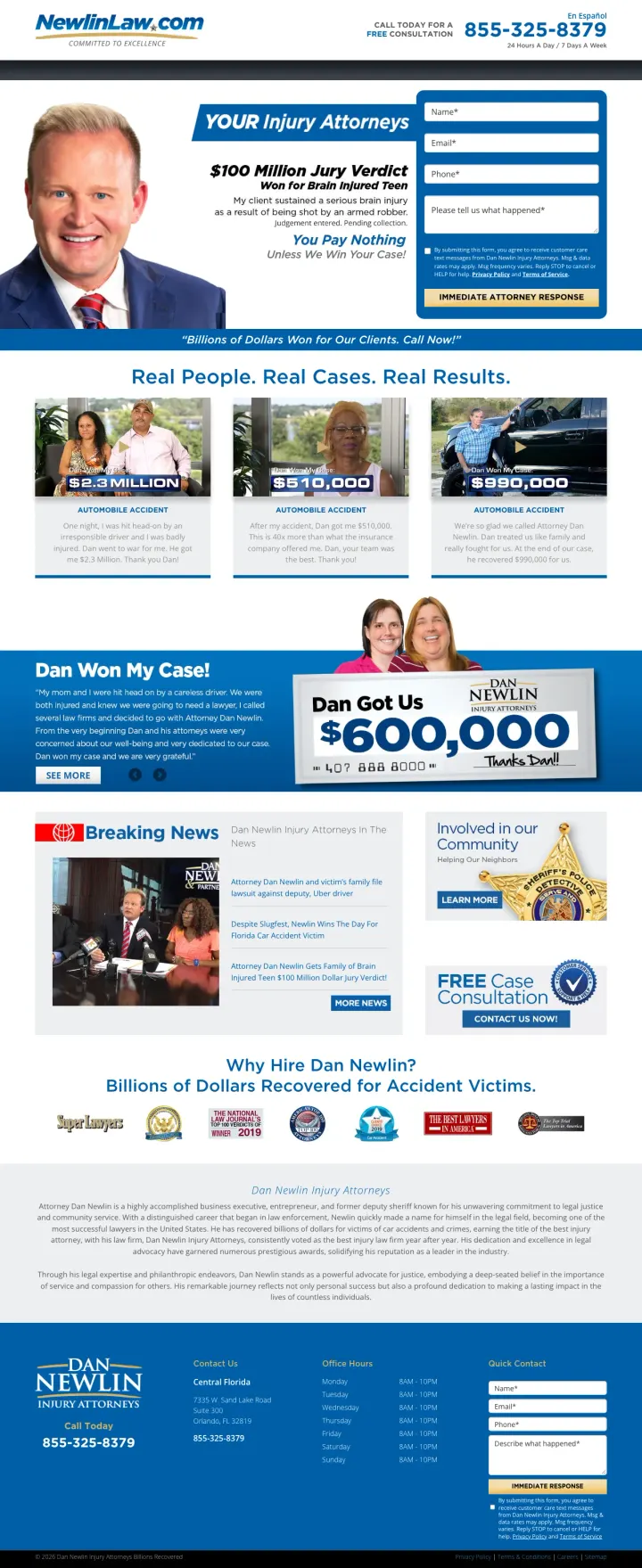
Why this breaks the rules: The page looks like a late-night TV infomercial - oversized attorney headshot, bold blue and yellow, all-caps 'WINNING BILLIONS' - which should undercut credibility for a high-stakes legal decision. But 15,000+ five star reviews and a 99.5% success rate overwhelm any design objection by sheer weight of numbers.
- fewer steps
'In a Wreck and Need a Check? CALL NOW!' tagline is deliberately informal and almost comedic - but for a ready-to-book visitor persona in crisis mode, this casual push to call cuts through the legal jargon that every competitor uses and feels accessible rather than intimidating
- reviews
Individual client testimonials with names, star ratings, and case outcomes ('Dan Won My Case! $1.4 Million') combine a named real person, a verdict amount, and an emotional endorsement in a single testimonial card
- reviews
Settlement amounts displayed as individual cards with photos ($8.5M, $850K, $890K, $875K) each with a case description visible - not just numbers but mini case studies
- too much at once
The page is extremely long with repeating CTAs and content sections that feel like a direct-response sales letter - visitors who are not the ready-to-book visitor may find the aggressive tone off-putting
- wrong promise
Multiple overlapping font sizes and bold text create visual chaos - the page tries to emphasize everything, which means nothing stands out
- extra steps
Form placeholder text ('Please tell us what happened*') is the only content prompt - a case type dropdown or checkboxes would be quicker than typing into a blank box and would improve lead quality
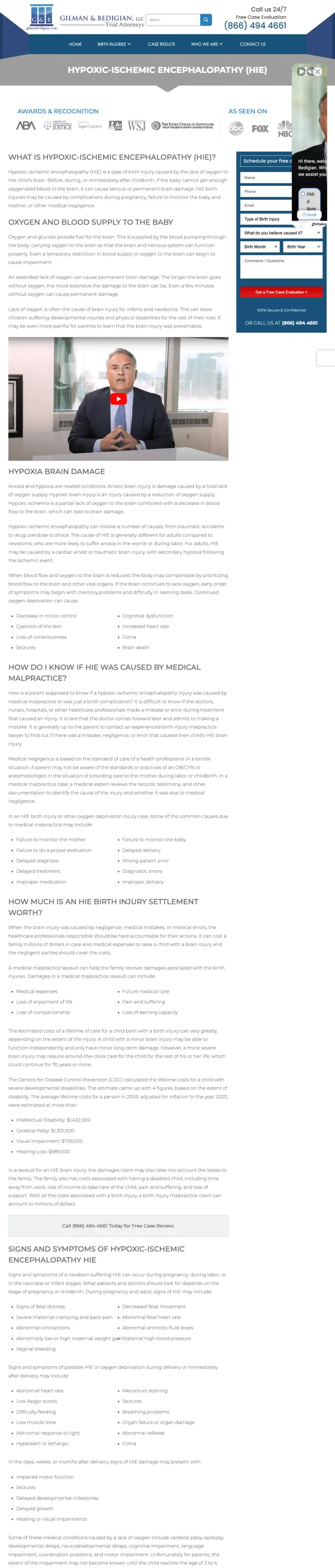
Why this breaks the rules: This page is extremely long and content-heavy - normally a loser pattern in PI. But for birth injury (specifically HIE), the visitor is a parent desperately researching a terrifying medical condition. The medical depth IS the proof, because it shows the firm understands the specific injury, not just personal injury in general.
- credentials
Condition-specific subdomain (philadelphiabirthinjuries.gilmanbedigian.com) creates the impression of an entire website dedicated to birth injuries - the visitor feels they found a specialist, not a generalist
- made personal
Quiz-style intake chatbot asking 'What do you believe caused it?' with options (Child Birth Injury, Wrongful Death) qualifies leads by medical context rather than legal context - speaking the parent's language rather than lawyer language
- exact numbers
Settlement amounts specific to birth injury cases ($1.4M, $1.3M, $799K, $589K) with the condition name let parents see what HIE cases specifically have settled for - not generic PI results but their exact situation
- wrong promise
Awards & Recognition strip appears before any empathetic content - a parent of an injured newborn needs emotional validation before they care about ABA memberships and WSJ features
- too much at once
The page is extremely long with detailed medical content about oxygen deprivation, brain damage, and neonatal complications - while appropriate for the audience, the sheer volume may overwhelm a parent who is already emotionally devastated
- wrong promise
Chat widget video (attorney talking head) auto-plays and covers a significant portion of the page content - disruptive for a visitor trying to read about their child's condition
Compare the winners
The same questions asked of every winner, so you can find the row that matches the searches you are already paying for.
| Page | Entry path | Phone in the first screen | Rating before the scroll | Credential you can check | Standout move |
|---|---|---|---|---|---|
| #1Isaacs & Isaacs | Form beside the tick list | Tiny | Yes | First screen | Google score above the headline |
| #2Morgan & Morgan | Form beside the headline | Yes | No | None | Insurer's offer drawn against the verdict |
| #3Gilman & Bedigian | Form under the hero | Yes | No | Footer only | Every result tagged by injury type |
| #4Arnold & Itkin | Form in the right rail | Tiny | No | None | A wall of record verdicts |
| #5Anidjar & Levine | Short form in the hero | Yes | No | Footer only | Team crests instead of award seals |
| #6Steinger, Greene & Feiner | Call button, no form | Yes | No | None | A settlements row under the hero |
| #7McMahan Law Firm | One question, then Submit | Yes | Yes | First screen | The Google score, in the first screen |
| #8Frantz Law Group | Accident type dropdown | Tiny | No | None | Verdicts printed to the cent |
| #9LaBovick Law Group | Get free help link | Tiny | Yes | None | Traffic camera footage on offer |
| #10Pond Lehocky Giordano | A story panel, no menu | Yes | No | None | Tell us your story, not contact us |
Match the row to the search you are buying. Somebody typing a firm name and a city at two in the morning is frightened and wants a human, so the header does the selling and a big readable number closes it. Somebody typing what is my claim worth is still comparing, and results tagged with the accident type plus a review count beats any amount of copy about how hard you fight. You paid the same for both of those clicks.
The copy bank
Lines lifted word for word off the pages above. We say whose page each one came from, and one click copies it.
Get Free Help Now!
Personal injury attorneys dedicated to fighting for your right to compensation
Awards & Recognition
Speak with a workers’ compensation attorney today.
Award-Winning Representation
Losers
3 pages burning ad spend with fundamental issues
Every click to these pages costs real money. We found missing proof, mismatched intent, weak CTAs, and messaging that ignores what the searcher actually typed. Here is what to avoid.
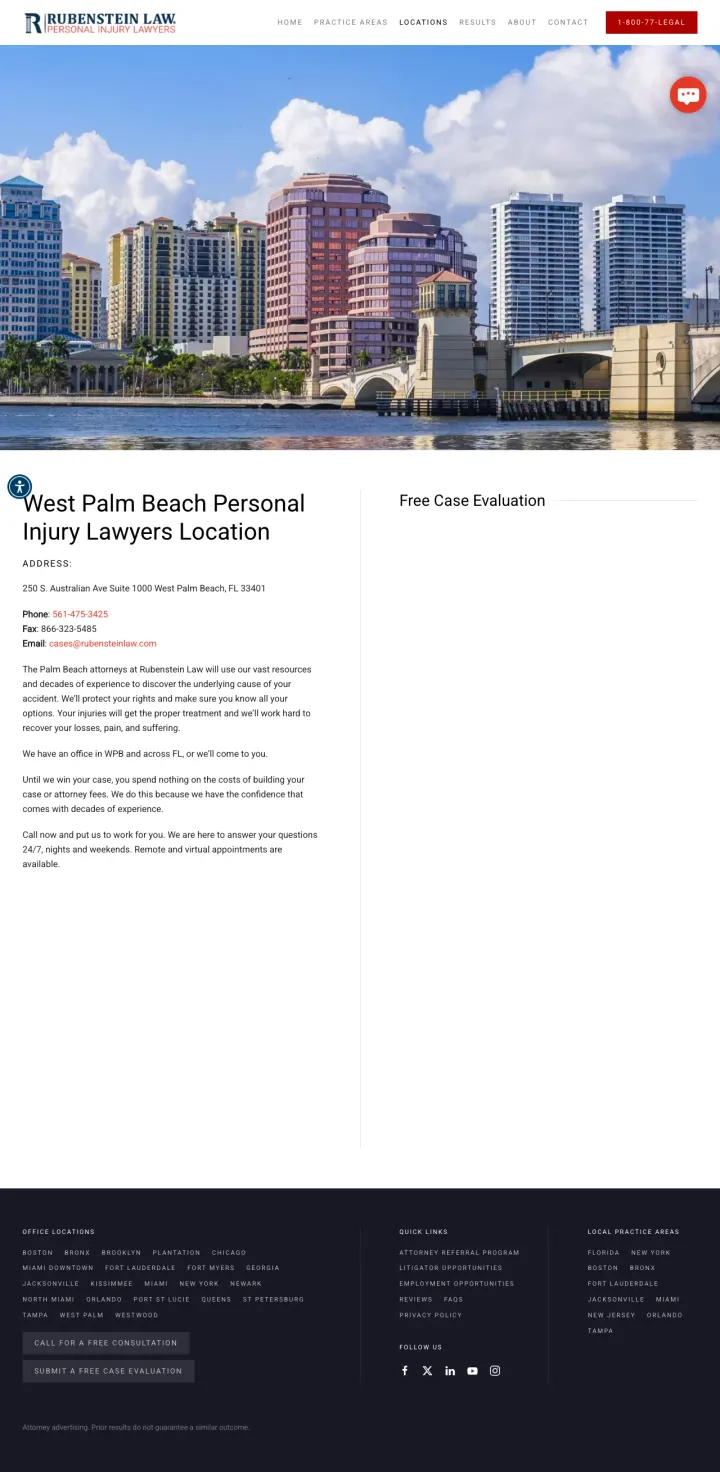
Ad says 'Rubenstein Law - Hurt or Injured? Billions in Client Settlements' but the landing page is a location office page with a giant skyline photo of West Palm Beach, an address, and two paragraphs of boilerplate text. No settlement figures (despite claiming 'Billions'), no attorney photos, no case types. At PI CPCs, each click pays for a Google Maps pin with extra words.
- looks off
Hero image is a city skyline photo of West Palm Beach that occupies 60% of the above-fold viewport - a paid visitor searching for a personal injury lawyer sees a tourism photo instead of settlement amounts, attorney faces, or a form
- no proof
Ad claims 'Billions in Client Settlements' but the landing page shows zero dollar figures - the biggest claim in the ad never appears on the page
- wrong promise
Full website navigation (Home, Practice Areas, Locations, Results, About, Contact) with 6 exit paths on a page that already has minimal conversion architecture
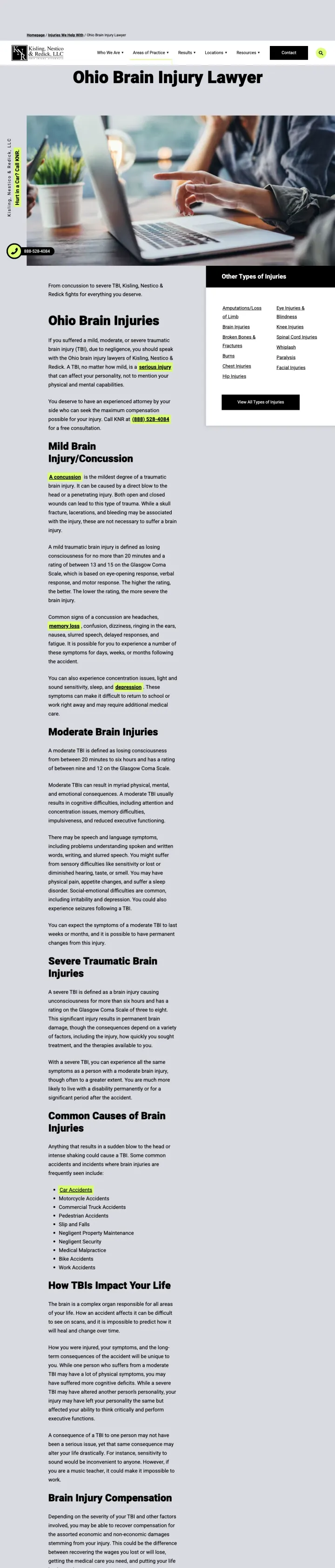
Ad promises 'Legal Help After TBI - Max compensation, max compassion. No fees unless we win' but the landing page is a 2,000+ word medical education article about brain injury classifications (mild, moderate, severe TBI), the Glasgow Coma Scale, and diffuse axonal injury pathology. No settlement figures, no case results, no form. The page reads like a neurology textbook at $100+ per click.
- extra steps
No form anywhere on the page - the only conversion path is a phone number in a floating sidebar button. For a brain injury victim who may have cognitive difficulties, asking them to make a phone call rather than fill out a simple form creates an unnecessary barrier
- wrong promise
2,000+ words of medical content about TBI classifications (Glasgow Coma Scale ratings, diffuse axonal injury, subdural hematomas) serves the wrong audience - the visitor searched for a lawyer, not a medical reference
- wrong promise
'Other Types of Injuries' sidebar links (Amputations, Eye Injuries, Knee Injuries, Spinal Cord Injuries) create exit paths to other practice area pages, pulling the visitor's attention away instead of getting them to contact the firm
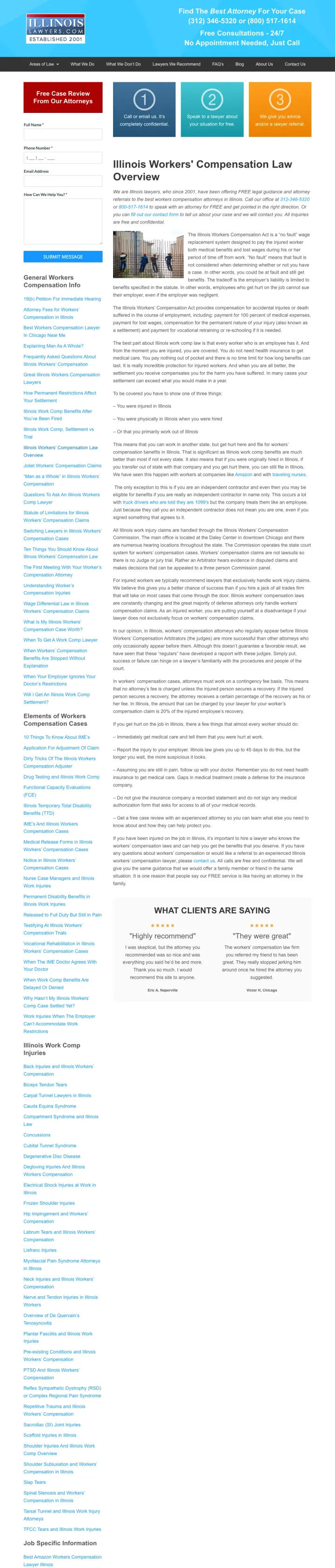
Ad promises 'Need a Workers Comp Attorney? No Fee Unless You Win. Talk to a lawyer for free' but the page is a comprehensive legal overview of Illinois Workers' Compensation Act, covering benefit calculations, employer obligations, and legal procedures. The form exists but is overshadowed by thousands of words of legal content. At workers' comp CPCs, each click subsidizes a law school textbook.
- wrong promise
The page is a legal encyclopedia: 'Illinois Workers Compensation Act is a no fault wage replacement system designed to pay the injured worker both medical benefits and lost wages' - this reads like a law school casebook, not a landing page for an injured worker who just wants help
- wrong promise
No settlement amounts, no case results, no success metrics anywhere - the page says '300,000+ Cases Since 2001' in the ad but never shows what those cases were worth
- looks off
Construction site stock photo next to walls of text creates an educational resource feel rather than an actionable landing page - an injured worker needs empathy and a phone number, not a legal primer
What we learned
Settlement dollar figures in the hero are the single strongest trust differentiator
The top-performing pages lead with specific dollar amounts recovered - not vague claims but exact figures like '$8 Billion Won' or '$800 Million Recovered.' This matters because PI searchers are fundamentally asking 'how much is my case worth?' and seeing big numbers immediately answers that question. Pages that lead with empathy language but no numbers consistently underperform pages that lead with numbers then add empathy.
Chatbot case-type selectors outperform static forms for intake qualification
Three of the strongest pages use intelligent chat widgets that ask 'What kind of case?' with clickable options (Car Accident, Truck Accident, Slip & Fall) instead of or alongside traditional forms. This converts the intake form from a chore into a conversation, and immediately routes the visitor to the right specialist - critical because PI encompasses dozens of case types and a truck accident victim needs to feel their specific situation is understood.
Dual conversion paths (phone + form) capture both crisis and research visitors
12 of 16 relevant pages offer both a prominent phone number and a form. The pages that do this best make the phone number feel urgent (24/7, click-to-call) and the form feel safe ('Free Case Review' vs 'Contact Us'). Pages with only phone or only form are leaving money on the table because PI visitors split roughly 50/50 between crisis callers (ready-to-book visitor, calling from the accident scene) and researchers (comparison-stage visitor, comparing firms from their couch).
7 of 16 pages use full site navigation instead of isolated landing pages
Nearly half of pages reviewed include full website navigation menus. At $100-$1,000+ per click, every nav link is an exit path that wastes ad spend. The strongest performers (wewin.com, forthepeople.com, arnolditkin.com) strip navigation entirely and create focused conversion funnels.
Winners lead with specific dollar figures recovered, named attorneys with photos, and intake forms or chatbots above the fold on stripped-down landing pages with no site navigation. Losers send $100-$1,000+ clicks to team photo galleries, location stub pages, or educational content articles that answer legal questions without providing any conversion path.
If you're building a page like these yourself, here's my comparison of AI landing page builders, with prices and what each one is best for.
Every page above is fed by a campaign spending serious money. If you want both halves handled - the pages and the bidding - our team manages PPC for law firms.
What the injury winners taught us
Injury clicks are among the dearest words anyone buys, and most of these pages spend the first screen on adjectives. The ones that win spend it on a readable phone number, a result the visitor can measure against their own accident, and a promise about what it costs to ring. The losers open with how hard they fight, which is the one thing every competitor is also saying.
- 1
Print a phone number you can read from arm's length. Every page in this file gets a number into the first screen, and several of them set it in type so small it reads as a utility bar. A person calling from the hard shoulder with a cracked screen and a shaking hand is not going to squint. Make it the second biggest thing on the page after the headline, and make it a tap target on a phone.
- 2
Put a review count where the money decision happens. Only a handful of these pages show a rating before anyone scrolls, and they are the firms that clearly ask every client for one. The stars take up no room. Every injury firm in your city is claiming to be top rated, and the one with a live Google score beside the claim is the one a stranger believes.
- 3
Sort your case results by accident type. A single firm total makes the visitor do the maths on whether you have handled anything like their crash. The winners here split the results by truck, car, motorcycle, dog bite and birth injury, with a figure on each. Somebody hit by a semi scans for the semi row and stops there, and that is the moment they decide to call.
- 4
Shut the chat widget until they have scrolled. A chat panel opens itself over the hero on almost half the pages in this file, covering the form, the submit button or a third of the screen. You paid for the click and then hid the thing the click was for. Set the widget to appear on scroll or on exit, and check what it covers on a laptop screen before you call the page done.
Score your own injury page
Every line below came off a screenshot somebody sat and read. Open your own page beside it and tick what it already does.
Now point postclick at your page
wewin.com runs a settlement ticker down its landing page: $8M Big Truck, $2.7M Car Accident, $1.47M Motorcycle. Someone who just got rear-ended scrolls until they find their own accident and the number it paid. We read 43 of these pages against the ads paying for the clicks. 10 held up. Nobody's read yours like that yet. Postclick names what's costing you the call, draws new versions as real images, and builds the one you pick as HTML you own.