

These are real staffing / recruitment pages spending actual money on Google Ads right now.
From real staffing / recruitment Google Ads campaigns in the US
The landing pages actually worth stealing from
So you know exactly what to avoid

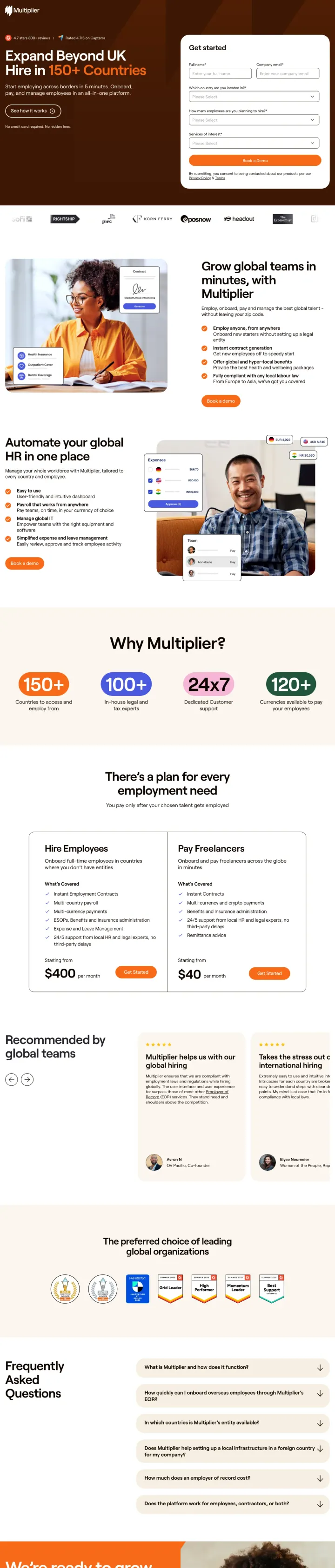
Why This Breaks the Rules: Traditional staffing pages sell access to candidates. Multiplier sells the legal infrastructure to employ people you have already found. The visitor does not need help finding talent -- they need help employing them compliantly in another country. This flips the staffing value proposition from 'we find people' to 'we handle the paperwork so you can hire anyone, anywhere.'
'Start employing across borders in 5 minutes' combines a speed claim with a scope claim -- 5 minutes is specific enough to be credible while 'across borders' signals global reach, and together they promise that international hiring is no harder than domestic hiring
Transparent pricing with two tiers ($400/employee, $40/freelancer) plus 'No credit card required. No hidden fees.' addresses every pricing objection in one section -- the visitor can immediately calculate their cost (10 employees = $4K/month) without talking to sales
Client logos (PwC, Korn Ferry, The Economist, SoFi) provide instant enterprise credibility -- these are not 'best of staffing' badges, they are named clients that any HR professional recognizes, making the 'trusted by global teams' claim verifiable
The form has a massive country dropdown with 200+ options and required fields for 'How many employees' and 'Services of interest' -- this qualification depth is appropriate for their sales process but adds friction for a visitor who just wants to understand whether Multiplier operates in one specific country
118 links on a paid landing page, including full footer navigation (Products, Solutions, Resources, Company, Partners, Strategic Partners). At enterprise EOR CPCs, every footer link is an exit path that bleeds a qualified lead to a research session.
Named testimonials (Fadilah Ibrahim, Avron N, Elyse Neumeier, Chiaki Iwata, Dinky Valerio) are all from small/mid-market companies that most visitors will not recognize -- the PwC and Korn Ferry logos suggest enterprise clients but the testimonials suggest startup adoption, creating a credibility mismatch

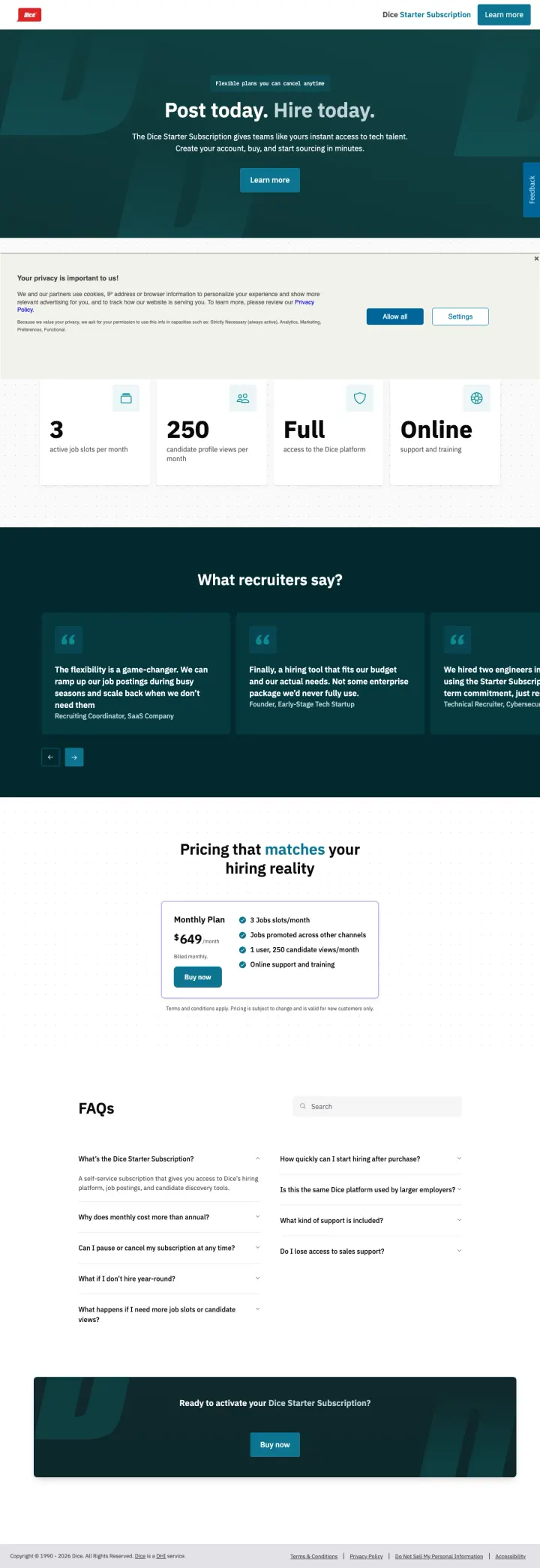
Why This Breaks the Rules: Every other staffing page in this set uses a consultation form to generate a sales-qualified lead. Dice skips the entire sales process with a 'Buy now' button at $649/month -- no demo request, no callback, no 'tell us about your needs.' This works because their target buyer (startup/SMB hiring 1-3 tech roles) actively wants to avoid talking to a sales rep.
'Post today. Hire today.' is the shortest, most direct headline in the entire staffing set -- it makes a same-day promise in four words, which is bold enough to be memorable and specific enough to be testable
Transparent pricing ($649/month) with clear scope (3 job slots, 250 candidate views, 1 user) eliminates the 'call for pricing' friction that kills self-serve buyers -- showing what you get for the money is radical transparency in an industry that hides fees behind sales calls
Recruiter testimonials with specific outcomes ('We hired two engineers in three weeks using the Starter Subscription') from named roles and companies (Technical Recruiter, Cybersecurity Firm / VP, VS Consulting) provide credible proof without requiring client logos
The 'Buy now' button goes directly to a registration/payment page with no intermediate step -- this is ideal for the self-serve buyer but terrifying for the 60%+ of staffing visitors who want to evaluate before committing money
No form, no phone number, no demo request option -- visitors who are interested but not ready to buy $649/month have zero way to engage with Dice other than purchasing, which means the page captures only the bottom-of-funnel buyers
The FAQ section answers 9 questions that are all variations of 'is this product right for me?' rather than showing what the platform actually looks like -- no screenshots, no video tour, no preview of the candidate search experience

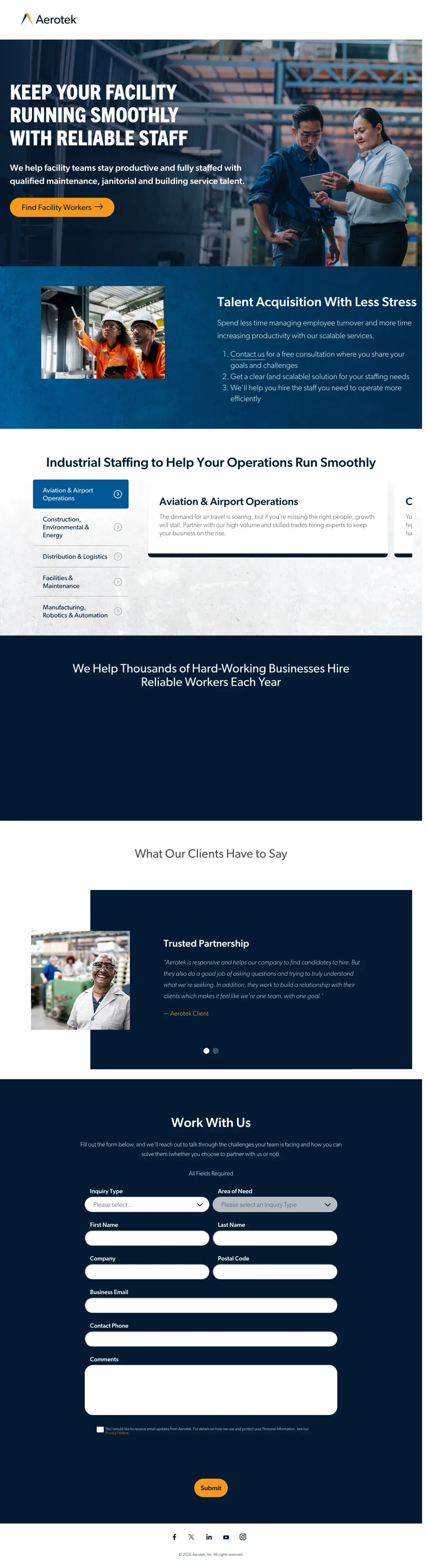
Break your staffing process into a numbered 3-step sequence visible above the fold: '1. Contact us for a free consultation, 2. Get a clear solution, 3. We help you hire.' Numbered steps reduce perceived complexity for a first-time staffing buyer who has never engaged an agency before.
The 3-step process (Contact us > Get a solution > Hire staff) is visible in the second viewport and reframes what could be an intimidating B2B sales process into something that feels as simple as ordering a service -- this matters because many facility managers have never used a staffing agency before
Industry carousel with 5 vertical tabs (Aviation, Construction, Distribution, Facilities, Manufacturing) lets the visitor self-select their sector and see role-specific copy -- this single component does the work of 5 separate landing pages while keeping the form unified
Scale stats (200+ offices, 1,500+ clients, 6,000+ contractors) appear mid-page in a dark blue banner that visually separates the sales content from the proof section -- the placement matters because by this point the visitor has already seen the process and verticals, so the stats confirm rather than lead
The form is buried at the very bottom of the page below testimonials, stats, and industry tabs -- a visitor who arrives ready to submit a request has to scroll past everything to find the conversion path, wasting their intent
Both client testimonials are attributed to 'Aerotek Client' with no name, title, or company -- anonymous testimonials in B2B staffing carry almost zero credibility because the visitor assumes they are fabricated
The hero headline 'Keep Your Facility Running Smoothly With Reliable Staff' targets facility management but the ad was triggered by 'staffing agencies in fort lauderdale' -- a geo-specific search landing on a non-geo page creates a location relevance gap

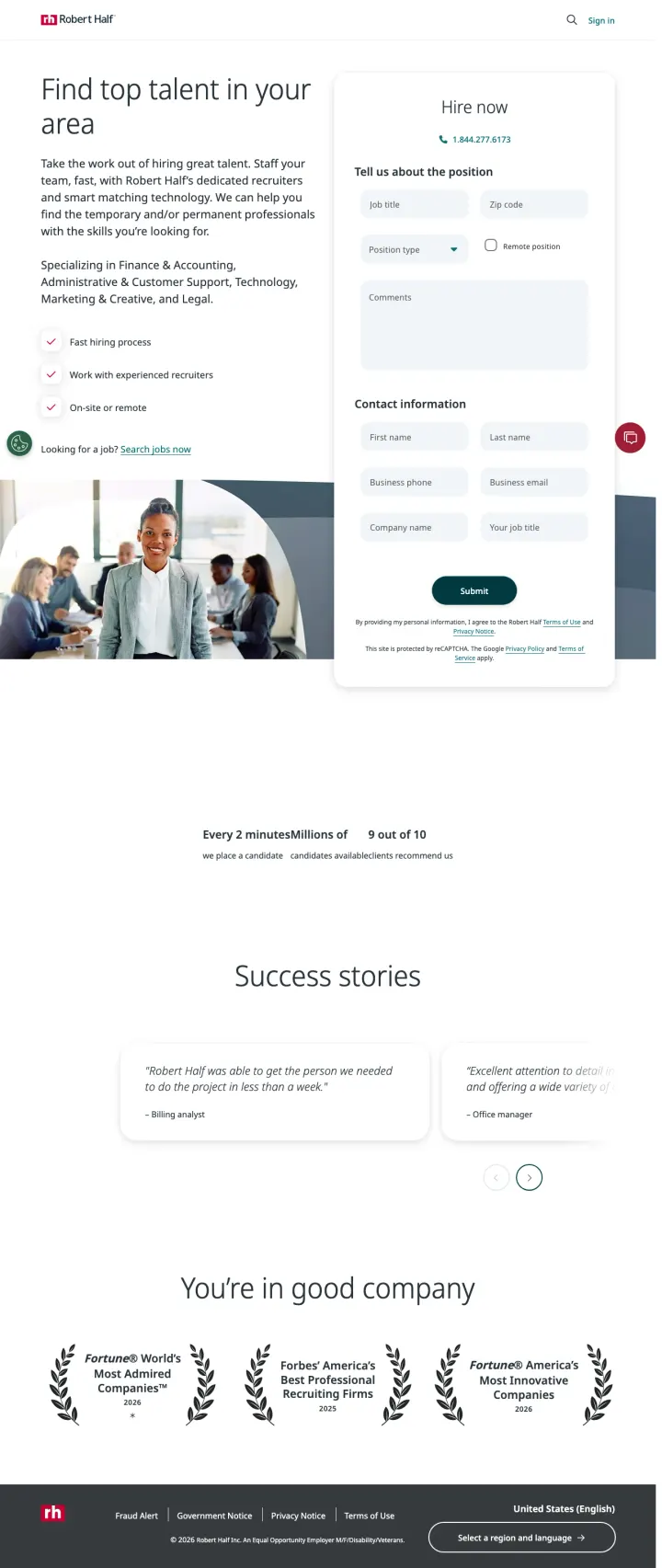
Show a multi-field form (position type, city, state) above the fold so the visitor starts describing their need before they finish reading. The act of selecting 'Finance & Accounting' from a dropdown creates commitment momentum that carries through to form submission.
'Find top talent in your area' headline with a city/state form field immediately localizes the experience -- a hiring manager in Houston sees this page will find them Houston candidates, not generic national talent
Fortune 'World's Most Admired Companies,' Forbes 'America's Best Professional Recruiting Firms,' and Forbes 'America's Most Innovative Companies' badges create a triple-credentialed trust bar that no competitor across the pages reviewed matches
'Every 2 minutes' placement velocity stat and '9 out of 10' client satisfaction rate above the fold give quantified proof of operational speed and quality
The form asks for position type, city, and state before asking for any contact information -- a visitor who fills these fields then sees additional contact fields may feel bait-and-switched by the progressive disclosure
Success stories section uses generic two-line quotes without company names, industries, or specific outcomes -- after the strength of the Fortune/Forbes badges, the testimonials feel thin
'Looking for a job?' link in the hero area creates an exit path for job seekers who clicked the employer-facing ad, splitting the audience at the point of conversion

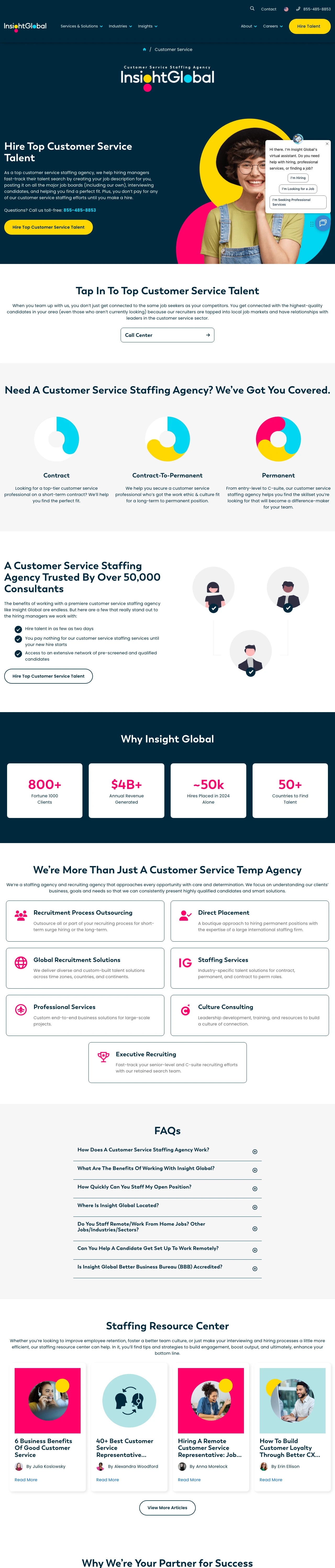
Lead with your strongest risk-reversal statement above the fold: 'You don't pay for any of our staffing efforts until you make a hire' eliminates the biggest objection a hiring manager has about engaging a staffing agency.
'Hire in as few as two days' paired with 'you don't pay until you make a hire' stacks speed and risk-reversal into two sentences -- this addresses the #1 concern (how fast) and #4 concern (what does it cost) from the buyer's mental checklist simultaneously
Toll-free phone number (855-485-8853) is visible above the fold next to the headline, not buried in a footer -- for the Red-dominant staffing buyer who has an open role right now, a visible phone number IS the conversion path
Stats section (800+ Fortune 1000 clients, $4B+ revenue, ~50K hires in 2024, 50+ countries) provides institutional scale proof that a hiring manager can use to justify the vendor choice to their boss -- this is not vanity, it is ammunition for internal buy-in
The form opens as a modal overlay with a multi-step wizard (employer vs job seeker, type of hire, number of openings) that adds friction for a visitor who just wants to say 'I need someone' -- a 3-field inline form would convert more of the impulse inquiries
19 navigation links in the header provide extensive exit paths for a page that should funnel toward one action -- every nav link is a paid click leaking to an organic page
Anonymous 'Aerotek Client' style testimonials appear nowhere; instead the page has no named client testimonials at all -- for a $4B company placing 50K hires, the absence of a single named hiring manager quote is conspicuous

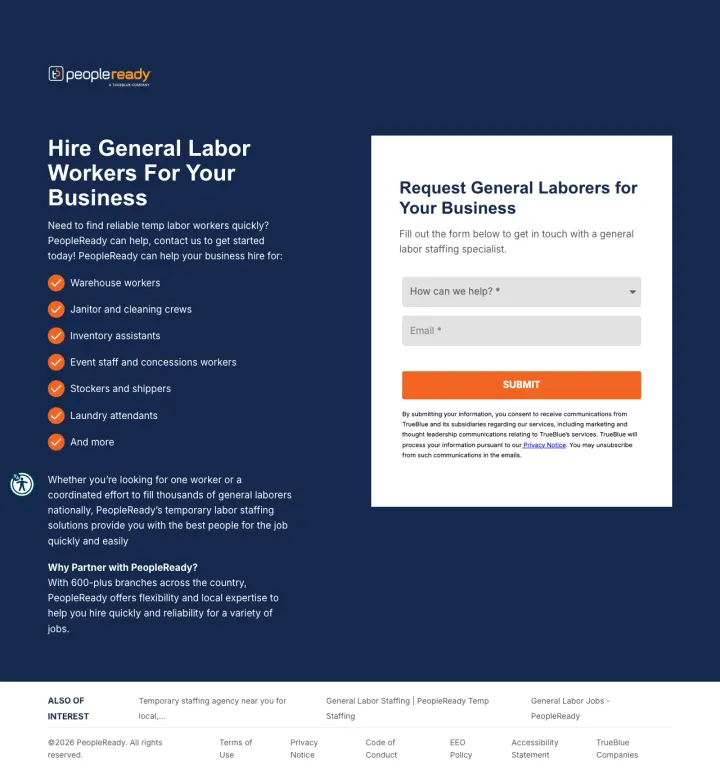
For blue-collar staffing, reduce your form to the absolute minimum (dropdown + email). The hiring manager at a warehouse does not have time for an 8-field form -- they need workers today and will call if the form feels too long.
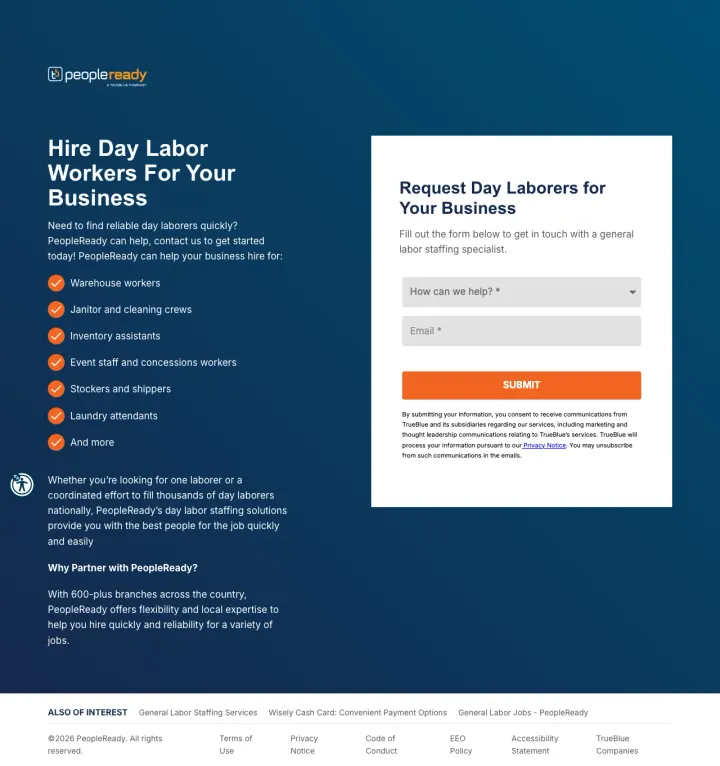
'Hire General Labor Workers For Your Business' headline is an exact keyword match for day labor and general labor searches -- no cleverness, no abstraction, just the thing the visitor searched for
Two-field form (dropdown: 'How can we help?' + email) is the lowest-friction staffing form in this entire swipe file -- it takes 10 seconds to complete, which matches the urgency of a hiring manager who needs workers tomorrow
Role checklist (warehouse workers, janitor crews, inventory assistants, event staff, stockers, laundry attendants) lets the visitor confirm their specific role is covered without reading paragraphs of marketing copy
Almost no trust signals -- no client logos, no placement counts, no review ratings. For a national staffing brand, the absence of scale proof reads as either lazy or small-time, both of which sink a temp-labor buyer's confidence.
'Whether you're looking for one worker or a coordinated effort to fill thousands' is the only scale claim, and it appears below the fold in small text
The dark navy footer takes up nearly a third of the page real estate with links to Terms of Use, Privacy Notice, and corporate compliance pages that no hiring manager will click

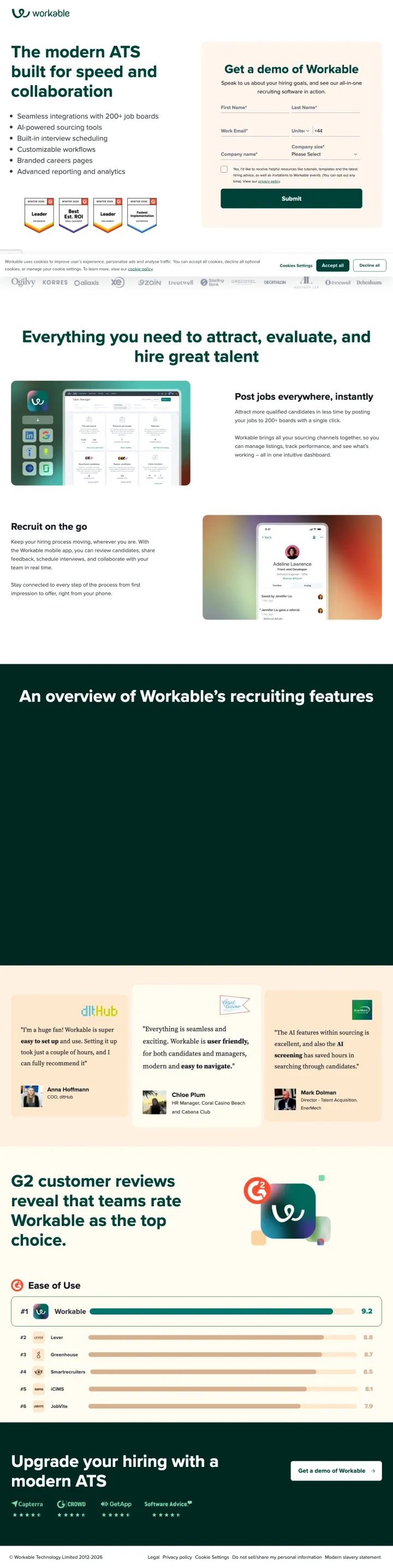
Show a product screenshot with a G2 review summary directly in the hero. The visitor sees what the product looks like AND what peers think about it in the same glance, combining visual proof with social proof.
'The modern ATS built for speed and collaboration' headline names the two things recruiters care about most -- speed (time-to-fill) and collaboration (hiring team alignment) -- in eight words
G2 review section with specific category ratings (Ease of Use, Quality of Support) and comparison statements ('teams rate Workable as the top choice') provides granular peer validation, not just a badge
Product screenshot showing the actual ATS interface (candidate pipeline, job posting view) lets the recruiter mentally try the tool before filling out the demo form
The demo form on the right asks for company size, current ATS, and hiring volume which are strong qualifying fields, but the form headline 'Get a demo of Workable' is generic -- it should reference the ATS-specific keyword that brought the visitor here
200+ job board posting claim appears mid-page but is not quantified further -- a recruiter wants to know if Indeed, LinkedIn, and Glassdoor are included, not just that there are 200+ boards
Three Workable landing page variants (ATS demo, recruiting demo, recruitment software demo) appear to be identical pages with different URLs targeting different keyword clusters -- this is thin content territory
Pages that break the playbook in interesting ways

Add a 'Requested Timeline' dropdown to your form with options like 'Immediate: Within 12 Hours' and 'Urgent: Within 48 Hours' -- this signals that fast turnaround is normal for you while letting the visitor self-select their urgency level.
The form includes a 'Requested Timeline' field with three options: 'Immediate: Within 12 Hours,' 'Urgent: Within 48 Hours,' and 'Future: Outside of 48 Hours' -- this single dropdown communicates speed capability, sets expectations, and qualifies the lead simultaneously without any additional copy
'600-plus branches across the country' with the subhead 'local expertise' addresses the staffing buyer's concern about whether this agency can source talent in THEIR market -- national scale with local execution is the exact positioning that mid-market companies want
The page is a true stripped landing page: no header nav, no footer links, logo + headline + bullet list + form -- this focus discipline is rare in staffing where most pages try to sell every service the company offers
No speed claim in the headline or hero area -- the visitor has to reach the form's 'Requested Timeline' dropdown to discover that 12-hour turnaround is available, which means most visitors will never see the strongest selling point
No client logos, no placement stats, no testimonials -- for a company with 600+ branches, the complete absence of social proof forces the visitor to trust the brand name alone, which only works if they already know PeopleReady
The 'Primary Worker Skill Need' dropdown (General Labor / Skilled Labor / Tradespeople) is useful but the form is 11 fields total including state dropdown and zip -- this length is appropriate for a qualified lead but will lose the impulse 'I need someone today' visitor

Show named recruiter headshots with their specialization areas on your staffing landing page. Hiring managers want to know who will work on their search, not just that 'our team' will help. Named faces with titles convert better than anonymous brand promises.
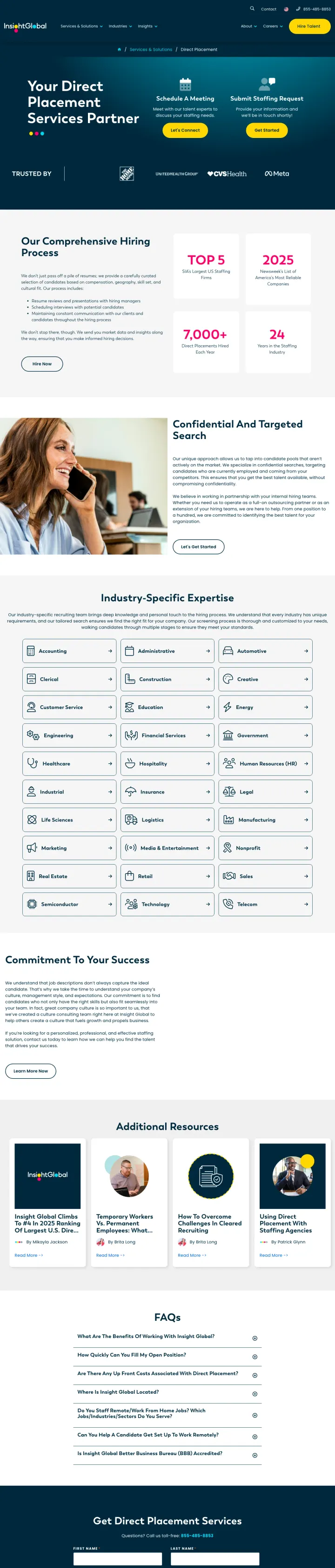
'Your Direct Placement Services Partner' headline immediately qualifies the visitor for perm hiring (not temp staffing), preventing intent mismatch for the 40% of staffing visitors who need permanent hires
Named recruiter headshots with specialization titles (appears to be team members with specific vertical expertise) humanize the staffing firm and signal that the visitor will work with a specialist, not a generalist
Quantified metrics (10K+ placements, 40+ years) above the fold provide scale proof, while the FAQ section addresses common objections (timeline, guarantee, cost structure) that delay conversion
The yellow CTA buttons blend with the warm page palette rather than creating contrast -- a high-urgency staffing page needs a CTA that jumps off the screen
'Additional Resources' section with blog links creates exit paths on a page that should have a single conversion action -- at staffing CPCs, every blog link is an expensive distraction
The page distinguishes 'Direct Placement' from 'Contract' and 'Contract-to-Hire' but does not clearly explain the pricing model for direct placement, which is typically a percentage of first-year salary
3 pages burning ad spend with fundamental issues
Every click to these pages costs real money. We found broken trust signals, mismatched intent, weak CTAs, and messaging that ignores what the searcher actually typed. Here is what to avoid.

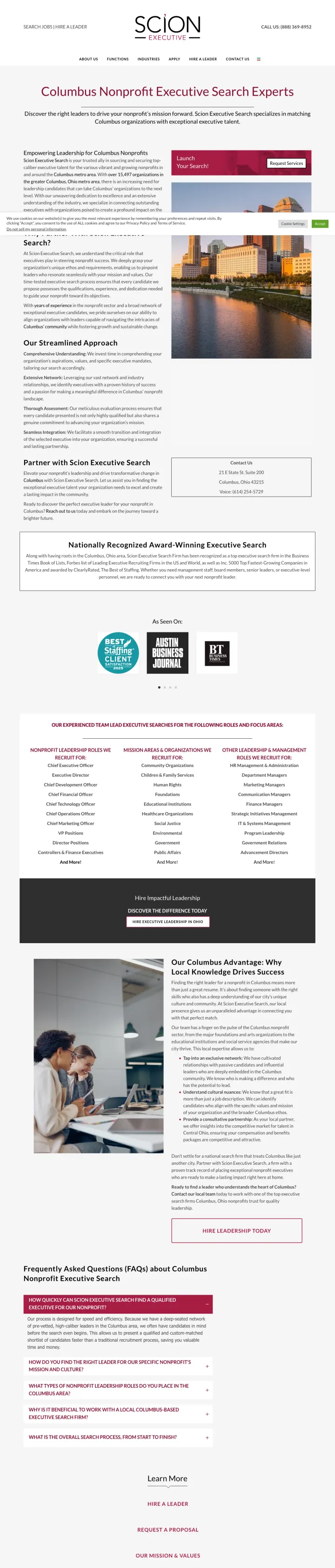
At $20-60 per click for executive search keywords, sending traffic to a full-site content page with no form, no phone number above the fold, and full header navigation is paying for visitors to browse your blog rather than request a consultation.
Full site navigation with 8+ top-level menu items gives the visitor complete freedom to leave the page they paid to reach -- every nav click is a leaked paid click that will never convert
No form anywhere on the visible page -- the visitor who searches 'executive search firms columbus ohio' and lands here has no obvious way to submit their hiring need without hunting for a contact page
Phone number exists only in the header, styled as body text, and competes with navigation elements -- for a visitor ready to call about a $15K-$30K executive placement fee, the phone should be the most visually prominent element on the page

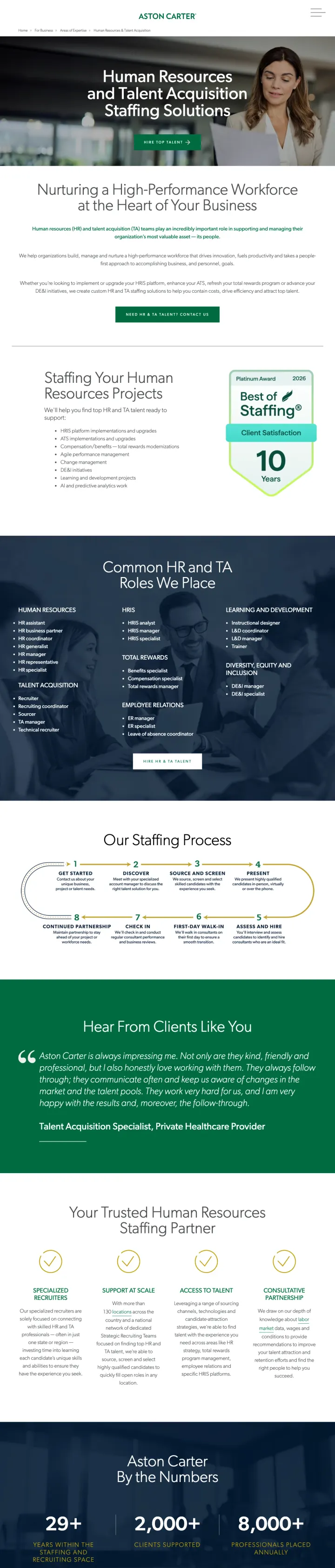
Ads triggered by 'staffing companies in miami' (4,400 sv) send traffic to a page where the contact form requires scrolling past an 8-step process infographic, 30+ role titles, a client testimonial, 4 capability sections, and 3 stat cards. At high-volume spend, the conversion rate loss from this scroll depth is substantial.
The contact form is below 8 major content sections including a full role taxonomy (30+ job titles across 7 categories), an 8-step process infographic, testimonials, and stat cards -- by the time a visitor reaches the form, they have either converted via a competitor or abandoned
The page lists 30+ specific HR/TA job titles across 7 categories (HR, TA, HRIS, Total Rewards, Employee Relations, L&D, DE&I) creating a reference document rather than a conversion page -- this depth serves SEO but punishes PPC visitors who already know what they need
No phone number visible anywhere on the page despite being triggered by local search terms ('staffing companies in miami') -- visitors searching with city-level intent expect a local number and the absence signals 'corporate, not accessible'

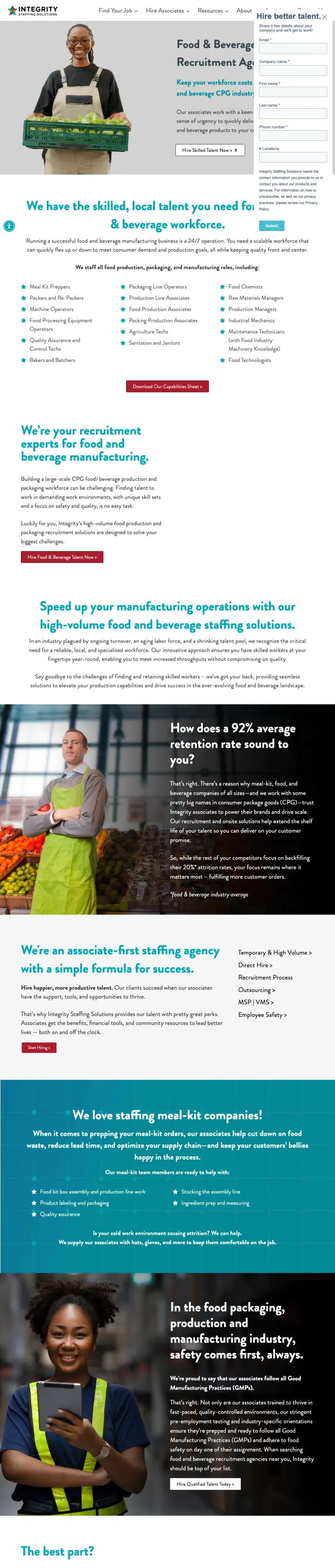
Every CTA on this page ('Hire Skilled Talent Now', 'Hire Food & Beverage Talent Now', 'Build Your Custom Solution Now') links to a separate /contact-us/ page rather than an inline form. At $20+ per click, forcing an additional page load between the visitor's intent and the conversion form loses a measurable percentage of already-qualified traffic.
Zero forms on the entire page -- all 6 CTA buttons link to a separate /contact-us/ page, adding an unnecessary step between intent and conversion for every visitor who already decided to engage
The page is 2,500+ words covering food production, meal kits, grocery, vertical farming, and safety compliance -- this content depth serves organic search but punishes PPC visitors who already searched 'food and beverage staffing agency' and need to submit a request, not read a white paper
No phone number anywhere on the page despite the ad copy mentioning an '8-hour guarantee' -- a visitor who wants to test that guarantee needs to find a phone number that does not exist on the page they landed on
PeopleReady's 2-field form (dropdown + email) is the fastest conversion path in the staffing swipe file, and it works because a warehouse manager needing laborers tomorrow will not fill out 8 fields. Robert Half's progressive form (position type, city, state, then contact info) works for professi...
Robert Half's /hire-finance-accounting page lists 'Accountant, Bookkeeper, CFO, Controller, Financial Analyst, Payroll Specialist' so a hiring manager scanning for 'accounting temps' sees their role in the first 5 seconds. The general /hire page works for brand searches but forces visitors to sel...
Robert Half displays Fortune Most Admired, Forbes Best Professional Recruiting, and Forbes Most Innovative in a triple badge bar. Workable shows G2 category ratings with specific scores. Multiplier shows multiple G2 Leader badges. At the enterprise tier, staffing buyers need proof the vendor has ...
Aerotek leads with '200+ offices, 170,000+ workers, 18,000+ clients.' Insight Global shows '10K+ placements, 40+ years.' Robert Half shows 'every 2 minutes' placement velocity. In staffing, scale equals capability -- a hiring manager with 50 warehouse roles to fill in 3 cities needs to know the a...
Winners put the contact form above the fold (or within 1 scroll) and match form complexity to hiring urgency. Losers bury forms below process diagrams, methodology descriptions, and corporate overview content that hiring managers with urgent roles have no patience to read.