 Our AI Tools
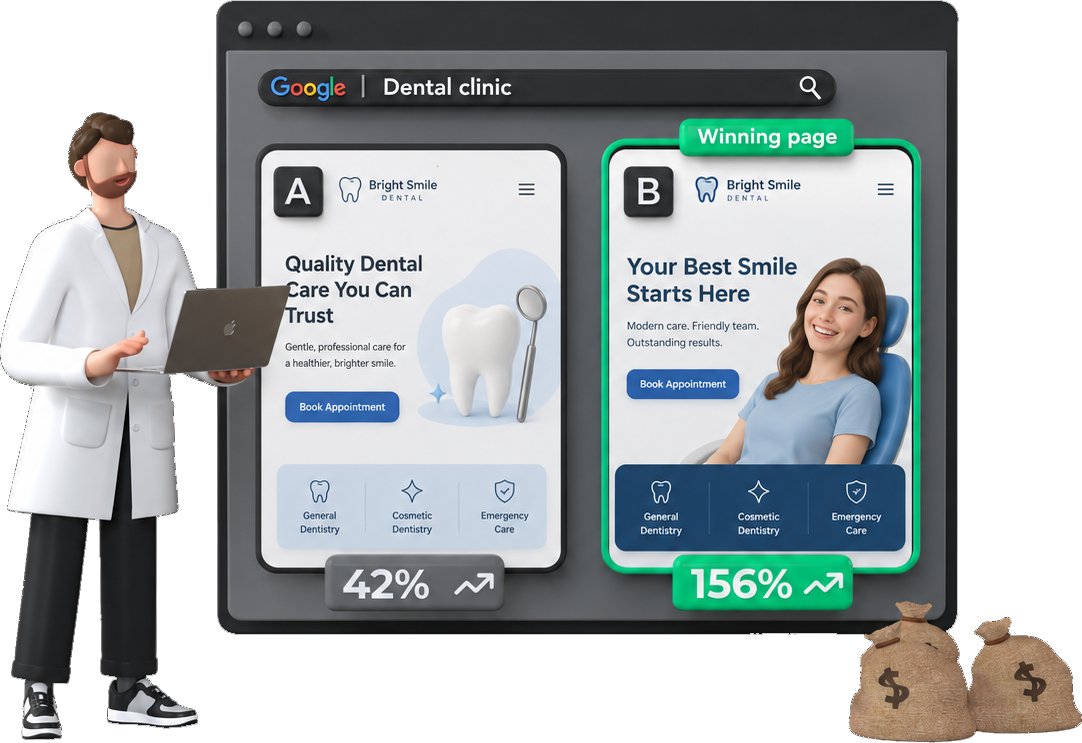









Most lists of conversion rate optimization tools are written for sites with free traffic. Yours costs money. Every visitor who leaves without converting is a click you already paid for, and that changes which tools are worth buying.
So here are ten, priced from each vendor’s own page on 3 October 2026, in the order I would buy them. Three are free for good. Three more buys are traps, and I name them below.
👉 The short version
Start free: Google Analytics 4 to see where paid visitors leave, and Microsoft Clarity to watch them do it. Then fix the page: Postclick audits it free. Pay for A/B testing only when your traffic can finish a test, which at a typical cost per click means about $30,000 a month on one page. Below that, test big changes, not small ones.
The 10 tools, in the order I would buy them:
- Google Analytics 4, free, finds the page that leaks
- Microsoft Clarity, free, records why people leave
- Hotjar, free to 200,000 sessions, adds exit surveys
- Crazy Egg, from $29, heatmaps with testing from $99
- Lucky Orange, from $39, every feature on every plan
- Postclick, free to start, tells you what to change
- Swipe Pages, testing from $89, the cheapest page test
- Unbounce, testing from $149, the most capable builder
- Convert, from $399, tests the page you already have
- VWO and Optimizely, priced on a call
And the 3 to avoid: Swipe Pages Startup for testing, Crazy Egg Starter on paid traffic, and VWO or Optimizely for one landing page.
The four jobs a CRO tool does
The mistake I see most is buying a testing tool before anyone has counted, watched or fixed anything.
| Job | The question it answers | Tools | From |
|---|---|---|---|
| 1. Count | Which landing page loses paid visitors, and where? | Google Analytics 4, Microsoft Clarity | Free |
| 2. Watch | What do people do in the seconds before they leave? | Clarity, Hotjar, Crazy Egg, Lucky Orange | Free |
| 3. Fix | What is wrong with the page, and what should replace it? | Postclick | Free to start |
| 4. Test | Did the new version beat the old one? | Swipe Pages, Crazy Egg, Unbounce, Convert, VWO, Optimizely | $89 a month |
Counting and watching tell you where the leak is. The fix is the part that moves the conversion rate. Testing only proves it, and proof needs traffic.
Can your traffic finish an A/B test?
Work this out before you buy any testing tool. It takes two minutes and it saves most people a few hundred dollars a month.
Across the 53 US Search accounts I can see with $1,000 or more of spend, the median cost per click is $4.34. Divide your monthly budget by that and you have your paid visitors.
Then take a landing page converting at 5%. To prove a 20% lift (5% to 6%) at the usual 95% confidence and 80% power, you need about 16,310 visitors split across the two versions. Evan Miller’s sample size calculator gives about the same figure if you want to check it with your own numbers.
| Monthly ad spend on the page | Paid visitors a month | Time to prove a 20% lift | Time to prove a 50% lift |
|---|---|---|---|
| $3,000 | 691 | About 2 years | About 18 weeks |
| $10,000 | 2,304 | About 7 months | About 6 weeks |
| $30,000 | 6,912 | About 10 weeks | About 2 weeks |
| $100,000 | 23,041 | About 3 weeks | Under a week |
At $10,000 a month, a test of a new button colour runs for seven months. Nobody waits that long. They stop it after three weeks when one version looks ahead, and then they ship a result that was noise.
The fix is to test bigger changes. A 50% lift needs only 2,935 visitors, because a big difference shows up in a small sample.
A new headline that answers the search, a form moved from screen three to screen one, a page that loads in two seconds instead of six: those are the changes that produce a 50% lift on a paid landing page, and those are what a small account should test.

1. Google Analytics 4, where paid visitors leave
GA4 is free and you probably already have it. Filter the landing page report to Google Ads traffic and sort by sessions. The pages with the most paid sessions and the lowest key event rate are where your money leaks.
That one report decides which page every other tool on this list should look at. If the conversion tag is not firing, nothing below means anything, so check the tracking first.
2. Microsoft Clarity, the one I run on my own site
Clarity is free forever, with no traffic cap. It records sessions, draws heatmaps and flags rage clicks and dead clicks. I have run it on ppc.io since July 2025 and it has cost me nothing.
For a paid account the useful view is the recordings filtered to one landing page and to visitors from Google Ads. Watch twenty of them. You will see the leak before the twelfth.

A heatmap tells you where people click. A recording tells you why they stopped. This one is six seconds long, and Clarity tagged it as a rage click without me asking.

3. Hotjar, now part of Contentsquare
Hotjar’s pricing page now sends you to Contentsquare. The free plan covers 200,000 sessions a month with replays, heatmaps, funnels and basic surveys, which is more than most single landing pages get. Growth is $49 a month, or $39 billed yearly, from 7,000 sessions. The reason to pay is surveys: the Voice of Customer Growth plan is $99 a month for 500 responses, and a one-question exit survey (“What stopped you today?”) is the cheapest research a paid account can buy.

4. Crazy Egg, heatmaps and a cheap way into testing
Crazy Egg starts at $29 a month for 5,000 tracked pageviews, with a 30-day trial. A/B testing starts on Plus at $99 for 150,000 pageviews. That makes it the cheapest way to get heatmaps and split testing in one tool. The 5,000 pageview cap on Starter is about $21,700 of clicks a month at the median, so check the sum before you pick the plan. Crazy Egg also ran the only public AI page against human page test I’ve found, and the AI landing page builder test explains why its sample was smaller than it looks.
5. Lucky Orange, everything on every plan
Lucky Orange is $39 a month for 3,500 sessions, $32 billed yearly, with every feature on every plan: recordings, heatmaps, funnels, form analytics, surveys and live chat. The trial is seven days. It suits a small business that wants one login. The 3,500 session cap fills quickly if more than one page gets paid traffic.
6. Postclick, the step before the test
I built this one, so weigh this section accordingly.
Every tool above tells you where people leave. None of them tells you what to change. That is the gap I built Postclick to fill.
It audits the page your ads send people to and lists every leak, ranked by what it costs. Then it designs two better versions in your brand and builds the one you pick as a complete HTML page you own and host anywhere, including on any builder below.

An audit is 18 credits, two designs 20 and a build 60. The free plan is 98 credits for 30 days with no card, enough to take one page from audit to finished build. Paid plans are $9, $29 and $99 a month.
It does not record sessions and it does not run split tests. It reads the page the way a buyer from your ad would, which is the step recordings cannot do for you.
The audit is built on what I learned reading 2,201 landing pages by hand across 54 industries, every one of them behind a real Google Ads campaign. The pages that converted answered the search in the headline, showed one thing to do and loaded fast on a phone. Most of the pages that did not had the fix sitting in plain sight.
7. Swipe Pages, the cheapest landing page test
From here on, the tools test the fix. Google Optimize was the free answer until Google shut it down in September 2023. There is no free replacement of the same quality, so testing is now the most expensive job on this list. Most of these tools keep it off the entry plan.
Swipe Pages moved A/B testing to its Marketer plan: $89 a month, or $69 billed yearly, for 50,000 visitors. Startup at $39 a month no longer includes it. If you build pages and want to test them in the same tool, this is still the cheapest way to do it, and the pages are fast, which matters for Quality Score.

8. Unbounce, the most capable builder for testing
Unbounce starts testing on Experiment at $149 a month, $112 billed yearly, for 30,000 visitors. Optimize at $249 adds Smart Traffic, which sends each visitor to the version most likely to convert. The Unbounce alternatives post has the visitor cap sums.

9. Convert, testing on the page you already have
Convert tests your existing pages without moving them into a builder. Growth is $399 a month, $299 billed yearly, for 100,000 tested users, with a 15-day trial and no card. If you spend over $30,000 a month on one page and your developers will not rebuild it, this is the one I would look at first.

10. VWO and Optimizely, priced on a call
VWO now sits under Wingify, and its pricing page says AB Tasty and VWO have merged. Neither VWO nor Optimizely shows a price: every plan is a demo. Both are good. Both are built for teams running many tests a quarter on sites with heavy traffic, and a single paid landing page is rarely that.
3 CRO buys to avoid on a paid account
All three look sensible on a pricing page. All three cost a paid account money for nothing.
1. Swipe Pages Startup, if you bought it to test. Swipe Pages moved A/B testing up to Marketer at $89 a month. Startup at $39 no longer includes it. It did when I checked on 30 August, so an older list may still say it does. If testing is the reason you are buying, Startup is the wrong plan.
2. Crazy Egg Starter on a paid landing page. $29 a month buys 5,000 tracked pageviews and no A/B testing. At the $4.34 median cost per click, that cap covers about $21,700 of clicks a month. Spend more than that on the page and you outgrow the plan inside the month. Clarity has no cap and costs nothing.
3. VWO or Optimizely for one landing page. Neither shows a price: you book a demo to find out. Both are built for teams running many tests a quarter on heavy traffic. If one paid page is the problem, Convert tests it at a published $299 a month billed yearly, with a 15-day trial and no card.
All ten compared
| Tool | Job | Free plan | Paid from | Entry plan limit | Trial |
|---|---|---|---|---|---|
| Google Analytics 4 | Count | Yes | Free | None that matters | - |
| Microsoft Clarity | Watch | Yes | Free | No traffic cap | - |
| Hotjar | Watch | 200,000 sessions | $49 Growth | From 7,000 sessions | Free plan |
| Crazy Egg | Watch, test | No | $29 Starter | 5,000 pageviews, no A/B | 30 days |
| Lucky Orange | Watch | No | $39 Build | 3,500 sessions | 7 days |
| Postclick | Fix | 98 credits | $9 | Audit 18, designs 20, build 60 credits | No card |
| Swipe Pages | Build, test | No | $39 Startup | A/B from $89 Marketer | 14 days |
| Unbounce | Build, test | No | $29 Starter | A/B from $149 Experiment | 14 days |
| Convert | Test | No | $399 Growth | 100,000 tested users | 15 days |
| VWO and Optimizely | Test | No | On request | On request | Demo |
Prices are monthly unless marked yearly, read on 3 October 2026. They change: Swipe Pages moved its testing tier between my check on 30 August and this one.
What I would run at each budget
| Ad spend a month on the page | Count and watch | Fix | Test |
|---|---|---|---|
| Under $10,000 | GA4 and Clarity, free | A Postclick audit on the top page | A four-week before and after |
| $10,000 to $30,000 | Add Hotjar Growth for surveys | Postclick, then rebuild the page | Big changes only, in Swipe Pages or Unbounce |
| Over $30,000 | Add exit surveys on every paid page | Every new landing page before it launches | Convert or VWO, one test at a time |
Under $10,000, a before and after is honest enough: change one big thing, run it for four weeks, and compare the conversion rate in Google Ads against the four weeks before. It will not survive a statistician. It will tell you whether the new page is a disaster, and the A/B test you cannot finish would not tell you more.
How I would set up CRO on a paid account
- Check the conversion tag fires. Every number after this depends on it. The tracking audit checks it.
- Find the page. GA4 landing page report, Google Ads traffic only, most sessions and lowest key event rate.
- Watch twenty recordings in Clarity. Same page, Google Ads visitors only. Write down every place three or more people stop.
- Audit the page. Run it through Postclick and compare its list with your notes from the recordings.
- Do the sum. Budget divided by cost per click, then the visitors you need. If a test cannot finish in eight weeks, make a bigger change or skip the test.
- Ship one big change. The headline that matches the search, the form on screen one, the page under three seconds on a phone. The six landing page checks cover what to look for.
Can this page run an A/B test? Paste into a doc
PAGE: ____________________________
MONTHLY AD SPEND ON THIS PAGE: $______   COST PER CLICK: $______  (median I see: $4.34)
PAID VISITORS A MONTH = spend / CPC = ______

CURRENT CONVERSION RATE: ____%
LIFT YOU EXPECT:  20% (small change)  /  50% (big change)
VISITORS NEEDED, BOTH VERSIONS (at 5% conversion): 16,310 for 20%, 2,935 for 50%
  (other rates: evanmiller.org/ab-testing/sample-size.html, double the figure it gives)

MONTHS TO FINISH = visitors needed / paid visitors a month = ______
UNDER 2 MONTHS? Y = A/B test it.  N = make the change bigger, or do a before and after.

CONVERSION TAG CHECKED: Y / N    20 RECORDINGS WATCHED: Y / N    PAGE AUDITED: Y / N
Two mistakes I see with CRO tools
Stopping a test early. At $10,000 a month a small change needs seven months. A test stopped at week three because one version is ahead is a coin flip with a chart on it.
Watching recordings of everyone. Organic visitors, returning customers and your own team behave nothing like someone who clicked an ad thirty seconds ago. Filter to paid traffic or the recordings will send you to fix the wrong thing.
If you would rather have it done for you
The page your ads point at, audited free
Paste the address into Postclick and read the leaks in a few minutes, with no card. If you want the audit, the new page and the testing run for you, the conversion rate optimization service is the one to read.
- What are the best conversion rate optimization tools?
- For paid traffic, start with the free ones: Google Analytics 4 to find the page that loses paid visitors and Microsoft Clarity to watch them leave. Then fix the page with an audit such as Postclick. Add an A/B testing tool such as Swipe Pages, Unbounce or Convert only when your traffic can finish a test. Prices read on 3 October 2026.
- Are there free CRO tools?
- Yes. Google Analytics 4 and Microsoft Clarity are free, and Clarity has no traffic cap. Hotjar's free plan, now on Contentsquare, covers 200,000 sessions a month. Postclick gives 98 free credits for 30 days, enough to take one page from audit to finished build. There is no free A/B testing tool of the quality Google Optimize was before it shut down in September 2023.
- How much traffic do I need to A/B test a landing page?
- For a page converting at 5%, about 16,310 visitors across both versions to prove a 20% lift, or 2,935 to prove a 50% lift, at 95% confidence and 80% power. At the $4.34 median cost per click, that is about seven months of a $10,000 monthly budget for the small change and six weeks for the big one.
- Which CRO tools should I avoid?
- On a paid account, avoid three buys. Swipe Pages Startup if you want to A/B test, because testing moved to the $89 Marketer plan. Crazy Egg Starter on a paid page, because its 5,000 pageview cap covers only about $21,700 of clicks a month at a $4.34 cost per click and it has no A/B testing. And VWO or Optimizely for a single landing page, because neither publishes a price and both are built for large testing teams. Prices read on 3 October 2026.
- What replaced Google Optimize?
- Nothing free of the same quality. The cheapest landing page testing is Swipe Pages at $89 a month, or $69 billed yearly. Crazy Egg tests from $99, Unbounce from $149 and Convert from $399. VWO and Optimizely do not publish prices.
- What is the difference between a CRO tool and a landing page builder?
- A builder hosts the page. A CRO tool finds out why the page does not convert, fixes it or proves the fix worked. Some builders, such as Unbounce and Swipe Pages, include A/B testing, which makes them both. The landing page builder for Google Ads post compares seven of them.