Paste the page behind your ad. You get a score out of 100, every leak ranked by what it costs you, and the fix to try first.

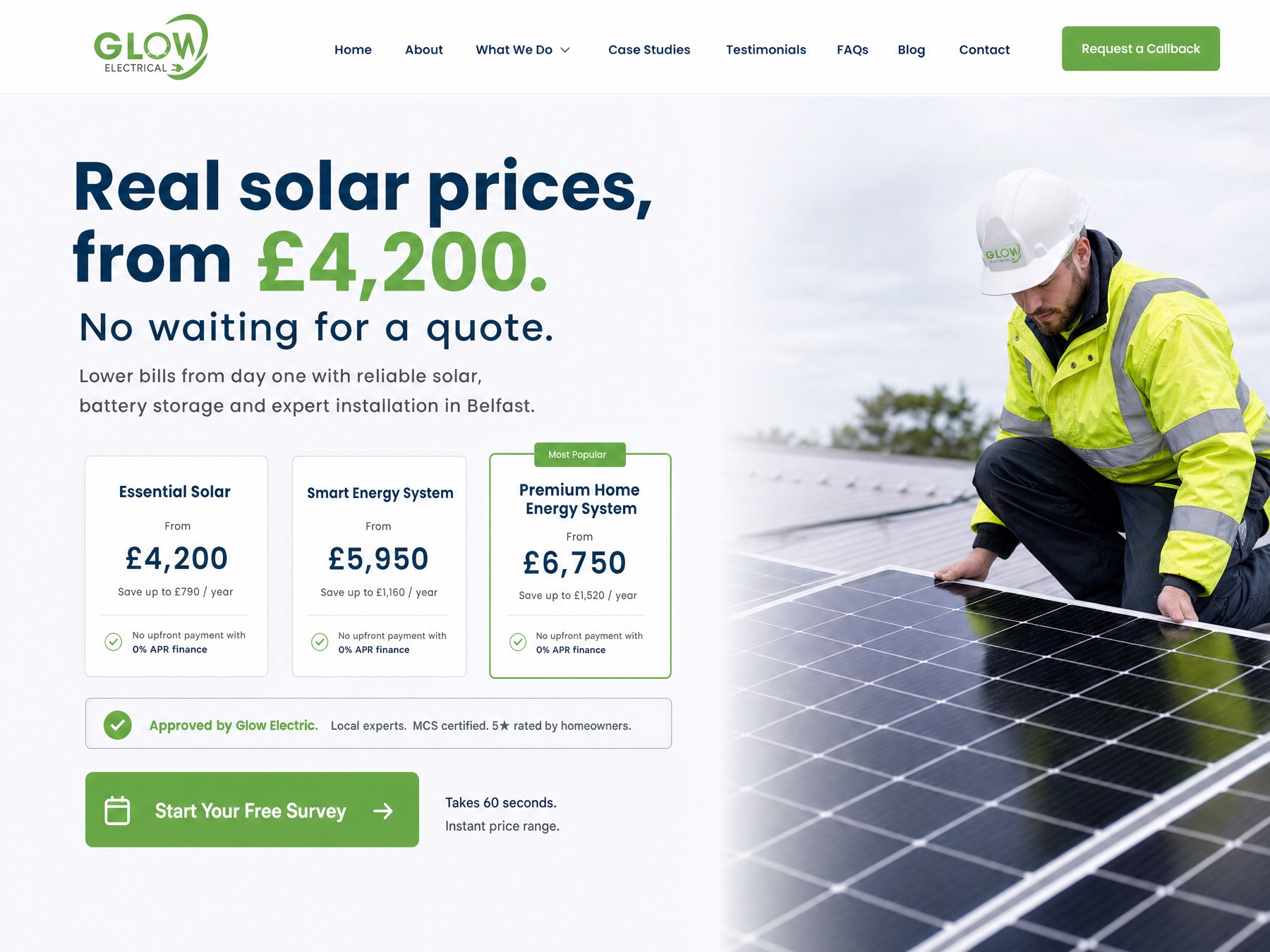
Cut your electricity bills with solar and battery storage in Belfast
Leaks, by cost 5
Seven checks, each scored out of 100, then weighted into one number. The weights favour fit over looks, so a plain page that answers the ad beats a beautiful one that doesn't.
| Check | Weight | The question it answers |
|---|---|---|
| Campaign fit Does the page answer the search or ad that brought the visitor? | 22% | Does the page answer the search or ad that brought the visitor? |
| Offer Can a visitor tell what they get, what it costs and why now? | 20% | Can a visitor tell what they get, what it costs and why now? |
| Conversion leaks Where does the page lose people, ranked by what each leak costs? | 18% | Where does the page lose people, ranked by what each leak costs? |
| Page structure Does each section do a job, in the order a buyer needs it? | 15% | Does each section do a job, in the order a buyer needs it? |
| Trust Is there proof a stranger would believe, close to the ask? | 13% | Is there proof a stranger would believe, close to the ask? |
| Persuasion Does the copy handle the doubts that stop a buyer? | 7% | Does the copy handle the doubts that stop a buyer? |
| Design Does the layout help the reader, or get in the way? | 5% | Does the layout help the reader, or get in the way? |
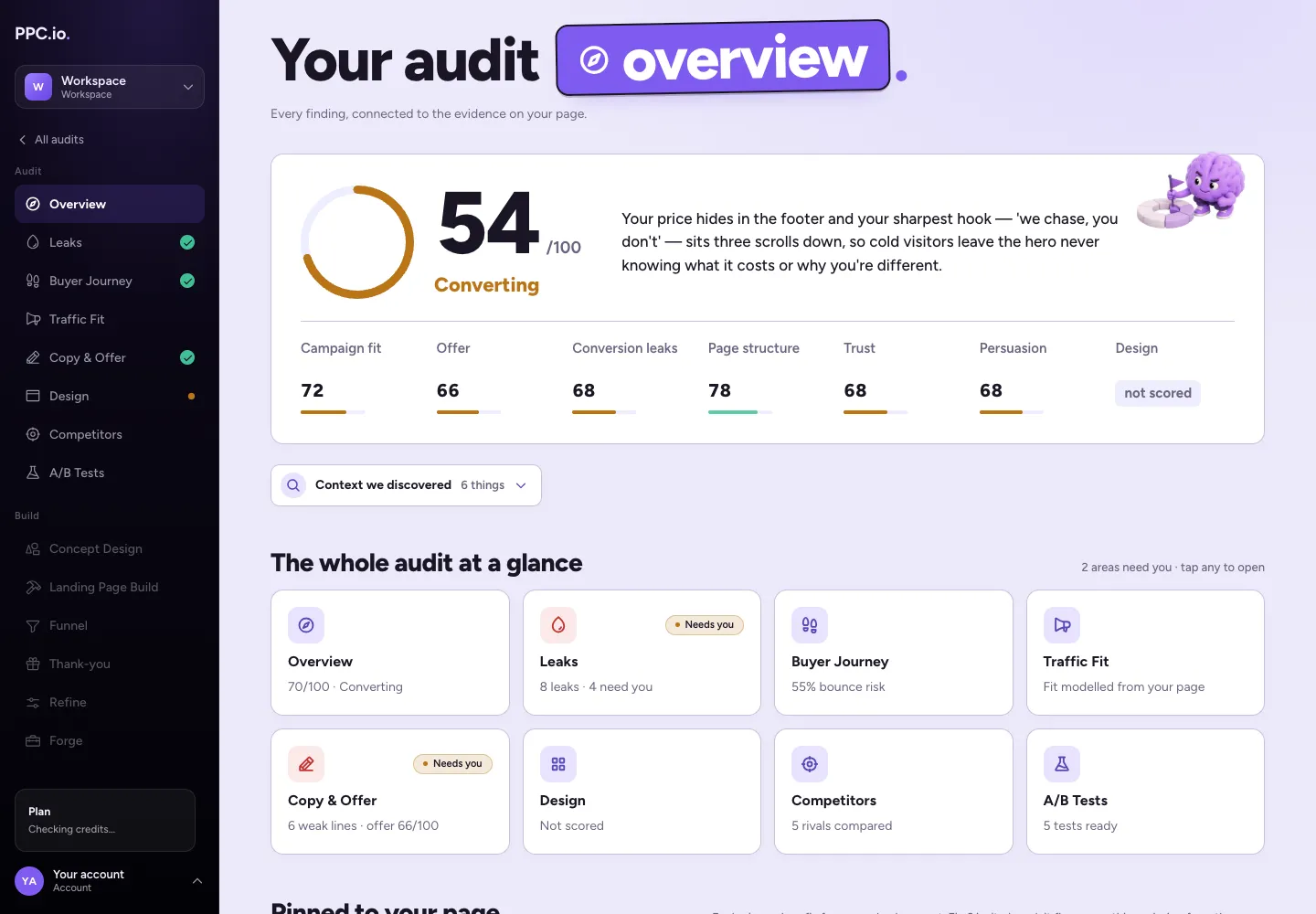
Use the exact URL from the ad. Your homepage is the wrong page to test. A landing page can only be judged against the search that brought someone there.
The score tells you how far off the page is. The leaks tell you why, ranked by what each one costs, so the top one is where your money goes first.
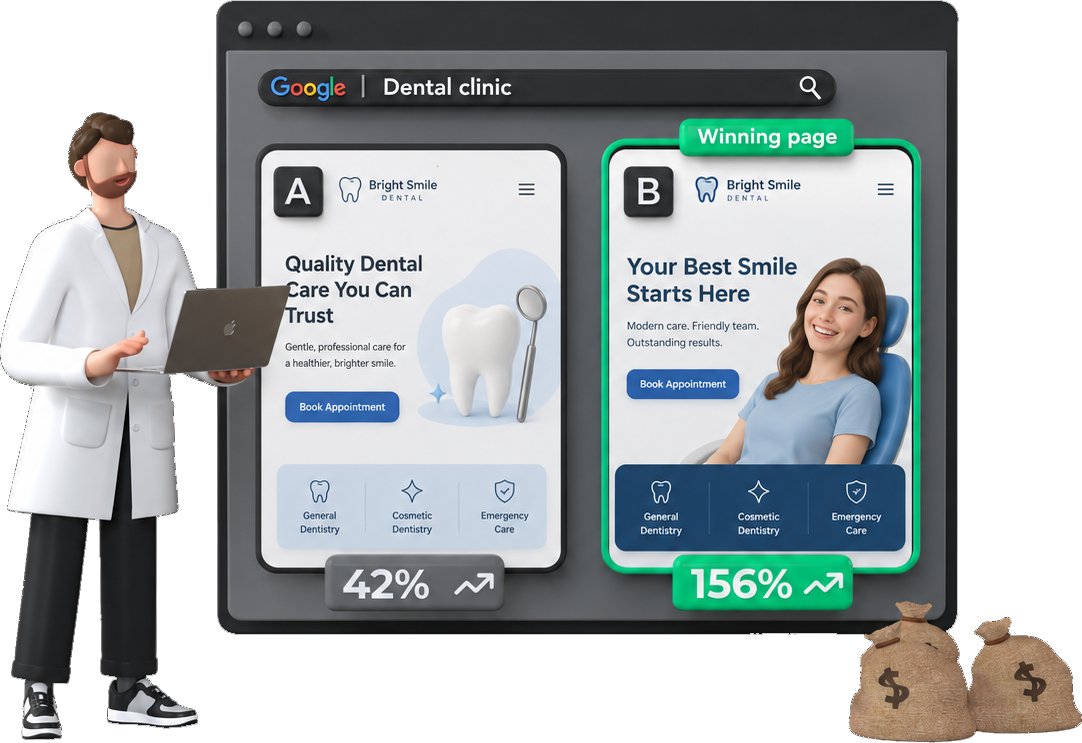
Change the top leak, then run it against the old page as a Google Ads experiment. The analyzer tells you what to test. The experiment tells you if it worked.
The audit stops at the fixes if that's all you need. If you want the page redone, Postclick designs new versions from the findings and builds the one you pick.

These tools answer different questions. A screenshot critique, a session recording and a speed report each tell you something useful, so start with the question you need answered. You probably don't need all seven.
| Tool | Use it to find out | Price | What it misses |
|---|---|---|---|
| This analyzer Free audit, designs and a built page | What to fix first, and what the page could look like It reads the page. It doesn't see real visitors. | Free audit, designs and a built page | It reads the page. It doesn't see real visitors. |
| Claude or ChatGPT Free tier. Claude Pro is $20 a month | A critique you run yourself, with your own brief It can describe things that are not on the page. Check every finding. | Free tier. Claude Pro is $20 a month | It can describe things that are not on the page. Check every finding. |
| Microsoft Clarity Free | What visitors actually do: recordings, heatmaps, rage clicks It shows what people do. It can't tell you why. | Free | It shows what people do. It can't tell you why. |
| Lyssna Free plan. Paid plans and recruiting people cost extra | Whether real people understand the offer and can finish the task It takes days, and the testers have to look like your buyers. | Free plan. Paid plans and recruiting people cost extra | It takes days, and the testers have to look like your buyers. |
| LandingAnalyze Free, three reports a day, one per site | A quick AI critique from a URL By its own FAQ, it can't see videos, popups or other interactive parts of the page. | Free, three reports a day, one per site | By its own FAQ, it can't see videos, popups or other interactive parts of the page. |
| Fibr No public prices. Every plan starts with a demo | Different versions of the page for different audiences More than you need for a one-off critique. | No public prices. Every plan starts with a demo | More than you need for a one-off critique. |
| PageSpeed Insights Free | Whether the page is slow or jumps around while it loads It will never tell you the headline contradicts the ad. | Free | It will never tell you the headline contradicts the ad. |
Prices and limits checked 1 October 2026.
Pick a finding you can check in a minute. If the report says your form is buried, open the page and find the form. If it says there's no price, look at the whole page and any pricing tabs.
When we reviewed Drata's demo page on 13 September, the form sat right below the hero. An earlier AI critique had called it buried below the features. That was a bad observation, however convincing the rest of the paragraph sounded.
If you'd rather run the critique yourself in Claude or ChatGPT, give it this brief. It makes the tool point at what it saw instead of guessing.
Ad or search term: [paste the actual wording]
Customer: [who is buying, and what do they need?]
Offer and price: [include the conditions]
Conversion: [what counts as a useful enquiry or sale?]
Page: [URL plus desktop and mobile screenshots]

For each recommendation:
1. Point to the exact page element you observed.
2. Explain why it may cause a problem for this customer.
3. Suggest one change and what we should measure.
4. Say what you could not inspect. Do not invent performance figures.
Then test the change against the old page, and judge it on lead quality as well as form fills. A redesign that looks better is not a result until it beats the page it replaced.
Conversion rate moves the numbers more than cost per click does. Taking a page from 2% to 4% doubles the leads for the same spend, which is why I'd fix the page before touching the bids. The PPC calculator shows what that's worth at your budget.
If you want to see what good looks like first, we read 2,201 pages behind real Google Ads campaigns in 54 industries for the landing page swipe file. If the page needs rebuilding, the landing page builder comparison prices seven builders by visitor cap and the cost of A/B testing.
Yes. Your first page includes an audit, two page designs and one built page, on us, with no card needed. You have 30 days from signup to use it.
The seven sub-scores roll up into one score out of 100 with fixed weights. Campaign fit and offer carry the most, design the least, so a plain page that answers the ad scores higher than a beautiful one that does not.
70 or more is strong and 88 or more is elite. Between 50 and 70 the page works but leaks. Under 50, fix the page before you raise the budget, because more clicks will only leak faster.
No. It needs the public address of the page and nothing else. It reads the page the way a visitor does.
Yes. Any public page works, on any builder. Running your own page and a rival page side by side is one of the quickest ways to see what your page leaves out.
It depends on the question. For a scored critique with the fix to try first, use this one. For what visitors actually do, use Microsoft Clarity, which is free. For whether people understand the offer, use Lyssna. For speed, use PageSpeed Insights. Most pages behind an ad need the first two.
Yes. Both can read screenshots of a page, and OpenAI says its image descriptions can be wrong. Give either one the ad, the customer and clear desktop and mobile screenshots, then check every finding against the page. Paste in a bare URL and ask how to improve conversions, and you get a confident answer about a page it may never have seen.
You can stop there and use the fixes. Or use your first page to get new page designs and build the one you pick. The audit, designs and built page are included, and you can download the HTML.
 Our AI Tools